
How much does 3D printing cost? At home, a typical small PLA print costs about $0.50 and a medium one about $1.80, including filament, electricity, machine wear and a margin for failures (estimates below). A large 400 g print lands near $11. Electricity adds only about 2 cents per print hour, while print services charge by the gram or hour.
Plastic is usually the biggest single line, so this guide starts from the prices in our 3D printer filament cost guide and adds everything else a print uses. You get the formula, three worked examples, how to make your slicer do the math, and what a print service charges instead.
If you are still deciding whether to buy a machine at all, our guide on whether a 3D printer is worth it looks at yearly running costs and alternatives.
The short answer
| Cost line | Typical figure (estimate) | Basis |
|---|---|---|
| PLA filament | About 1.9 cents per gram | Bambu Lab PLA Basic, $18.99 per kg (September 2026) |
| Electricity | About 1.7 cents per print hour | 95 W average (Bambu Lab A1, PLA) × 18.31 cents per kWh |
| Machine wear | About 15 cents per print hour | $299 printer ÷ 2,000 print hours (assumption) |
| Failed prints | 10% on top | Assumption; track your own rate |
| Small print (15 g, 1 hour) | About $0.50 | Sum of the lines above |
| Medium print (60 g, 3 hours) | About $1.80 | Sum of the lines above |
| Large print (400 g, 16 hours) | About $11.29 | Sum of the lines above |
| Campus print service | $0.15 per gram, $3 minimum | University of Florida Marston Makerspace |
How much does 3D printing cost per print?
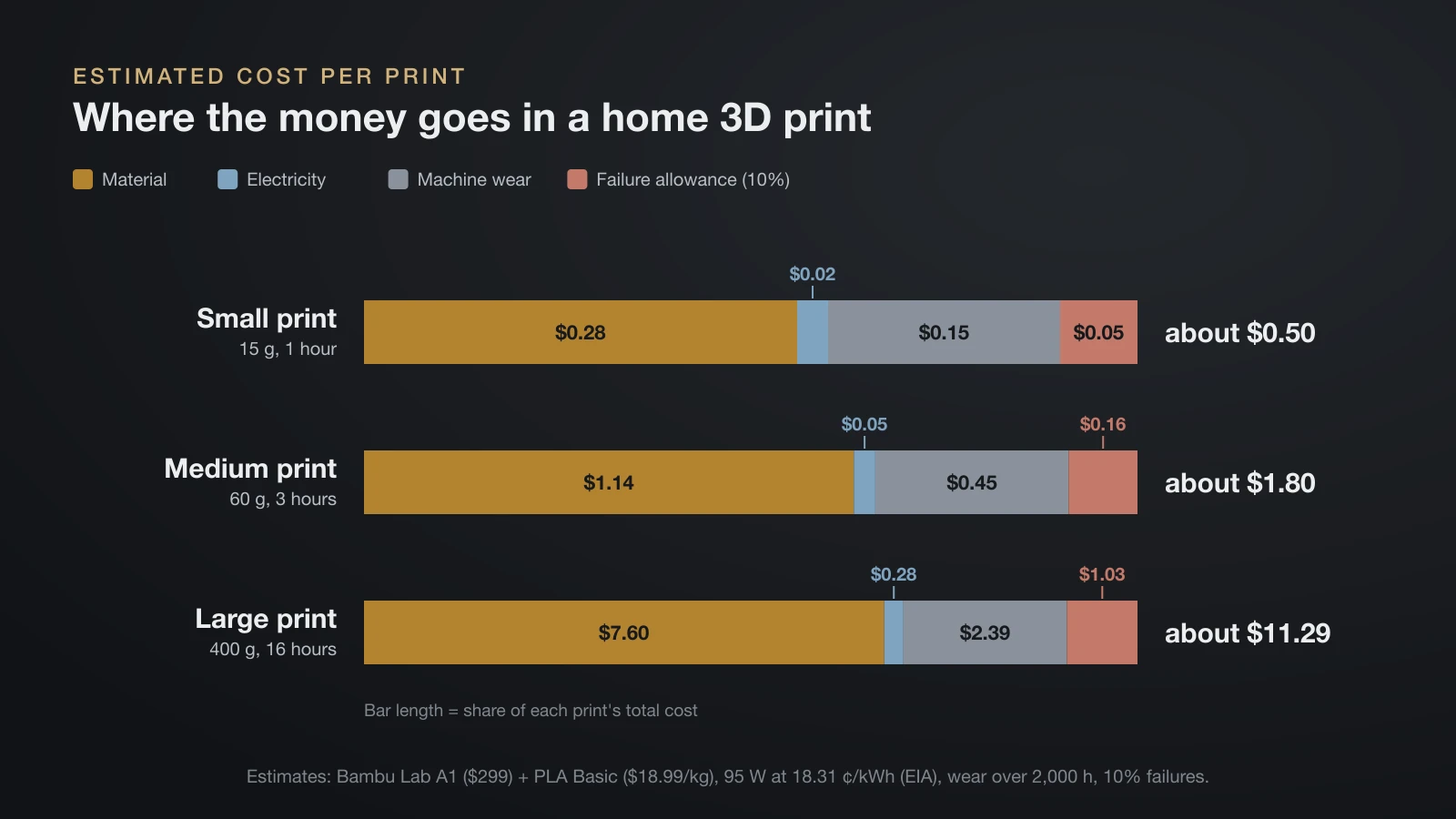
A home 3D print costs roughly $0.50 for a small part, $1.80 for a medium part and about $11 for a large one, using the assumptions below. Every figure is an estimate built from list prices and a manufacturer’s measured power draw, so you can swap in your own numbers.
The table assumes a Bambu Lab A1 ($299 on Bambu Lab’s US store, September 2026) printing PLA Basic ($18.99 per kg). The weights and print times are illustrative assumptions, not measurements.
| Line | Small: 15 g, 1 h | Medium: 60 g, 3 h | Large: 400 g, 16 h |
|---|---|---|---|
| Material (grams × $0.01899) | $0.28 | $1.14 | $7.60 |
| Electricity (95 W × hours × $0.1831 per kWh) | $0.02 | $0.05 | $0.28 |
| Machine wear ($299 ÷ 2,000 h × hours) | $0.15 | $0.45 | $2.39 |
| Failure allowance (10% of the lines above) | $0.05 | $0.16 | $1.03 |
| Total per print (estimate) | About $0.50 | About $1.80 | About $11.29 |
Material dominates the large print, while wear matters most on small, slow ones. Your own time is not in the table; if you sell prints, add labor, packaging and fees as our guide to things to 3D print and sell explains.
The 3D printing cost formula
The 3D printing cost formula adds four lines: material, electricity, machine wear and a failure allowance. Written out, it looks like this:
cost per print = material + electricity + wear + failure allowance
- Material: grams from your slicer × (price per kg ÷ 1,000). Include supports, purge and prime tower, which come out of the same spool.
- Electricity: average watts ÷ 1,000 × print hours × your price per kWh. The U.S. Energy Information Administration (EIA) put the average residential price at 18.31 cents per kWh in July 2026.
- Wear: printer price ÷ the print hours you expect from it, × print hours. Nozzles, build plates and fans wear out too, so this line covers repairs as well as the machine.
- Failure allowance: a percentage on top of the other lines for prints that fail or need a second attempt.
Use the average power, not the rating on the power supply. Bambu Lab lists a maximum of 350 W at 110 V for the P1S, but measured an average of 105 W while printing PLA.
Wear is real even on reliable machines. Prusa says its printers need maintenance about every 800 print hours on average, most often a nozzle change, after which they keep printing for hundreds of hours more.
How much electricity does a 3D printer use?
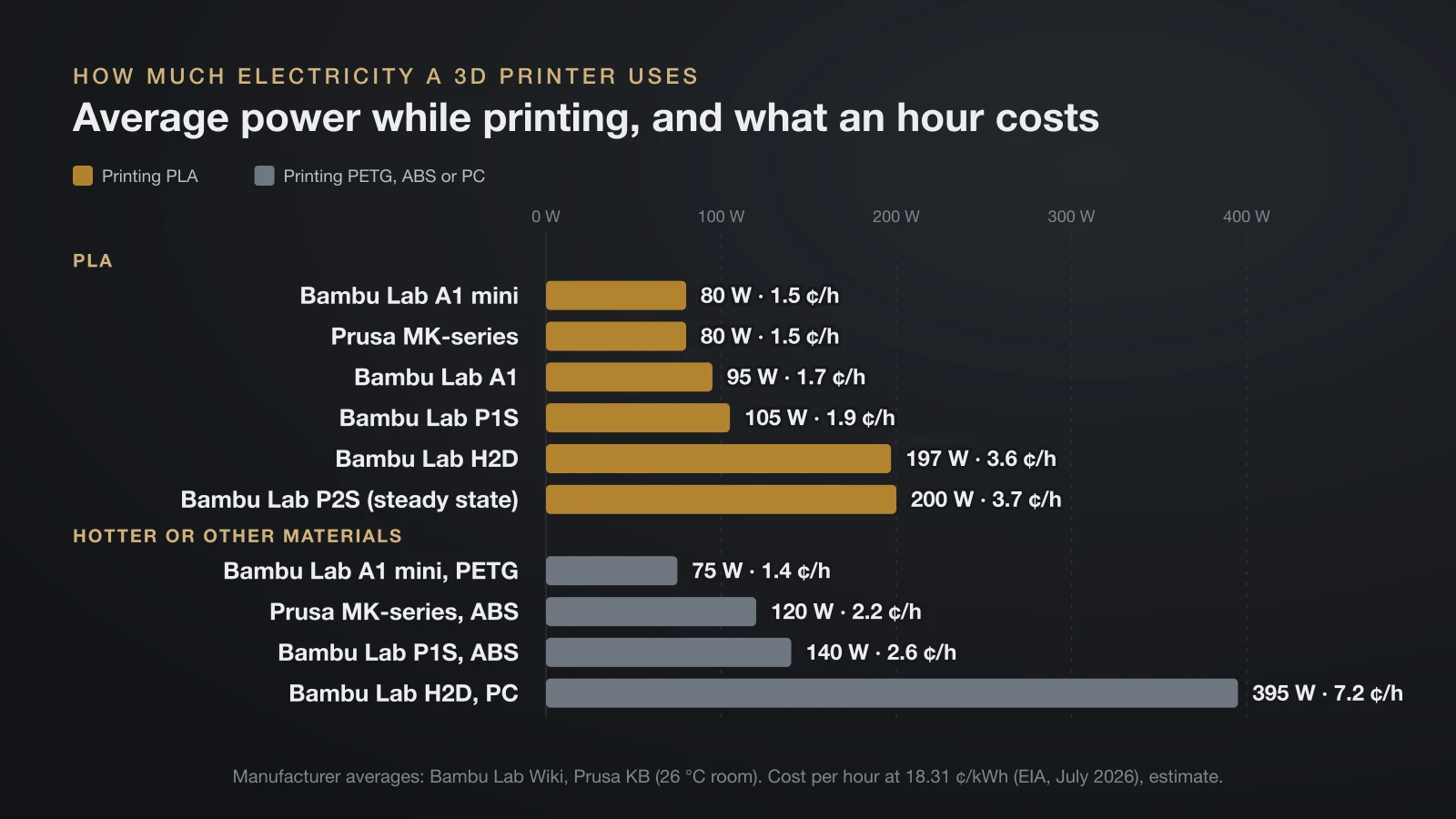
A desktop 3D printer uses roughly 80 to 200 W on average while printing PLA, according to the manufacturers’ own measurements. That works out to about 1.5 to 3.7 cents per print hour at the US average price, and more for hot materials or big, heated machines.
| Printer (manufacturer figure) | Material | Average power | Cost per print hour at 18.31 ¢/kWh (estimate) |
|---|---|---|---|
| Bambu Lab A1 mini | PLA / PETG | 80 W / 75 W | 1.5 / 1.4 cents |
| Prusa MK-series | PLA / ABS | 80 W / 120 W | 1.5 / 2.2 cents |
| Bambu Lab A1 | PLA | 95 W | 1.7 cents |
| Bambu Lab P1S | PLA / ABS | 105 W / 140 W | 1.9 / 2.6 cents |
| Bambu Lab P2S | PLA (steady state) | 200 W | 3.7 cents |
| Bambu Lab H2D | PLA / PC | 197 W / 395 W | 3.6 / 7.2 cents |
Prusa measured its figures at 26 °C (79 °F) room temperature, and Bambu Lab’s A1 and P1S figures come from test prints of about 16 to 23 minutes. Heat-hungry plastics such as ABS and polycarbonate (PC) need a hotter bed and nozzle, and larger machines heat a bigger plate, which is why the draw climbs; our guide to large 3D printers covers what else changes with size.
Even at the high end, electricity rarely decides the cost of a print. A 16-hour PLA job on the H2D uses about 3.2 kWh, roughly 58 cents (estimate), against several dollars of filament.
3D printing cost calculator: work it out in six steps
A 3D printing cost calculator is just the formula above with your own numbers, and a notepad or spreadsheet does the job. Here is a worked example for a 120 g PETG part that prints in 6 hours on a Bambu Lab A1 mini ($219, PETG Basic at $16.99 per kg, both September 2026 list prices).
- Slice the model and note the total filament weight and print time: 120 g and 6 h.
- Material: 120 × ($16.99 ÷ 1,000) = $2.04.
- Electricity: 75 W average for the A1 mini printing PETG, so 0.075 kW × 6 h × $0.1831 = $0.08.
- Wear: $219 ÷ 2,000 h (assumption) = about $0.11 per hour, × 6 h = $0.66.
- Failure allowance: 10% of $2.78 = $0.28.
- Add it up: about $3.06 per part (estimate).
In a spreadsheet, the whole calculator fits in one cell: =(g*kg_price/1000 + W/1000*h*kwh_price + printer_price/life_h*h) * 1.1. Change the 1.1 if your failure rate is higher or lower than 10%.
For the wear line, a cheaper machine lowers the hourly cost. Buying secondhand is one way, and our used 3D printer buying guide lists what to check first.
How to get a cost estimate from your slicer
Your slicer can do most of this math if you enter a price in the filament profile. It then multiplies the estimated filament weight by that price after every slice, so you see the cost next to the print time.
| Slicer | Where to enter it | What it adds up |
|---|---|---|
| PrusaSlicer | Filament settings: Cost (money per kg) and Density | Filament cost of the print, with a separate figure for the wipe tower |
| OrcaSlicer | Filament: Price; Printer settings: Time cost (cost per hour) | Filament cost plus a charge for every print hour |
| Bambu Studio | Filament settings: Price (money per kg) | Filament cost; the slicing view lists weight for the model, flushing and prime tower |
OrcaSlicer’s Time cost field is the most useful one for home printing. Enter your electricity plus wear per hour, for example $0.0174 + $0.1495 = about $0.17 per hour for the A1 figures above, and the slicer’s total covers everything except failures.
Check the density in each filament profile, because slicers convert length to grams with it. A wrong density gives a wrong weight, and then a wrong cost.
What do 3D printing services charge for?
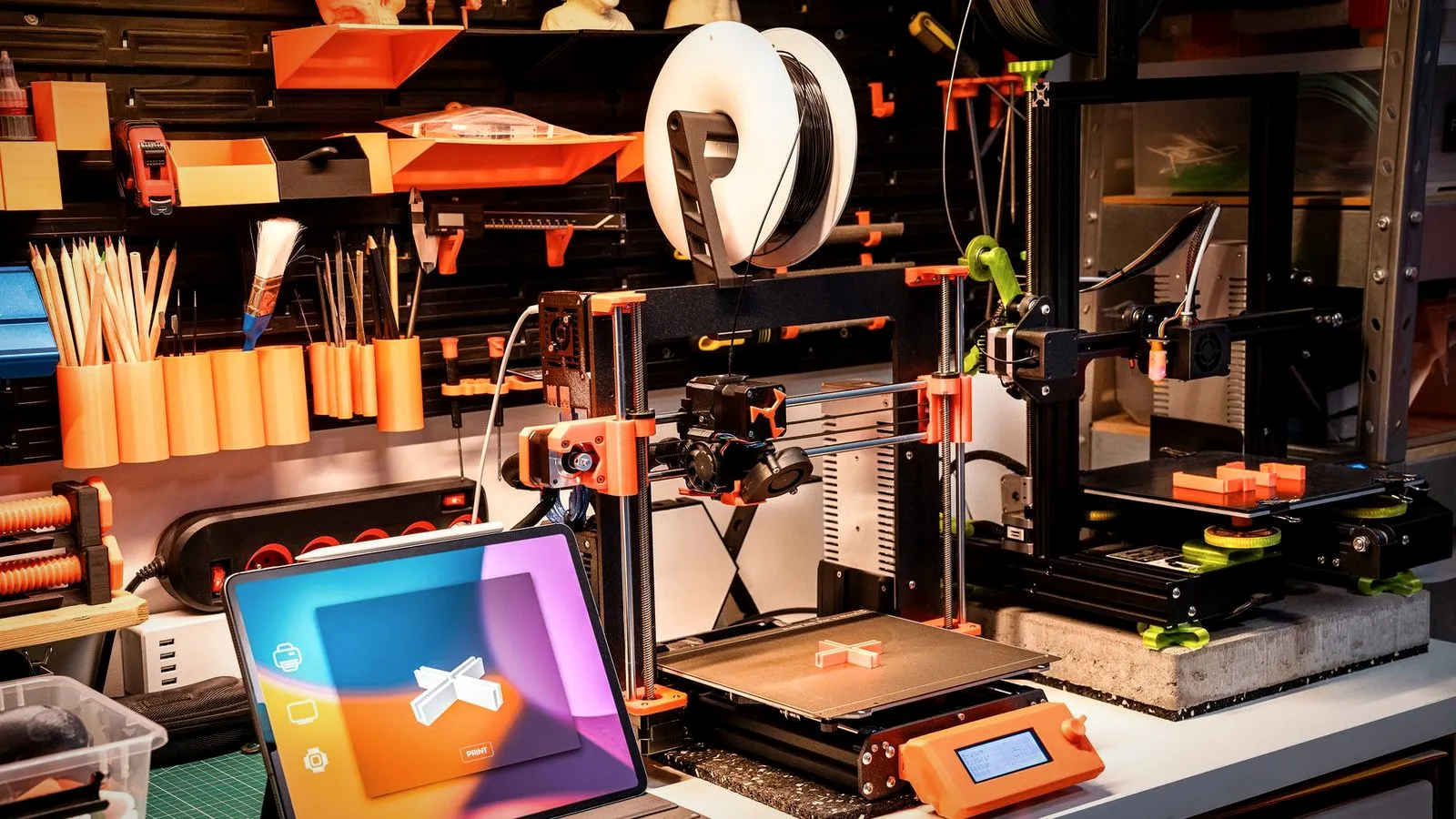
3D printing services charge for material, machine time, file preparation, finishing and delivery, not just for plastic. The mix depends on the service:
- Material: billed per gram or per cubic centimeter, with engineering plastics, resin and metal costing far more than PLA.
- Machine time: some services bill by the print hour, since a long print blocks a machine for other jobs.
- Setup and minimum charge: checking the file, slicing and starting the job take staff time, which is why many services have a minimum order.
- Finishing: support removal, sanding, dyeing or painting are often extra.
- Shipping and lead time: faster turnaround usually costs more.
Campus makerspaces are the easiest way to see real per-gram pricing. The University of Florida’s Marston Makerspace quotes PLA prints at $0.15 per gram with a $3.00 minimum (price page read September 30, 2026), printed on Prusa MK4 and XL printers.
| Example print | Home estimate (table above) | At $0.15 per gram, $3 minimum |
|---|---|---|
| Small, 15 g | About $0.50 | $3.00 (minimum applies) |
| Medium, 60 g | About $1.80 | $9.00 |
| Large, 400 g | About $11.29 | $60.00 |
Commercial online services quote each file individually, so there is no fair single number to give. Upload the same file to two or three services and compare the quote, material and delivery date.
What makes one print cost more than another?
Size, infill, supports, material and the printer itself decide whether a print costs cents or dollars. The biggest levers:
- Scale: a model scaled to 200% has eight times the volume of the original (2 × 2 × 2), so material and print time rise much faster than the size.
- Infill and walls: a decorative part rarely needs dense infill; fewer walls and lower infill cut grams and hours.
- Supports: support material is paid for and thrown away, and it adds print time. Orienting the part to need less of it saves both.
- Layer height: thinner layers look smoother but take longer, which raises the electricity and wear lines.
- Material: Bambu Lab lists ASA at $29.99 per kg against $18.99 for PLA Basic, about 58% more per kilogram; ASA is less dense, so the same part weighs less and the real gap is smaller.
- Multicolor: single-nozzle color changes purge filament at every swap, which our guide to multi-color 3D printers explains.
The bottom line
A home 3D print usually costs well under $2 for small and medium parts and about $11 for a large 400 g part, once you add filament, electricity, machine wear and a 10% failure margin. Filament and wear matter far more than electricity, which is about 2 cents per print hour on a typical desktop printer. Enter your prices in the slicer to see the cost of every print, and expect a print service to charge several times more for the staff time and minimums behind it.
Sources
- Bambu Lab: US store list prices read September 29, 2026 for the A1 mini ($219), A1 ($299), PLA Basic ($18.99), PETG Basic ($16.99) and ASA ($29.99); Wiki Printer and AMS power parameters (average power: A1 mini 80 W PLA and 75 W PETG, A1 95 W PLA, P1S 105 W PLA and 140 W ABS, H2D 197 W PLA and 395 W PC, P2S 200 W steady-state PLA; P1S maximum 350 W at 110 V); Bambu Studio source code (filament Price in money per kg, for statistics)
- Prusa Research: Knowledge Base FAQ (MK-series average 80 W with PLA and 120 W with ABS at 26 °C; maintenance about every 800 print hours, most often the nozzle) and List of placeholders (PrusaSlicer total cost, total weight and wipe tower cost values); PrusaSlicer 2.9.6 source code (filament Cost in money per kg and Density, for statistics)
- OrcaSlicer Wiki: Material basic information (filament Price, for statistics) and Advanced printer settings (Time cost, the printer cost per hour)
- U.S. Energy Information Administration: Electric Power Monthly, Table 5.6.A (US average residential price 18.31 cents per kWh, July 2026)
- University of Florida, Marston Makerspace: 3D Printing ($0.15 per gram of filament, $3.00 minimum, PLA only, Prusa MK4 and XL printers; read September 30, 2026)