
Is a 3D printer worth it? Yes, if you will use it regularly: for replacement parts, organizers, hobby models, gifts or prototypes, and if you enjoy some tinkering. Running costs are low, about 2 cents per gram of PLA and roughly 2 cents per hour of electricity. For a few prints a year, a print service or library is cheaper.
This guide weighs who gains the most, what owning a printer really costs each year, how hard it is to learn and what to try before buying. For the plastic side of the budget, see our breakdown of 3D printer filament cost by material.
The short answer
| A 3D printer is worth it if you… | Skip it (for now) if you… |
|---|---|
| Would print something most weeks | Need only a few parts a year |
| Fix, adapt or organize things around the house | Expect store-bought quality with no setup |
| Have a hobby that uses custom parts (models, cosplay, tabletop, RC) | Have no ventilated spot for a machine that runs for hours |
| Want to learn design or prototype your own products | Want strong metal parts or certified safety parts |
| Enjoy troubleshooting as part of the hobby | Get frustrated by failed attempts |
Who is a 3D printer worth it for?
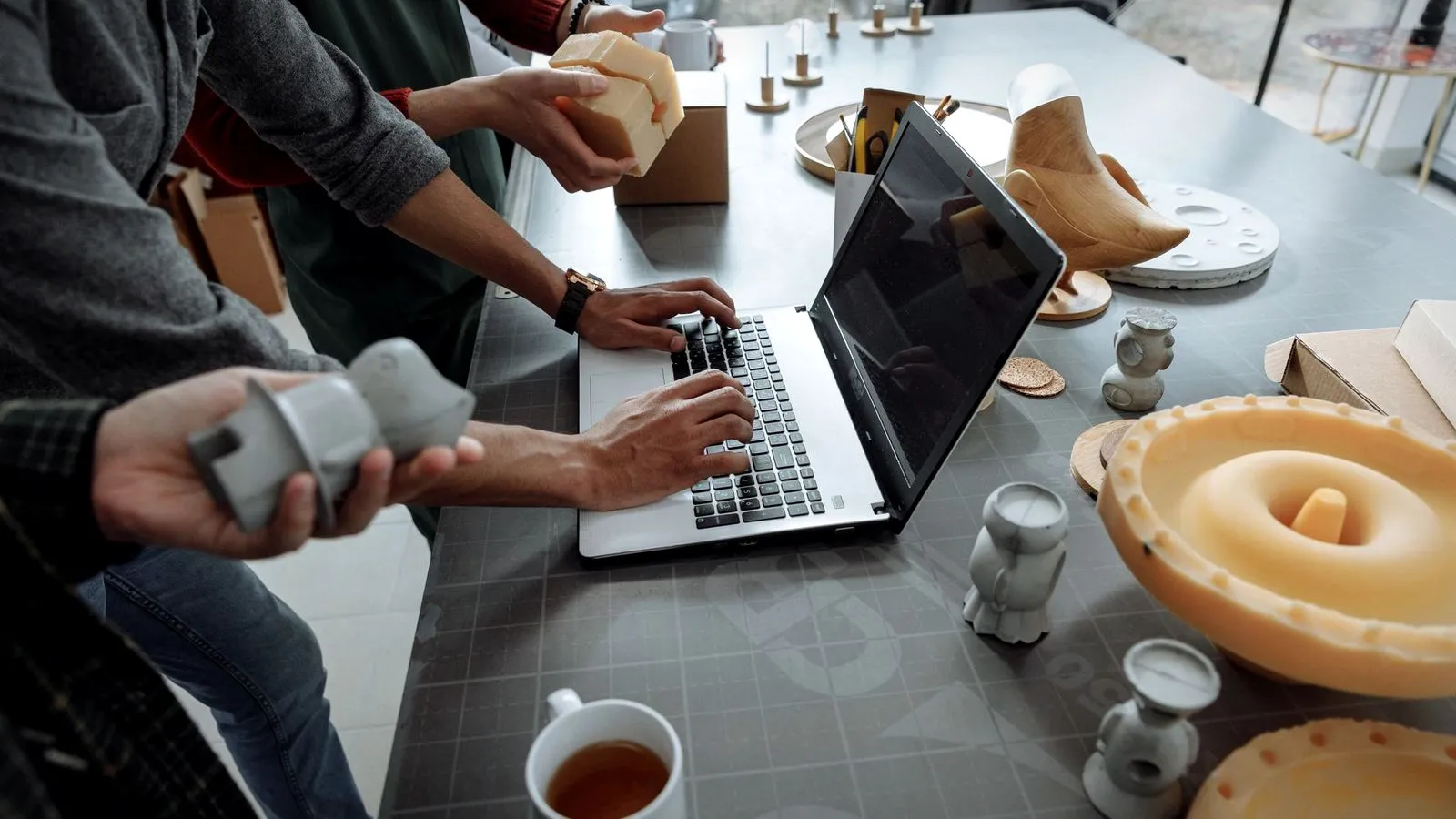
A 3D printer is worth it for people who print regularly and have a steady supply of useful jobs for it. The value comes from use, not ownership, and these groups get the most out of one:
- Fixers: a broken knob, clip or bracket that is no longer sold can often be measured and printed. The part costs cents in plastic.
- Organizers: drawer inserts, cable clips and wall mounts that fit your exact space are among the most practical prints.
- Hobbyists: tabletop gamers, model builders, cosplayers and RC fans print terrain, parts and props they would otherwise buy.
- Designers and students: a printer turns a CAD model into something you can hold in hours, which makes it a strong learning tool.
- Small sellers: some people print and sell parts or designs; our guide to things to 3D print and sell covers what sells and what you may legally sell.
If you recognize yourself in two or more of these groups, the printer is likely to earn its space.
When a 3D printer is not worth it
A 3D printer is not worth it if it would mostly sit idle, or if the parts you need are beyond what a home printer can make. The clearest cases are:
- Occasional needs: one or two parts a year cost less from a print service than a printer plus filament.
- Structural or safety parts: printed plastic is weaker between layers, and parts such as brackets under heavy load, climbing gear or car safety parts should be bought, not printed.
- Instant results: prints take hours, and the first attempt at a new model does not always work.
- No suitable space: a printer needs a stable surface, fire safety and ventilation, which rules out some small apartments and bedrooms.
Is 3D printing expensive?
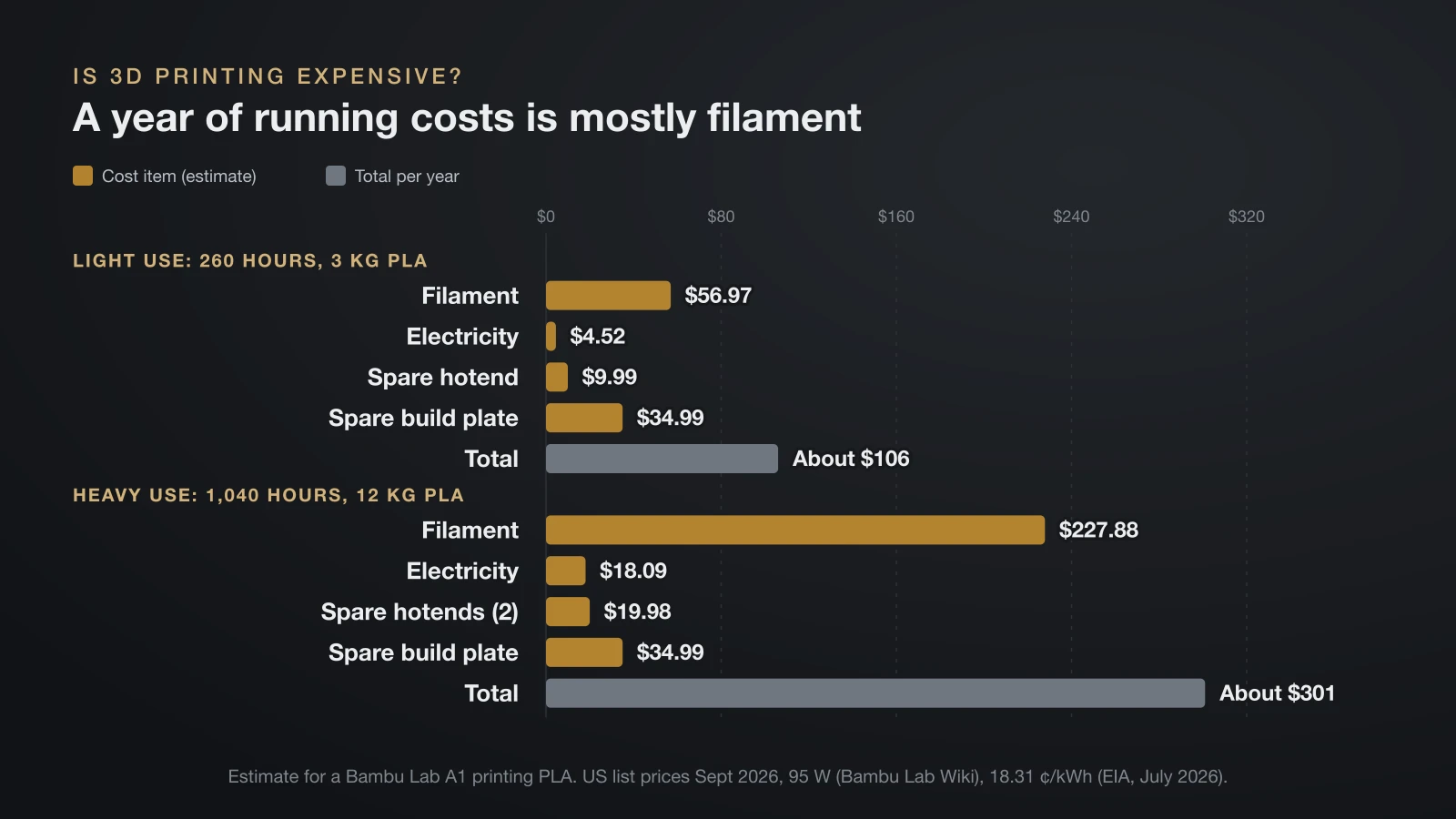
3D printing is not expensive to run: after buying the printer, filament is the main ongoing cost, and electricity is small. As of September 2026, Bambu Lab’s US store lists the A1 mini at $219, the A1 at $299 and the P2S at $549, or $329, $399 and $749 with the multicolor unit. For the cost of a single part, see our 3D printing cost guide.
The running costs break down as follows (list prices as of September 2026, estimates labeled):
| Cost item | Figure | Basis |
|---|---|---|
| PLA filament | $18.99 per kg (about 1.9 cents per gram) | Bambu Lab PLA Basic, 1 kg with spool |
| Electricity | About 1.7 cents per print hour (estimate) | 95 W average for the A1 printing PLA × 18.31 cents per kWh |
| Spare hotend with 0.4 mm nozzle | $9.99 | Bambu Lab A1 hotend, stainless steel |
| Spare textured PEI build plate | $34.99 | Bambu Lab A1 plate |
The electricity figure uses the US average residential price for July 2026 from the U.S. Energy Information Administration (EIA) and the average power Bambu Lab measured for the A1 printing PLA. Prusa measured about 80 W for its MK-series printers with PLA and 120 W with ABS, so most home printers land in the same range.
Annual running cost estimate
The two scenarios below are estimates built from the figures above, with the assumptions shown. They exclude the printer itself, paid model files and your time.
| Assumption | Light use | Heavy use |
|---|---|---|
| Print hours per year | 260 (5 hours a week) | 1,040 (20 hours a week) |
| PLA used per year | 3 kg | 12 kg |
| Filament | $56.97 | $227.88 |
| Electricity (95 W × hours × $0.1831/kWh) | $4.52 | $18.09 |
| Spare hotends | 1 × $9.99 | 2 × $9.99 = $19.98 |
| Spare build plates | 1 × $34.99 | 1 × $34.99 |
| Total per year (estimate) | About $106 | About $301 |
Filament dominates in both cases. Engineering plastics such as ASA or nylon cost more per kilogram, and failed prints add to the filament line, so budget a margin on top.
A secondhand printer can lower the entry price further; our used 3D printer buying guide lists what to check before you pay.
Is 3D printing hard?
3D printing is not hard to start, but it takes practice to do well. Printing a downloaded model on a modern machine is close to “load filament, pick a file, press print”: Bambu Lab says the A1 calibrates its Z-offset, bed level, vibration resonance and nozzle pressure automatically for every print.
The learning curve shows up in three places:
- The slicer: choosing supports, infill, layer height and orientation decides whether a print succeeds and how strong it is.
- Materials: PLA is forgiving, while ABS, ASA, nylon and flexible TPU each bring their own settings and problems.
- Troubleshooting: first-layer problems, stringing and warping still happen. Knowing how to calibrate a 3D printer turns most failures into quick fixes.
Designing your own parts is a separate, bigger skill. Many owners print downloaded models for a long time before learning CAD, and that is a fine way to start.
How much time does 3D printing take?
3D printing takes hours per print, but most of that time is unattended machine time, not your time. A small part can be done quickly, while a large model can run overnight or longer, depending on size, layer height and speed.
Your hands-on time goes into finding or designing a model, slicing it, starting the print, removing supports and cleaning up. Budget extra time for the first attempt at any new model, since a failed or poorly fitting print often needs a second try.
Long prints also mean the machine runs while you sleep or work. NIOSH advises placing printers in areas with fire detection and keeping clearance from combustible materials, so a working smoke alarm near the printer is a must.
Space, noise and ventilation
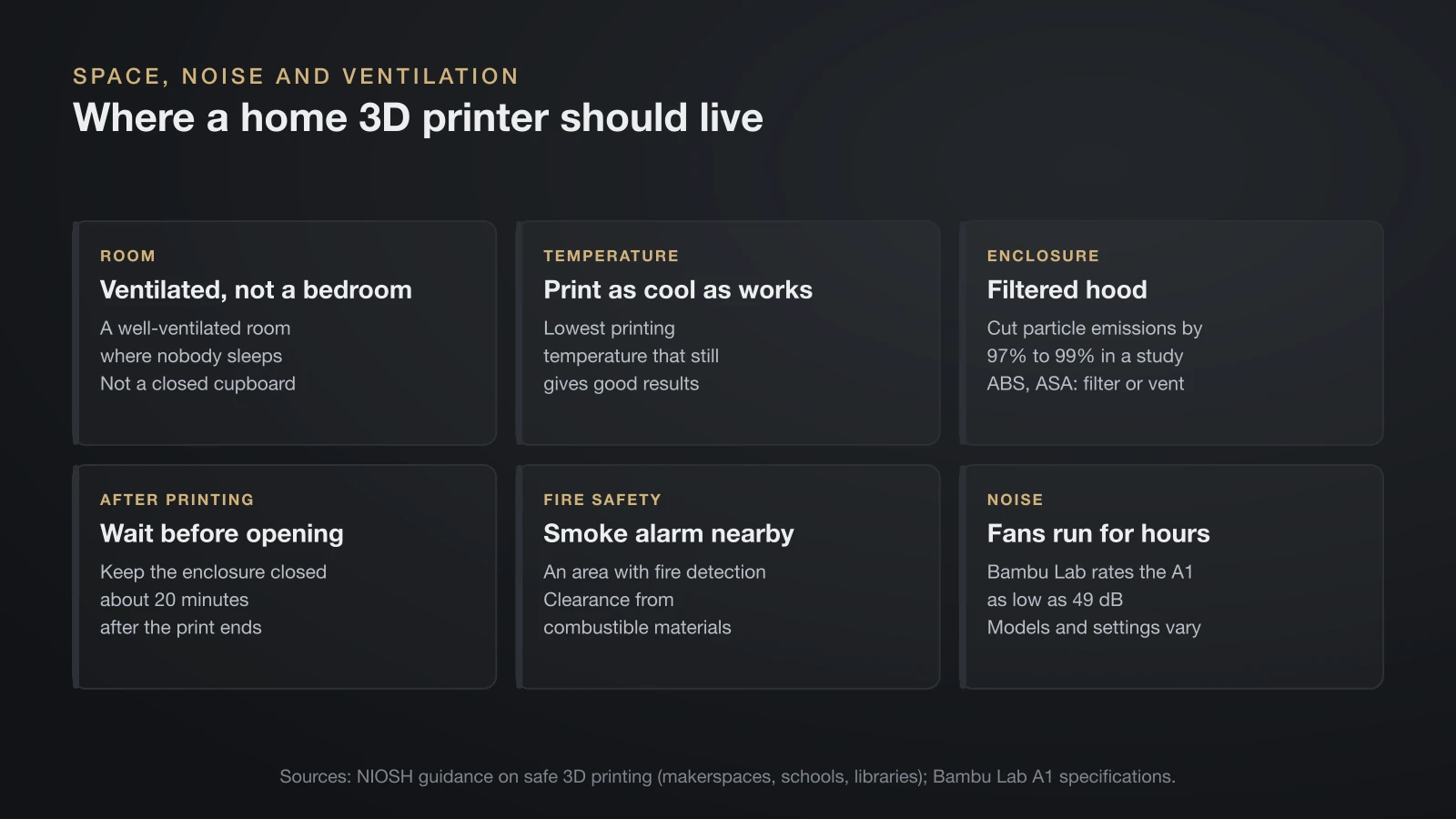
A 3D printer needs a stable surface, space around it and a ventilated room, because it releases particles and fumes while printing. NIOSH notes that ultrafine particles and volatile organic compounds (VOCs) have been detected in 3D printer emissions, and it recommends reducing exposure rather than ignoring it.
- Room: choose a well-ventilated room where nobody sleeps, not a bedroom or a closed cupboard.
- Temperature: NIOSH advises selecting the lowest printing temperature that gives good results.
- Enclosure: a filtered enclosing hood cut particle emissions by 97% to 99% in a study NIOSH cites. ABS and ASA especially benefit from an enclosure with filtration or venting.
- Clearance time: NIOSH cites keeping an enclosure closed for about 20 minutes after printing before opening it.
- Noise: fans and motors make noise for hours; Bambu Lab rates the A1 as low as 49 dB, but models and settings vary.
Resin printers raise the bar further, with liquid resin that needs gloves and careful handling. Our resin vs filament guide compares the two if you are unsure which type to buy.
Alternatives to buying a 3D printer
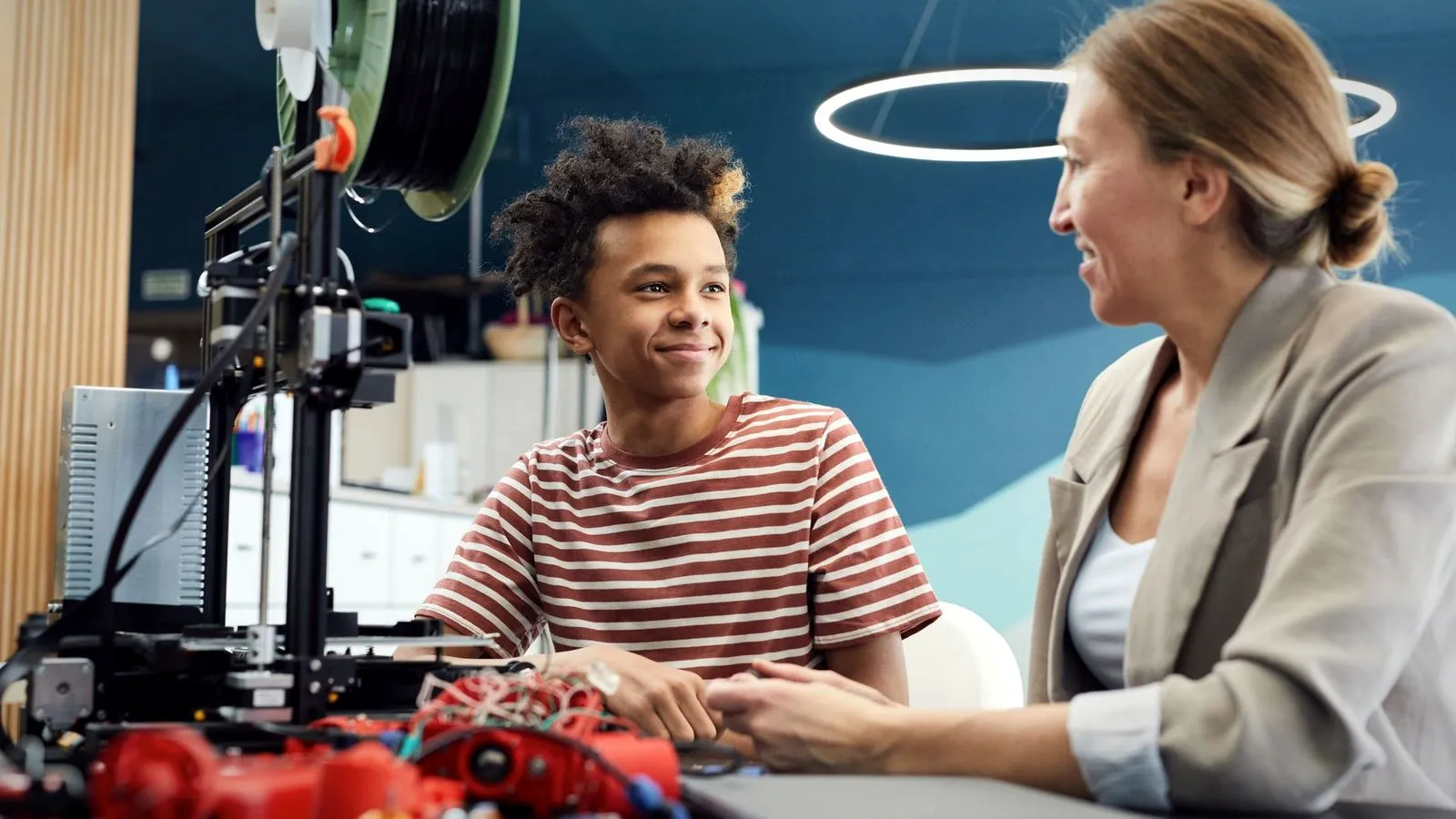
You can try 3D printing without buying a printer through a makerspace, a public library or an online printing service. Each one suits a different need:
| Option | Best for | Trade-off |
|---|---|---|
| Public library or school printer | Trying the hobby, small PLA prints | Queues, size and material limits |
| Makerspace | Learning from other members, access to several machines and tools | Membership fees, travel |
| Online printing service | One-off parts, engineering materials, resin or metal | Price per part, shipping time |
| Friend or local maker | Simple parts at low cost | Depends on their time and printer |
NIOSH’s safe printing guide is written for exactly these places: makerspaces, schools, libraries and small businesses. If you find yourself queuing at the library every week, that is a good sign a home printer would be worth it.
Should I get a 3D printer? A quick checklist
You should get a 3D printer if you can answer yes to most of these questions. Be honest about the first two, because they decide whether it gets used:
- Can you name five things you would print in the first month?
- Will you still have a job for it every week after that?
- Do you have a ventilated room with a stable table, away from where people sleep?
- Are you comfortable with failed prints as part of learning?
- Is your budget enough for the printer plus a few spools of filament and spare parts?
Three or more “no” answers suggest starting with a library, makerspace or print service first.
The bottom line
A 3D printer is worth it for people who will print regularly, from repairs and organizers to hobby parts and prototypes. Running costs are modest: the estimate above lands at about $106 a year for light use and $301 for heavy use, mostly filament. It is not worth it for occasional prints, structural parts or anyone without a ventilated space, and a library, makerspace or print service is the cheapest way to find out.
Sources
- Bambu Lab US Store, list prices read September 29, 2026: A1 mini, A1 (full-auto calibration, 49 dB rating), P2S, PLA Basic, Bambu Hotend A1/A2 and Textured PEI Plate
- Bambu Lab Wiki: Printer and AMS power parameters (A1 average power 95 W printing PLA)
- Prusa Knowledge Base: FAQ (MK-series average power 80 W with PLA and 120 W with ABS at 26 °C room temperature)
- U.S. Energy Information Administration: Electric Power Monthly, Table 5.6.A (US average residential price 18.31 cents per kWh, July 2026, released September 24, 2026)
- NIOSH (CDC): Approaches to Safe 3D Printing, publication 2024-103 (ultrafine particles and VOCs in emissions, lowest workable temperature, 97–99% particle reduction with a filtered hood, 20-minute clearance time, fire detection and clearance from combustibles, makerspaces, schools and libraries)