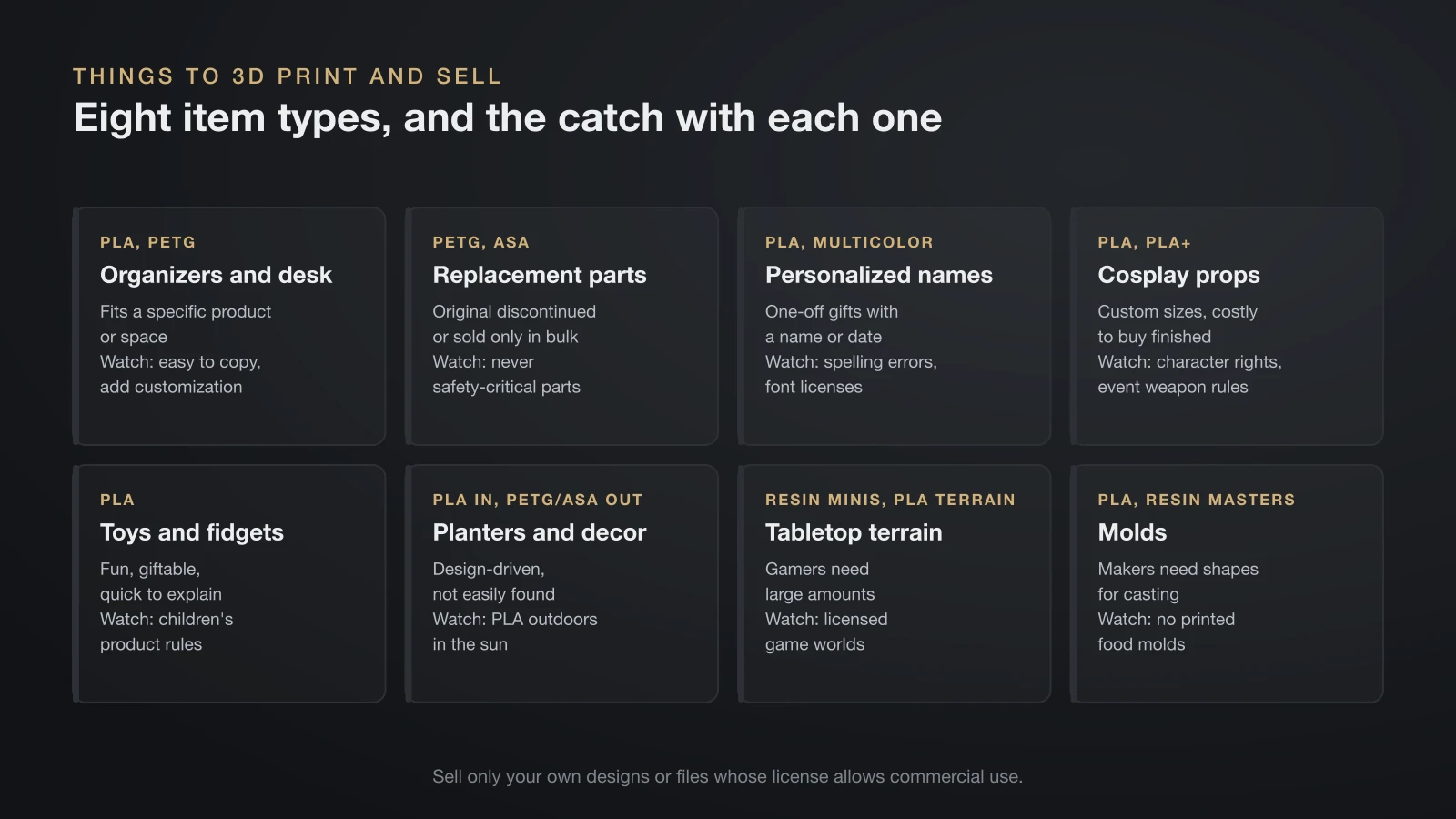
The best things to 3D print and sell are items buyers cannot easily get in a store: custom organizers and desk accessories, replacement parts, personalized name gifts, cosplay props, articulated toys and fidgets, planters and decor, tabletop terrain and molds. Sell only designs you created or are licensed to sell, and price in your time.
This guide covers eight item types that suit selling, the main ways to make money with a 3D printer, the license and safety rules and a pricing formula with a worked example. For projects to print for yourself instead, browse our list of 3D print ideas.
The short answer
| Item type | Why it sells | Typical material | Watch out for |
|---|---|---|---|
| Organizers, cable and desk accessories | Fits a specific product or space | PLA, PETG | Easy to copy, so add customization |
| Replacement parts | Original part discontinued or sold only in bulk | PETG, ASA | Never safety-critical parts |
| Personalized name items | One-off gifts with a name or date | PLA, multicolor | Spelling errors, font licenses |
| Cosplay props | Custom sizes, costly to buy finished | PLA, PLA+ | Character rights, event weapon rules |
| Articulated toys and fidgets | Fun, giftable, quick to explain | PLA | Children’s product rules |
| Planters and home decor | Design-driven, not easily found | PLA indoors; PETG or ASA outdoors | PLA outdoors in the sun |
| Tabletop miniatures and terrain | Gamers need large amounts | Resin (minis), PLA (terrain) | Licensed game worlds |
| Molds | Makers need shapes for casting | PLA, resin masters | No printed food molds |
Things to 3D print and sell: 8 item types that work
Things to 3D print and sell work best when the buyer values fit, personalization or availability more than the price of the plastic. Each type below lists why it sells and what to watch in production. Print times vary with size, layer height and printer, so check your own slicer before you promise a delivery date.
Organizers, cable and desk accessories
Organizers sell because they solve one exact problem: a drawer insert for a specific toolset, a stand for a popular device, or clips for a certain desk. Our guide to 3D printed cable management shows the part types that work. PLA handles most indoor pieces; use PETG near warm electronics. These designs are easy to copy, so a size option or custom text helps you stand out.
Replacement parts
Replacement parts sell to people whose original piece is discontinued or sold only in large packs: appliance knobs, battery covers, clips and caps. They take careful measuring and fit tests, and PETG or ASA suits parts that face heat or wear. Never sell parts whose failure could injure someone, and do not use a brand’s name or logo to market them.
Custom name and personalized items
Personalized items sell because the buyer cannot find them anywhere else: name signs, keychains, door plaques, pet tags and desk nameplates. Most are flat, fast prints in PLA, and a multi-color 3D printer or a filament change at a set layer adds a second color. Double-check spellings, and check that the font’s license allows commercial use.
Cosplay props
Cosplay props sell to fans who want a helmet, armor piece or prop sized for their body, which store-bought versions rarely are. They are large prints with long print times and a lot of sanding and painting, so price the finishing work, not just the plastic. Our 3D printed cosplay guide covers materials and finishing, and character designs belong to their owners.
Articulated toys and fidgets
Flexi animals, fidget clickers and puzzles are giftable and quick to demonstrate in a photo or video. They print in PLA and depend on a well-tuned printer, since a fused joint ruins the part. Our guide to 3D printed articulated toys covers tolerances and safety, and anything made for children falls under the children’s product rules below.
Planters and home decor
Planters, vases, lamp shades and wall art sell on design, so original shapes and good photos matter more than speed. Prusa’s material guide notes that PLA degrades under UV light and softens above 60 °C (140 °F), so sell PLA pieces for indoor use and use PETG or ASA for outdoor planters. State the material and whether the item is watertight.
Tabletop miniatures and terrain
Tabletop gamers buy terrain, buildings, dice towers and storage in quantity. Filament printers handle terrain well, while fine-detail miniatures print best on resin; our resin vs filament comparison explains the trade-off. Many miniature designers sell commercial licenses to print shops, which is often the only legal route to selling their figures.
Molds
Molds and mold masters sell to soap makers, candle makers and resin casters who need a custom shape. A printed master cast in silicone is the most common route, as our 3D printed molds guide explains. Do not sell printed molds for food: Prusa does not recommend printed parts for direct food contact, because bacteria can grow in the grooves between layers.
What 3D printed items sell best?
The best selling 3D printed items share a few traits rather than a single category, and no public data set ranks 3D printed goods across marketplaces. Before you print stock, check an idea against this list:
- Customizable: a name, size or color option turns a commodity into a one-off.
- Hard to buy elsewhere: discontinued parts, niche hobby accessories and exact-fit organizers face less competition.
- Small and light: cheaper to ship and less likely to break in transit.
- Reliable to print: a design that fails often eats the margin.
- Clearly legal: your own design, or a file with a commercial license.
Search the marketplace you plan to use for the item, read reviews of similar products, and look at what buyers complain about. That is free, current demand data.
How to make money with a 3D printer
You can make money with a 3D printer in four main ways: selling finished prints, printing on demand for local customers, taking custom commissions and selling your own digital designs. They differ in how much printing, design work and customer contact they involve.
| Route | How it works | Main skill | Main risk |
|---|---|---|---|
| Sell finished prints | List items on a marketplace, your own site or at craft fairs | Product choice, photos | Competition, copycats |
| Local print service | Print customers’ files, often for makers or small businesses | Reliable printing | Liability for their designs |
| Custom commissions | Design and print one-off parts or props to order | CAD, communication | Time spent on revisions |
| Sell your designs | Sell model files or commercial licenses to other printers | Original design | Needs a following |
Selling designs scales best, because a file can sell many times without printing. Selling prints is the easiest start, and our guide on whether a 3D printer is worth it covers what owning one really costs. Registering a business, sales tax and income tax are outside this guide; the IRS and the Small Business Administration (SBA) publish official guidance.
What you can legally 3D print and sell
You can legally sell prints of your own original designs and of files whose license allows commercial use; everything else needs permission. This is general information, not legal advice, and rules differ by country.
Model licenses
Many free models use Creative Commons licenses, and Creative Commons offers six license types built from four elements:
- BY: credit the creator.
- SA: share adaptations under the same terms.
- NC: noncommercial use only, meaning use not primarily intended for commercial advantage or money. Selling prints of an NC model breaks the license.
- ND: no derivatives or adaptations.
Check the license on each model page, not just the platform’s defaults; our Thingiverse 3D prints guide shows where to find it. Some designers offer a separate commercial license or a paid membership for sellers.
Characters, logos and brands
A free file of a film, game or cartoon character carries the fan designer’s license at best, not the studio’s permission. Trademarks such as logos and brand names identify who makes a product, so putting them on prints you sell can mislead buyers and invite a takedown. Stick to original designs or officially licensed files. For your own brand, our guide to 3D printing logos covers the full workflow.
Children’s products and food contact
Items for children face US safety rules. The Consumer Product Safety Commission (CPSC) requires manufacturers of children’s products (designed mainly for children 12 or younger) to issue a Children’s Product Certificate based on tests by a CPSC-accepted lab.
Small batch manufacturers can get relief from some third-party testing, but only after registering with the CPSC each year. The limits are $1,436,864 or less in total gross revenue from consumer products and no more than 7,500 units of the covered product in the prior year. Tests for small parts and for lead in paint still need a third-party lab.
For food, do not sell printed cups, plates or cookie cutters as food safe. Prusa does not recommend printed parts for direct food contact, whatever the filament.
How to price 3D prints
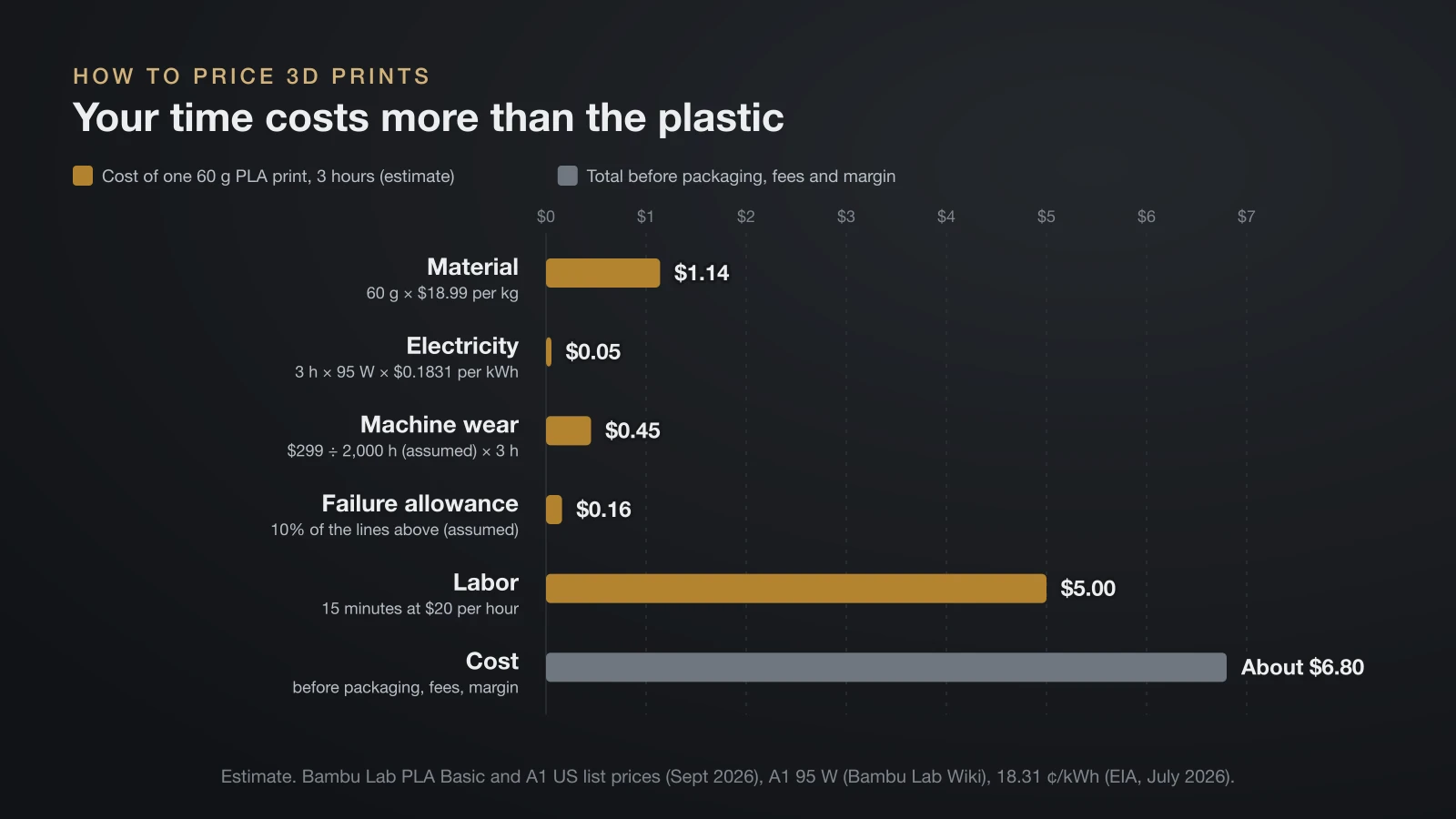
To price 3D prints, add up material, machine time, electricity, a failure allowance and your labor, then add packaging, platform fees and your margin. The formula keeps you from pricing by plastic alone:
cost = material + electricity + machine wear + failure allowance + labor
Worked example (estimate)
The example below is an estimate for a 60 g PLA part that prints in 3 hours on a Bambu Lab A1. Every assumption is shown so you can swap in your own numbers.
| Line | Assumption | Cost |
|---|---|---|
| Material | 60 g × $18.99 per kg (Bambu Lab PLA Basic, September 2026) | $1.14 |
| Electricity | 3 h × 95 W (A1 average, PLA) × $0.1831 per kWh (EIA, July 2026) | $0.05 |
| Machine wear | $299 printer ÷ 2,000 print hours (assumed life) × 3 h | $0.45 |
| Failure allowance | 10% of the lines above (assumed) | $0.16 |
| Labor | 15 minutes hands-on at $20 per hour (your rate) | $5.00 |
| Cost before packaging, fees and margin | About $6.80 |
Labor dominates even at a modest rate, which is why items that print unattended and need little cleanup make the best products. Add packaging, the platform’s current fees from its own fee page, shipping and your profit margin to reach a price. For other materials and per-gram figures, see our 3D printer filament cost guide.
The bottom line
The best things to 3D print and sell are customized, hard-to-find or hobby-specific items: organizers, replacement parts, name gifts, props, toys, decor, terrain and molds. Sell only your own designs or files with a commercial license, keep clear of characters and brands, and follow CPSC rules for anything aimed at children. Price with the full formula, because your time usually costs more than the plastic.
Sources
- Creative Commons: About CC Licenses (six license types; BY, SA, NC and ND elements; definition of noncommercial)
- U.S. Consumer Product Safety Commission: Children’s Product Certificate and Small Batch Manufacturers and Third Party Testing (children 12 or younger, CPSC-accepted labs, $1,436,864 revenue and 7,500 unit limits, annual registration, small parts and lead in paint still third-party tested)
- Prusa Knowledge Base: PLA (softens and deforms above 60 °C, degrades under UV, not recommended for direct food contact because layer grooves can harbor bacteria)
- Bambu Lab: A1 and PLA Basic US store list prices read September 29, 2026 ($299, $18.99 per kg) and Wiki printer power parameters (A1 average 95 W printing PLA)
- U.S. Energy Information Administration: Electric Power Monthly, Table 5.6.A (US average residential price 18.31 cents per kWh, July 2026)