
3D printer filament cost starts at about $17 to $20 per 1 kg spool for PLA, PETG and ABS on the manufacturers’ own US stores, as of September 2026. So how much does 3D printer filament cost for tougher jobs? ASA and polycarbonate run about $25 to $40 per kg, reinforced nylon $67 to $80, and PEEK $765.
That works out to roughly 2 cents per gram for everyday PLA. This guide lists current list prices by material, converts them to cost per gram and per meter, and shows the formula to price any print. If you are still deciding whether printing pays off at all, read our guide on whether a 3D printer is worth it.
The short answer
| Question | Answer (as of September 2026, 1.75 mm, 1 kg list prices) |
|---|---|
| PLA, PETG, ABS | About $17 to $25 per kg |
| ASA, polycarbonate (PC) | About $25 to $40 per kg |
| TPU (flexible) | About $39 to $50 per kg |
| Nylon (PA) | About $67 to $80 per kg |
| PEEK | $765 per kg (3DXTech ThermaX) |
| Cost per gram of PLA | About 1.6 to 2.0 cents |
| Cost of one print | Grams from your slicer × price per gram (estimate) |
3D printer filament cost by material
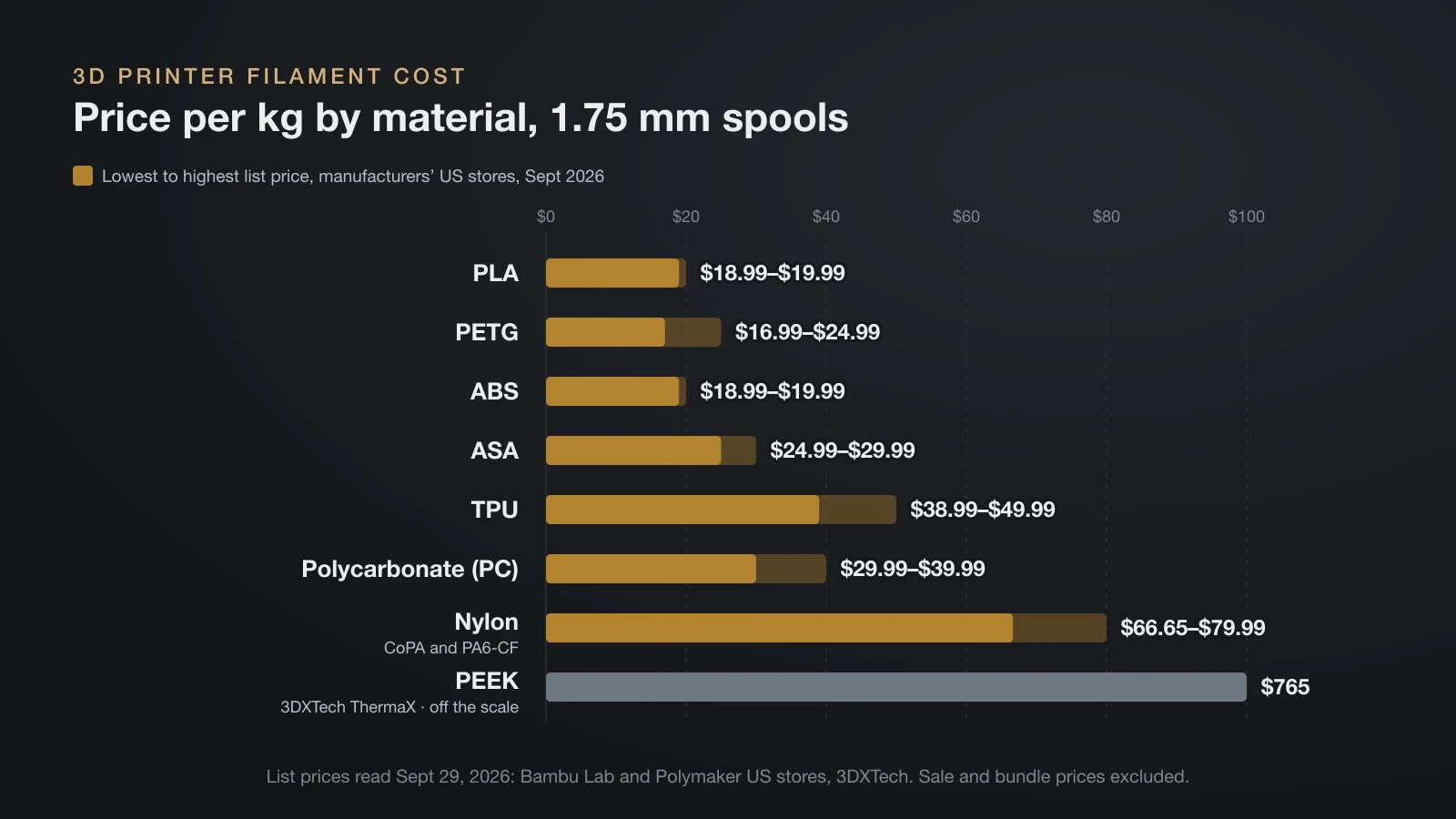
Filament prices depend mostly on the plastic: commodity materials cost about $20 per kg, and high-temperature engineering plastics cost many times more. The table below uses list prices read on September 29, 2026 from the manufacturers’ own US online stores, for 1 kg of 1.75 mm filament with a spool unless noted. Sale and bundle prices are not included.
| Material | Bambu Lab US store | Polymaker US store | Price range per kg |
|---|---|---|---|
| PLA | $18.99 (PLA Basic; refill $15.99) | $19.99 (PolyLite PLA) | $18.99–$19.99 |
| PETG | $16.99 (PETG Basic; refill $13.99), $18.99 (PETG HF) | $18.99–$24.99 (PETG, by color) | $16.99–$24.99 |
| ABS | $18.99 (refill $15.99) | $18.99–$19.99 (PolyLite ABS) | $18.99–$19.99 |
| ASA | $29.99 | $24.99–$26.99 | $24.99–$29.99 |
| TPU | $38.99 (TPU for AMS; refill $34.99) | $49.99 (PolyFlex TPU95-HF) | $38.99–$49.99 |
| Polycarbonate (PC) | $39.99 | $29.99 (PolyLite PC) | $29.99–$39.99 |
| Nylon | $79.99 (PA6-CF, carbon fiber) | $49.99 per 750 g (PolyMide CoPA), about $66.65 per kg | $66.65–$79.99 |
| PEEK | Not sold | Not sold | $765 (3DXTech ThermaX PEEK, 1 kg) |
Prices change often, and each store runs its own bulk and bundle deals, so treat the table as a snapshot. A “refill” is a coil of filament without the plastic spool: Bambu Lab notes that refills must be used with a reusable spool.
For the materials themselves, see our guides to ASA filament, nylon filament and PEEK 3D printer filament. PEEK is on a different planet: it needs a high-temperature printer that most hobbyists do not own.
Filament cost per gram and per meter
Filament cost per gram is the spool price divided by 1,000, so a $18.99 PLA spool costs about 1.9 cents per gram. Per meter depends on density too, because a lighter plastic gives you more strand from the same kilogram.
| Filament (Bambu Lab) | Price per kg | Density (data sheet) | Meters per kg (1.75 mm) | Cost per gram | Cost per meter |
|---|---|---|---|---|---|
| PLA Basic, with spool | $18.99 | 1.24 g/cm³ | About 335 m | 1.9 cents | About 5.7 cents |
| PLA Basic, refill | $15.99 | 1.24 g/cm³ | About 335 m | 1.6 cents | About 4.8 cents |
| PETG Basic, with spool | $16.99 | 1.25 g/cm³ | About 333 m | 1.7 cents | About 5.1 cents |
| ASA, with spool | $29.99 | 1.05 g/cm³ | About 396 m | 3.0 cents | About 7.6 cents |
Meters are calculated for a round 1.75 mm strand at the data sheet density, the same method as in our 1.75 mm filament guide. All per-gram and per-meter values are estimates from list prices.
ASA costs more per kilogram than PLA, but its lower density narrows the gap per meter. Since a slicer extrudes a volume of plastic, not a weight, the same part in ASA weighs about 15% less than in PLA (1.05 ÷ 1.24, estimate).
Filament cost calculator: the formula
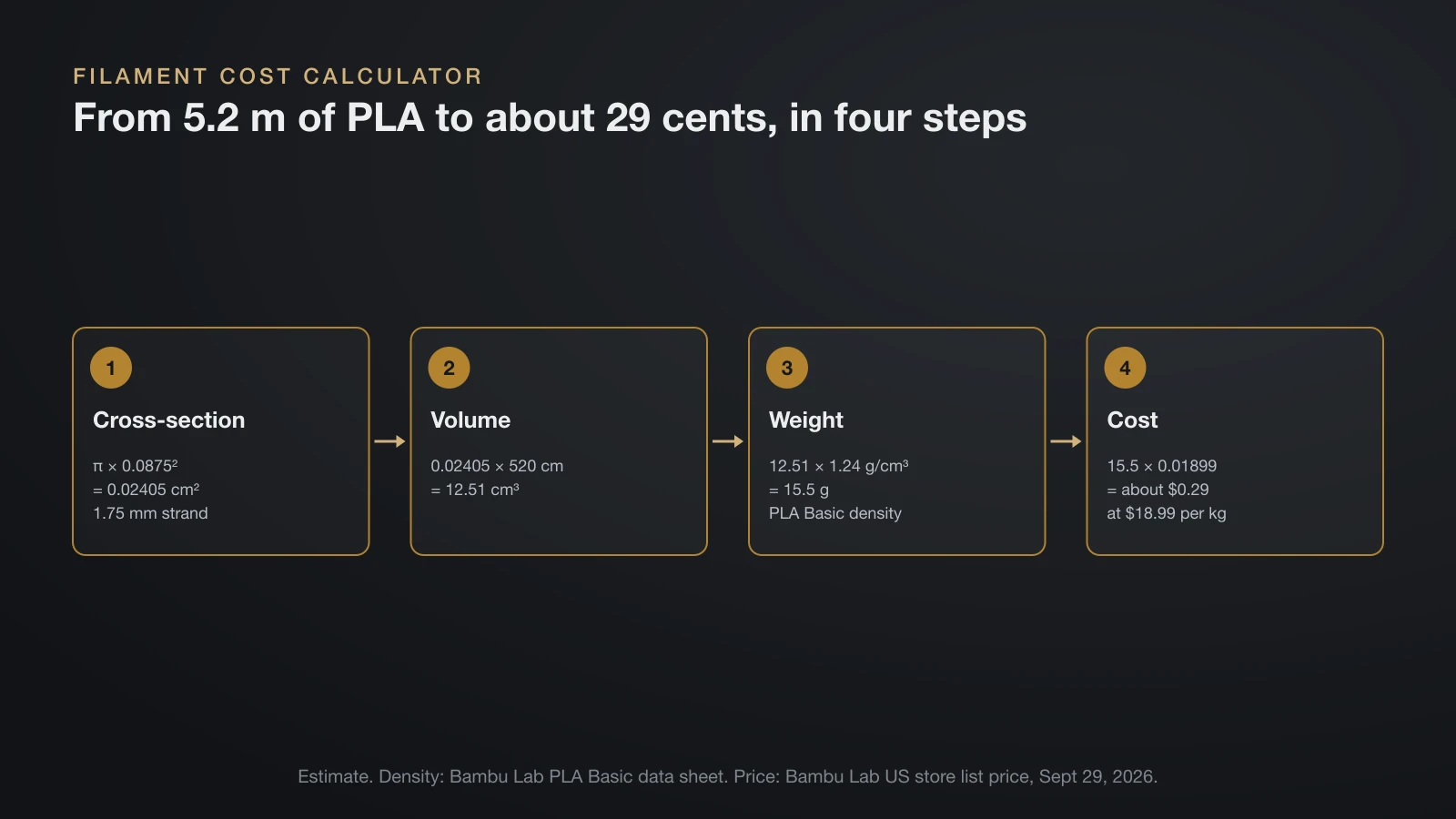
A filament cost calculator needs only three inputs: the length or weight of filament, the plastic’s density and the spool price. Your slicer usually gives you grams directly, but the full formula shows where that number comes from.
- Cross-section of the strand: π × (diameter ÷ 2)². For 1.75 mm filament: π × 0.0875² = 0.02405 cm².
- Volume used: cross-section × length in cm. For 5.2 m (520 cm): 0.02405 × 520 = 12.51 cm³.
- Weight: volume × density from the data sheet. For PLA Basic at 1.24 g/cm³: 12.51 × 1.24 = 15.5 g.
- Cost: grams × (spool price ÷ 1,000). At $18.99 per kg: 15.5 × 0.01899 = about $0.29.
Add a margin on top for failed prints, supports and purge waste, which come out of the same spool. For a quick answer, skip steps 1 to 3 and multiply the slicer’s gram figure by your price per gram.
Example: cost of common prints
The table multiplies assumed print weights by the list prices above. Weights are illustrative assumptions, not measurements: check your own slicer for real numbers.
| Example print (assumed weight) | PLA Basic ($18.99/kg) | PETG Basic ($16.99/kg) | ASA ($29.99/kg) |
|---|---|---|---|
| Keychain or name tag (8 g) | $0.15 | $0.14 | $0.24 |
| Phone stand (40 g) | $0.76 | $0.68 | $1.20 |
| Desk organizer (150 g) | $2.85 | $2.55 | $4.50 |
| Large planter or helmet shell (500 g) | $9.49 | $8.49 | $14.99 |
Material is rarely the whole cost. Electricity, wear parts, failed prints and your time add up. Our breakdown of 3D printing cost puts a number on each, and our guide to things to 3D print and sell shows how to fold them into a price.
How slicers estimate filament use
Slicers estimate filament use by adding up every extrusion move in the toolpath and converting that length to weight with the density in the filament profile. Bambu Studio, for example, shows the length and weight of filament used for the model, for flushing and for the prime tower after slicing.
That estimate is only as good as the profile. If the density in your filament settings is wrong, the gram figure is wrong too, so copy the value from the spool’s data sheet. Many slicers also have a cost field in the filament profile: enter your price per kg and the slicer prints a cost estimate next to the weight. Our STL to G-code guide explains how the slicer turns a model into those moves.
Multicolor prints are the big exception to “the model weight is the cost.” Bambu Lab notes that multimaterial prints tend to be very costly in time and materials, because a single nozzle must flush old filament at every color change. Check the flush and prime tower weights before you print; see our multi-color 3D printers guide for ways to reduce that waste.
What makes filament more expensive?
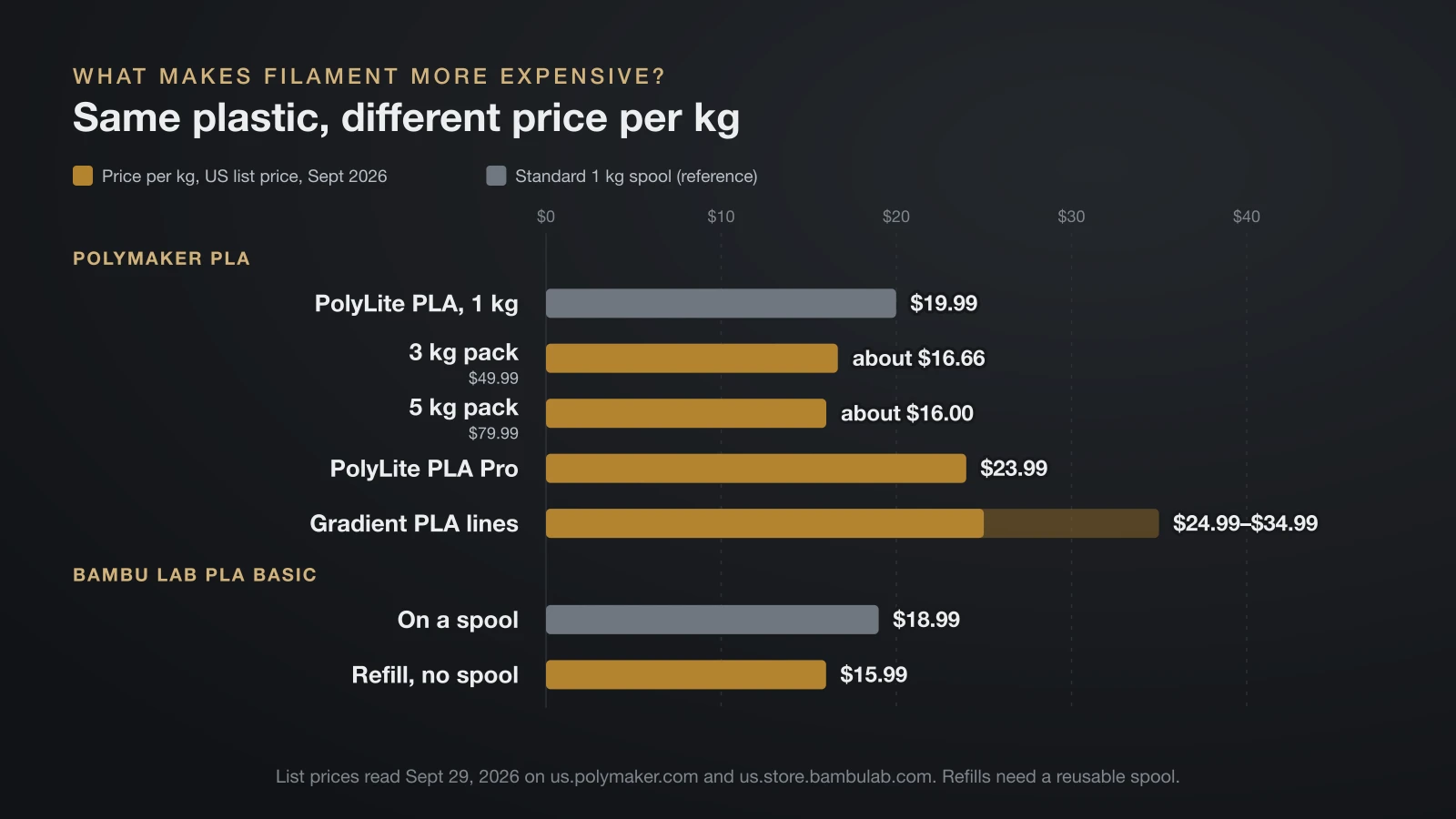
Filament gets more expensive with the base polymer, additives, spool format and color effects, while buying in bulk lowers the price per kilogram. The store prices above show each factor.
- Base plastic: engineering plastics cost more to make and to process. PC, nylon and PEEK sit well above PLA and PETG in every catalog.
- Fiber reinforcement: carbon fiber raises the price and the hardware bill. Bambu Lab’s PA6-CF page says stainless steel nozzles are not recommended, and 0.2 mm nozzles are not compatible.
- Special colors and effects: Polymaker’s gradient PLA lines list at $24.99 to $34.99 per kg, against $19.99 for plain PolyLite PLA.
- Spool or refill: Bambu Lab’s refills cost $3 less per kg than the same filament on a spool, if you already own a reusable spool.
- Bulk size: Polymaker lists PolyLite PLA at $49.99 for 3 kg and $79.99 for 5 kg, about $16.66 and $16.00 per kg.
- Upgraded formulas: tougher PLA grades such as PolyLite PLA Pro ($23.99) cost a little more; our PLA Plus guide explains what the extra money buys.
Moisture is a hidden cost. Filament that absorbs water prints poorly, and a spool that has to be thrown away or re-dried costs more than a cheaper spool stored properly.
How to spend less on filament
The cheapest filament is the one that ends up in a good print, so reducing waste saves more than chasing the lowest price per kilogram. Start with these steps:
- Calibrate once: a tuned first layer and flow setting prevent the failed prints that burn through spools; our guide on how to calibrate a 3D printer covers the steps.
- Print a small test first: check the fit of a part at small size, or print one piece of a multi-part model, before committing hundreds of grams.
- Lower infill and walls where strength does not matter: decorative parts rarely need the default settings.
- Buy refills or bulk packs for the one or two materials you use most, and single spools for everything else.
- Store spools dry: a sealed box with desiccant keeps hygroscopic plastics such as nylon, TPU and PETG printable.
- Plan multicolor prints: fewer color changes per layer means less flush waste.
The bottom line
As of September 2026, 3D printer filament costs about $17 to $25 per kg for PLA, PETG and ABS on the manufacturers’ own US stores, $25 to $50 for ASA, PC and TPU, $67 to $80 for nylon and $765 for PEEK. Everyday PLA works out to about 2 cents per gram, so most small prints cost well under a dollar in plastic. Use your slicer’s gram estimate times your price per gram, and add a margin for waste.
Sources
- Bambu Lab US Store, list prices read September 29, 2026: PLA Basic, PETG Basic, PETG HF, ABS, ASA, TPU for AMS, PC and PA6-CF (1 kg spool and refill prices, refill needs a reusable spool, PA6-CF nozzle cautions and drying)
- Bambu Lab technical data sheets and Wiki: PLA Basic TDS, PETG Basic TDS, ASA TDS, View slicing information and Reduce waste during filament change (densities 1.24, 1.25 and 1.05 g/cm³; slicer filament length and weight for model, flushing and prime tower; multimaterial waste)
- Polymaker US Store, list prices read September 29, 2026: PolyLite PLA, PolyLite PLA Pro, PETG, PolyLite ABS, ASA, PolyLite PC, PolyFlex TPU95-HF, PolyMide CoPA, Gradient Crystal PLA and Gradient Starlight PLA (1 kg, 3 kg, 5 kg and 750 g prices)
- 3DXTech: ThermaX PEEK (1.75 mm, 1 kg list price $765.00, read September 29, 2026)