
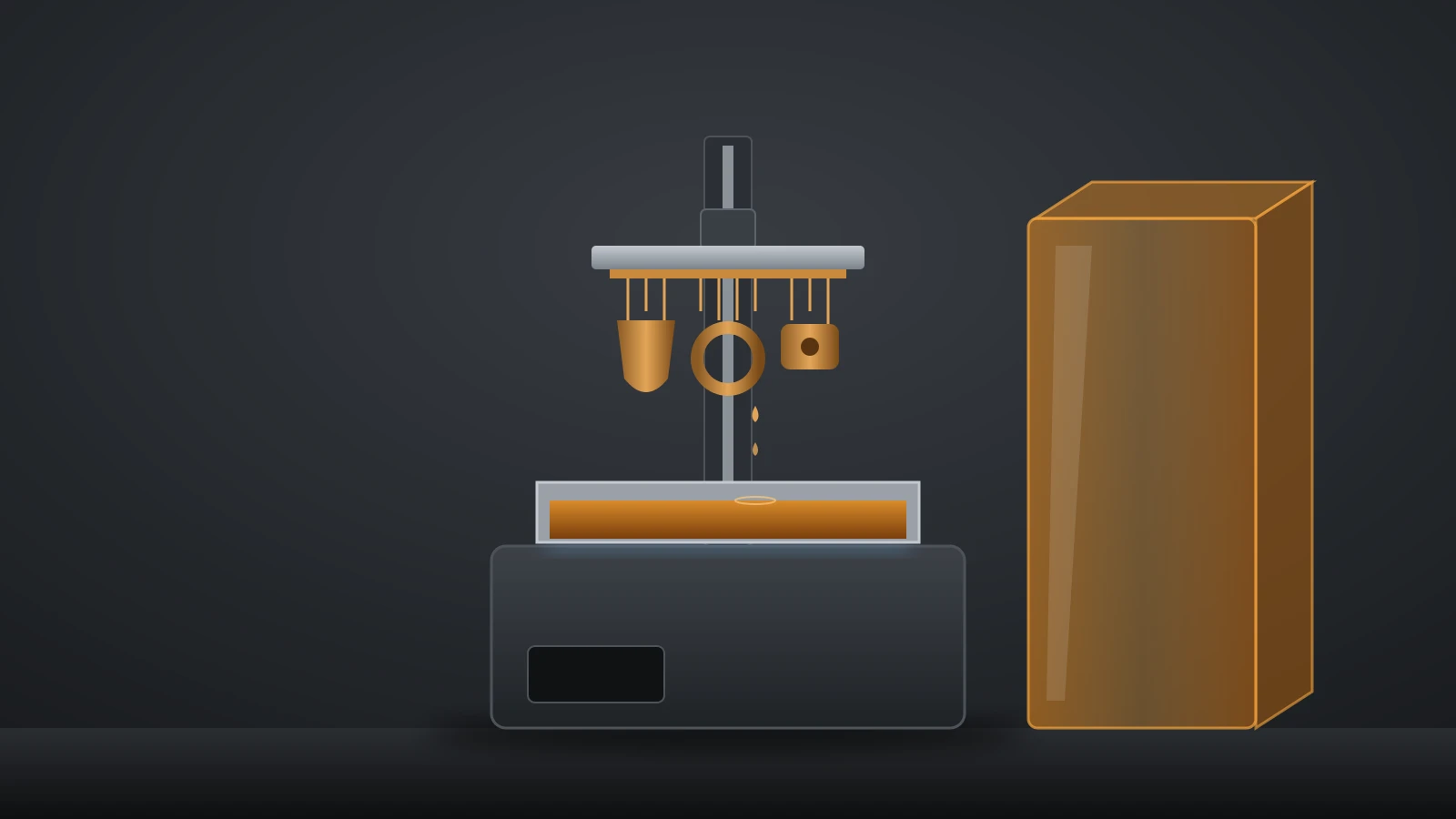
3D printing resin is a liquid photopolymer that hardens into solid plastic when a resin printer’s UV light hits it, usually at 405 nm. You can choose standard, tough (ABS-like), flexible, high-temperature, water-washable and castable resins. Every print must be washed and cured, and liquid resin needs gloves, ventilation and hazardous-waste disposal.
If you are still choosing a printer type, our comparison of resin vs filament weighs detail against practicality.
The short answer
| Question | Answer |
|---|---|
| What it is | A liquid photopolymer that cures layer by layer under UV light |
| Wavelength | 405 nm is the common standard for desktop printers; check that resin and printer match |
| Main types | Standard, tough or ABS-like, flexible, high-temperature, water-washable, castable |
| Washing | Isopropyl alcohol (IPA) for most resins; water only for water-washable resin |
| Curing | Minutes to hours under UV light, depending on the resin |
| Safety | Nitrile gloves, eye protection, a ventilated room; liquid resin is a skin sensitizer |
| Storage | Opaque, sealed bottle at room temperature, out of sunlight |
| Disposal | Never down the drain; cure leftovers solid or take liquids to hazardous waste |
How does 3D printing resin work?
3D printing resin works by turning from liquid to solid wherever UV light reaches it. Prusa describes resins as photosensitive materials made of three parts: monomers and oligomers that form the core, photoinitiators that react to UV light and start the hardening, and additives that change color and properties.
NIOSH groups the printers that use it as vat photopolymerization. Prusa lists three kinds that run on liquid resin: laser SLA (stereolithography), DLP (digital light processing) and the LCD-based MSLA (masked SLA) printers common at home. Each one cures a thin layer, lifts the build platform and repeats. Prusa notes that sunlight cures resin too, which is why it is sold in opaque bottles.
Types of 3D printing resin
The main types of 3D printing resin are standard, tough, flexible, high-temperature, water-washable and castable, and each one is tuned for a specific property. The example figures come from each maker’s own data on post-cured parts.
| Type | What it is for | Example data (manufacturer) |
|---|---|---|
| Standard | Miniatures, display models, prototypes | Prusa: smooth and detailed, but fragile and not for mechanical parts |
| Tough or ABS-like | Snap fits, enclosures, parts that get handled | Formlabs Tough 2000: 40.4 MPa tensile strength, 79% elongation, “comparable to ABS” |
| Flexible | Grips, gaskets, bumpers, soft-touch parts | Formlabs Flexible 80A: Shore 83A hardness, 230% elongation |
| High-temperature | Molds, fixtures near heat, hot air or fluid | Formlabs High Temp: heat deflection 238 °C (460 °F) at 0.45 MPa |
| Water-washable | Hobby prints without an IPA bath | Elegoo and Anycubic: rinse in water instead of alcohol |
| Castable | Jewelry and other lost-wax casting patterns | Formlabs Castable Wax: 20% wax-filled, 0.0–0.1% ash |
Standard and tough resins
Standard resin is the default for figures and display models because it captures the finest detail. Prusa warns that it is fragile, so snap fits and dropped parts call for tough or ABS-like blends. Even Formlabs Tough 2000 deflects at 70 °C (158 °F) under a 0.45 MPa load, so tough does not mean heat resistant.
Flexible and high-temperature resins
Flexible resins behave like rubber, which suits grips and seals, though Prusa notes that they print at lower resolution. High Temp resin reaches 238 °C at 0.45 MPa only after a second, thermal post-cure at 160 °C (320 °F) for 180 minutes in a non-food oven; at the heavier 1.8 MPa load it deflects at 101 °C.
Water-washable and castable resins
Water-washable resin skips the alcohol bath, which suits a home setup, but the rinse water still contains resin and needs the same care as dirty IPA. Castable resins burn out cleanly in a casting flask, which makes them the base of 3D printed jewelry made in gold or silver. Our guide to 3D printed molds covers other ways to cast from prints.
How to choose a resin for your printer
The most important check when buying resin is that its curing wavelength matches your printer. Prusa calibrates its MSLA printer for 405 nm resins and warns that badly mismatched exposure times can even damage a printer. Run through this list before you buy:
- Wavelength: Elegoo sells its standard and ABS-like resins as 405 nm resins for LCD, MSLA and DLP printers, and Anycubic lists 365–405 nm for its water-wash resin.
- Exposure settings: use the maker’s published exposure times as the starting point and run a test print.
- Washing method: decide between an IPA setup and water-washable resin before you buy several bottles.
- Property you need: detail (standard), toughness (ABS-like), flexibility, heat or castability.
- Data sheets: download the safety data sheet (SDS) and technical data sheet (TDS) for every resin you use.
- Shelf life: check the production or expiry date on the bottle.
Figures and busts mostly print in standard or ABS-like resin; our guide to 3D printed action figures shows how resin compares for faces, joints and paint.
Resin safety: gloves, ventilation and skin contact
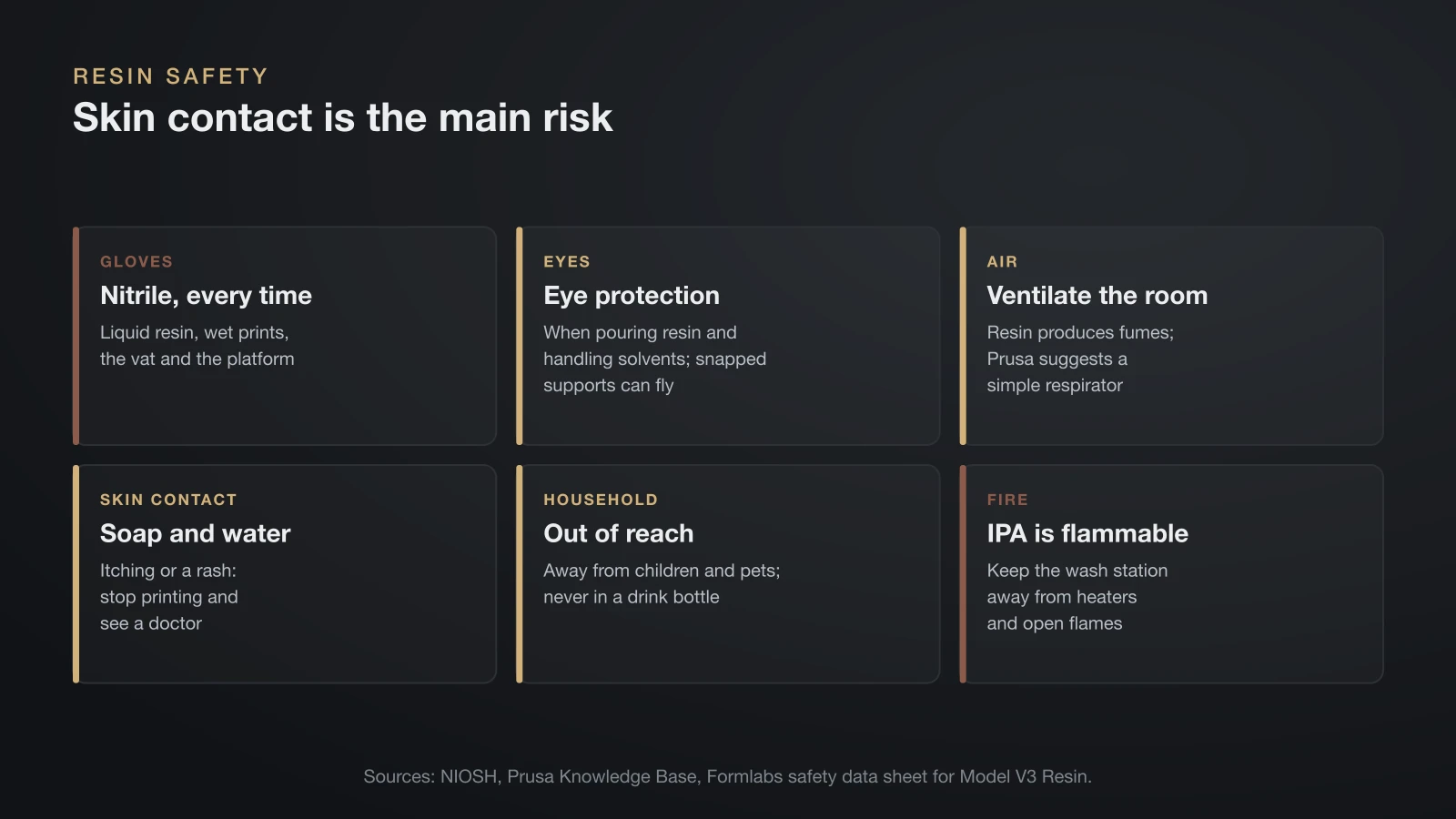
Liquid resin is a hazardous chemical, and skin contact is the main risk. NIOSH notes that some chemicals in liquid resins may cause skin irritation or sensitization. The safety data sheet for Formlabs Model V3 Resin lists H317 (may cause an allergic skin reaction), H315 and H319 (skin and serious eye irritation), H335 (may cause respiratory irritation) and H411 (toxic to aquatic life).
- Gloves: nitrile or other chemical-resistant gloves whenever you touch liquid resin, a wet print, the vat or the build platform.
- Eyes: eye protection when pouring resin, as NIOSH recommends, and when handling solvents. Formlabs adds that snapping supports can throw small pieces.
- Air: keep the room ventilated while printing; Prusa says resin produces fumes and recommends a simple respirator.
- Skin contact: wash with soap and water. Prusa says anyone who develops itching or a rash should stop printing and see a doctor.
- Household: keep resin out of reach of children and pets, and never store it in a drink bottle.
NIOSH notes that many post-processing solvents, isopropanol included, are flammable, so keep the wash station away from heaters and open flames.
How to wash resin prints with alcohol or water
Resin prints are washed to remove the uncured liquid resin that coats every surface. Most resins wash in isopropyl alcohol; Elegoo also lists ethanol for its standard resin, and water-washable resins rinse in plain water.
- Remove the print with gloves on: slide a scraper under the edge of the raft. Formlabs warns that tools slip on resin-coated plates, so keep sharp edges pointed away from you.
- Wash: agitate the part in the solvent for the time your resin specifies (see the table).
- Rinse: a second bath of clean solvent or water removes the last film. For some resins, Formlabs notes that parts can stay tacky once the IPA holds more than 5% dissolved resin.
- Dry: let all solvent or water evaporate before curing; Formlabs suggests at least 10 minutes of air drying for Tough 2000 V2.
| Resin (maker) | Wash time | Note |
|---|---|---|
| Formlabs Standard V5 (Grey, Clear, Black, White) | 5 minutes in IPA | Earlier V4 versions: 10 minutes |
| Formlabs Tough 2000 V2 | 15 minutes in IPA | Air dry at least 10 minutes |
| Formlabs Durable V2 | 20 minutes in IPA | No more than 20 minutes in solvent in total |
| Formlabs High Temp | 5 minutes in IPA | No more than 6 minutes in total |
| Prusament Tough Resin | 5 minutes in IPA above 90% | Dry 3 minutes at 45 °C (113 °F) |
| Anycubic Water-Wash Resin+ | In water | Do not soak longer than 30 minutes |
Longer is not better, because excess solvent exposure lowers part quality for several resins. Supports usually come off after curing; our guide to 3D printing supports explains why and how to remove them cleanly.
How long to cure resin prints
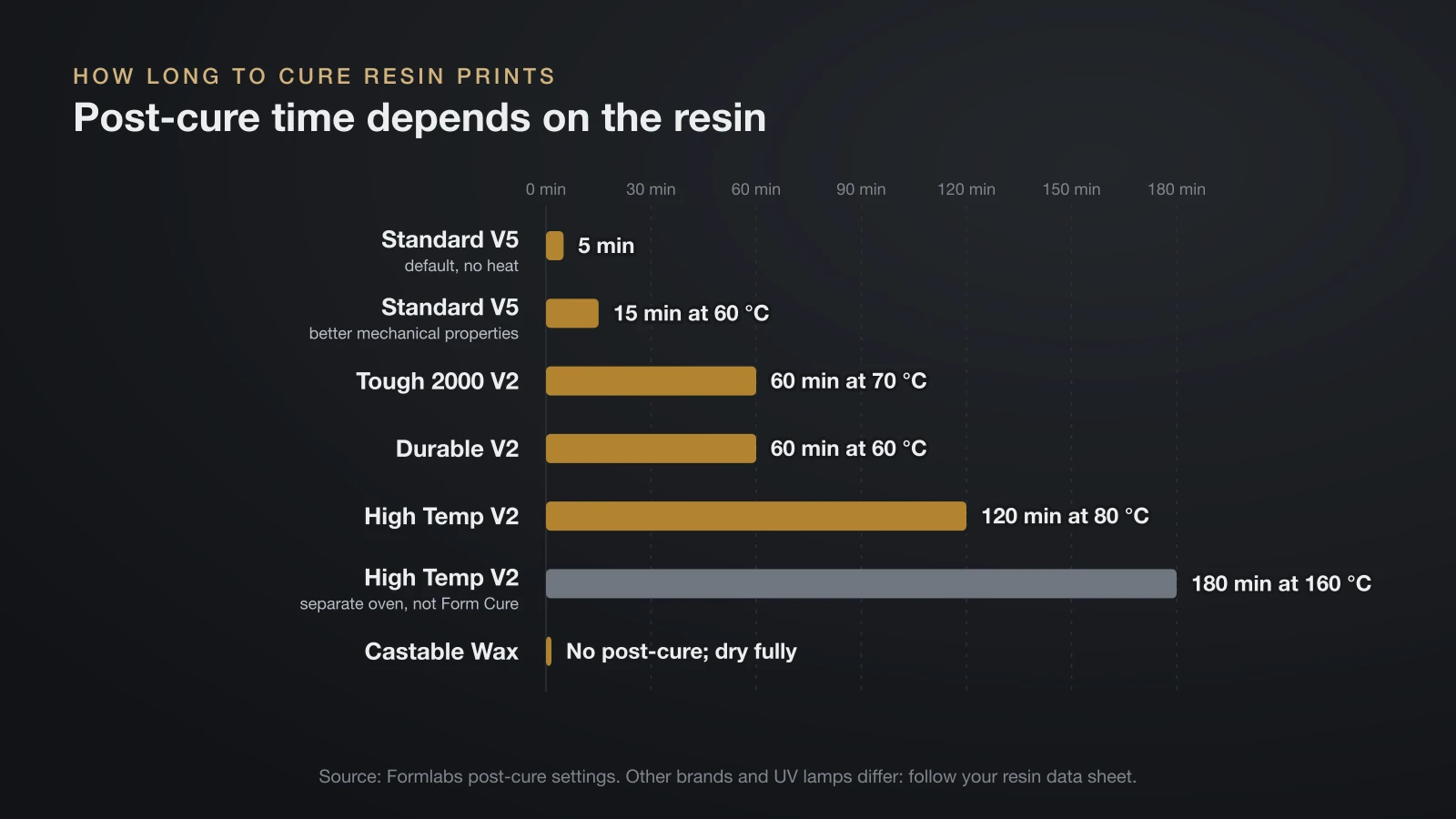
Curing resin prints takes from a few minutes to a few hours, set by the resin and the light source. Post-curing finishes the hardening and brings the part up to its rated strength. Formlabs publishes settings for its Form Cure unit, which cures with UV light and heat:
| Resin | Post-cure (Formlabs Form Cure) |
|---|---|
| Standard V5 (Grey, Clear, Black, White) | 5 minutes, no heat (default); 15 minutes at 60 °C (140 °F) for better mechanical properties |
| Tough 2000 V2 | 60 minutes at 70 °C |
| Durable V2 | 60 minutes at 60 °C |
| High Temp V2 | 120 minutes at 80 °C (176 °F); for full heat resistance, a further 180 minutes at 160 °C in a separate, non-food oven, not the Form Cure |
| Castable Wax | No post-cure needed; dry fully before casting |
Prusa’s data sheet lists 3 minutes of curing for Prusament Tough Resin, and Anycubic says water-wash resin cures in about an hour of summer sun. Sunlight works but varies with season and weather, so a UV station is far more repeatable.
Formlabs says over-curing is acceptable unless a resin’s instructions say otherwise, and it recommends longer times for thick, bulky parts that heat up slowly. Turn or flip the part halfway so shaded sides cure too.
How to store 3D printing resin
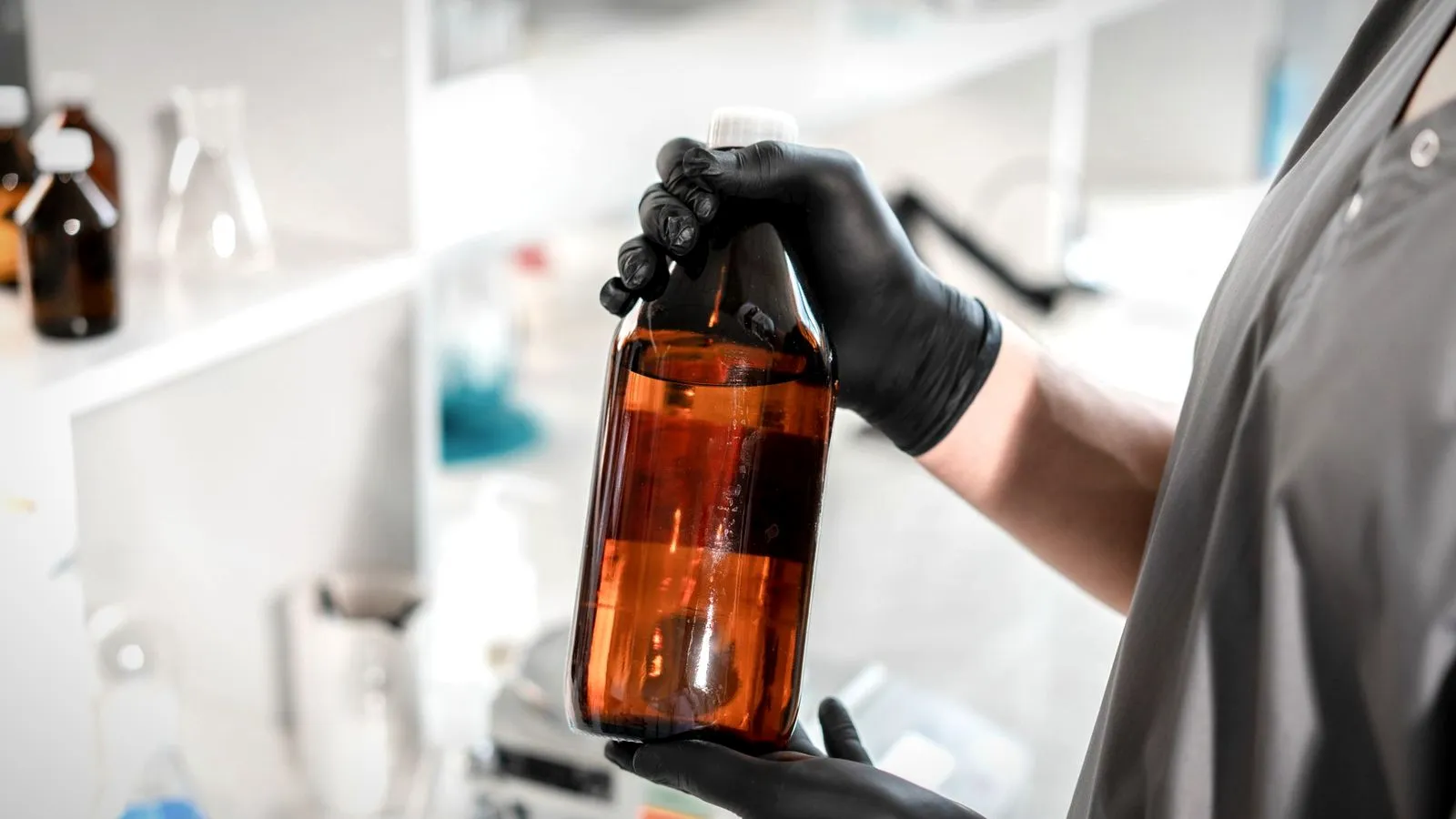
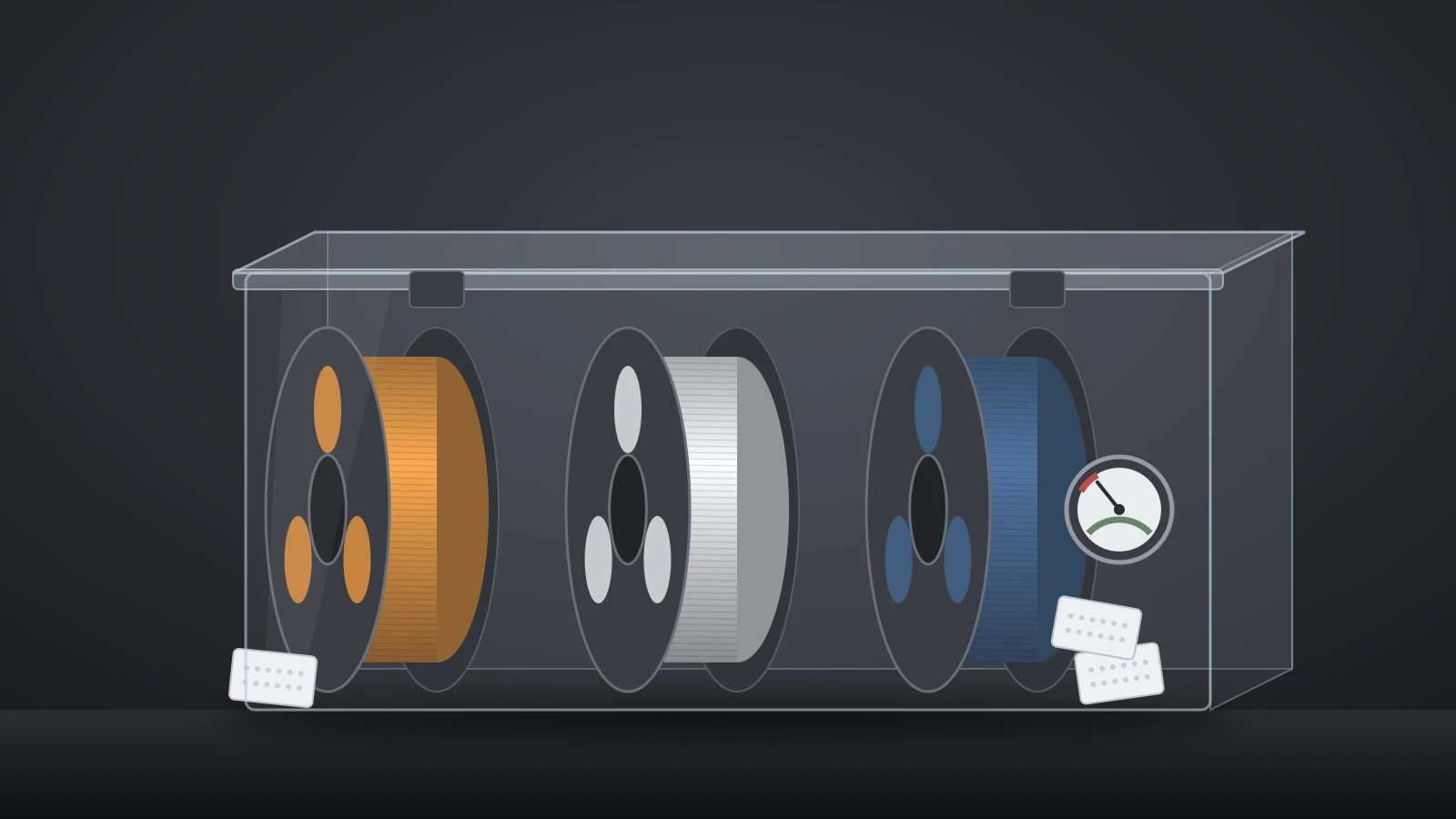
Store resin in its original sealed, opaque bottle, in a dark place at room temperature. Light starts the curing reaction, and temperature changes the resin’s thickness and shelf life.
| Guideline | Prusa | Formlabs |
|---|---|---|
| Temperature | 18–32 °C (64–90 °F); cold changes viscosity and can cause gelation | 10–25 °C (50–77 °F) for best performance; heat shortens shelf life |
| Light | Opaque bottles, away from light | Away from direct sunlight |
| Before printing | Shake about 10 seconds | Shake the cartridge, stir the tank |
| Long-term | Original container, sealed | Opaque HDPE or polypropylene bottle, not the tank |
Shelf life varies by resin. Formlabs gives the example of a 24-month resin that it may ship until six months before expiry, and it warns that expired resin reacts less to light, so prints may fail.
How to dispose of resin and dirty IPA
Never pour liquid resin, partly cured resin or resin-laden solvent down a drain or into household trash. Formlabs and Prusa both treat liquid resin as chemical waste, to be handled under your local rules.
- Paper towels and gloves: Formlabs says to cure them in sunlight or UV light, then put them in household waste.
- Small amounts of leftover resin: pour into a labeled, clear, resin-safe container and leave it in the sun for 1–10 days until solid.
- Larger amounts: take liquid resin to your local hazardous-waste collection.
- Used IPA or wash water: Anycubic advises against pouring water-wash residue into the sewer. Check your SDS and local rules before disposing of any used solvent.
- Cured resin: Formlabs says fully cured resin cannot be recycled and can go out with household waste.
The bottom line
3D printing resin gives the finest detail of any home printing material, from standard resin for figures to tough, flexible, heat-resistant and castable blends for real parts. Match the 405 nm wavelength and exposure settings to your printer, wash and cure every print to the maker’s times, and treat liquid resin and dirty solvent as chemical waste. Gloves, eye protection and fresh air are part of every print.
Sources
- Formlabs: material pages for Tough 2000, Flexible 80A, High Temp and Castable Wax; support articles Form Wash time settings, Form Cure time and temperature settings, Resin care, Disposing of resin and Removing parts from the build platform; Model V3 Resin SDS (mechanical and heat data, wash and cure times, storage at 10–25 °C, shelf life, disposal, H317, H315, H319, H335, H411)
- Prusa Research: Knowledge Base Resins and Prusament Tough Resin technical data sheet (resin components, 405 nm, storage at 18–32 °C, shaking, gloves, respirator, allergy, disposal, resin types; wash 5 minutes in IPA above 90%, dry 3 minutes at 45 °C, cure 3 minutes, heat deflection 55 °C at 0.45 MPa)
- Elegoo: Standard Photopolymer Resin V2.0, ABS-Like Resin V3.0 and Water-Washable Resin (405 nm, cleaning with isopropyl alcohol or ethanol, water rinsing, LCD, MSLA and DLP compatibility)
- Anycubic: User guide for Water-Wash Resin+ (365–405 nm, soak no longer than 30 minutes, about one hour of summer sunlight to cure, wastewater not into the sewer)
- NIOSH (CDC): Approaches to Safe 3D Printing, publication 2024-103 (vat photopolymerization, isopropanol wash and UV post-cure, skin irritation and sensitization, nitrile gloves, eye protection when pouring resin, flammable solvents)