
PETG filament is polyethylene terephthalate glycol-modified, a clear, tough copolyester that prints at about 230–260 °C (446–500 °F) on a 60–90 °C (140–194 °F) bed. It is stronger in tension and more heat resistant than PLA, resists water, warps far less than ABS and suits functional parts, though it strings easily and absorbs moisture.
That mix makes PETG the usual step up from PLA for brackets, holders and outdoor parts. Exact temperature settings by brand are in our PETG temperature guide.
The short answer
| PETG filament | |
|---|---|
| What it is | PET modified with a second glycol (CHDM), an amorphous copolyester |
| Strength (Bambu Lab data sheets) | 51 MPa tensile along layers, vs 35 MPa for PLA Basic |
| Heat deflection, 0.45 MPa | 68–78 °C (154–172 °F) by brand, about 10–20 °C above PLA |
| Nozzle and bed | About 230–260 °C and 60–90 °C, by brand and plate |
| Cooling fan | Low, roughly off to 60% |
| Build surface | Textured or satin PEI; glue stick on smooth PEI |
| Moisture | Hygroscopic; dry before printing |
| Main drawbacks | Stringing, weak bridges, bonds hard to smooth PEI |
| Good for | Mechanical parts, damp places, most outdoor use below 80 °C |
Where to buy PETG filament and what to check
PETG filament is sold by nearly every filament maker, on their own web stores and through retailers, usually as 1 kg spools of 1.75 mm filament. Because the base plastic is the same, the differences that matter are on the label and the data sheet, not in the name. Check these before you order:
- Diameter and tolerance. Most printers take 1.75 mm; makers such as Bambu Lab list ±0.03 mm. Our 1.75 mm filament guide explains why tolerance matters.
- A published data sheet. Look for nozzle and bed ranges, drying settings and heat deflection with the test load stated (0.45 or 1.8 MPa).
- The grade. Standard, matte, translucent, high-flow (HF) and carbon fiber (CF) PETG print differently; CF needs a hardened nozzle.
- Packaging. A vacuum-sealed bag with desiccant means the spool should arrive dry.
- Spool or refill. Refills are cheaper but need a matching reusable spool.
- Spool size. If you use a filament changer, check the spool fits its limits.
- Food-contact claims. Treat them as material-only; a printed part is a different matter (see below).
Price comparisons by material and brand are in our guide to 3D printer filament cost. If you print on a Bambu Lab machine, our Bambu filament guide covers that maker’s PETG lines, refills and RFID tags.
What is PETG filament?
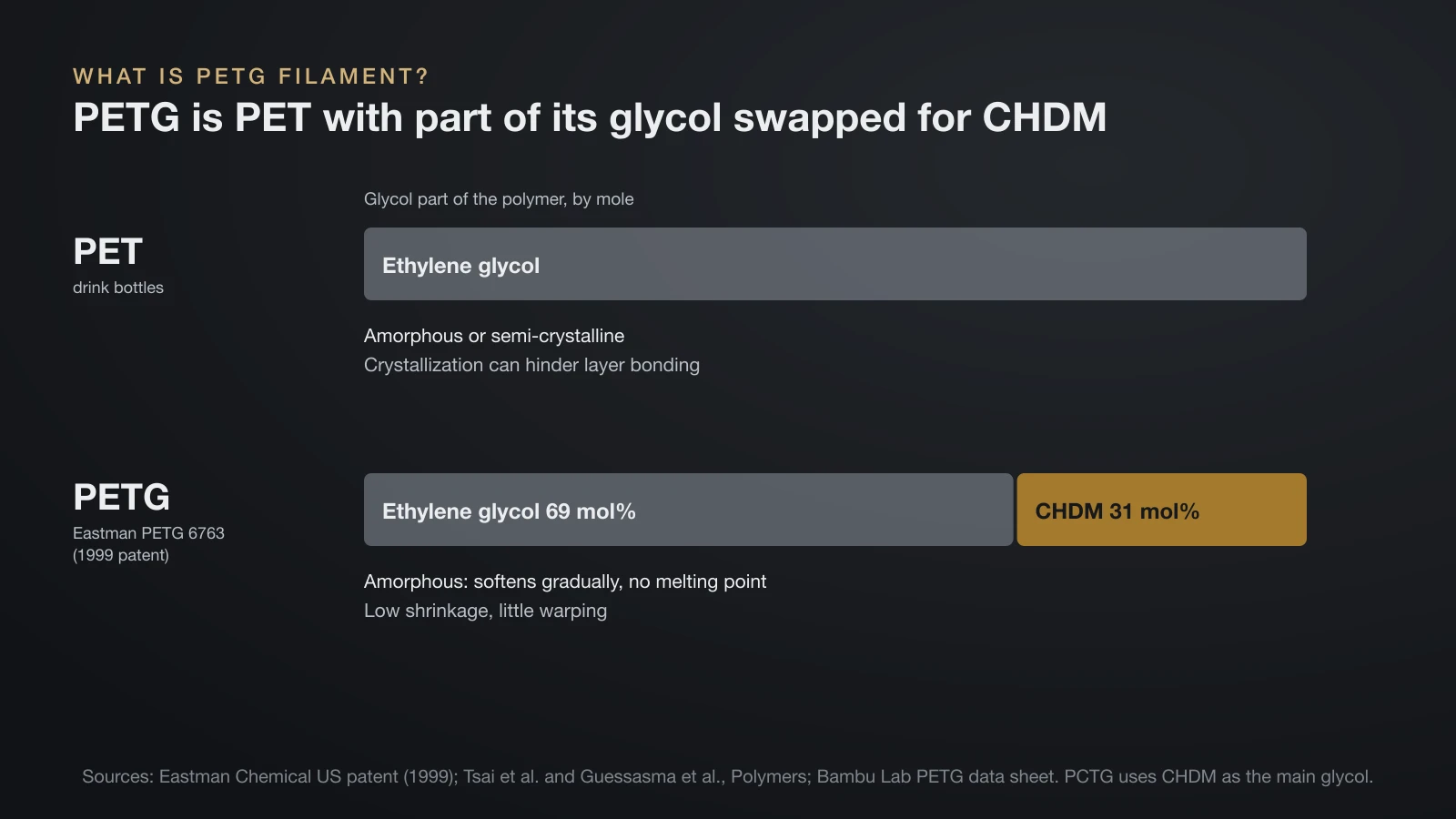
PETG filament is a glycol-modified form of PET, the polyester used in drink bottles. The “G” means a second glycol, cyclohexanedimethanol (CHDM), replaces part of PET’s ethylene glycol during manufacturing. Resin maker Eastman Chemical describes its PETG 6763 in a 1999 US patent as 31 mol% CHDM and 69 mol% ethylene glycol.
Prusa sums up why that matters for printing: glycol makes PET less brittle, easier to print and more transparent. Bambu Lab’s data sheet lists its melting temperature as N/A, which fits an amorphous plastic that softens gradually instead of melting at one point.
PET vs PETG
PET and PETG share the same basic chemistry, but they behave differently once heated. PET can exist in both amorphous and semi-crystalline forms, while PETG does not crystallize and is treated as an amorphous resin, as Tsai and colleagues note in a 2022 Polymers study.
| PET | PETG | |
|---|---|---|
| Glycol | Ethylene glycol | Ethylene glycol plus CHDM |
| Structure | Amorphous or semi-crystalline | Amorphous |
| Printing | Crystallization can raise melt viscosity and hinder layer bonding | Low shrinkage, attributed to no crystallization during extrusion |
That lack of crystallization is why PETG warps little and prints with a stable flow. A 2019 Polymers paper by Guessasma and colleagues cites earlier work that found limited warping and low shrinkage for PETG, explained by the same lack of crystallization. Its tougher relative, PCTG, uses CHDM as the main glycol; see our PCTG filament guide.
PETG filament properties: data sheet numbers
On one maker’s data sheets, PETG is the strongest of the three common filaments in a straight pull, sits between PLA and ABS for heat, and absorbs impacts better than PLA. These values come from Bambu Lab’s technical data sheets, with every bar printed and tested the same way.
| Property (Bambu Lab data sheet) | PLA Basic | PETG Basic | ABS |
|---|---|---|---|
| Tensile strength, X-Y / Z (ISO 527) | 35 / 31 MPa | 51 / 35 MPa | 33 / 28 MPa |
| Bending strength, X-Y (ISO 178) | 76 MPa | 75 MPa | 62 MPa |
| Bending modulus, X-Y (ISO 178) | 2,750 MPa | 1,950 MPa | 1,880 MPa |
| Impact, unnotched, X-Y / Z (ISO 179) | 26.6 / 13.8 kJ/m² | 34.2 / 10.5 kJ/m² | 39.3 / 7.4 kJ/m² |
| Heat deflection, 0.45 / 1.8 MPa (ISO 75) | 57 / 54 °C | 71 / 68 °C | 87 / 84 °C |
| Density (ISO 1183) | 1.24 g/cm³ | 1.25 g/cm³ | 1.05 g/cm³ |
| Water absorption (25 °C, 55% RH) | 0.43% | 0.45% | 0.65% |
PETG is less stiff than PLA (a lower bending modulus), so a PETG bracket flexes a little more before it breaks. Bambu Lab printed these test bars at 100% infill and annealed the PLA and ABS bars, so real parts score lower. For a full three-way comparison, see PLA vs PETG vs ABS; for nylon, polycarbonate and carbon fiber grades, see our guide to the strongest filament.
PETG HF and other PETG filament grades
PETG HF is Bambu Lab’s high-flow PETG, formulated to print faster with little tuning. Bambu Lab says it can print up to twice as fast as standard PETG, though the gain depends on the model’s size and shape, and its filament guide lists a 230–260 °C nozzle range.
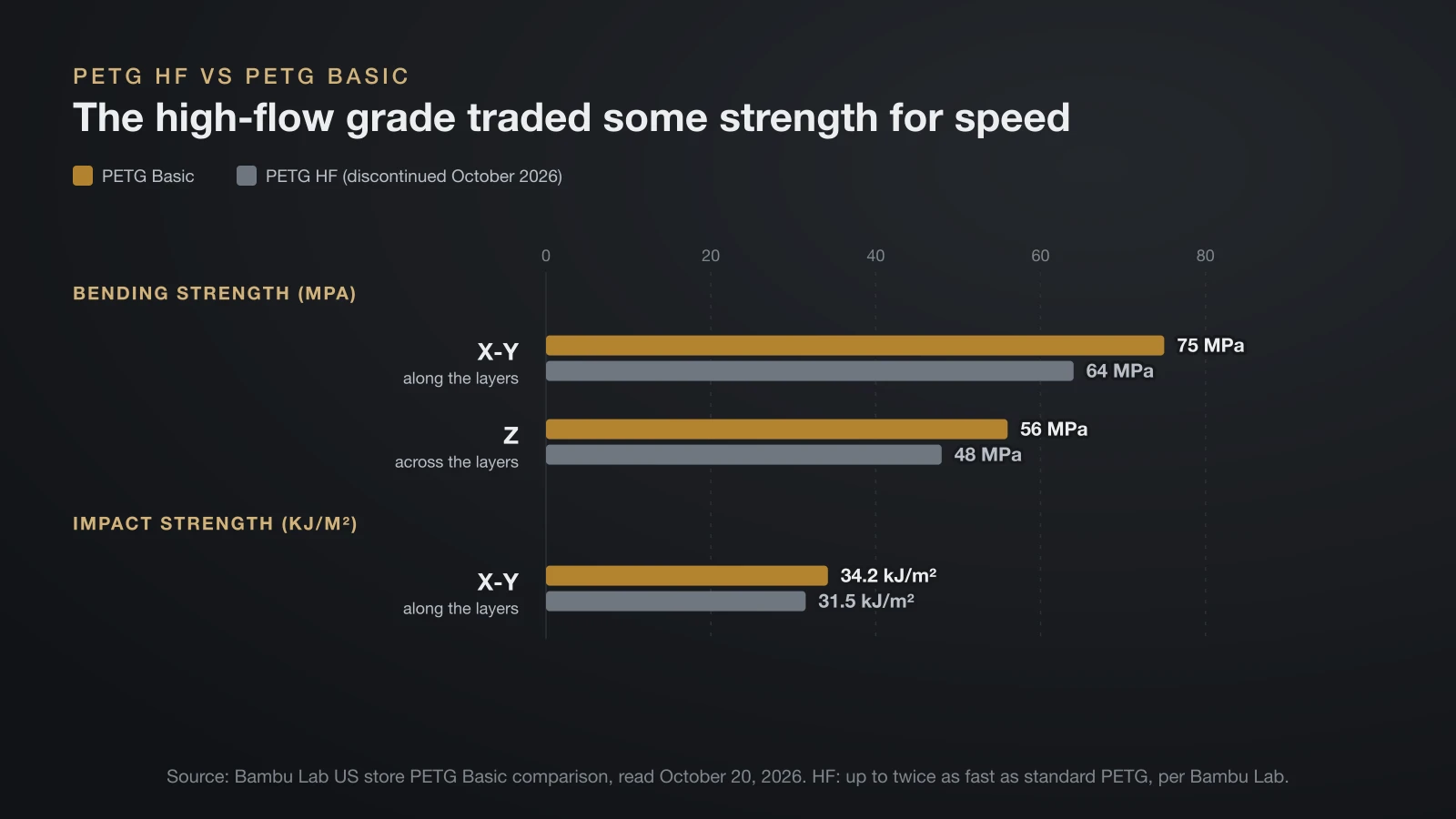
In October 2026, Bambu Lab’s US store marked PETG HF as discontinued, to be sold until stock runs out, and pointed buyers to an upgraded PETG Basic. Its own comparison shows the trade-off:
| Bambu Lab store comparison | PETG Basic | PETG HF |
|---|---|---|
| Bending strength, X-Y | 75 MPa | 64 MPa |
| Bending strength, Z | 56 MPa | 48 MPa |
| Impact strength, X-Y | 34.2 kJ/m² | 31.5 kJ/m² |
Other grades change looks or stiffness rather than speed. Translucent PETG prints clear-ish parts that look best with a large nozzle, slow speed and fans off, per Bambu Lab. PETG-CF adds chopped carbon fiber for stiffness and needs a hardened steel nozzle, and Bambu Lab advises gloves and goggles when handling or sanding it.
How to print PETG filament
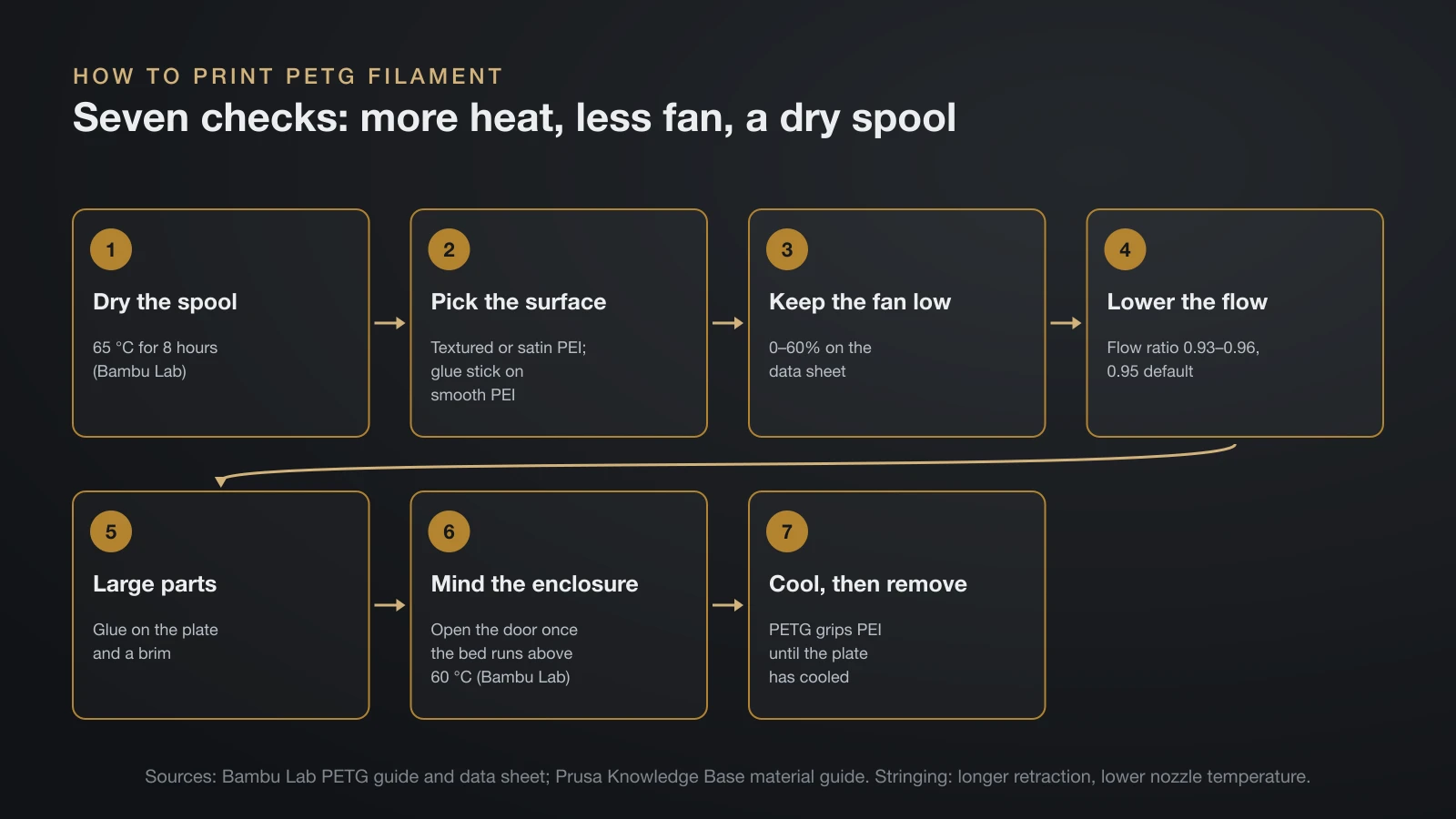
PETG prints well on most FDM printers once you give it more heat, less cooling and a dry spool than PLA. The settings below come from Prusa’s material guide and Bambu Lab’s PETG guide.
Temperatures at a glance
Manufacturer data sheets put PETG at about 230–260 °C at the nozzle and 60–90 °C on the bed, depending on brand and plate. Finished parts bend under a light 0.45 MPa load at about 68–78 °C. Full brand-by-brand values, first-layer settings and a temperature tower method are in our PETG temperature guide.
Print settings checklist
- Dry the spool. Bambu Lab calls PETG highly hygroscopic and dries it at 65 °C for 8 hours; a filament dryer does this unattended.
- Pick the surface. Use textured or satin PEI. Prusa warns that PETG can bond too strongly to smooth PEI and damage it, so add a glue stick as a release layer there.
- Keep the fan low. Bambu Lab’s data sheet lists 0–60%. Prusa still uses some cooling, since it keeps detail and cuts stringing and oozing.
- Lower the flow slightly. Bambu Lab recommends a flow ratio of 0.93–0.96 for PETG-type filament, with 0.95 as its default.
- Fight warping on large parts. Bambu Lab says PETG warps more easily than PLA; glue on the plate and a brim help.
- Mind the enclosure. An enclosure protects layer bonds in a cold room, but Bambu Lab advises opening the door once the bed runs above 60 °C so the filament does not soften in the extruder.
- Let parts cool before removal. Bambu Lab notes PETG Basic sticks strongly to PEI until the plate cools.
Stringing is PETG’s most common flaw. Prusa says longer retraction and a lower nozzle temperature reduce it, and a dry spool matters just as much; our guide to 3D print stringing covers the full fix list.
What is PETG filament used for?
PETG filament is used for mechanical and functional parts that need more toughness, heat resistance or water resistance than PLA offers. Prusa calls it especially suitable for mechanical parts indoors and outdoors, and for waterproof parts thanks to its strong layer adhesion.
Bambu Lab’s product pages name typical PETG prints:
- Around the house: holders, wall hooks, brackets, clips and bathroom accessories.
- Outdoors: garden labels, planter pots, bird cages and watering cans.
- Impact-prone items: outdoor toys and parts that may be dropped or knocked.
- Vehicles: some automotive parts, within PETG’s heat limit.
Prusa lists PETG’s weak spots too: poor bridging and overhangs, limited fine detail and supports that are hard to remove. For small, detailed decorative models, PLA usually gives the cleaner result.
Is PETG filament UV resistant, waterproof and food safe?
PETG is water resistant and works for most outdoor parts, but makers publish no UV test data, and printed PETG is not a food-contact material. Here is what the sources actually say:
| Question | What the sources say |
|---|---|
| Waterproof? | Prusa lists PETG as water and humidity resistant and suitable for waterproof parts; Bambu Lab measures 0.45% water absorption at 55% RH |
| UV resistant? | Bambu Lab markets its PETG as UV resistant but gives no test value; Guessasma et al. (2019) describe PETG as having low UV resistance |
| Outdoors? | Prusa rates it for most exterior use below 80 °C (176 °F) |
| Food safe? | Bambu Lab says its PETG is not food-contact grade; Prusa does not recommend any filament for dishes, because printed layers trap bacteria |
For parts that sit in full sun all year, ASA is the material built for it; our ASA filament guide compares the two on heat and weathering.
Can you print PETG and PLA together?
Yes, PETG and PLA can share one print, but they bond to each other only weakly, which is exactly why they work as supports for each other. Bambu Lab’s wiki says PETG HF, PETG Basic and PLA Basic can be used as support for one another in some cases, so a PLA interface comes off a PETG part cleanly.
That weak bond also means you should not mix them inside one load-bearing part and expect a strong joint. Bambu Lab’s dedicated Support for PLA/PETG uses differences in polarity to minimize fusion with both plastics, so one support spool serves either material. Keep each material at its own temperature range, and expect the printer to purge between them.
The bottom line
PETG filament is glycol-modified PET: amorphous, tough, water resistant and stronger in tension than PLA, with heat deflection around 68–78 °C under a light load. Buy a spool with a full data sheet, dry it, print on textured PEI or glue-coated smooth PEI with a low fan, and tune out stringing. Use it for functional and outdoor parts below 80 °C, and choose ASA for full sun or more heat.
Sources
- Bambu Lab: technical data sheets V3.0 for PETG Basic, PLA Basic and ABS; Wiki PETG guide, filament guide and support filaments; US store pages for PETG Basic, PETG HF and Support for PLA/PETG, read October 20, 2026 (properties, settings, drying, flow ratio, grades, uses, food contact, mutual support)
- Prusa Knowledge Base: PETG material guide (glycol, smooth PEI warning, cooling, stringing, uses, exterior use below 80 °C, food contact, pros and cons)
- Eastman Chemical Company: U.S. Patent 5,989,663 (1999; composition of PETG 6763)
- Tsai H.-H. et al. (2022), Feasibility Study on the Fused Filaments of Injection-Molding-Grade Poly(Ethylene Terephthalate) for 3D Printing, Polymers 14(11): 2276
- Guessasma S., Belhabib S., Nouri H. (2019), Printability and Tensile Performance of 3D Printed Polyethylene Terephthalate Glycol Using Fused Deposition Modelling, Polymers 11(7): 1220