
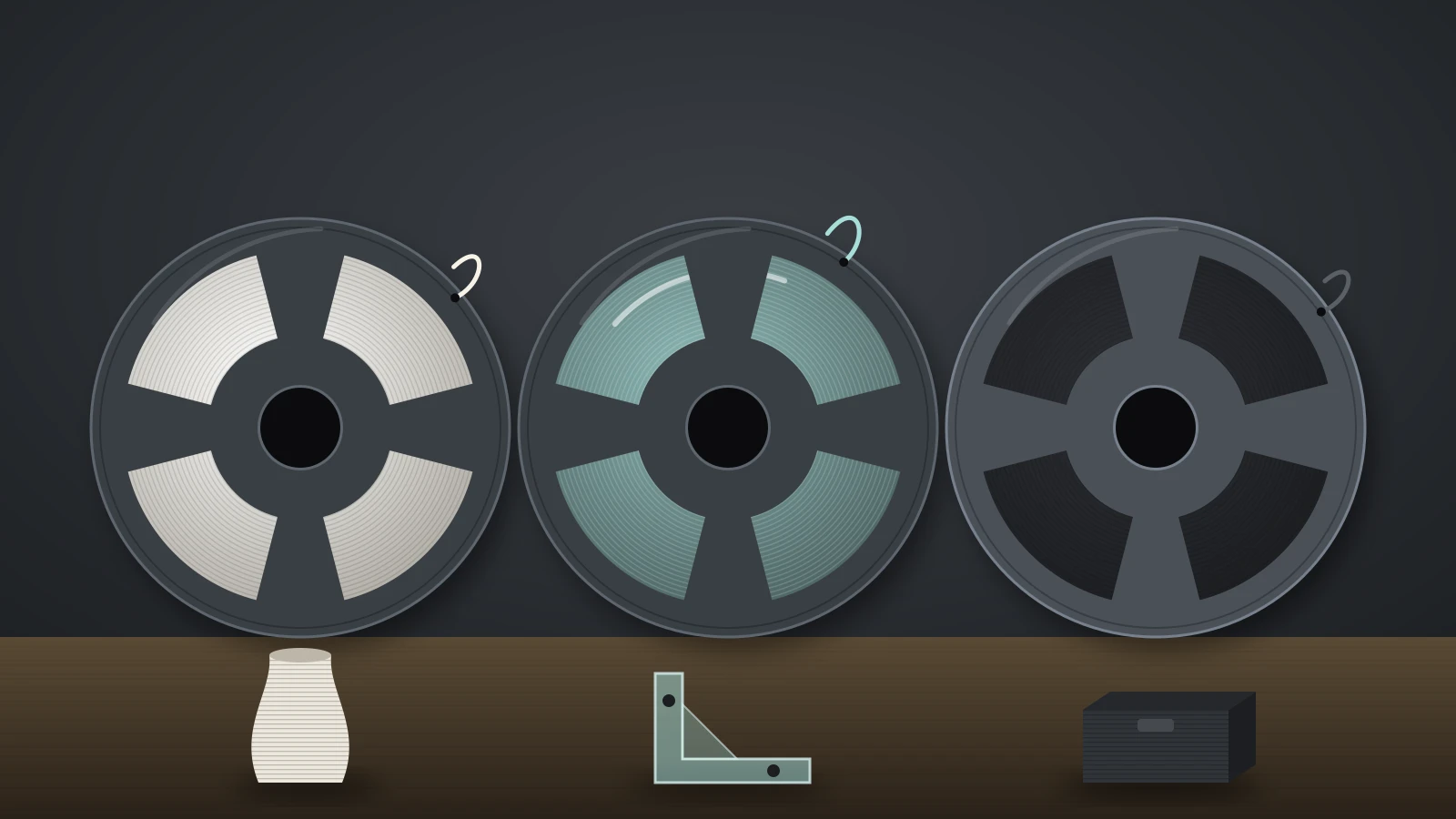
PETG vs PLA vs ABS comes down to ease, strength and heat. PLA prints most easily, PETG is strongest in tension and resists water, and ABS takes the most heat and impact but needs an enclosure and ventilation. Bambu Lab’s data sheets put their 0.45 MPa heat deflection at 57, 71 and 87 °C (135, 160 and 189 °F).
Pick PLA by default, PETG for tough functional parts and anything damp, and ABS for indoor parts that get warm or knocked. Our ABS vs PLA comparison goes deeper on the oldest pairing, and the PLA filament guide and ABS filament guide cover each plastic on its own.
The numbers come from one maker, Bambu Lab, whose version 3.0 data sheets test all three plastics with the same ISO methods. Other brands differ by a few degrees or megapascals, so compare within one brand.
The short answer
| PLA | PETG | ABS | |
|---|---|---|---|
| Ease of printing | Easiest; open printer is fine | Easy, but strings | Hardest: hot bed, enclosure, warping |
| Nozzle / bed | 190–230 °C / 35–45 °C | 230–260 °C / 65–75 °C | 240–270 °C / 80–100 °C |
| Bends under load (0.45 MPa) | 57 °C | 71 °C | 87 °C |
| Tensile strength along the layers | 35 MPa | 51 MPa | 33 MPa |
| Impact strength along the layers | 26.6 kJ/m² | 34.2 kJ/m² | 39.3 kJ/m² |
| Outdoors | Degrades in UV light | Most outdoor use below 80 °C | Yellows and turns brittle |
| Pick it for | Models, prototypes, decor | Brackets, damp spots, functional parts | Warm or knocked indoor parts |
PLA vs PETG vs ABS: data sheet comparison
On one maker’s data sheets, PETG leads in tensile strength, ABS in heat and impact, and PLA in bending strength and bending stiffness. Strength, heat, density, water and drying rows come from Bambu Lab’s sheets; the enclosure, ease and finishing rows from Bambu Lab’s and Prusa’s material guides.
| Property | PLA Basic | PETG Basic | ABS |
|---|---|---|---|
| Nozzle temperature | 190–230 °C | 230–260 °C | 240–270 °C |
| Bed temperature | 35–45 °C | 65–75 °C | 80–100 °C |
| Enclosure | Not needed | Optional; helps in a cold room | Needed |
| Heat deflection, 0.45 MPa (ISO 75) | 57 °C | 71 °C | 87 °C |
| Heat deflection, 1.8 MPa (ISO 75) | 54 °C | 68 °C | 84 °C |
| Tensile strength, X-Y / Z (ISO 527) | 35 / 31 MPa | 51 / 35 MPa | 33 / 28 MPa |
| Bending strength, X-Y (ISO 178) | 76 MPa | 75 MPa | 62 MPa |
| Bending modulus, X-Y (ISO 178) | 2,750 MPa | 1,950 MPa | 1,880 MPa |
| Impact, unnotched, X-Y / Z (ISO 179) | 26.6 / 13.8 kJ/m² | 34.2 / 10.5 kJ/m² | 39.3 / 7.4 kJ/m² |
| Density (ISO 1183) | 1.24 g/cm³ | 1.25 g/cm³ | 1.05 g/cm³ |
| Water absorption (25 °C, 55% RH) | 0.43% | 0.45% | 0.65% |
| Drying before printing | 50 °C for 8 h | 65 °C for 8 h | 80 °C for 8 h |
| Ease of printing | Easiest | Easy; stringing | Hardest; significant warping |
| Finishing | Wet sanding, paint | Hard to smooth chemically | Acetone smoothing and gluing |
Two caveats apply. Bambu Lab printed every test bar at 100% infill and annealed the PLA and ABS bars (not the PETG bars), so real parts score lower. And brands differ: Prusament PLA lists 55 °C and Prusament PETG 68 °C at 0.45 MPa, and Prusa’s material table gives 63–78 °C for PETG brands and 81–97 °C for ABS. Among standard grades the order never changes.
Which is strongest: PLA, PETG or ABS?
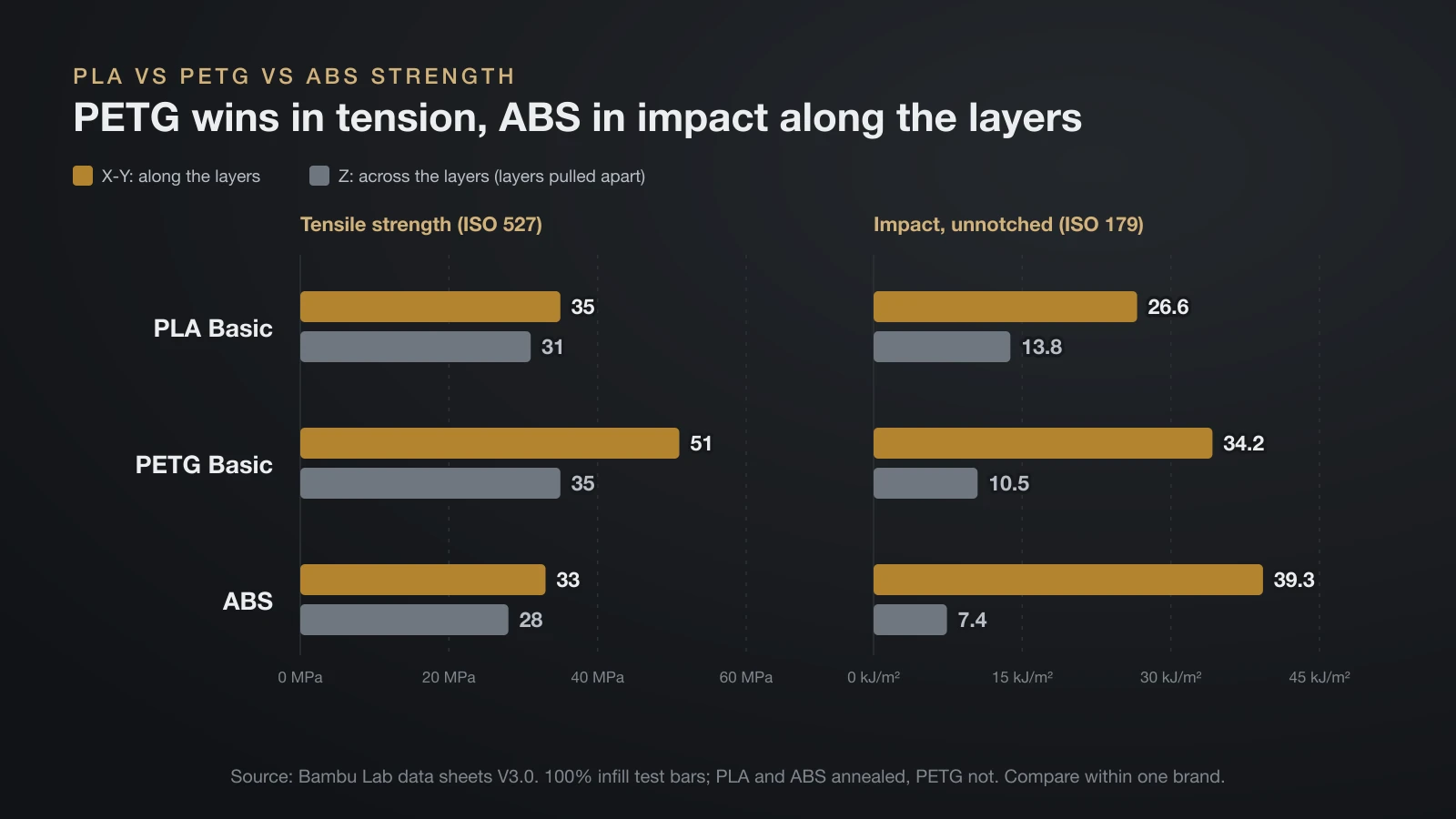
PETG is the strongest of the three in a straight pull, ABS is the toughest when a part gets hit, and PLA is the strongest and stiffest in bending as long as it stays cool. The answer depends on the load:
| Load on the part | Strongest of the three | PLA / PETG / ABS |
|---|---|---|
| Pulling along the layers | PETG, by about 45% | 35 / 51 / 33 MPa |
| Pulling the layers apart (Z) | PETG | 31 / 35 / 28 MPa |
| Bending | PLA, PETG almost level | 76 / 75 / 62 MPa |
| Sudden impact along the layers | ABS | 26.6 / 34.2 / 39.3 kJ/m² |
| Impact across the layers | PLA | 13.8 / 10.5 / 7.4 kJ/m² |
| Load in a warm place | ABS, then PETG | 54 / 68 / 84 °C at 1.8 MPa |
The 45% is our ratio of 51 to 35 MPa. They also fail differently: Prusa says PLA breaks along layers or into shards on impact, and calls PETG tough and durable and ABS high in tenacity.
Heat changes the ranking. Under load, PLA starts to bend at about 55 °C, PETG in the high 60s and ABS in the 80s. For a ranking that adds nylon, polycarbonate and carbon fiber grades, see our guide to the strongest filament.
Printing PLA, PETG and ABS: temperatures, bed and enclosure
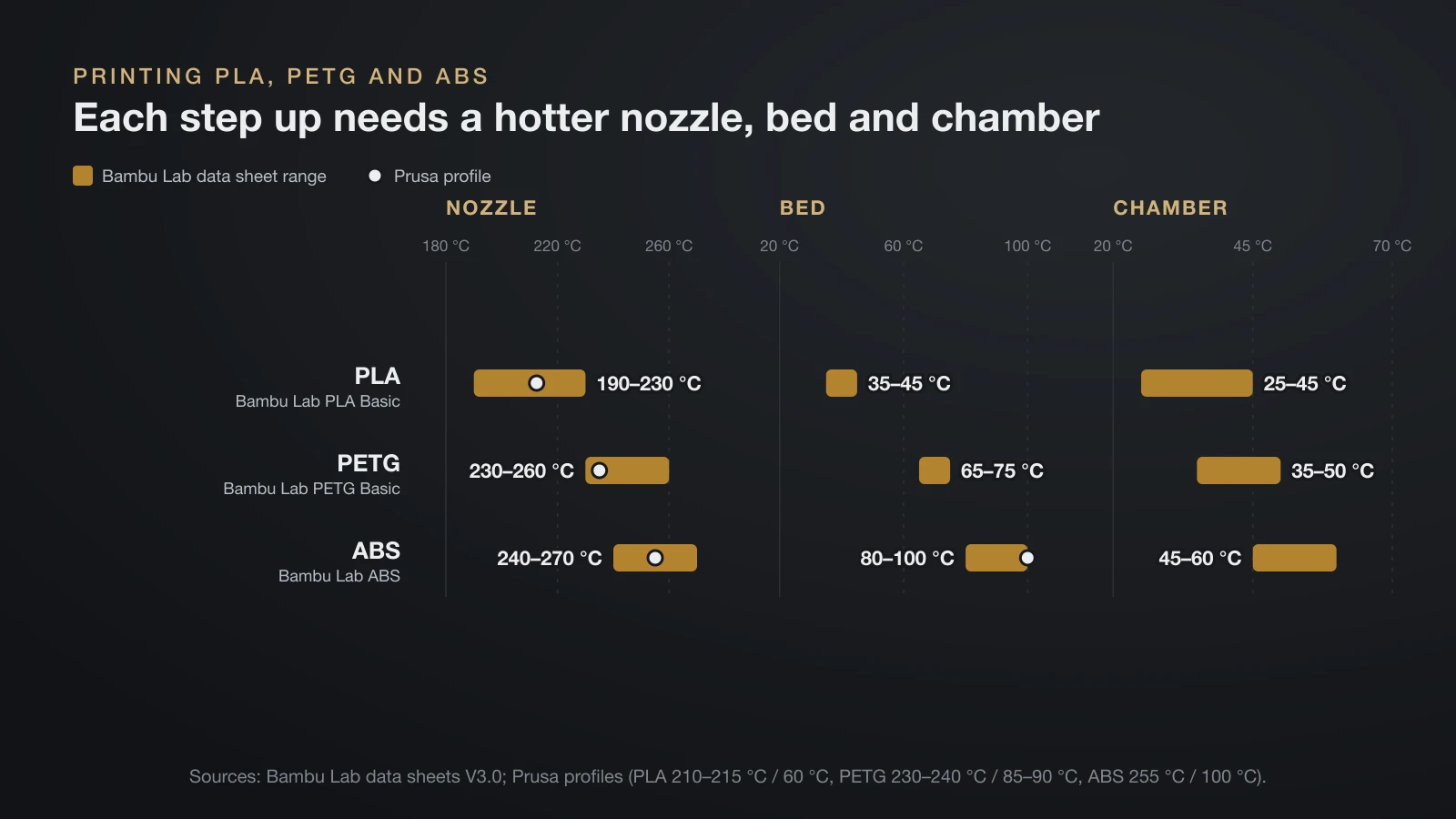
PLA prints on almost any FDM printer with the fan on, PETG needs a hotter nozzle, a warmer bed and a low fan, and ABS needs the most heat plus a warm, closed chamber. Beyond nozzle and bed, these settings separate them:
| Setting | PLA Basic | PETG Basic | ABS |
|---|---|---|---|
| Chamber (Bambu Lab) | 25–45 °C | 35–50 °C | 45–60 °C |
| Part cooling fan (Bambu Lab) | On | 0–60% | 0–80% |
| Prusa profile, nozzle / bed | 210–215 °C / 60 °C | 230–240 °C / 85–90 °C | 255 °C / 100 °C |
| Main printing problem | Filament softens and clogs in a hot, closed chamber | Stringing; bonds too hard to smooth PEI | Warping and split layers |
Bambu Lab recommends an enclosed printer for ABS, which needs higher bed and chamber temperatures to suppress warping and layer separation. It rates PLA and PETG as not prone to warping, fine on open or enclosed machines, though an enclosure helps PETG’s layer bonds in a cold room.
Prusa adds that ABS shrinks about 1–2% as it cools and requires an enclosure. Our guide to enclosed 3D printers compares passive and heated chambers, and the guide to 3D print warping covers lifted corners.
Too much chamber heat hurts the other two: Bambu Lab says to open the door when the bed runs above 45 °C for PLA or 60 °C for PETG. Prusa also warns that PETG can bond to smooth PEI hard enough to damage it; the PETG temperature guide lists settings by brand.
Heat, UV and outdoor use: PLA, PETG and ABS
ABS handles the most heat, PETG is the most practical of the three outdoors, and PLA belongs indoors, away from sun and warm spots. Prusa says PLA deforms above 60 °C (140 °F), and Bambu Lab advises against PLA in environments at about 50 °C (122 °F) or higher.
| Where the part lives | PLA | PETG | ABS |
|---|---|---|---|
| Warm spots around 50 °C | Not recommended | Yes | Yes |
| Near 70–80 °C | No | Borderline: deflects at 68–71 °C | Yes: deflects at 84–87 °C |
| Outdoors in sun | No: degrades in UV light (Prusa) | Most outdoor use below 80 °C (Prusa) | Yellows and turns brittle (Prusa) |
No maker here publishes a UV test value. Bambu Lab credits its PETG Basic and ABS with UV resistance, while Prusa says ABS lacks it. For full sun, use ASA (see the alternatives below).
In a parked car, PLA is out, PETG is borderline and ABS suits interior parts out of direct sun; see our guide to 3D printed car parts.
Fumes and safety: PLA, PETG and ABS
ABS gives off the most fumes of the three, mainly styrene and ultrafine particles, while PLA and PETG release less, though none belongs in a closed room right next to you. The evidence:
- NIOSH reports higher airborne ultrafine particle concentrations when printing ABS than PLA, and suggests substituting PLA where the part allows.
- A 2022 chamber study by Wojnowski and colleagues found volatile organic compound (VOC) emissions from PETG and nylon more than an order of magnitude lower than from ABS, with the nozzle at 240 °C for ABS and PETG. That is one printer and one spool of each.
- The makers: Prusa warns of styrene fumes from ABS, and Bambu Lab tells PLA and PETG users to ventilate or filter.
NIOSH notes that emissions rise mainly with extruder temperature, so ABS starts behind by running hottest. Its guidance helps with all three:
- Use the lowest nozzle temperature that still gives good parts.
- Print inside a filtered enclosure; a filtered enclosing hood cut particle emissions by 97–99% in a study NIOSH cites.
- Keep the enclosure closed for about 20 minutes after the print ends.
Food contact, water and chemicals: PLA, PETG and ABS
None of the three is a good choice for printed cups, plates or utensils, but they differ in how they handle water, oil and chemicals. Prusa does not recommend any filament for dishes, because bacteria grow in the grooves between layers, and Bambu Lab says its PETG and its PLA (apart from PLA Pure) are not food-contact grade.
Bambu Lab’s data sheets rate chemical resistance in plain words:
| Bambu Lab data sheet | PLA Basic | PETG Basic | ABS |
|---|---|---|---|
| Acids and alkalis | Not resistant | Not resistant | Resistant |
| Oil and grease | Resistant to most | Resistant to most | Not resistant to some |
| Organic solvents | Not resistant to some | Not resistant to some | Not resistant to some (Prusa: acetone smooths it) |
All three are insoluble in water, and the ratings come without test conditions, so test a spare part with the real chemical first. Prusa recommends PETG for waterproof parts thanks to its strong layer bonding.
Finishing, moisture and cost: PLA, PETG and ABS
ABS is the easiest of the three to finish, PLA is the most forgiving about moisture, and all three cost about the same per spool. Prusa names acetone smoothing as a main reason to choose ABS and says chemical smoothing of PLA or PETG works only in a laboratory.
All three absorb under 1% water at saturation in Bambu Lab’s tests (ABS the most, 0.65%), and Bambu Lab calls PETG highly hygroscopic and links damp spools to stringing, bubbles and weak parts. PLA, by contrast, tolerates normal storage at 50–60% humidity. A filament dryer handles the drying temperatures in the table above.
Standard PLA, PETG and ABS sit in the same budget price band; our guide to 3D printer filament cost lists current maker prices. ABS goes a little further: at 1.05 against 1.24 g/cm³, a 1 kg spool holds roughly 18% more length than PLA (estimate: 1.24 ÷ 1.05, same diameter), while PETG matches PLA.
Which one to choose for your part
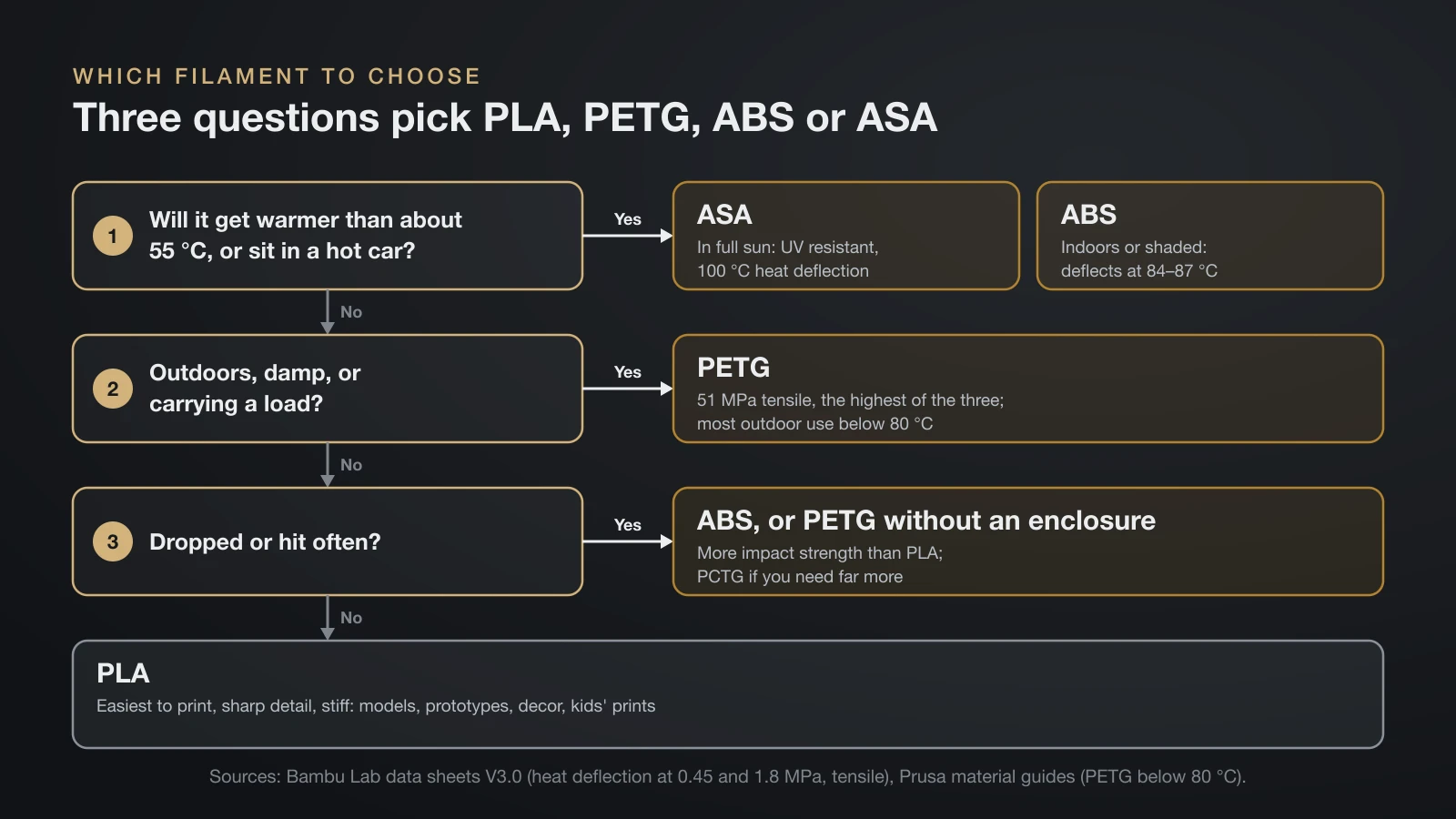
Choose PLA unless the part will get warm, wet or knocked around, PETG for most functional parts, and ABS when heat or impact decides:
| Part | Best of the three | Why |
|---|---|---|
| Display models, figures, decor | PLA | Sharp detail, stiff, low warping |
| Kids’ toys and classroom prints | PLA | Fewer particles than ABS; see 3D printed toys |
| Brackets, hooks, shelf supports indoors | PETG | Highest tensile strength in both directions |
| Planters, bathroom and damp spots | PETG | Water and humidity resistant |
| Outdoor parts out of full sun | PETG | Most outdoor use below 80 °C |
| Electronics boxes near warm parts | ABS | Deflects at 84–87 °C |
| Car interior parts out of direct sun | ABS | Heat resistance |
| Clips and handles that get dropped | ABS, or PETG without an enclosure | More impact strength than PLA |
Two related materials fill the gaps:
| Alternative | Closest to | What it adds | Trade-off |
|---|---|---|---|
| ASA filament | ABS | UV resistance; 100 °C heat deflection at 0.45 MPa vs 87 °C for ABS (Bambu Lab) | Still needs an enclosure and ventilation |
| PCTG filament | PETG | 92 kJ/m² notched Izod impact vs 5 kJ/m² for Fiberlogy’s own PETG | Prints hotter, at 250–270 °C |
Our 3D printer filament guide maps flexible, wear-resistant and high-temperature materials. For anything load-bearing or safety-critical, none of these plastics replaces an engineered part.
The bottom line
In the PLA vs PETG vs ABS choice, PLA wins on ease and detail, PETG on tensile strength and water resistance, and ABS on heat and impact. Bambu Lab’s data sheets put them at 35, 51 and 33 MPa in tension and 57, 71 and 87 °C in heat deflection at 0.45 MPa. Print PLA by default, PETG for functional and damp parts, ABS in an enclosure for warm indoor parts, and ASA for full sun.
Sources
- Bambu Lab: technical data sheets V3.0 for PLA Basic, PETG Basic, ABS and ASA, and the Wiki filament guide, PETG guide and PLA guide
- Prusa: Knowledge Base PLA, PETG and ABS guides, material table, Prusament PLA and Prusament PETG data sheets
- NIOSH (CDC): Approaches to Safe 3D Printing, publication 2024-103
- Wojnowski W. et al. (2022), Emission Profiles of Volatiles during 3D Printing with ABS, ASA, Nylon, and PETG Polymer Filaments, Molecules 27(12): 3814
- Fiberlogy: PCTG technical data sheet and Easy PET-G product page