
Bambu filament is Bambu Lab’s own range of 1.75 mm 3D printer filament, sold through its official store in PLA, PETG, ABS, ASA, TPU, polycarbonate, nylon blends and support materials. Each spool carries an RFID tag that a Bambu Lab AMS reads to load the material settings, and cheaper refills come without the plastic spool.
That makes Bambu filament a system as much as a product: the spool, the refill format and the tag are built around Bambu Lab printers. For how it compares with Polymaker, Prusament and other makers, see our guide to the best filament brands.
The short answer
| Question | Answer (Bambu Lab, October 2026) |
|---|---|
| Where to buy | Bambu Lab’s official store or its listed authorized resellers |
| Diameter | 1.75 mm, ±0.03 mm on most lines (TPU for AMS and Support for PLA/PETG ±0.05 mm) |
| Refill or spool | Refills are cheaper but need a reusable spool |
| Example price | PLA Basic 1 kg: $17.99 with spool, $14.99 refill (November 4, 2026) |
| RFID tag | Read by the AMS to sync material and color |
| Other printers | Works on any 1.75 mm printer; set the profile by hand |
| Hardened nozzle | Needed for CF and GF blends |
Where to buy Bambu filament and what to check
Bambu Lab sells its filament directly through its regional online stores, and the US store ships from a US warehouse. Filament orders above $59 ship free within the 48 contiguous states, and the store footer links a list of authorized resellers. Before you order, check these points on the product page:
- The exact line. PLA Basic, PLA Matte and PLA Silk+ print alike but look different; PETG Basic and PETG Translucent differ in finish. Read the line name, not just “PLA”.
- Refill or filament with spool. Most lines come both ways. A refill only works on a reusable spool.
- The “Cautions for Use” box. It states AMS fit, nozzle limits and whether an enclosed printer is required.
- Weight. Most spools hold 1 kg; PVA and Support for PLA/PETG come in 0.5 kg.
- Discontinued notices. In October 2026, PETG HF was marked discontinued, and three PA6-GF colors were gone.
- The data sheet. Every line links a technical data sheet (TDS) with print, drying and strength values.
On November 4, 2026, PLA Basic listed at $17.99 with a spool and $14.99 as a refill for 1 kg. For prices across materials and brands, see our breakdown of 3D printer filament cost.
Bambu filament lineup in October 2026
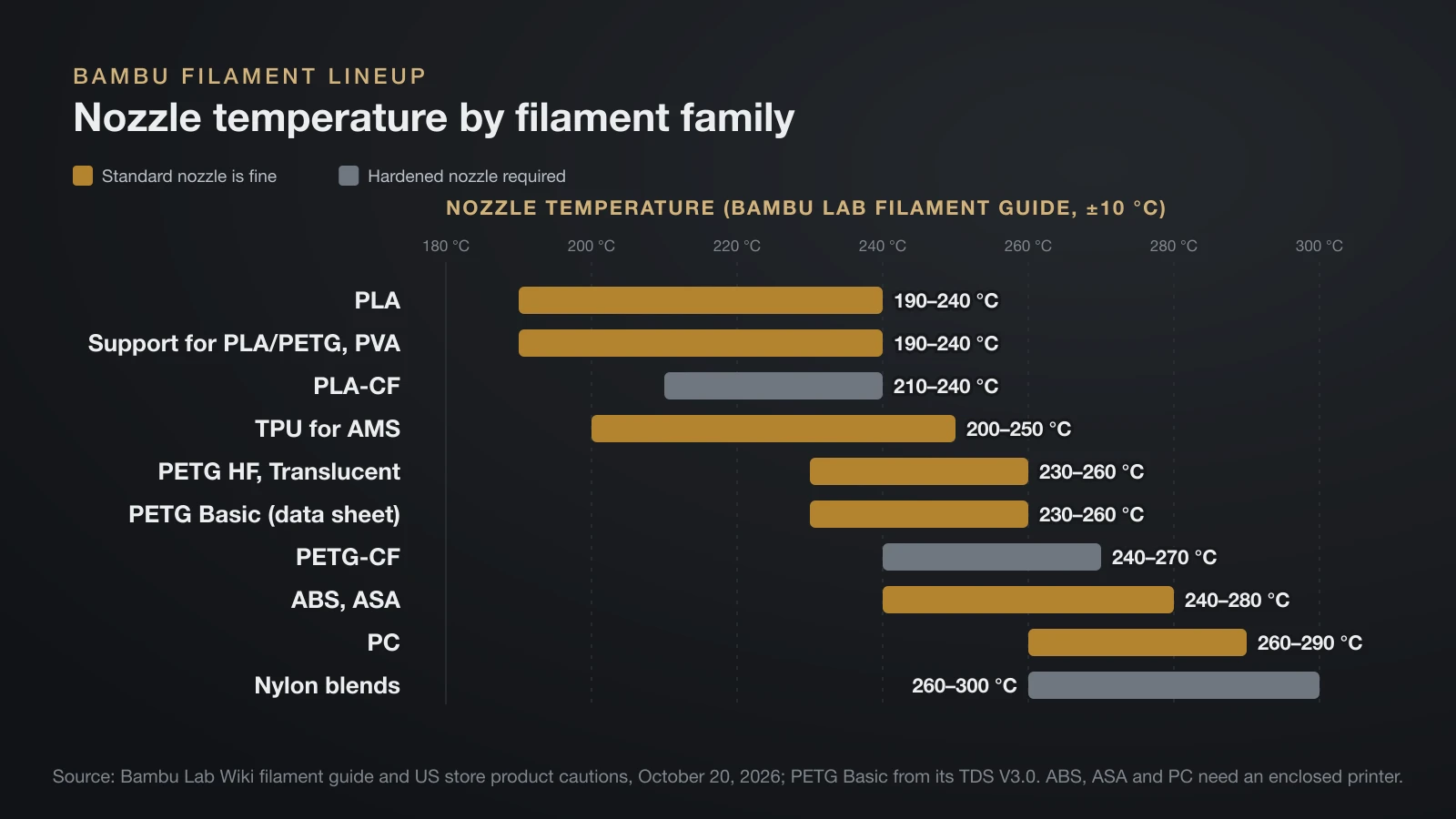
Bambu Lab’s US store listed these main filament families, among others, on October 20, 2026. The nozzle ranges come from Bambu Lab’s filament guide (±10 °C), and the AMS and nozzle columns from each product page’s cautions.
| Family | Lines in the US store | Typical use | Nozzle temperature | AMS fit | Hardened nozzle |
|---|---|---|---|---|---|
| PLA | Basic, Matte, Silk+, Pure, Tough+, Translucent, Silk Multi-Color | Everyday and decorative parts | 190–240 °C | All AMS series | No |
| PLA-CF | PLA-CF | Stiff, matte parts | 210–240 °C | All AMS series | Yes |
| PETG | Basic, Matte, Translucent, HF (discontinued) | Tough, water-resistant parts | 230–260 °C (Basic data sheet); guide 240–270 °C for generic PETG | All AMS series | No |
| PETG-CF | PETG-CF | Stiff functional parts | 240–270 °C | AMS, AMS 2 Pro, AMS HT; not AMS lite | Yes |
| ABS | ABS | Warm indoor parts | 240–280 °C | Not AMS lite | No; enclosed printer required |
| ASA | ASA | Outdoor parts | 240–280 °C | Not AMS lite | No; enclosed printer required |
| TPU | TPU for AMS | Flexible parts | 200–250 °C | All AMS series | No; no 0.2 mm nozzle |
| PC | PC | Heat-resistant parts | 260–290 °C | Not AMS lite | No; enclosed printer required |
| Nylon blends | PA6-CF, PA6-GF, PAHT-CF | Engineering parts | 260–300 °C | PA6-CF: none; others not AMS lite | Yes |
| Support | Support for PLA/PETG, PVA | Support interfaces | 190–240 °C | All AMS series (PVA when dry) | No; PVA not with a 0.2 mm nozzle |
Two lines changed recently: PAHT-CF replaced the discontinued PA-CF, and Bambu Lab says an upgraded PETG Basic takes over from PETG HF. For the material families themselves, our guides to PLA filament and PETG filament explain properties and settings.
Bambu filament refills vs spools
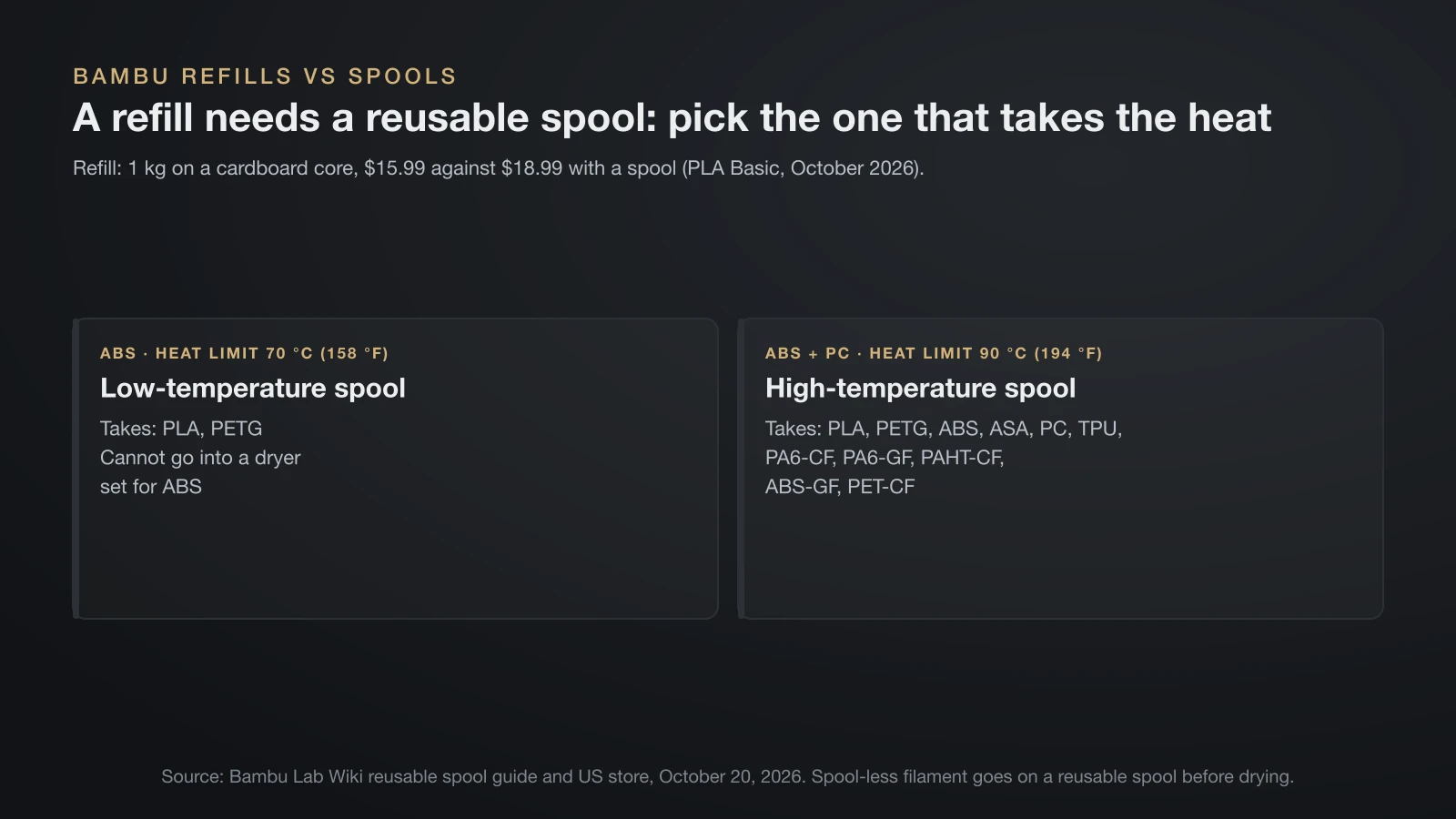
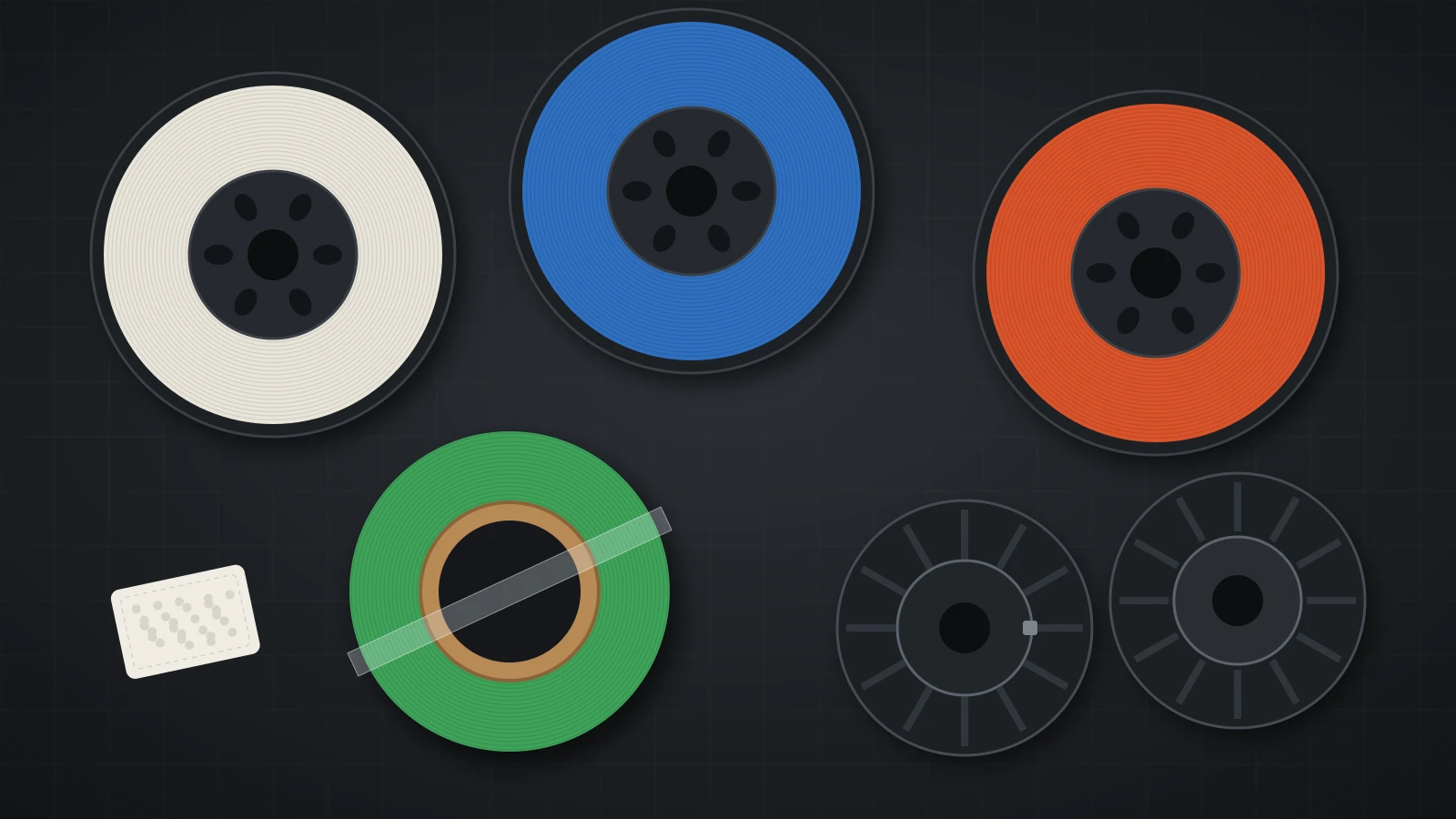
A Bambu refill is the same 1 kg of filament wound on a cardboard core without the plastic spool, and it costs less: $14.99 against $17.99 for PLA Basic in November 2026. Bambu Lab says designing its feed system around a reusable spool cuts plastic waste in filament use by at least 20%.
The catch is that every refill must be mounted on a Bambu reusable spool, which comes in two types:
| Reusable spool | Material | Heat limit | Filaments it takes |
|---|---|---|---|
| Low temperature | ABS | 70 °C (158 °F) | PLA, PETG |
| High temperature | ABS + PC | 90 °C (194 °F) | PLA, PETG, ABS, ASA, PC, TPU, PA6-CF, PA6-GF, PAHT-CF, ABS-GF, PET-CF |
To load one, unpack the refill but keep its clear strap on, twist the spool open, line the notch on the cardboard core up with the clip, close the spool until it clicks and only then peel off the strap. The heat limit matters when drying: a low-temperature spool cannot go into a dryer set for ABS. Bambu Lab also notes that spool-less filament has to go on a reusable spool before it is dried.
RFID tags and the AMS: what the chip does
The RFID tag on a Bambu spool stores the filament’s identity and printing parameters, which the AMS (Automatic Material System) reads when the spool is loaded. Bambu Lab’s wiki says the AMS syncs the filament information, such as type and color, to Bambu Studio, so the slicer and printer pick the matching profile without manual entry.
On an official spool, the printer screen shows the detected type and color, and that slot cannot be edited by hand. A damaged tag, or one sitting at the edge of the reader, triggers a read error; Bambu Lab’s fix is to pull out about 5 cm of filament and try again. Its support filaments use the same chip to set support parameters automatically.
The tag is a convenience, not a lock. For spools without one, including third-party brands, you enter the material and color on the screen or in Bambu Studio; our guide to Bambu Lab 3D printers covers the AMS spool size limits for those. The AMS family also drives multi-color printing, which our multi-color 3D printers guide explains.
Using Bambu filament in other printers
Bambu filament works in any printer built for 1.75 mm filament, because it is standard thermoplastic filament with a ±0.03 mm diameter tolerance on most lines. What you lose is the automatic setup. Bambu Lab says its print parameters are embedded in the RFID tag and read through its AMS, so a printer without an AMS treats the spool like any other.
- Set the profile by hand. Start from the nozzle and bed values on the line’s data sheet, then tune with a temperature tower.
- Check the spool fits. Bambu Lab gives its reusable spool as 200 mm across and 67 mm wide; make sure your holder or filament changer takes it.
- Respect the cautions. CF and GF blends still need a hardened nozzle, and ABS, ASA and PC still want an enclosed printer such as the Bambu Lab P1S.
Going the other way, Bambu Lab printers accept third-party 1.75 mm filament within the AMS spool and material limits, explained in our Bambu Lab printer guide.
Bambu filament profiles in slicers
Bambu filament profiles ship inside Bambu Studio, and selecting the matching Bambu preset loads Bambu Lab’s tuned temperatures, speeds and flow values. With an AMS, the RFID tag selects that preset for you; without one, you pick it from the filament list.
If you slice in OrcaSlicer instead, our Orca Slicer vs Bambu Studio comparison covers how the two handle filament profiles and calibration. A Bambu PLA profile is a starting point for other brands’ PLA, but not a substitute for checking their own data sheet.
Storing and drying Bambu filament
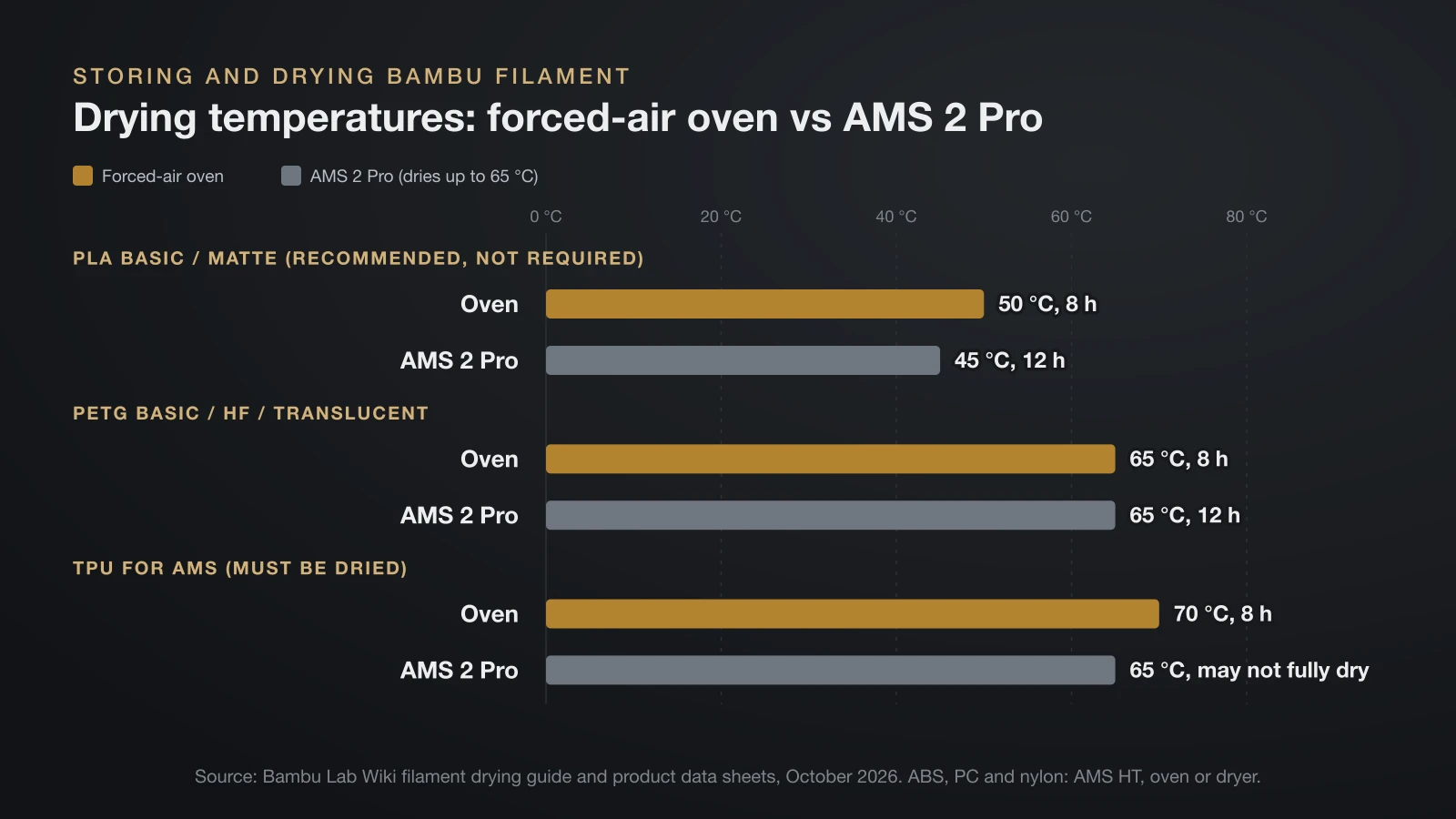
Bambu Lab tells buyers to keep filament sealed with desiccant and to dry it before use, especially PETG, TPU, PVA and the nylon blends. Damp filament causes stringing, bubbles, holes, rough surfaces and weaker parts, according to its wiki.
| Bambu filament | Forced-air oven | AMS 2 Pro | Notes from Bambu Lab |
|---|---|---|---|
| PLA Basic / Matte | 50 °C (122 °F) for 8 h | 45 °C for 12 h | Drying recommended, not required |
| PETG Basic / HF / Translucent | 65 °C (149 °F) for 8 h | 65 °C for 12 h | Dry PETG Basic after 72 h above 50% humidity |
| TPU for AMS | 70 °C for 8 h | 65 °C, may not fully dry | Must be dried before use |
The AMS 2 Pro dries up to 65 °C, so hotter materials such as ABS, PC and nylon need an AMS HT, an oven or a dedicated filament dryer. For boxes, desiccant and humidity targets between prints, see our guide to filament storage.
Is Bambu filament good? What the data shows
Bambu filament is well documented, which is the part of “good” you can verify before buying. Each line links a technical data sheet, a safety data sheet and RoHS paperwork from its product page, and most lines state a ±0.03 mm diameter tolerance.
- Emissions: PLA Basic and PETG Basic are certified to UL GREENGUARD (UL 2904), a standard for 3D printer emissions.
- Consistency of settings: RFID presets and data sheet values come from the same maker, so profiles match the spool.
- Food contact: Bambu Lab marks most of its filaments as not food grade; PLA Pure is the exception, tested as a filament under EU food-contact rules, though Bambu Lab does not guarantee printed parts are food safe.
- Ventilation: it still advises printing in a well-ventilated room or with filtration.
Whether it suits you depends on your printer, your parts and the price per kilogram you can find. Compare the data sheet values with another brand’s for the same material, using the same test method, before deciding.
The bottom line
Bambu filament is standard 1.75 mm filament with extras built for Bambu Lab printers: RFID tags the AMS reads, refills for a reusable spool and presets in Bambu Studio. Buy it from Bambu Lab’s store or an authorized reseller, check the line, the refill format and the cautions box, and dry hygroscopic grades before printing. On other printers it runs fine once you set the profile from its data sheet.
Sources
- Bambu Lab US Store, read October 20, 2026: PLA Basic, PETG Basic, PETG HF, PLA-CF, PETG-CF, ABS, ASA, PC, TPU for AMS, PA6-CF, PA6-GF, PAHT-CF, PVA, Support for PLA/PETG and the filament collection (lines, prices, cautions, tolerances, RFID, certifications, discontinued notices, shipping)
- Bambu Lab Wiki: filament guide (nozzle temperatures, hardened nozzles, AMS compatibility) and filament drying (drying values, spool dimensions, moisture symptoms)
- Bambu Lab Wiki: Bambu reusable spool guide (spool types, heat limits, 20% less plastic waste, refill loading)
- Bambu Lab Wiki: Introduction to AMS, AMS setup and filament loading, RFID read error HMS_0700-2000-0001-0084 and support filaments in Bambu Studio (RFID sync, read errors, support presets)