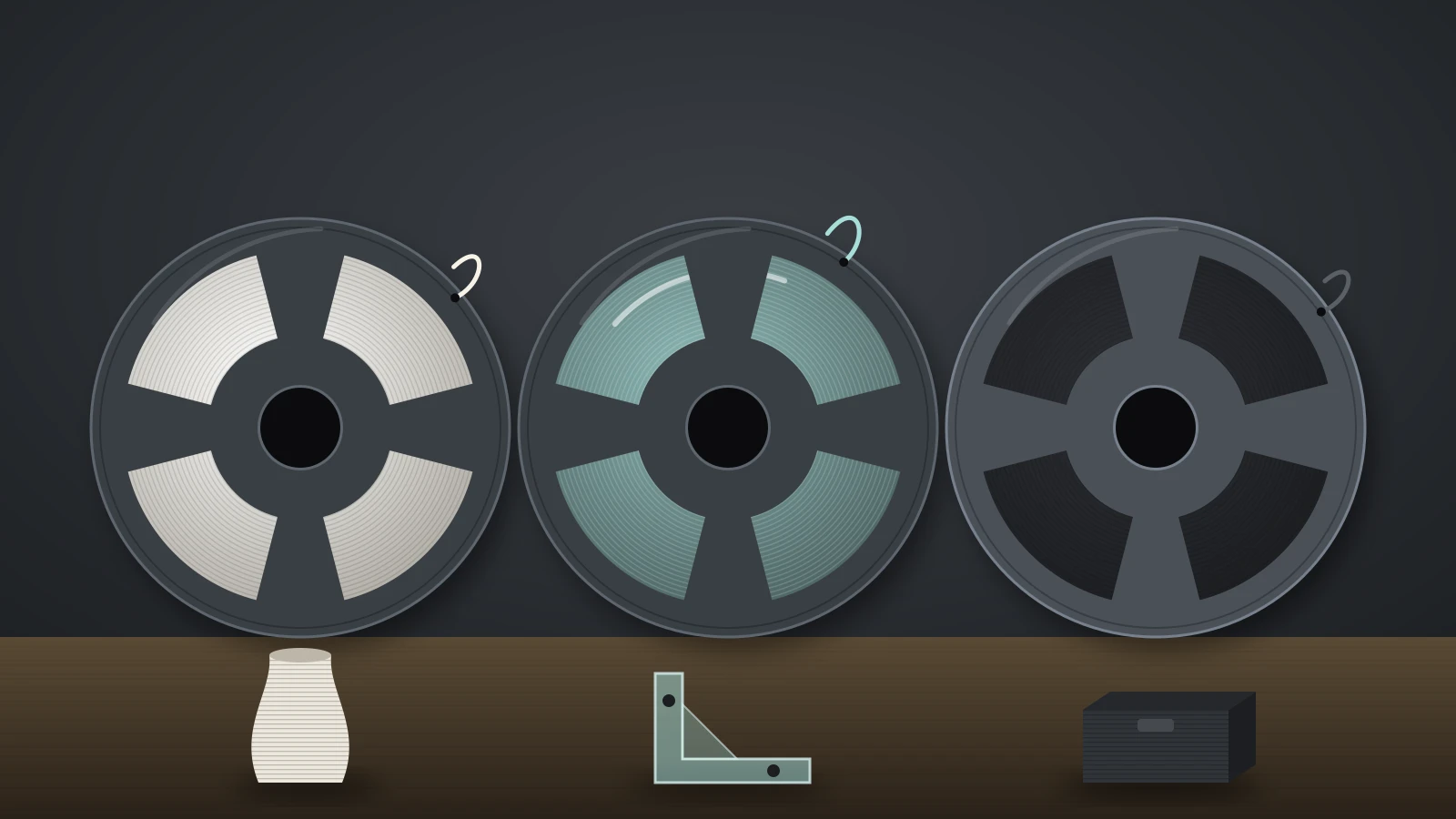


Glow in the dark filament is PLA or PETG mixed with a phosphorescent powder that soaks up light and gives it back as a visible glow in the dark. It prints at normal PLA or PETG settings, but the powder is abrasive, so makers require a hardened steel nozzle. Prints glow brightly for minutes and faintly for hours, per Prusa.
Bambu Lab’s PLA Glow and Prusa’s Prusament PETG Ultraglow publish full data sheets, so the numbers below come from those two makers. For the base plastic, see our PLA filament guide; the glow version prints much the same, apart from the nozzle.
The short answer
| Glow in the dark filament | |
|---|---|
| What it is | PLA or PETG filled with a light-storing powder (strontium aluminate in Prusa’s case) |
| Nozzle | Hardened steel or harder; brass and stainless steel wear out |
| Nozzle size | 0.4 mm minimum (Bambu Lab); 0.6 mm recommended (Prusa) |
| Glow PLA settings | 190–230 °C nozzle, 35–45 °C bed (Bambu Lab PLA Glow) |
| Glow PETG settings | 260 ± 10 °C nozzle, 85 ± 10 °C bed (Prusament PETG Ultraglow) |
| Charging | UV light works best; daylight and bright LEDs work more slowly |
| Glow time | Strong for minutes; weak glow visible after 6–8 h (Prusa) |
| Safety | Non-toxic and non-radioactive filler (Prusa); not food grade (Bambu Lab) |
What is glow in the dark filament?
Glow in the dark filament is an ordinary printing plastic with a luminous powder mixed in. Bambu Lab’s PLA Glow uses “luminous powder” as its additive, and its safety data sheet gives the split: 80–98% polylactic acid (PLA) and 2–20% additive by weight. Prusa names its filler: strontium aluminate, packed into clear PETG “as much as physically possible.”
The powder is phosphorescent. It absorbs energy from light, then releases it slowly as a visible glow once the room goes dark, and it can repeat that cycle every time it is recharged. More powder means a brighter glow, which is why Prusa filled its PETG to the maximum it could still print reliably.
Two base plastics dominate:
- Glow PLA: the common choice. It prints like regular PLA at low temperatures, with no enclosure.
- Glow PETG: tougher and more heat resistant. Prusa picked PETG for exactly those reasons, so glowing parts can also be functional.
What to check before buying glow in the dark filament
Before buying glow in the dark filament, check what your printer’s nozzle and feeder can handle, because the abrasive powder rules out some common hardware. The base polymer and published data matter more than the color name on the box.
- Nozzle requirement. If the listing says nothing about abrasion, look for a data sheet that does. Bambu Lab lists hardened steel as required for PLA Glow.
- Minimum nozzle size. Bambu Lab rules out 0.2 mm nozzles; Prusa recommends 0.6 mm.
- Feeder compatibility. Bambu Lab says PLA Glow works in its AMS, AMS 2 Pro and AMS HT but can cause faster wear, and is not compatible with the AMS lite.
- Base polymer. PLA for decorative prints, PETG for parts that get handled, warmed or loaded.
- A full data sheet. Bambu Lab and Prusa both publish heat deflection, tensile strength and print settings for their glow filaments.
- Diameter tolerance. Bambu Lab states ±0.03 mm for PLA Glow and Prusa ±0.04 mm for PETG Ultraglow.
Spool sizes differ too: Bambu Lab sells PLA Glow on 1 kg spools and Prusa sells PETG Ultraglow in 800 g.
Why glow filament needs a hardened steel nozzle
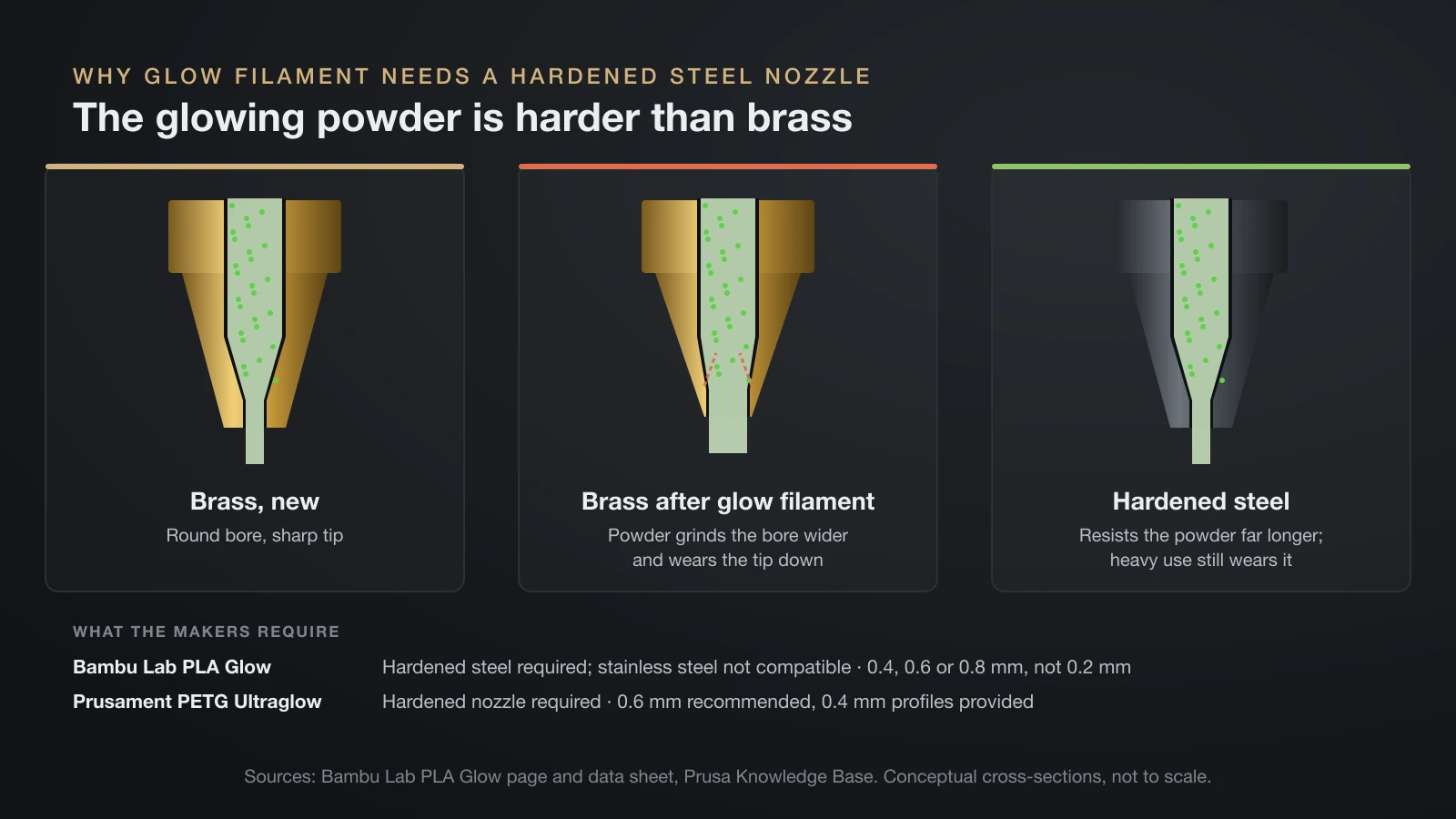
Glow filament needs a hardened steel nozzle because the glowing powder is harder than brass and grinds the nozzle bore wider as it passes. Prusa calls strontium aluminate “the hardest material we ever used” and warns that its glow PETG will destroy a brass nozzle quickly. Our guide to the 3D printer nozzle compares nozzle materials in detail.
What the two makers require:
| Bambu Lab PLA Glow | Prusament PETG Ultraglow | |
|---|---|---|
| Nozzle material | Hardened steel required; stainless steel not compatible | Hardened nozzle required |
| Nozzle size | 0.4, 0.6 or 0.8 mm; 0.2 mm not compatible | 0.6 mm recommended; 0.4 mm profiles provided |
| Other wear | Faster wear in AMS units | PTFE tubes, hardened nozzles and extruder gears |
Hardened steel is not wear-proof either. Prusa says occasional printing won’t be an issue, but regular high-volume use shortens the life of metal parts, including hardened nozzles. For heavy glow printing it suggests the E3D DiamondBack, a diamond-tipped nozzle harder than strontium aluminate.
Small nozzles also clog more easily with filled filament. Prusa recommends standard rather than high-flow nozzles for PETG Ultraglow, and our guide to a clogged 3D printer nozzle covers clearing one if particles do pack up.
Glow in the dark filament settings
Glow filament prints at the settings of its base plastic, with a hardened nozzle swapped in. These are the makers’ own values:
| Setting | Bambu Lab PLA Glow | Prusament PETG Ultraglow |
|---|---|---|
| Nozzle temperature | 190–230 °C (374–446 °F) | 260 ± 10 °C (500 °F) |
| Bed temperature | 35–45 °C | 85 ± 10 °C |
| Build surface | Cool, high temperature or textured PEI plate, with glue | PP, satin or textured sheet |
| Part cooling fan | On | 50%; 100% for bridges |
| Print speed | Below 250 mm/s | Up to 200 mm/s |
| Retraction | 0.6–1.0 mm at 20–40 mm/s | Not stated |
| Enclosure | Not needed (chamber 25–45 °C) | Not necessary |
| Drying | 55 °C for 8 h (forced-air oven) | Optional; helps after long storage |
Hardened steel conducts heat less well than brass, which is why our nozzle guide suggests printing a few degrees hotter: start in the middle of the range and raise it, within the maker’s range, if extrusion looks thin.
How long does glow in the dark filament glow?
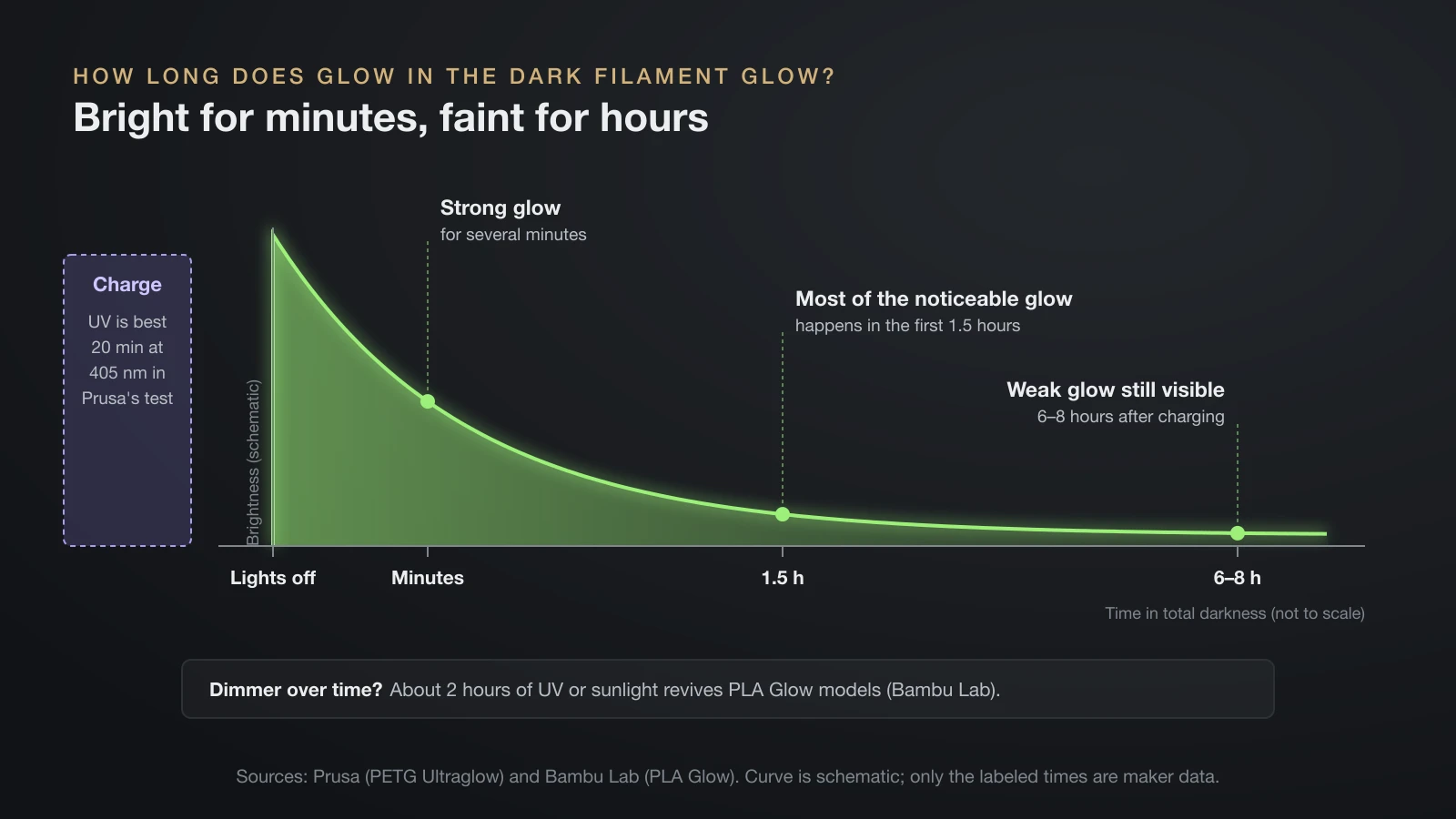
Glow in the dark filament glows strongly for several minutes after charging, then fades over hours. Prusa gives the clearest numbers for its PETG Ultraglow: most of the noticeable glow happens in the first 1.5 hours, and a weak glow can still be seen 6–8 hours after charging in total darkness.
How you charge it matters as much as the filament:
- UV light is best. Prusa calls UV the most effective way to charge strontium aluminate. Its brightness test charged prints for 20 minutes under a 405 nm UV source.
- Daylight and strong LEDs work, but more slowly.
- Warm, weak bulbs barely help. Prusa says common warm lights charge it slowly and will most likely not give the effect you want.
Over time a glowing part can seem dimmer. Bambu Lab says the luminous intensity of PLA Glow models diminishes over time, but about 2 hours of UV or sunlight revives the glow. It also warns that prolonged or frequent exposure can speed up PLA aging, so don’t leave PLA prints on a sunny windowsill to stay charged.
How to make glow prints brighter
The brightest glow comes from more glowing powder facing the viewer and a strong charge. Prusa’s own comparison found that its maximum-filled PETG outshone common glow PLA, which shows how much the pigment loading matters. A few practical rules follow from how the powder works; they are reasoned guidance rather than maker test data:
- Choose a highly filled filament. Brightness starts with how much powder the maker could pack in.
- Charge with UV, close to the part, right before the lights go off.
- Make the glowing feature solid. A thin glow skin over dark infill holds less powder than a solid feature, so give glowing text and edges real thickness.
- Keep other colors off the visible face. A darker layer printed over glow filament blocks both the charging light and the glow.
- Use glow as an accent. Prusa suggests printing the part in standard PETG and adding glowing details such as switches, handles or indicators on a multi-material printer.
Glow PLA vs glow PETG
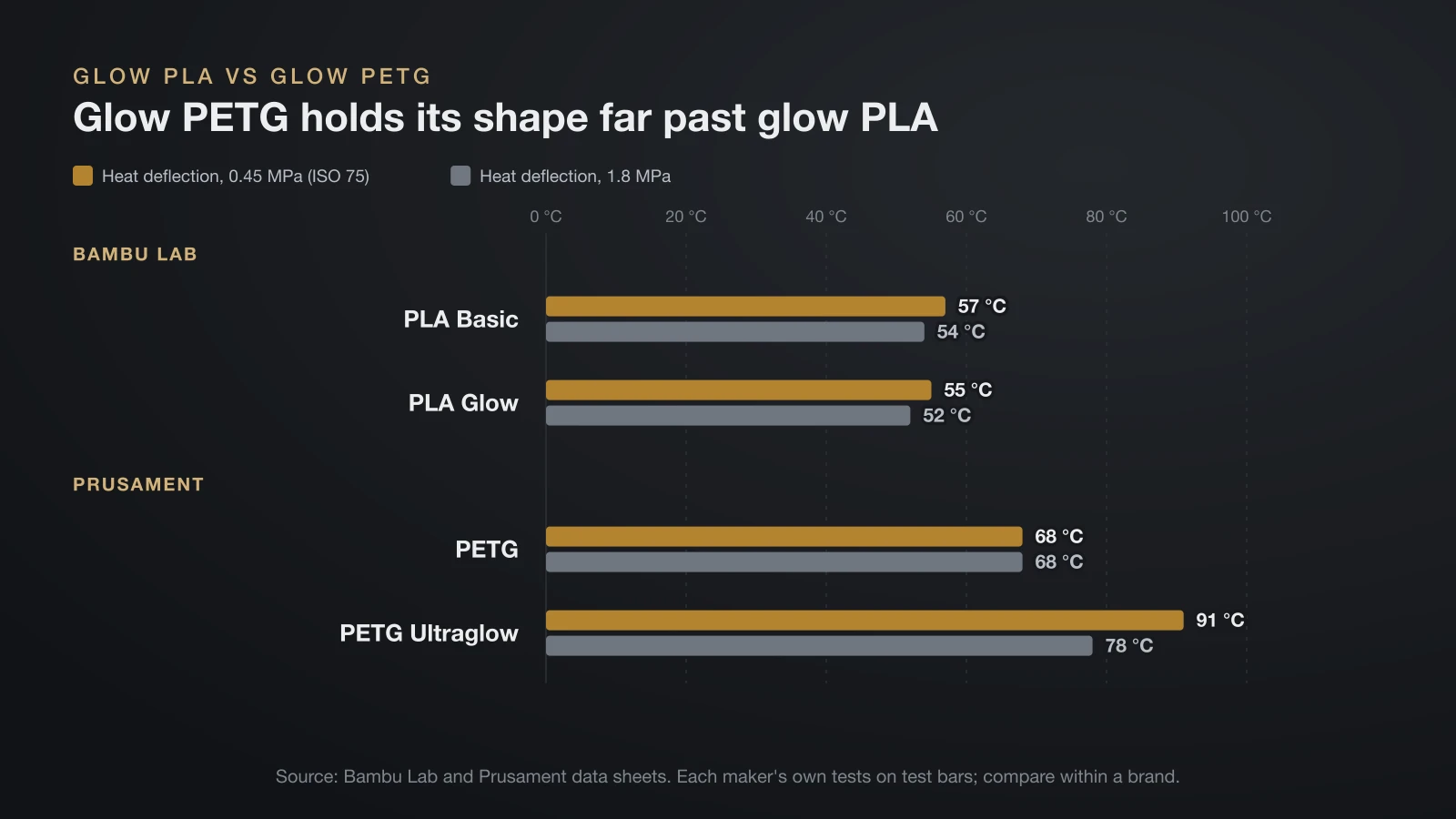
Glow PLA is easier to print, while glow PETG is tougher and holds its shape at much higher temperatures. The table compares each maker’s glow filament with its regular grade, using the makers’ own test methods.
| Property | Bambu Lab PLA Glow | Bambu Lab PLA Basic | Prusament PETG Ultraglow | Prusament PETG |
|---|---|---|---|---|
| Heat deflection, 0.45 MPa (ISO 75) | 55 °C | 57 °C | 91 °C | 68 °C |
| Heat deflection, 1.8 MPa (ISO 75) | 52 °C | 54 °C | 78 °C | 68 °C |
| Tensile strength, flat (ISO 527) | 32 MPa | 35 MPa | 42 MPa | Not compared |
| Tensile strength, across layers (ISO 527) | 26 MPa | 31 MPa | 20 MPa interlayer (Prusa method) | Not compared |
| Density (ISO 1183) | 1.26 g/cm³ | 1.24 g/cm³ | 1.5 g/cm³ | Not compared |
Two points stand out. Bambu Lab’s glow powder costs PLA a little strength and heat resistance compared with PLA Basic, while Prusa’s heavily filled PETG deflects at a higher temperature than plain Prusament PETG. Prusa also rates its glow PETG as slightly less elastic than pure PETG. The PETG cross-layer value uses a different Prusa test, so compare it only loosely with the PLA columns.
Is glow in the dark filament safe?
Glow in the dark filament made with strontium aluminate is not radioactive: Prusa states that the material is non-toxic and non-radioactive. That covers the filler, not every use of the finished part.
- Not food grade. Bambu Lab says PLA Glow prints should not be used for food storage or contact.
- Ventilation. Bambu Lab advises printing it in a well-ventilated area or with filtration, as for its other filaments.
- Small children. Bambu Lab asks users to keep filament and broken fragments away from infants, children and pets because of the choking risk.
Toys are a popular use, and Prusa lists them among its applications. Keep glowing parts for young children large, sturdy and free of small pieces, and read our guide to 3D printed toys for the safety rules that apply to anything made for kids.
What to make with glow in the dark filament
Glow in the dark filament suits parts you need to find, read or enjoy in the dark. The makers’ own suggestions:
- Safety signs and guiding arrows (Prusa).
- Frames for door locks and light switches (Prusa).
- Small items that are easy to lose, such as keychains and capsules (Prusa).
- Nameplates, logos and jewelry (Bambu Lab).
- Toys and props (Prusa).
Seasonal pieces such as Halloween decorations and star maps for a bedroom ceiling are popular glow projects too.
Glowing name tags and night-light shapes also make good presents; our list of 3D printed gifts has more ideas. If you want a decorative finish that shines in daylight instead, silk PLA gives a glossy, metallic look without the abrasion problem.
The bottom line
Glow in the dark filament is PLA or PETG loaded with a light-storing powder, usually strontium aluminate. Print it at the base plastic’s settings but swap in a hardened steel nozzle of 0.4 mm or larger, charge parts with UV for the brightest result, and expect a strong glow for minutes and a faint one for hours. Choose PLA for decoration and PETG for parts that need toughness or heat resistance.
Sources
- Bambu Lab: PLA Glow product page (nozzle, AMS and diameter cautions, recharging, safety tips), PLA Glow technical data sheet V1.0, PLA Glow safety data sheet (composition) and PLA Basic technical data sheet V3.0
- Prusa: Prusament PETG Ultraglow page and technical data sheet (settings, properties, glow time, applications), plus the Prusament PETG data sheet (heat deflection)
- Prusa Research: PETG Ultraglow announcement (non-toxic, non-radioactive, hardness, UV charging test) and Knowledge Base PETG Ultraglow troubleshooting (charging, 1.5 h glow, nozzles)