

PLA filament (polylactic acid) is the most common 3D printing plastic: a plant-based polyester that prints at about 190–230 °C (374–446 °F), needs little or no bed heat and barely warps. It holds fine detail, but it is brittle and softens at about 55–60 °C (131–140 °F), so it suits indoor parts rather than hot or outdoor ones.
Technical data sheets (TDS) put numbers on its strength and heat resistance, and they differ by brand. For brand-by-brand nozzle and bed values, see our full PLA temperature guide; this page keeps the settings to one summary table.
The short answer
| PLA filament | |
|---|---|
| What it is | Polylactic acid, a polyester made from plant sugars |
| Nozzle temperature | 190–230 °C (Bambu Lab, Polymaker); 210 ± 10 °C (Prusament) |
| Bed temperature | 35–45 °C (Bambu Lab); heated bed optional (Prusa) |
| Enclosure | Not needed (Polymaker) |
| Softens under load | About 54–60 °C heat deflection on data sheets |
| Strengths | Easy to print, stiff, sharp detail, little warping, almost no odor |
| Weaknesses | Brittle, low heat and UV resistance, weaker layer bonds |
| Food contact | Not recommended for printed dishes, even when the raw resin is food safe |
| Composting | Only in industrial facilities, not a garden heap |
| Best for | Prototypes, models, figures, decor, indoor organizers |
What is PLA filament made of?
PLA filament is made from polylactic acid, a polymer built from lactic acid that comes from fermented plant sugar. Prusa lists corn, sugar cane and sugar beet as typical sources, and NatureWorks, a major PLA resin producer, names corn, cassava, sugar cane and beets.
NatureWorks describes the route for its Ingeo resin in three steps:
- Sugar to lactic acid. Plants are milled to extract starch, enzymes convert it to dextrose, and microorganisms ferment the dextrose into lactic acid.
- Lactic acid to lactide. A two-step process turns lactic acid molecules into rings called lactide.
- Lactide to PLA. The rings are opened and linked into long chains of polylactide.
Filament makers buy resin pellets, add colorants or fillers, and extrude them into 1.75 mm or 2.85 mm strands. Our guide to 1.75 mm filament explains why the two diameters are not interchangeable.
PLA filament properties: data sheet numbers
PLA filament is stiff and strong along its layers but softens at a low temperature. The table compares two current data sheets; both use ISO test methods, but specimens and print settings differ between brands, so compare trends rather than single values.
| Property (test) | Bambu Lab PLA Basic | Polymaker PolyLite PLA |
|---|---|---|
| Density (ISO 1183) | 1.24 g/cm³ | 1.17 g/cm³ |
| Glass transition (DSC) | 60 °C | 61 °C |
| Melting temperature (DSC) | 160 °C | 150 °C |
| Heat deflection, 0.45 MPa (ISO 75) | 57 °C | 60 °C |
| Heat deflection, 1.8 MPa (ISO 75) | 54 °C | 58 °C |
| Tensile strength, X-Y (ISO 527) | 35 MPa | 52.3 MPa |
| Elongation at break, X-Y | 12.2% | 6.3% |
| Notched Charpy impact, X-Y (ISO 179) | 7.9 kJ/m² | 3.3 kJ/m² |
| Water absorption | 0.43% (saturated, 25 °C, 55% RH) | 0.51% (equilibrium) |
Three numbers matter most in practice:
- Heat deflection temperature (HDT): the point where a loaded test bar bends. Prusament PLA lists 55 °C at 0.45 MPa, the value used across this site, and Prusa says PLA parts lose strength above 60 °C.
- Impact strength: low. Prusa notes that PLA breaks along layers or into shards on impact; our PLA plus vs PLA comparison shows how much toughened grades add.
- Direction: layers are the weak point. Polymaker’s tensile strength drops from 52.3 MPa along the layers to 40.5 MPa across them.
Melting points of 150–175 °C (Prusa gives about 175 °C) matter for printing, not for use: a loaded part sags long before that.
How to choose a PLA filament spool
Choosing a PLA filament spool is mostly about checking the label and the data sheet before you buy, because documentation and packaging differ more than the plastic.
- Diameter: match your printer, almost always 1.75 mm on current machines.
- A published data sheet: look for nozzle and bed ranges, drying settings and heat deflection with the test load stated.
- Sealed packaging: a vacuum bag with desiccant. Bambu Lab specifies storage below 20% relative humidity for PLA Basic.
- Spool material and heat rating: Bambu Lab’s PLA spool is ABS rated to 70 °C (its ABS ships on a PC + ABS spool rated to 90 °C), which matters if you ever dry the spool.
- Nozzle compatibility: filled PLAs (wood, marble, glow, carbon fiber) can clog 0.2 mm nozzles or need hardened steel.
- The right type for the job: standard PLA for models, a toughened PLA for clips and brackets, silk or matte for looks.
PLA filament settings at a glance
PLA filament prints at 190–230 °C on most data sheets, with the part cooling fan on and a cool or barely warm bed. Start in the middle of your spool’s range and tune it with a temperature tower.
| Setting | Bambu Lab PLA Basic | Polymaker PolyLite PLA | Prusament PLA / Prusa profile |
|---|---|---|---|
| Nozzle | 190–230 °C | 190–230 °C | 210 ± 10 °C |
| Bed | 35–45 °C | 25–60 °C | 40–60 °C; 60 °C on PEI |
| Part cooling fan | On | On | 100% |
| Speed | Under 300 mm/s | 50–200 mm/s | Up to 200 mm/s |
| Retraction | 0.6–1.0 mm | 1–3 mm | Not listed |
| Heated bed | Yes, low | Low, 25–60 °C | Optional (Prusa) |
| Drying | 50 °C, 8 h | 55 °C, 6 h | 45 °C, 6 h |
Retraction depends on the extruder design; our direct drive vs Bowden extruder comparison explains why the ranges differ. For plate-by-plate bed values, the first layer and a temperature tower walkthrough, use the PLA temperature guide.
Types of PLA filament
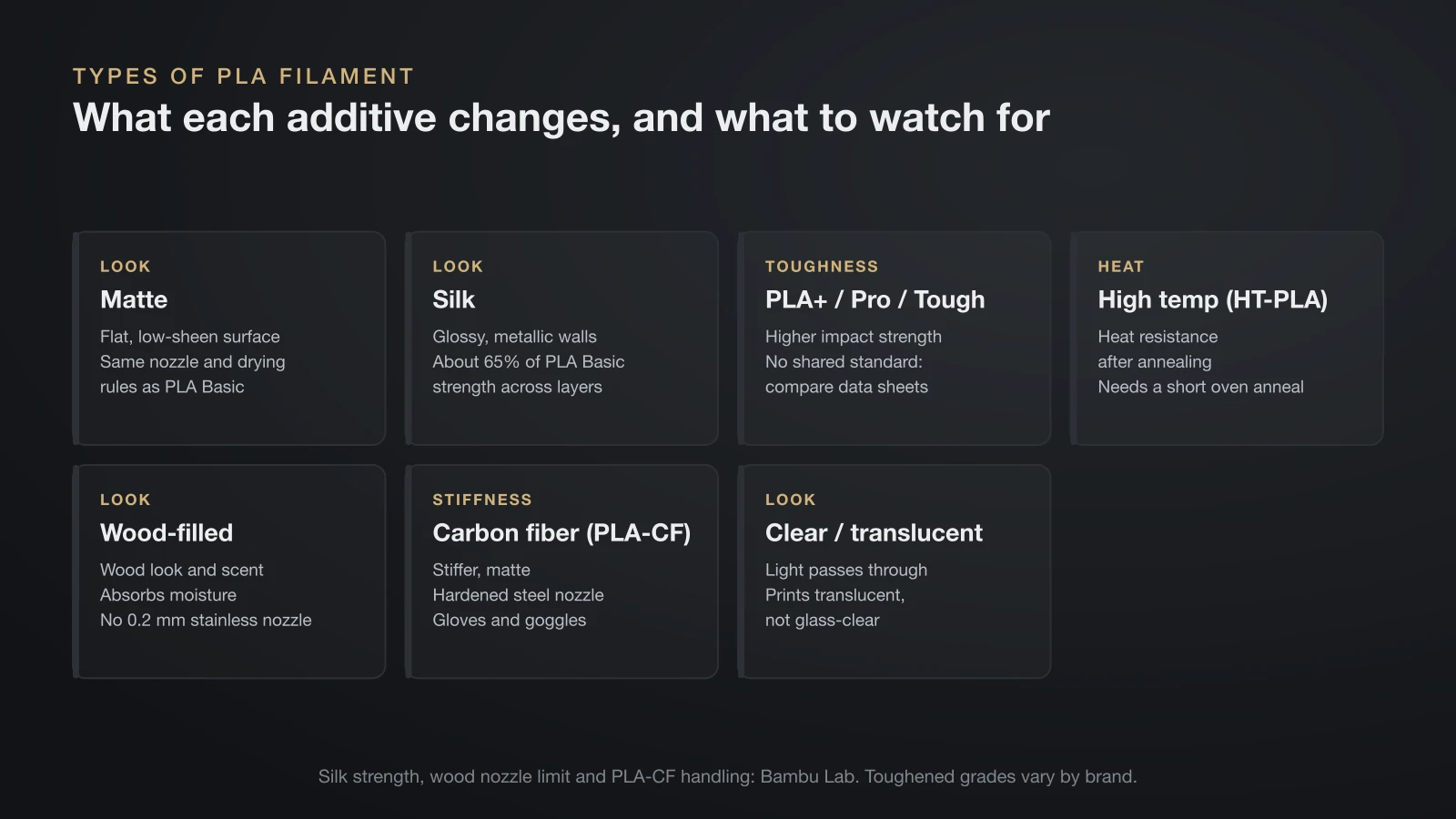
Most PLA types are standard PLA with an additive that changes the look, the toughness or the printing behavior. The table summarizes what each one changes and what to watch for.
| PLA type | What changes | Watch for |
|---|---|---|
| Matte | Flat, low-sheen surface | Same nozzle and drying rules as PLA Basic (Bambu Lab) |
| Silk | Glossy, metallic-looking walls | About 65% of PLA Basic’s strength across layers (Bambu Lab) |
| PLA+ / PLA Pro / Tough PLA | Higher impact strength | No shared standard; compare data sheets |
| High temp (HT-PLA) | Heat resistance after annealing | Needs a short oven anneal |
| Wood-filled | Wood look and scent | Absorbs moisture; avoid 0.2 mm stainless steel nozzles (Bambu Lab) |
| Carbon fiber (PLA-CF) | Stiffer, matte | Hardened steel nozzle; fiber debris |
| Clear / translucent | Light passes through | Prints translucent, not glass-clear |
The toughened family is covered in our PLA plus guide, fiber-filled grades in the carbon fiber filament guide and clarity tricks in the clear PLA guide. For PLA-CF, Bambu Lab recommends cut-resistant gloves and safety goggles, because the filament can carry microscopic barbs.
Is PLA filament food safe?
PLA filament is not a safe choice for printed dishes, cups or utensils, even though the base material can be food safe. Prusa states that the PLA material itself is food-safe but does not recommend it, or any other filament, for printing dishes, because the tiny grooves between layers can harbor bacteria. A sealing food-safe coating would be needed.
Bambu Lab is stricter on its own range: apart from its PLA Pure, its PLA filaments are not food-contact grade, and printed parts should not hold or touch food. For food molds, the safer route is printing a master and casting a food-grade silicone over it, as our 3D printed molds guide shows.
Is PLA biodegradable and compostable?
PLA is compostable only under industrial conditions, not in a backyard compost bin. The relevant US standard, ASTM D6400, covers plastics designed to compost in municipal and industrial aerobic facilities “where thermophilic conditions are achieved,” and ASTM notes it is equivalent to ISO 17088.
Bambu Lab’s wording is careful: PLA “can biodegrade in some artificial composting conditions.” Prusa goes further and warns that throwing PLA waste into garden compost is not a good idea, because it will not break down there and ends up contaminating the soil.
Treat a spool as compostable only if its maker says so for that product, and check whether a local facility accepts PLA before you collect scraps.
PLA and water: absorption and watertight prints
PLA takes up little water and does not dissolve in it, but printed parts can still leak. Bambu Lab lists its PLA Basic as insoluble in water with 0.43% saturated water absorption, a small value compared with nylon.
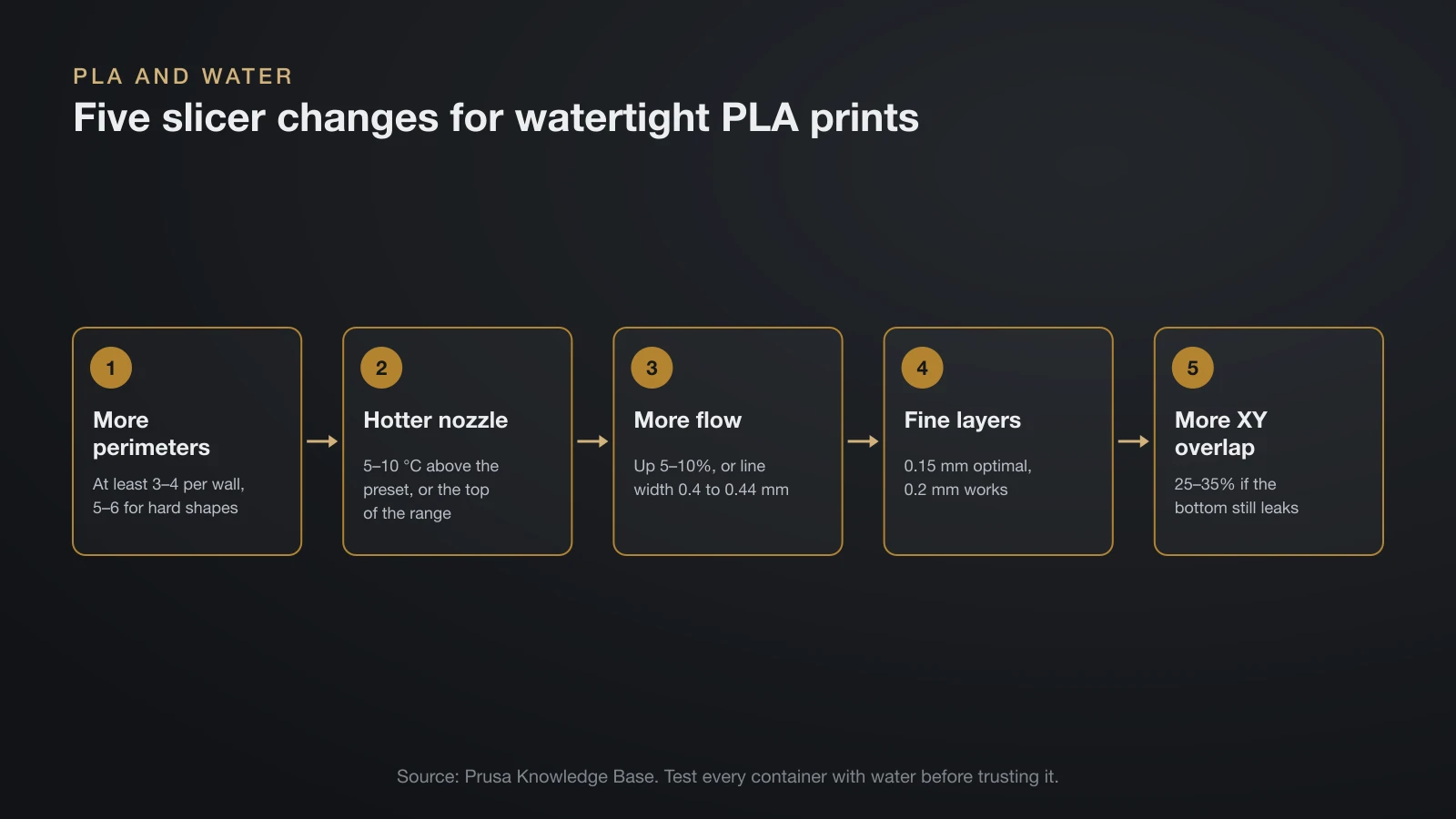
Leaks come from the printing, not the plastic. Prusa’s advice for watertight parts:
- Print at least 3–4 perimeters per wall, or 5–6 for difficult shapes, and avoid thick walls with infill inside.
- Raise the nozzle 5–10 °C above the preset, or use the top of the spool’s range.
- Increase flow 5–10%, or widen the line width from 0.4 to 0.44 mm.
- Keep layers fine: 0.15 mm is optimal, 0.2 mm works.
- Raise XY overlap to 25–35% if the bottom still leaks.
Seams are the usual weak point. Test every container with water before trusting it.
Storing and drying PLA filament
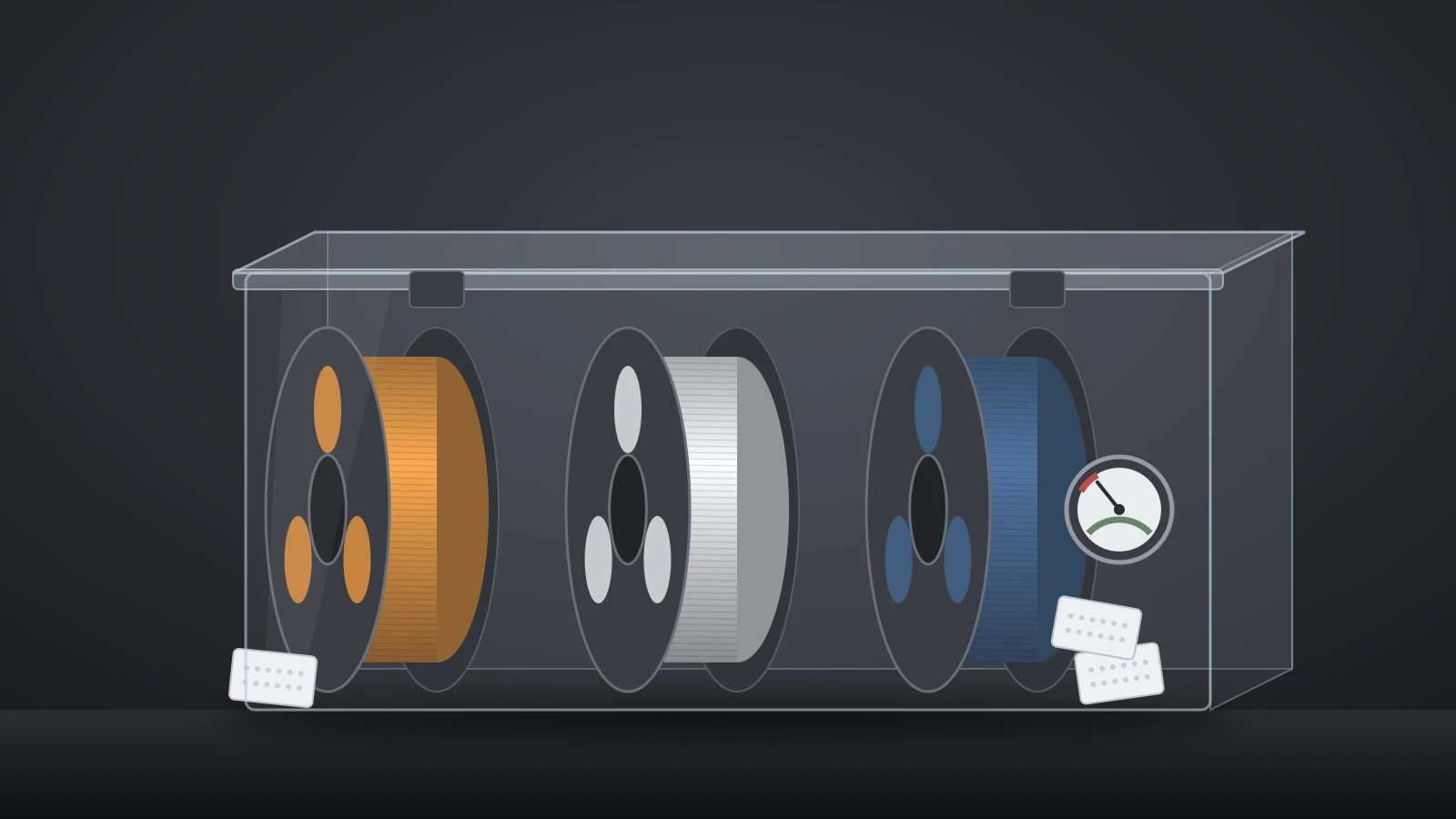
PLA filament absorbs less moisture than PETG or nylon, but an open spool still picks up water in humid air. Bambu Lab’s PLA guide says standard PLA tolerates 50–60% room humidity, while its data sheet asks for printing and storage below 20% relative humidity, sealed with desiccant.
Damp PLA strings, pops and prints rough walls. Dry it gently, at 45 °C for 6 hours (Prusa) or 50 °C for 8 hours (Bambu Lab), never in a microwave or kitchen oven. Boxes, desiccant, vacuum bags and racks are covered in our guide to filament storage.
Is PLA the right filament for your part?
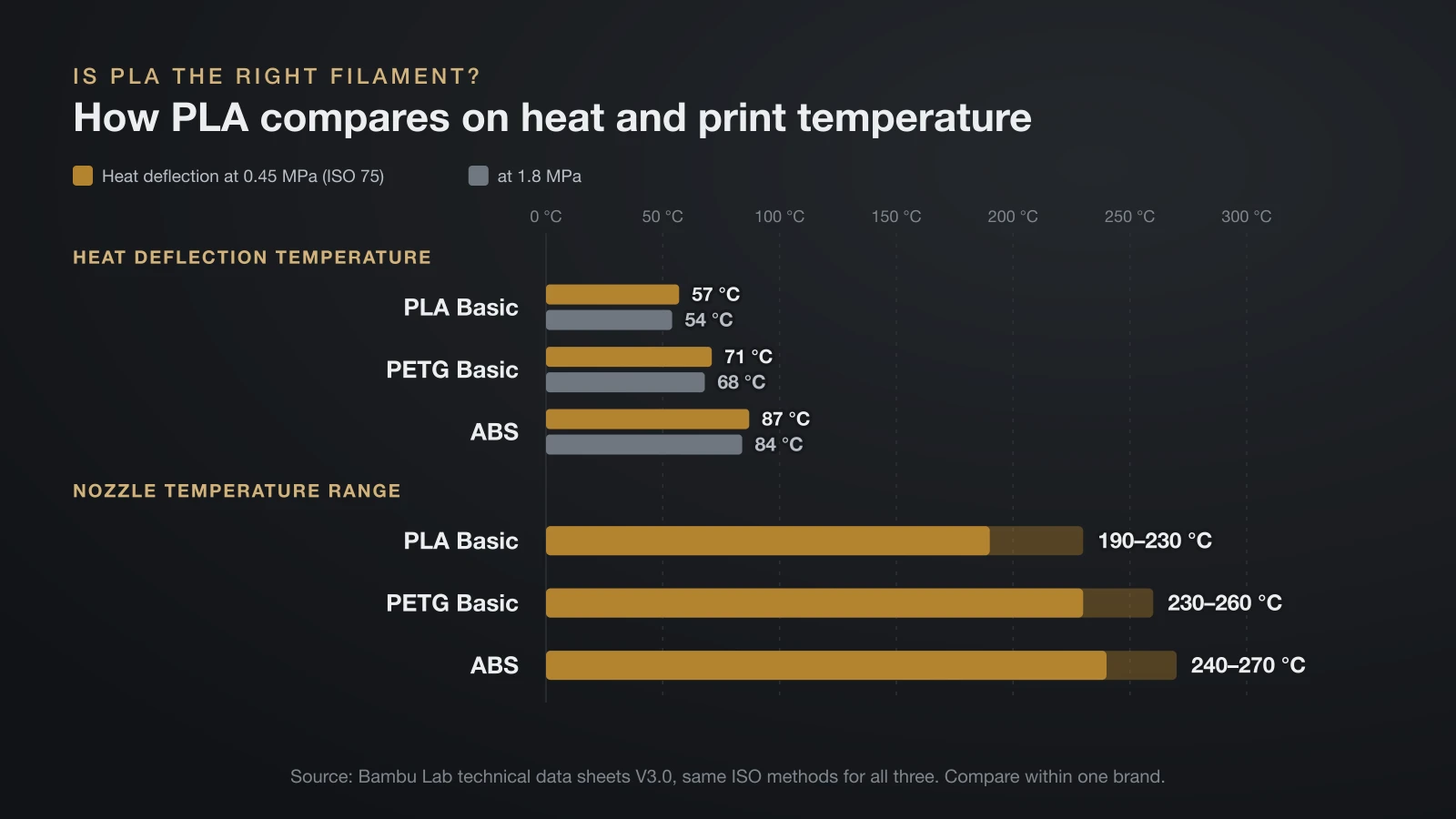
PLA is the right filament when a part stays indoors, away from heat and strong sun, and needs fine detail more than toughness. Bambu Lab’s version 3.0 data sheets, tested with the same ISO methods, show where the step up to PETG or ABS begins:
| Bambu Lab data sheet | PLA Basic | PETG Basic | ABS |
|---|---|---|---|
| Heat deflection, 0.45 MPa (ISO 75) | 57 °C | 71 °C | 87 °C |
| Heat deflection, 1.8 MPa (ISO 75) | 54 °C | 68 °C | 84 °C |
| Nozzle | 190–230 °C | 230–260 °C | 240–270 °C |
Move up when the part sees warmth, moisture or knocks: PETG for tough functional parts, covered in our PETG temperature guide, and ASA filament for outdoor parts in the sun.
When not to use PLA filament
PLA filament is the wrong choice whenever heat, sunlight or safety is involved. Skip it for:
- Hot places. Prusa says PLA gets soft and deforms above 60 °C, which rules out a car parked in the sun; see our guide to 3D printed car parts.
- Long outdoor use. Prusa says PLA degrades under UV light and calls it not ideal outdoors.
- Parts that must flex or take knocks. Thin clips and pins snap; a toughened PLA or PETG lasts longer.
- Load-bearing or safety-critical parts. Data sheet values come from ideal test bars, and no printed plastic should hold a load where failure could hurt someone.
Finishing PLA prints: sanding, gluing and painting
PLA sands, glues and paints well, but it does not respond to the acetone smoothing used on ABS and ASA. Prusa recommends wet sanding and says chemical smoothing of PLA needs dangerous solvents and lab conditions. Our guide to glue for PLA compares adhesives by job, and how to paint 3D prints covers primer and paint.
The bottom line
PLA filament is a plant-based polyester that prints easily at 190–230 °C, holds sharp detail and barely warps, which makes it the default for models, prototypes and indoor parts. Its limits are heat, sunlight and impact: parts soften around 55–60 °C and snap rather than bend. Keep it dry, keep it away from food and heat, and switch to PETG or ASA when the part has to work hard.
Sources
- Bambu Lab: technical data sheets V3.0 for PLA Basic, PETG Basic and ABS, plus the Wiki PLA usage guide and filament drying guide (properties, print and drying settings, storage humidity, spool rating, water solubility, composting wording, PLA types, food contact)
- Polymaker: PolyLite PLA technical data sheet (density, glass transition, melting and heat deflection temperatures, tensile strength X-Y and Z, elongation, notched Charpy impact, water absorption, print and drying settings)
- Prusa: Knowledge Base PLA guide, Watertight prints and Drying filament, and the Prusament PLA page and data sheet (raw materials, food contact, garden compost warning, UV, brittleness, wet sanding, watertight settings, drying, 210 ± 10 °C, up to 200 mm/s, heat deflection 55 °C at 0.45 MPa, melting point about 175 °C)
- NatureWorks: Ingeo technology (feedstocks and the sugar to lactic acid to lactide to polylactide process)
- ASTM International: D6400 specification for compostable plastics (scope: municipal and industrial aerobic composting under thermophilic conditions; equivalent to ISO 17088)