
The best filament brands are the ones that tell you exactly what you are buying: a stated diameter tolerance, a technical data sheet (TDS) with real test values, sealed and dry packaging and a spool that fits your printer. Prusament, Bambu Lab, Polymaker and several other makers publish most of that; many budget listings publish almost none of it.
No brand is best at everything, and the same brand can sell a precise premium line next to a looser budget one. The 12 makers compared here are described only by what their official pages and data sheets state. For what diameter tolerance means in practice, see our guide to 1.75 mm filament.
The short answer
| What to check | Good sign | Why it matters |
|---|---|---|
| Diameter tolerance | ±0.02 to ±0.03 mm stated on the page | Steadier extrusion; Prusa puts the industry standard at ±0.05 mm |
| Technical data sheet | Print settings plus tensile, impact and heat values with test methods | Lets you compare materials and check claims |
| Packaging | Vacuum sealed with desiccant | Damp filament causes stringing and surface defects |
| Spool | Fits your holder or feeder; refills if you reuse spools | Cardboard and odd sizes can jam automatic feeders |
| Color control | Measured, consistent colors between batches | Matching parts printed months apart |
| Range | The materials you need from one maker | One set of profiles, easier comparisons |
How to judge the best filament brands for your printer
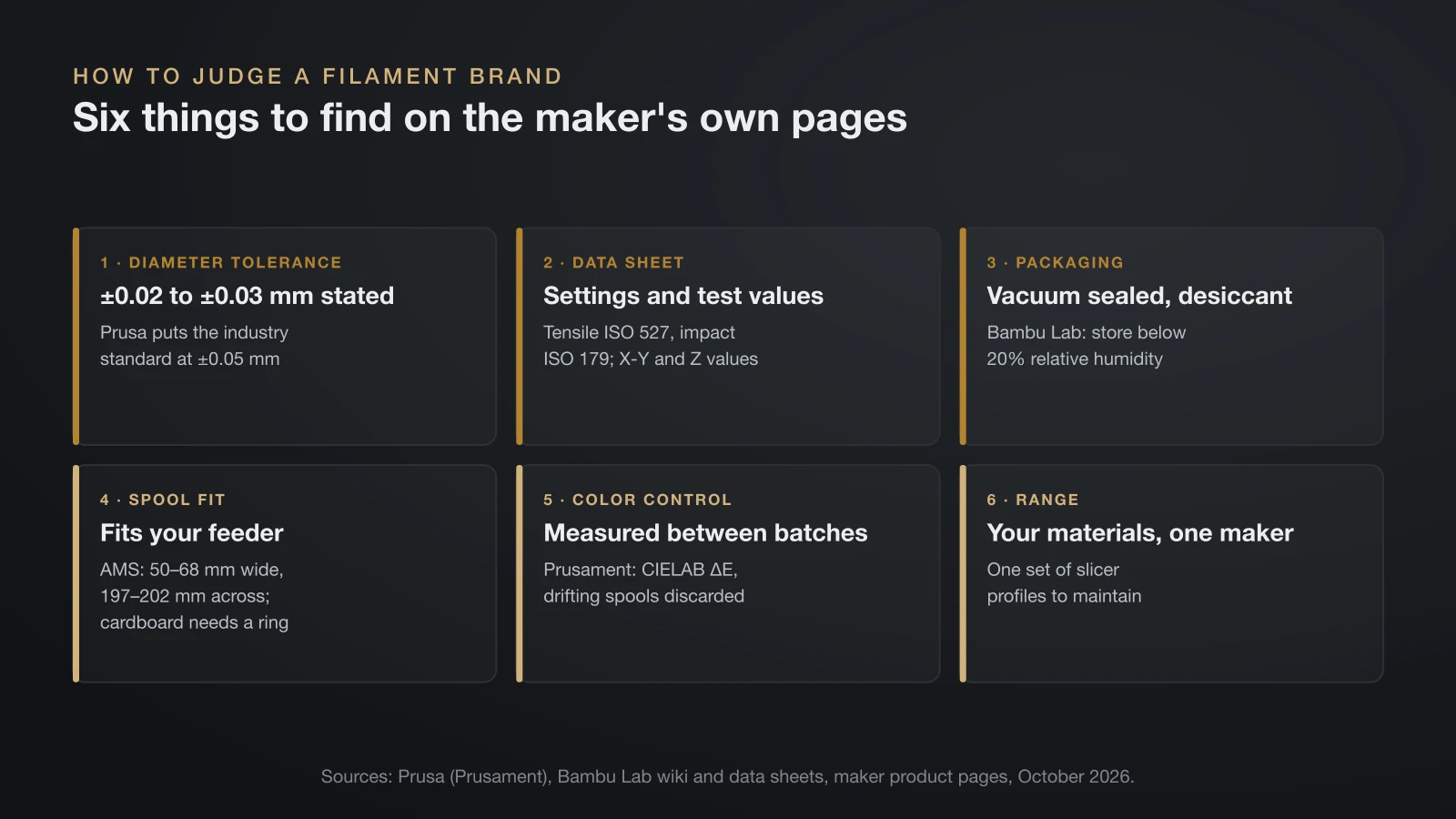
Judge a filament brand by what it publishes and how it packs the spool, not by its ranking on a list. Six checks cover nearly everything that separates a reliable spool from a frustrating one.
Stated diameter tolerance
A brand that states its tolerance gives you something to hold it to. Prusa says most manufacturers work to ±0.05 mm on 1.75 mm filament, while Prusament is held to ±0.02 mm for most materials and ±0.03 mm for blended colors. Bambu Lab lists ±0.03 mm for PLA Basic, and Overture, Elegoo, Sunlu and Atomic Filament each state ±0.02 mm on their pages.
A real technical data sheet
A useful TDS lists print settings and measured properties with the test method, such as tensile strength per ISO 527 and impact per ISO 179. The better ones give values both along the layers (X-Y) and across them (Z), which is how Bambu Lab and Polymaker present theirs. Our guide to the strongest filament shows what those numbers reveal when you compare one maker’s materials side by side.
Moisture packaging and drying guidance
Filament absorbs water from the air, so packaging matters before the spool is even opened. Prusa vacuum packs every Prusament spool, and Bambu Lab’s data sheets call for storage below 20% relative humidity, sealed with desiccant. Look for drying temperatures and times on the TDS too; our filament storage guide covers what to do once the bag is open.
A spool that fits your feeder
Spool size and material matter if you use an automatic material system. Bambu Lab’s AMS accepts spools 50–68 mm wide and 197–202 mm in diameter, and for cardboard spools Bambu Lab recommends fitting an adapter ring to reduce slipping and debris left behind in the unit. Our guide to multi-color 3D printers compares the feeder systems themselves.
Color consistency
Color matching between batches is hard to judge from a product photo. Prusa says it measures Prusament color continuously against the CIELAB ΔE color difference metric and discards any spool that drifts out of tolerance. Few brands describe their color control at all, so a stated method is a point in a brand’s favor.
Range and availability
A brand that covers the materials you use most saves you from rebuilding slicer profiles for every spool.
Filament brands compared: what the official pages state
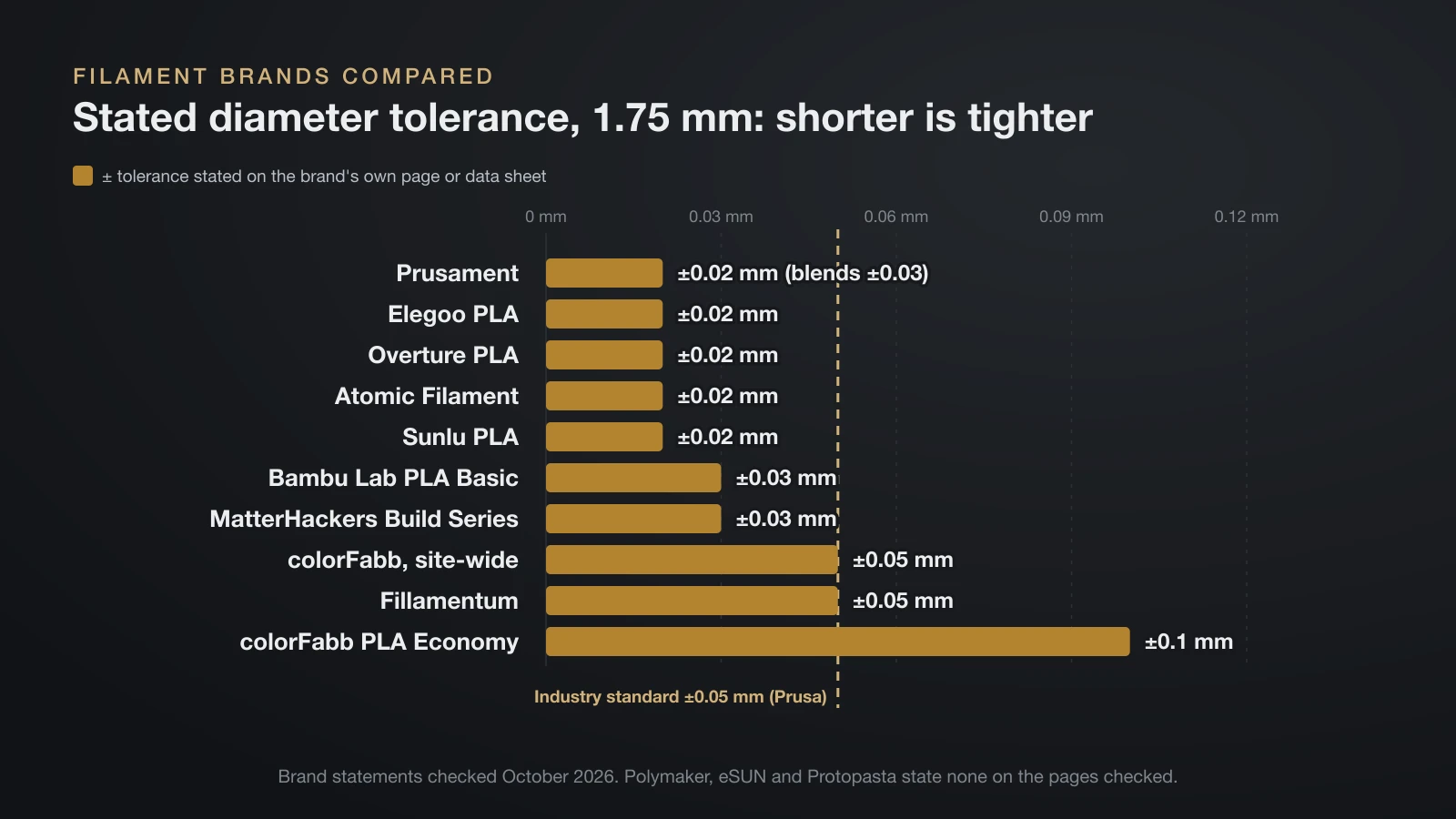
The table lists what each brand’s own website or data sheet states, checked in October 2026. “Not stated” means the pages checked did not give that detail, not that the brand lacks it.
| Brand | Based in or made in (brand statement) | Example lines | Spools and refills | TDS published | Stated diameter tolerance |
|---|---|---|---|---|---|
| Prusament (Prusa Research) | Made in Prusa’s own factory, Prague, Czech Republic | PLA, PETG, ASA, PC Blend, PA11, TPU 95A | Standard and 2 kg spools, refills; vacuum packed | Yes | ±0.02 mm (±0.03 mm for blends) |
| Bambu Lab | Not stated | PLA Basic, Matte, Silk+, Tough+, PETG, ABS, ASA, PC, PA6-CF, TPU | 1 kg on a 200 × 67 mm plastic spool, or refill for a reusable spool | Yes | ±0.03 mm (PLA Basic) |
| Polymaker | Not stated | PolyLite, Panchroma, PolyMide, Fiberon, PolyFlex | 1, 3 and 5 kg (PolyLite PLA); cardboard spools; no refills | Yes | Not stated on the PLA page |
| eSUN | Shenzhen, China (address on TDS) | PLA+ | Not stated | Yes | Not stated on the PLA+ TDS |
| Elegoo | Founded in Shenzhen, China | PLA, PLA Matte, PLA Silk, PETG, PETG Pro, PLA-CF, PETG-CF | 1 kg PLA on a cardboard spool | Not found | ±0.02 mm (PLA) |
| Sunlu | Zhongshan, Guangdong, China (compliance document) | PLA, PLA+, PLA+ 2.0, PETG, ABS, PA6-CF, PC, PEEK | 250 g mini spools to 5 kg spools; PLA and PETG refills | Not found | ±0.02 mm (PLA) |
| Overture | Not stated | PLA, PLA+, Matte, Silk, PETG, TPU, ABS, Easy Nylon, PC | 1, 2 and 3 kg PLA; PLA and PETG refills | Yes | ±0.02 mm (PLA) |
| MatterHackers | Not stated | Build Series PLA | 1 kg spool, 1.75 or 2.85 mm | Yes | ±0.03 mm |
| Atomic Filament | Made in Indiana, USA | PLA, PETG, ABS, ASA, PCTG, carbon fiber | 3.5 kg jumbo spools of PLA, PETG and ABS | Not found | ±0.02 mm |
| Protopasta (Protoplant) | Made in the USA | HTPLA, recycled PLA, conductive, carbon fiber, magnetic iron and stainless steel PLA | Cardboard spools; 50 g sample coils | Yes | Not stated |
| colorFabb | Belfeld, Netherlands; made in house in the EU | PLA Economy, woodFill, bronzeFill | XL spools only (PLA Economy) | Yes | ±0.05 mm (site-wide claim); ±0.1 mm for PLA Economy |
| Fillamentum | Made in Hulín, Czech Republic | PLA Crystal Clear and other PLAs | 750 g of filament on a 250 g spool (2019 data sheet) | Yes | ±0.05 mm (PLA Crystal Clear) |
Hatchbox, Inland and some other widely sold names are missing because their official spec pages could not be checked for this comparison. Apply the same checklist to them before you buy.
What stands out on each maker’s pages
The brands fall into four groups, and each group tends to publish different things. These notes stick to what the makers state.
Printer makers’ own filaments: Prusament, Bambu Lab, Elegoo
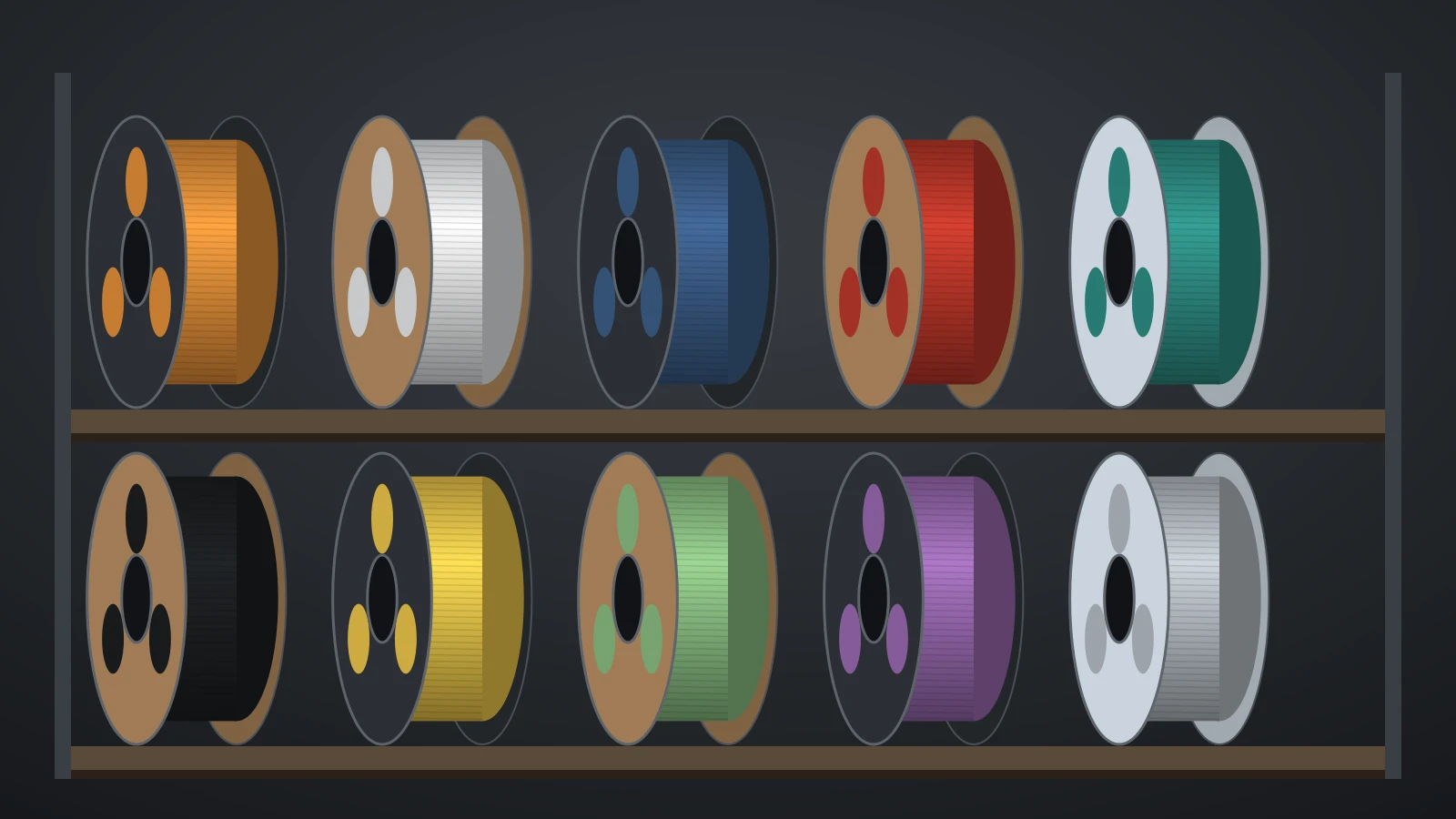
Printer companies make or brand filament to match their machines. Prusa says Prusament is made in the same building as its printers on twelve production lines, and each spool’s ID shows its production date, weight, length, maximum diameter deviation and ovality. Bambu Lab publishes data sheets for its materials, version 3.0 for core lines such as PLA Basic and PC, and sells refills that must go on a reusable spool. Elegoo uses cardboard spools with three holes for checking how much filament is left.
Large filament specialists: Polymaker, eSUN, Sunlu, Overture
These brands sell wide ranges at many price points. Polymaker uses cardboard spools and says they now have hardened edges that roll well in the AMS; it does not sell refills. eSUN publishes data sheets tested to Chinese GB/T standards; its impact values are Izod (GB/T 1843) rather than the Charpy (ISO 179) values most other makers list, so compare impact numbers with care. Sunlu and Overture both sell refills, and Overture publishes values such as layer adhesion on its PLA page.
US-made filament: Atomic Filament, Protopasta
Two brands state US manufacturing on their own pages. Atomic Filament says every spool is made in-house in Indiana, with a ±0.02 mm tolerance and 3.5 kg jumbo spools. Protopasta says its filament is made in the USA by Protoplant and sells specialty PLAs with conductive, magnetic iron and stainless steel fills.
European makers: colorFabb, Fillamentum, Prusament
European brands lean on in-house production and published data. colorFabb, based in the Netherlands, states ±0.05 mm precision in general but ±0.1 mm for its PLA Economy line, a reminder to check the line, not the brand. Fillamentum develops and manufactures its filaments in Hulín, Czech Republic, and its PLA Crystal Clear data sheet lists 750 g of filament per spool rather than the common 1 kg.
Best filament brands by material: what to look for
The best filament brand for PLA is not automatically the best one for nylon or PC. What matters shifts with the material.
- PLA: tolerance and color consistency matter most, because every brand’s PLA prints in a similar window. For tougher grades, compare each brand’s PLA+ with its own standard PLA, as our PLA+ vs PLA comparison does. Our PLA filament guide covers the material itself.
- PETG, nylon and PC: packaging and drying instructions matter most, because these absorb more moisture. Bambu Lab, for example, lists an 80 °C (176 °F) oven for 8 hours before printing its PC.
- Engineering and fiber-filled grades: pick brands that publish X-Y and Z strength, heat deflection with the test load, and nozzle requirements.
- Effect filaments: look for printing guides as well as settings. Bambu Lab, for instance, publishes a separate guide for its silk filaments; see our silk PLA guide for what those settings change.
Price is the last check, not the first. Our 3D printer filament cost guide compares manufacturer list prices per kilogram and what refills and bulk packs save.
The bottom line
The best filament brands are the ones that publish a diameter tolerance, a full data sheet, sealed packaging and spool dimensions, and Prusament, Bambu Lab, Polymaker, Overture and others state most of those openly. Check the specific line, because one brand can range from ±0.05 to ±0.1 mm. Match the spool to your feeder, store it dry and compare materials within one maker’s data.
Sources
- Prusa: How Prusament is made, The story behind Prusament, Prusament PLA page and About Prusa Research (±0.02/±0.03 mm, ±0.05 mm industry figure, CIELAB ΔE color control, vacuum packing, spool ID data, in-house production in Prague, 2 kg and refill options)
- Bambu Lab: PLA Basic store page (±0.03 mm, refills), technical data sheets for PLA Basic and PC (spool size, storage humidity, drying) and Wiki Notes for AMS, PLA guide and silk printing guide (spool dimensions, cardboard adapter, product lines, moisture effects)
- Polymaker: PolyLite PLA product page and technical data sheet (spool weights, cardboard spools, AMS edges, no refills, X-Y and Z values)
- Other makers’ official pages: eSUN PLA+ TDS, Elegoo PLA and About Elegoo, Sunlu PLA and compliance document, Overture PLA, MatterHackers Build Series PLA, About Atomic Filament and Protopasta (location, lines, spools, refills, data sheets, tolerances)
- European makers: colorFabb and colorFabb PLA Economy, About Fillamentum and Fillamentum PLA Crystal Clear data sheet (location, ±0.05 and ±0.1 mm, 750 g spool)