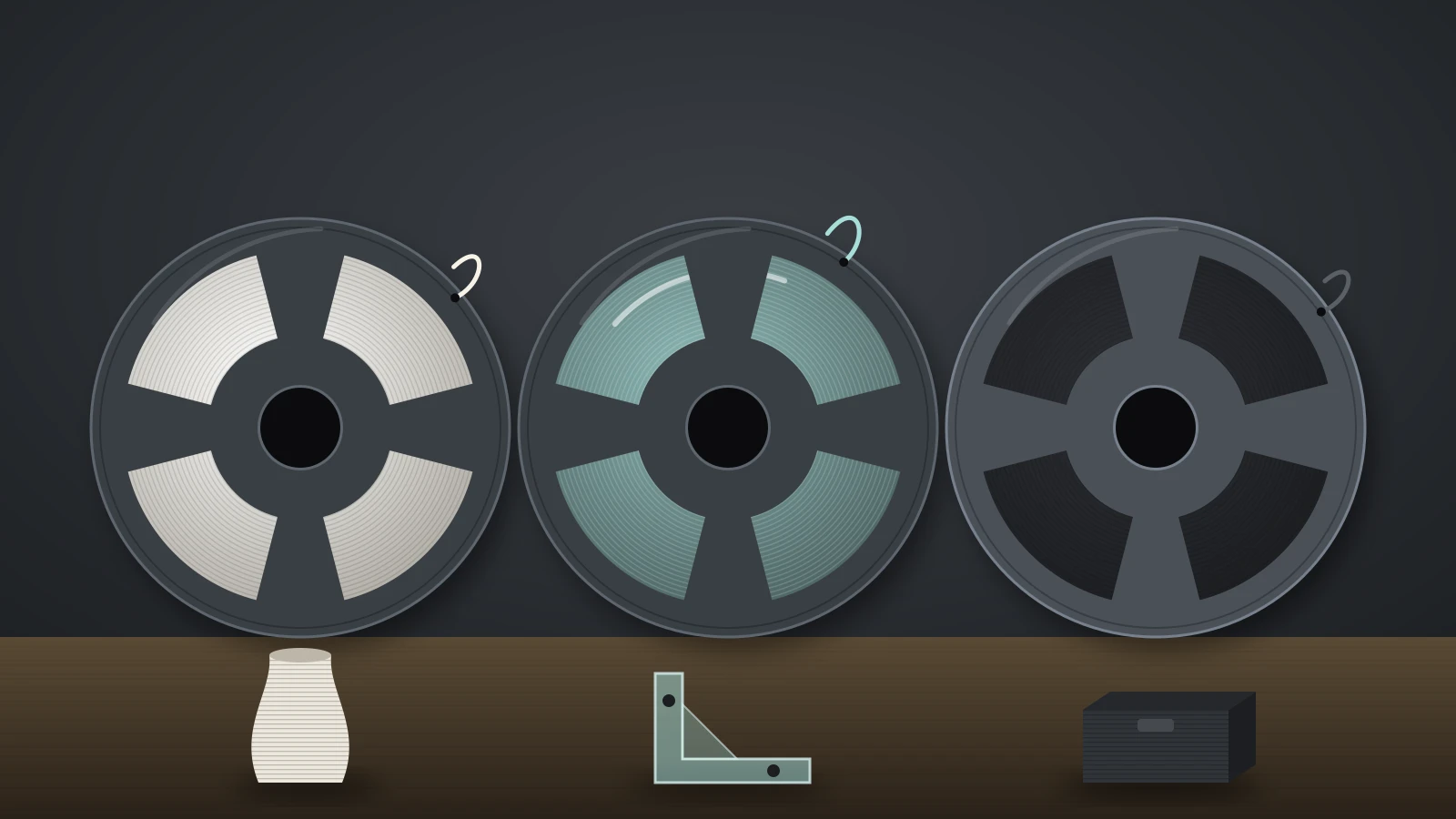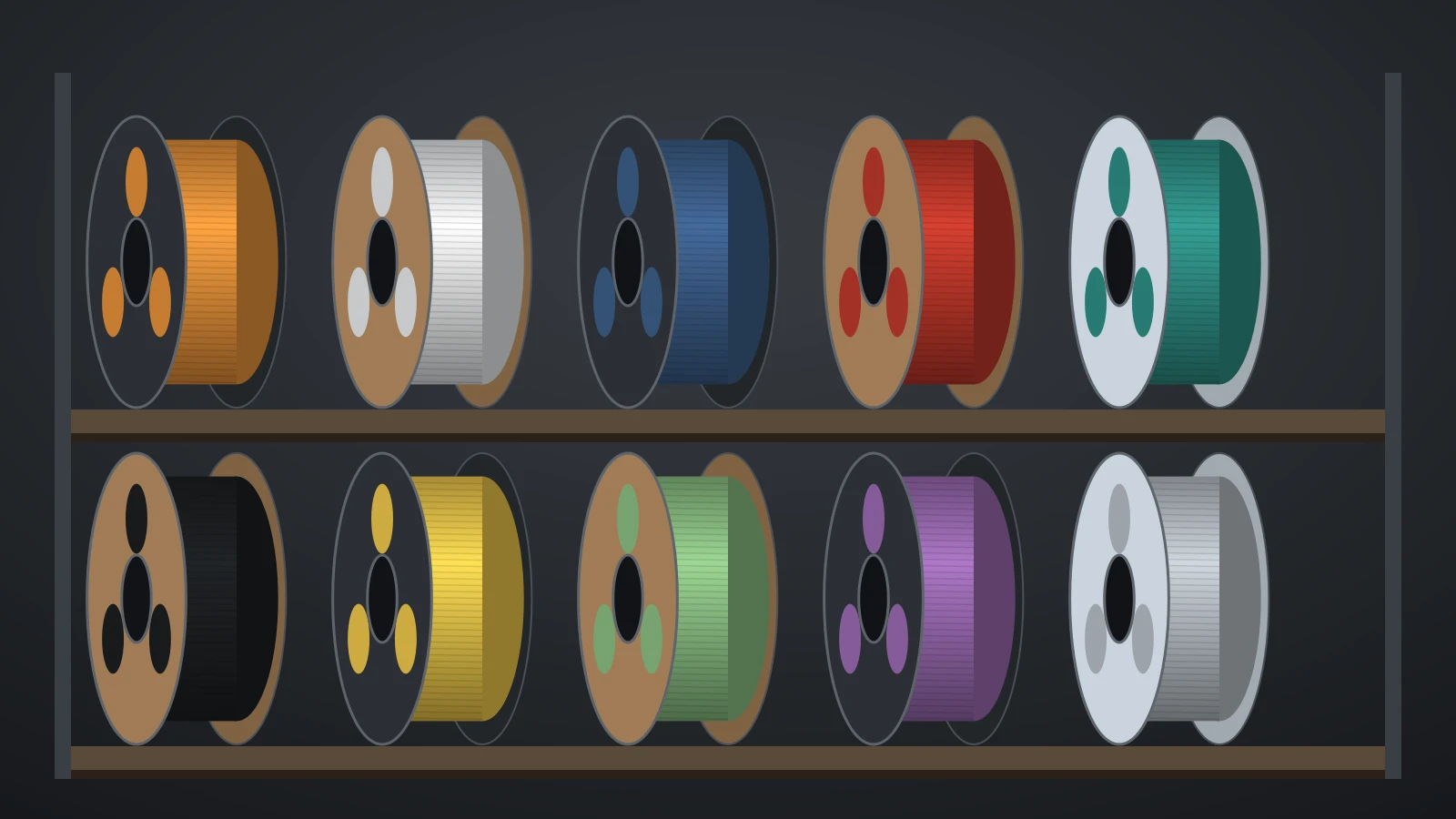

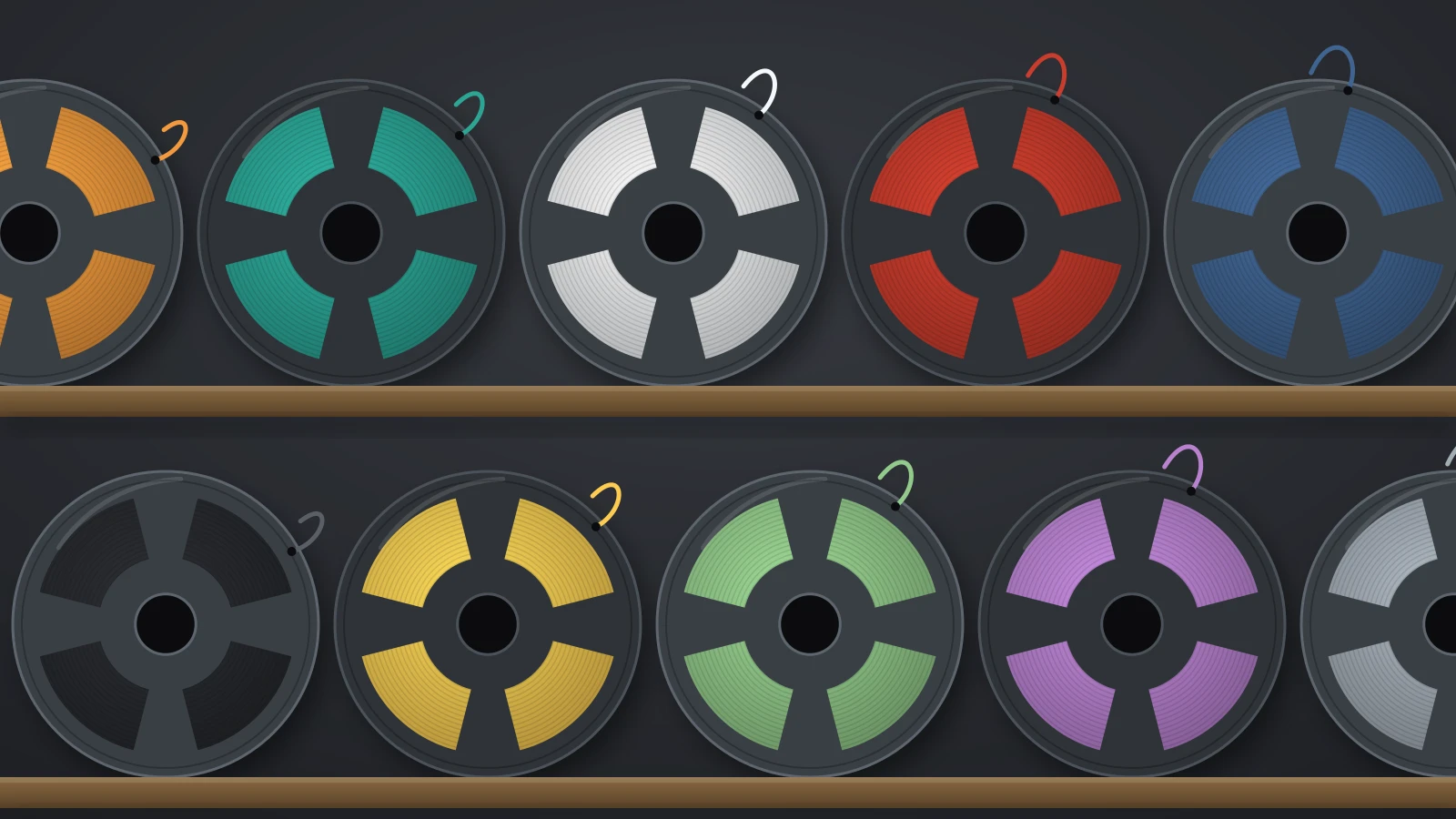
3D printer filament is a thin strand of thermoplastic wound on a spool, which a fused deposition modeling (FDM) printer melts in a hot nozzle and lays down layer by layer to build a part. Most spools hold 1 kg of 1.75 mm filament, and PLA, PETG and ABS cover most everyday prints.
Filament is the raw material of FDM 3D printing, the most common kind of home printer. Each material trades ease, strength and heat resistance differently: PLA filament suits models and prototypes, while tougher plastics take over for parts that get warm, wet or knocked.
The short answer
| Question | Answer |
|---|---|
| What it is | A thermoplastic strand on a spool, melted and extruded by an FDM printer |
| Diameter | 1.75 mm on most current printers; 2.85 mm on some |
| Standard roll | 1 kg of filament, about 335 m of 1.75 mm PLA |
| Easiest material | PLA: 190–230 °C nozzle, no enclosure |
| Stronger everyday material | PETG: 230–260 °C nozzle |
| Heat and sun | ABS indoors, ASA outdoors: 240–270 °C, enclosure |
| Check before buying | Diameter tolerance, data sheet, sealed packaging, spool fit |
| Store it | Sealed with desiccant; dry damp spools before printing |
What is 3D printer filament?
3D printer filament is a plastic wire, usually a thermoplastic that softens when heated and hardens again as it cools, sold on a spool for FDM printers. The extruder’s gears grip the strand and push it into the hotend, where it melts and leaves the nozzle as a thin bead that becomes one line of one layer.
Diameter is fixed by the printer. Bambu Lab’s data sheets list 1.75 mm, the size most current consumer machines take, while some printers take 2.85 mm, a size Polymaker also sells. A printer accepts only one; our guide to 1.75 mm filament explains why the two are not interchangeable.
What material is used in 3D printing?
FDM printers use filament, but other printer types use other materials. Resin printers cure a liquid photopolymer with light, layer by layer; our comparison of resin vs filament covers that trade-off. Industrial machines also fuse powders, including metals, which is a different process covered in our guide to metal 3D printing. When someone says “filament,” they mean the FDM strand.
Where to buy 3D printer filament and what to check
You can buy 3D printer filament from printer makers’ own stores, from filament brands and from general retailers, and the spool matters more than the shop. Check five things before you order:
- Diameter and tolerance. Match your printer, then look for a stated tolerance: ±0.03 mm for Bambu Lab PLA Basic and ±0.02 mm for most Prusament, against the ±0.05 mm that Prusa calls the industry standard.
- A technical data sheet (TDS). A good sheet lists nozzle and bed ranges, drying settings and heat deflection with the test load stated.
- Sealed packaging. A vacuum bag with desiccant; Bambu Lab’s data sheets call for printing and storage below 20% relative humidity.
- A spool that fits. Bambu Lab’s AMS takes spools 50–68 mm wide and 197–202 mm across, and Bambu Lab strongly advises an adapter ring for cardboard spools.
- Nozzle requirements. Bambu Lab calls for a hardened steel nozzle, not brass or stainless steel, with carbon fiber, glass fiber and particle-filled filaments such as glow PLA; see our 3D printer nozzle guide.
Brands differ more in what they publish than in the plastic itself. Our guide to the best filament brands compares 12 makers on tolerance, data sheets and spools.
Keep it dry after you buy
Every filament absorbs some water from the air, and some much more than others. Bambu Lab says standard PLA absorbs little water and tolerates normal storage at 50–60% room humidity, but calls PETG highly hygroscopic; damp spools string, bubble and print weak parts. Keep open spools sealed with desiccant, as our filament storage guide shows, and dry damp ones in a forced-air filament dryer, never a kitchen oven or microwave.
Common 3D printer filament materials at a glance
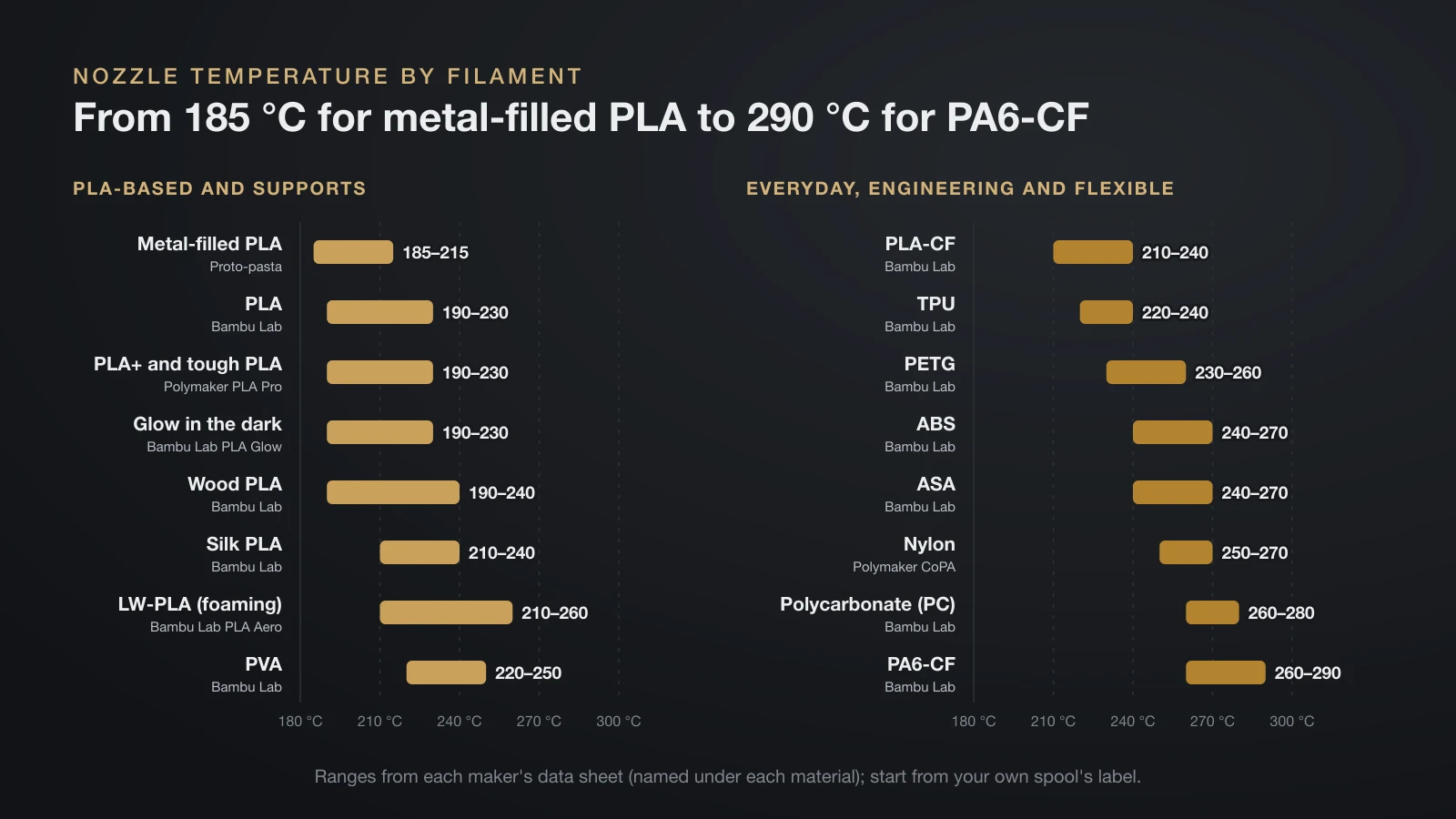
Most desktop prints use one of the materials below, and many specialty filaments are PLA or PETG with an additive. Nozzle ranges come from the named maker’s data sheet; each linked guide covers settings and properties in detail.
| Material | Good for | Nozzle temperature (maker) | Guide |
|---|---|---|---|
| PLA | Models, prototypes, decor | 190–230 °C (Bambu Lab) | PLA guide |
| PLA+ and tough PLA | Clips, brackets, everyday functional prints | 190–230 °C (Polymaker PLA Pro) | PLA plus |
| PETG | Strong functional parts, damp spots | 230–260 °C (Bambu Lab) | PETG temperature |
| ABS | Warm or knocked indoor parts | 240–270 °C (Bambu Lab) | ABS filament |
| ASA | Outdoor parts in sun | 240–270 °C (Bambu Lab) | ASA filament |
| TPU | Gaskets, bumpers, grips, phone cases | 220–240 °C (Bambu Lab) | TPU filament |
| Nylon | Gears, hinges, parts that rub | 250–270 °C (Polymaker CoPA) | Nylon filament |
| Polycarbonate (PC) | Parts facing heat and impact | 260–280 °C (Bambu Lab) | Polycarbonate |
| Carbon fiber filled | Stiff jigs, fixtures, brackets | 210–240 °C (PLA-CF) to 260–290 °C (PA6-CF), Bambu Lab | Carbon fiber filament |
| PVA | Water-soluble supports | 220–250 °C (Bambu Lab) | PVA filament |
| Silk PLA | Glossy vases, ornaments, gifts | 210–240 °C (Bambu Lab) | Silk PLA |
| Wood PLA | Wood-look decor and boxes | 190–240 °C (Bambu Lab) | Wood PLA |
| Metal-filled PLA | Heavy statues, props, trophies | 185–215 °C (Proto-pasta) | Metal filament |
| Glow in the dark | Markers, toys, night-visible parts | 190–230 °C (Bambu Lab PLA Glow) | Glow filament |
| LW-PLA (foaming) | RC aircraft, light props | 210–260 °C (Bambu Lab PLA Aero) | LW-PLA |
Multicolor prints come from either a spool with more than one color in the strand, such as gradient or dual-color silk PLA, or a printer that switches between spools during the print. Our guide to multi-color 3D printers compares the hardware options.
How to choose filament for your part
Choose filament by where the part will live and what load it will take, starting with PLA and moving up only when the part needs more. This table gives a starting point for common jobs:
| Your part | Start with | Why |
|---|---|---|
| Display models, figures, prototypes | PLA | Easiest to print, sharp detail |
| Brackets, hooks, everyday functional parts | PETG | Stronger in tension than PLA, handles damp spots |
| Parts near warm electronics or motors | ABS or PC | Heat deflection of 84 °C (ABS) and 117 °C (PC) at 1.8 MPa |
| Outdoor parts in full sun | ASA | UV and heat resistance |
| Flexible parts, grips, bumpers | TPU | Bends and absorbs impact |
| Gears, hinges, sliding parts | Nylon | Tough and low in friction |
| Stiff jigs and fixtures | Carbon fiber nylon | Stiffest common filament, 4,430 MPa modulus |
| Supports for complex overhangs | PVA | Dissolves in water; needs a multi-material printer |
For the three everyday plastics, our PLA vs PETG vs ABS comparison puts their data sheets side by side, and the strongest filament guide ranks materials by load. Then check that your printer can handle the choice:
- Enclosure: Bambu Lab recommends an enclosed printer for ABS, ASA, PC and nylon, which need hot beds and warm chambers to avoid warping and layer separation.
- Hotend temperature: PC and nylon run at about 250–290 °C, so confirm your hotend’s rated maximum.
- Nozzle: fiber and particle-filled spools need a hardened nozzle.
- Feeder: Bambu Lab does not recommend soft TPU or brittle and abrasive fiber-filled filaments in its AMS units, so check your feeder’s compatibility list.
How many grams of 3D printer filament are on a roll?
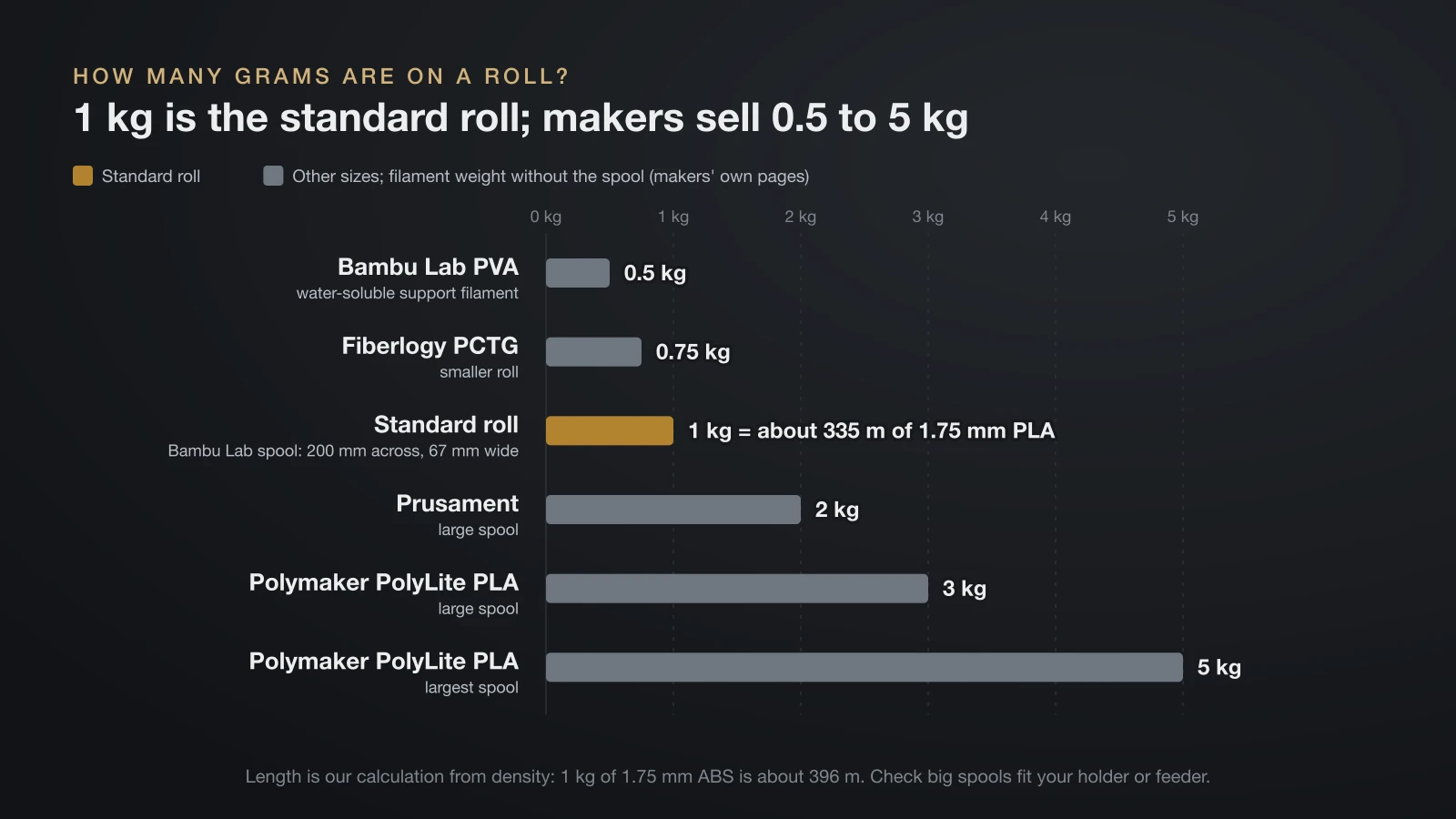
A standard roll holds 1 kg (1,000 g) of 3D printer filament, not counting the spool, but makers also sell smaller and larger sizes. Typical sizes on makers’ own pages:
- 1 kg: Bambu Lab’s standard spool, 200 mm across and 67 mm wide, also sold as a refill without the spool.
- 0.5 kg: Bambu Lab’s PVA support filament.
- 0.75 kg: Fiberlogy’s PCTG.
- 2 kg: Prusament spools, sold alongside standard spools and refills.
- 3 and 5 kg: Polymaker’s PolyLite PLA.
Length depends on density. One kilogram of 1.75 mm PLA at 1.24 g/cm³ is about 335 m (calculation: 1,000 g ÷ (1.24 g/cm³ × 0.02405 cm² cross-section) ≈ 33,500 cm). ABS, at 1.05 g/cm³, gives about 396 m from the same weight. Before buying a 3 or 5 kg spool, check that it fits your holder or feeder; Bambu Lab’s AMS, for example, takes only spools 197–202 mm across.
Price is compared per kilogram. Standard PLA, PETG and ABS form the cheapest tier, and engineering plastics cost more; our guide to 3D printer filament cost lists maker prices and a cost-per-print formula.
How to change 3D printer filament
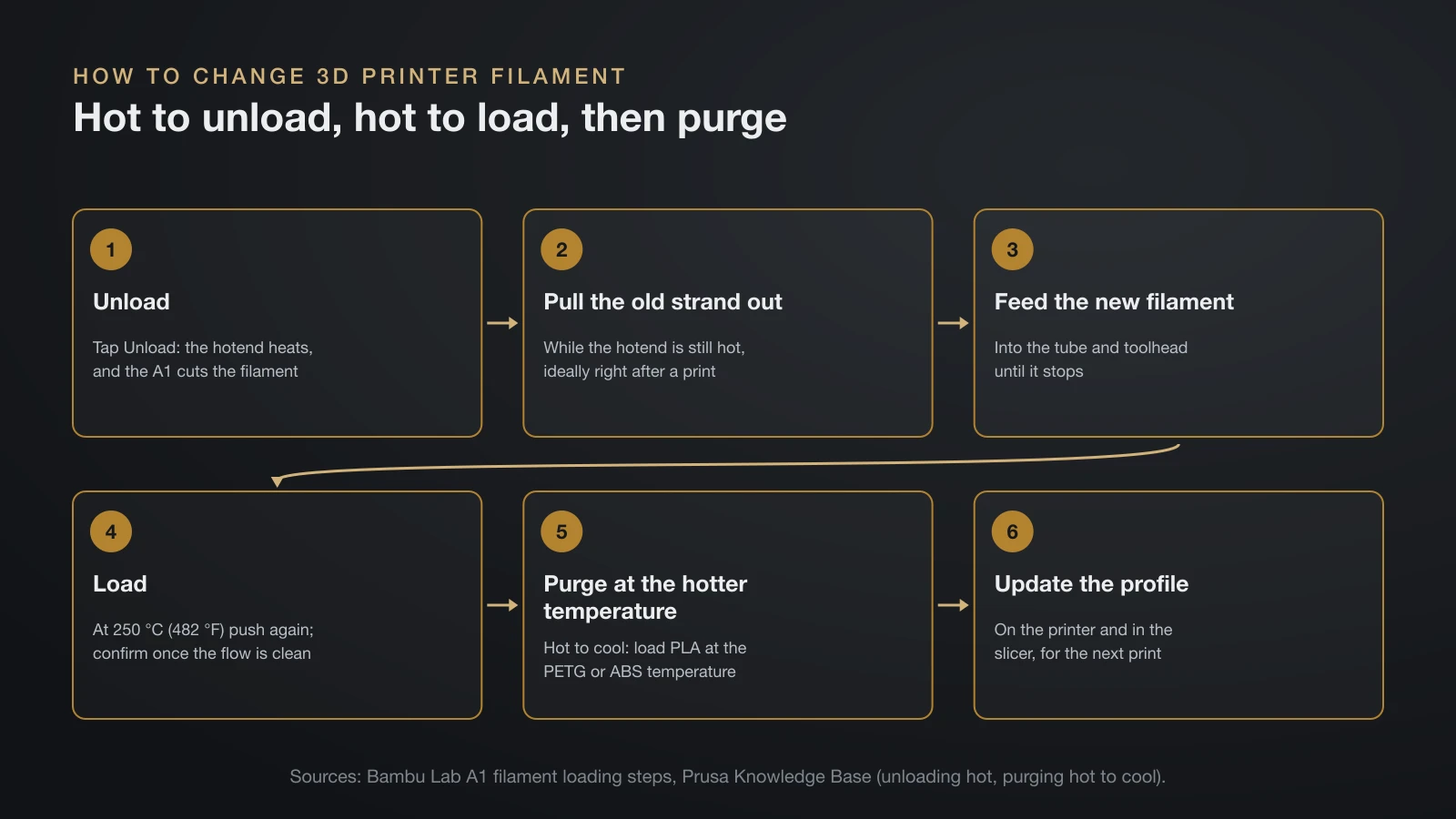
To change 3D printer filament, heat the nozzle, unload the old strand, then feed the new one until it flows cleanly from the nozzle. The routine on the A1, one of the current Bambu Lab 3D printers, is typical:
- Unload. Tap Unload on the screen. The printer heats the hotend and, on the A1, cuts the filament.
- Pull the old strand out while it is hot. Follow the prompt; Prusa also advises unloading right after a print, while the hotend is still hot.
- Feed the new filament. Push it into the tube and toolhead until it stops.
- Load. Tap Load. When the nozzle reaches 250 °C (482 °F), push the filament again and confirm once plastic flows smoothly from the nozzle.
- Purge at the hotter temperature. When switching from a hotter material to a cooler one, Prusa advises loading the new filament at the old one’s temperature, for example PLA at the PETG or ABS temperature, so it pushes the old plastic out.
- Update the filament profile on the printer and in the slicer so the next print uses the right temperatures.
Our guide on how to use a 3D printer puts loading filament in the context of a first print.
The bottom line
3D printer filament is the thermoplastic strand an FDM printer melts and stacks into parts, usually sold as 1 kg rolls of 1.75 mm filament. Start with PLA, move to PETG for tougher parts, ABS or PC for heat, ASA for sun, TPU for flex and nylon for wear. Buy spools with a stated tolerance, a data sheet and sealed packaging, and keep them dry.
Sources
- Bambu Lab: technical data sheets for PLA Basic, PETG Basic, ABS, ASA, TPU 95A HF, PC, PLA-CF, PA6-CF, PVA, PLA Silk+, PLA Wood, PLA Glow and PLA Aero; PLA Basic store page; Wiki filament guide, PLA guide, PETG guide, Notes for AMS and A1 first print with an external spool
- Polymaker: PolyLite PLA product page, PolyLite PLA Pro data sheet and PolyMide CoPA data sheet
- Prusa: How Prusament is made, Prusament PLA, Knowledge Base PLA guide, Under-extrusion and Heat creep
- Other makers’ official pages: Fiberlogy PCTG data sheet and Proto-pasta Iron-filled PLA