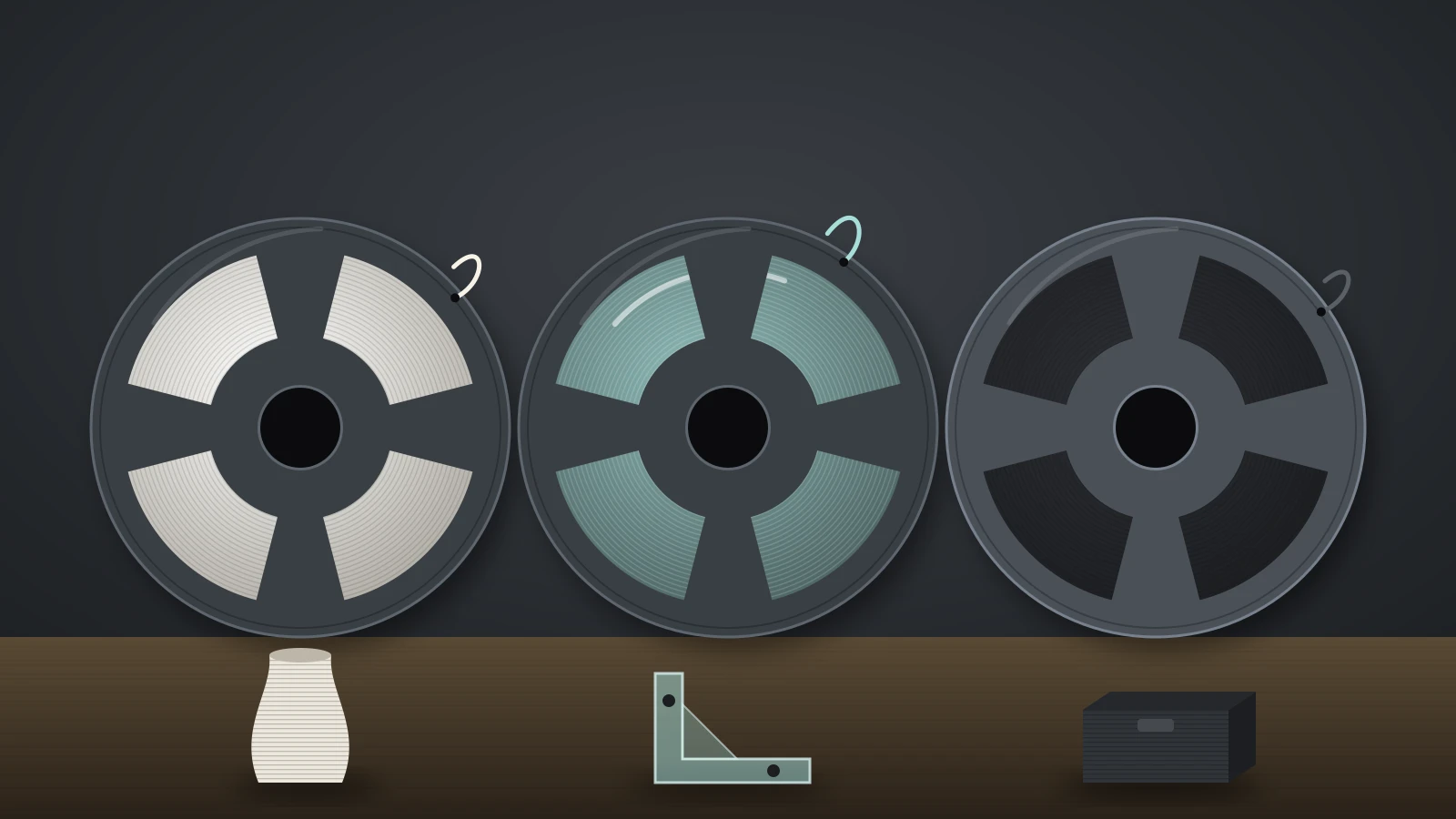

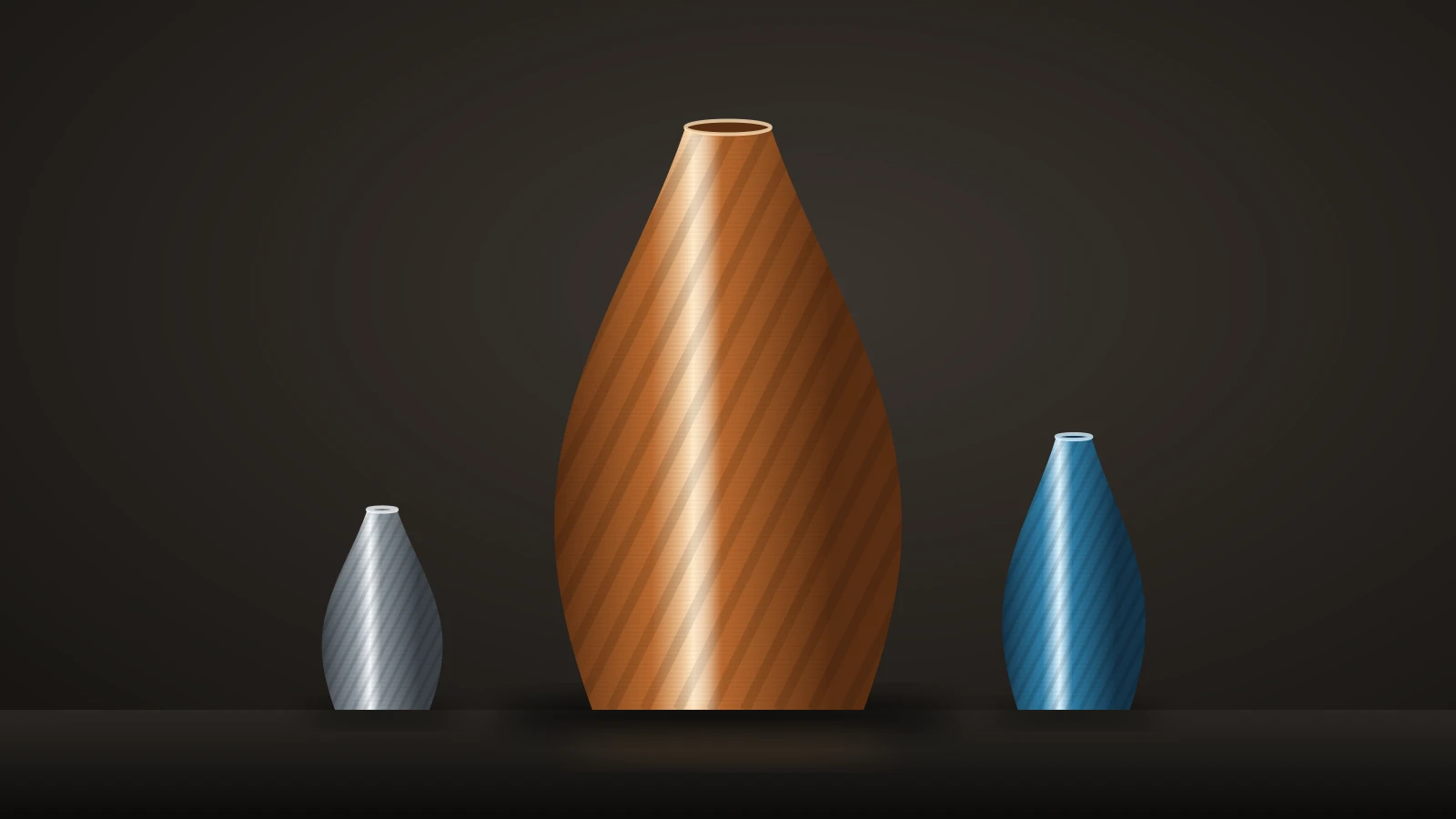
Silk PLA is standard PLA filament with additives that give printed walls a glossy, pearl-like or metallic sheen. It prints on any PLA-capable printer, usually a little hotter (about 210–240 °C on Bambu Lab’s data sheets) and with slower outer walls, and it trades some layer strength for the look.
That makes silk PLA a material for vases, ornaments, cosplay props and display pieces rather than brackets. It sits in the effect corner of the PLA filament family, next to matte, translucent and glow grades, and most brands sell it in solid, metallic and dual-color spools.
The short answer
| Silk PLA | |
|---|---|
| What it is | PLA with pearlescent additives (Bambu Lab); recipes are not published |
| Looks | High-gloss walls in solid, metallic and dual-color finishes |
| Nozzle temperature | 210–240 °C, 235 °C suggested (Bambu Lab); 190–230 °C (Polymaker Panchroma Silk) |
| Bed temperature | 35–45 °C (Bambu Lab); 25–60 °C (Polymaker) |
| Outer wall speed for best gloss | 40–60 mm/s, start at 50 mm/s (Bambu Lab) |
| Strength | Weaker between layers than regular PLA on Bambu Lab’s sheets |
| Best for | Vases, ornaments, cosplay props, figurines, gifts |
| Skip it for | Brackets, clips, hinges and other loaded parts |
What is silk PLA?
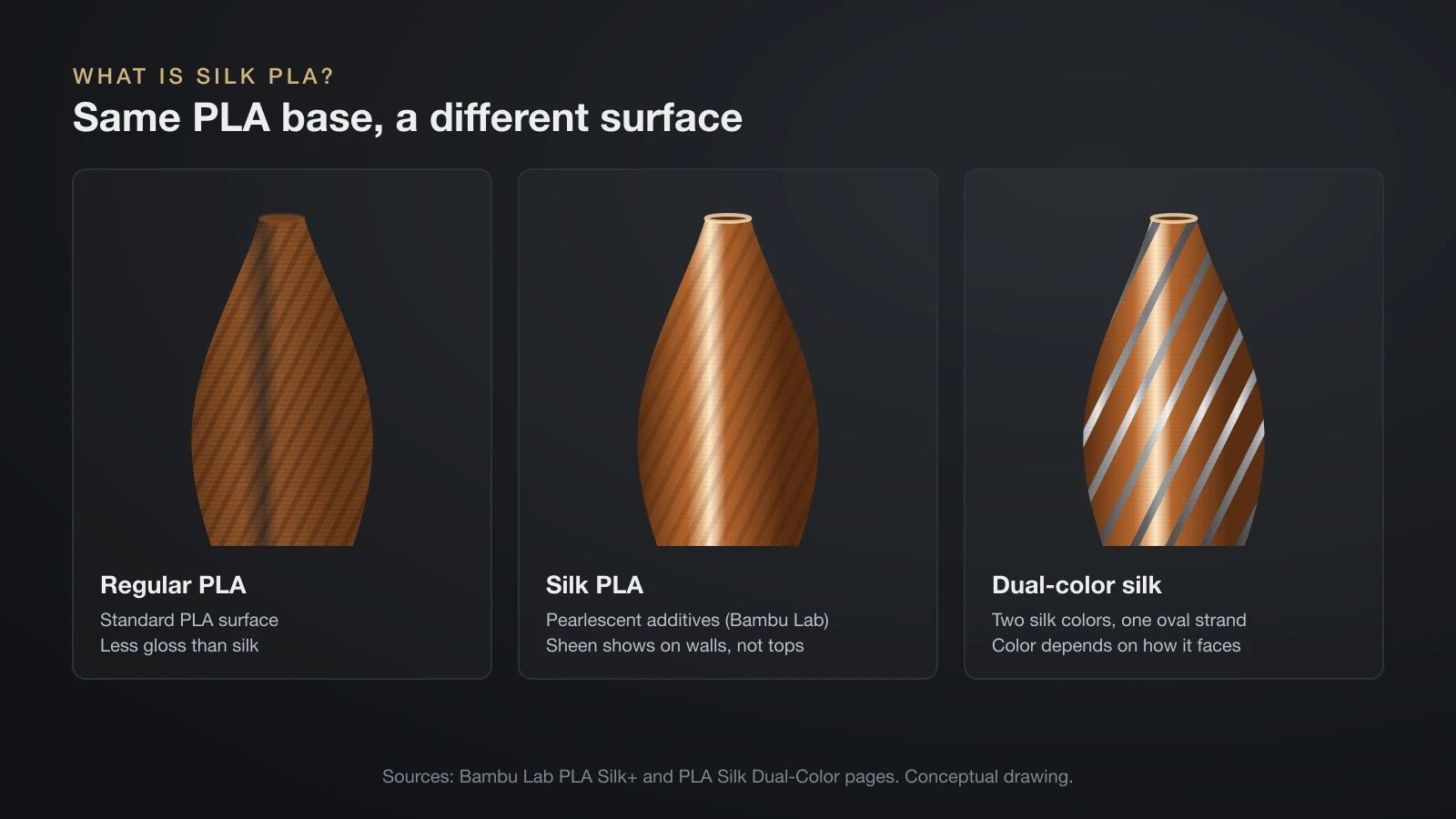
Silk PLA is polylactic acid (PLA) blended with additives that change how the surface reflects light. Bambu Lab says it makes its PLA Silk and Silk+ by adding pearlescent additives to standard PLA, giving a silk-like gloss suited to decorative parts and display models.
No maker publishes the exact recipe. Bambu Lab’s data sheets list the composition simply as polylactic acid, and the additives are what separate one brand’s silk from another’s. Bambu Lab’s PLA Silk+ has a density of 1.27 g/cm³ against 1.24 g/cm³ for its PLA Basic, so a silk spool handles and prints much like regular PLA.
Dual-color and multi-color silk
Dual-color silk puts two colors in one strand. Bambu Lab describes its PLA Silk Dual-Color as two silk colors blended into a single strand, with a cross-section that is oval rather than round, so the visible color depends on how the strand faces outward.
That shape has a side effect. Bambu Lab warns that the filament can rotate slightly during printing, causing uneven color transitions, and does not recommend dual-color silk on its A-series printers for that reason. Gradient and multi-color silk spools are another way to get color changes without extra hardware; our guide to multi-color 3D printers covers the machine-based options.
Silk PLA print settings from maker data sheets
Silk PLA uses PLA settings with a hotter nozzle and slower outer walls on most spools. Start from the numbers on your spool or its technical data sheet (TDS), because brands differ more than the label suggests.
| Setting | Bambu Lab PLA Silk+ | Bambu Lab PLA Silk (dual-color) | Polymaker Panchroma Silk |
|---|---|---|---|
| Nozzle temperature | 210–240 °C | 210–240 °C | 190–230 °C |
| Suggested nozzle | 235 °C (silk guide) | 235 °C (silk guide) | Standard PLA settings |
| Bed temperature | 35–45 °C | 35–45 °C | 25–60 °C |
| Cooling fan | On | On | On, full cooling |
| Maximum speed | Under 250 mm/s | Under 250 mm/s | Up to 250 mm/s |
| Outer walls for gloss | 40–60 mm/s | 40–60 mm/s | Slow down if the shine looks muted |
| Drying | 55 °C, 8 h | 55 °C, 8 h | 55 °C, 6 h |
The two brands disagree on nozzle size. Bambu Lab’s silk guide lists 0.2 and 0.4 mm nozzles as compatible and does not recommend 0.6 or 0.8 mm, while Polymaker suggests 0.4 mm or larger. A 0.4 mm nozzle suits both.
Temperature is the second lever. Bambu Lab says silk PLA usually needs a higher temperature to improve interlayer adhesion and recommends 235 °C (455 °F) for both the first layer and the rest. For how silk compares with other PLA types, see our PLA temperature guide.
Silk PLA sticks like any PLA. Polymaker suggests glue on PC or textured PEI sheets and letting the plate cool before removing the part; for a print that will not stay down, see 3D print not sticking to bed.
Silk PLA vs regular PLA
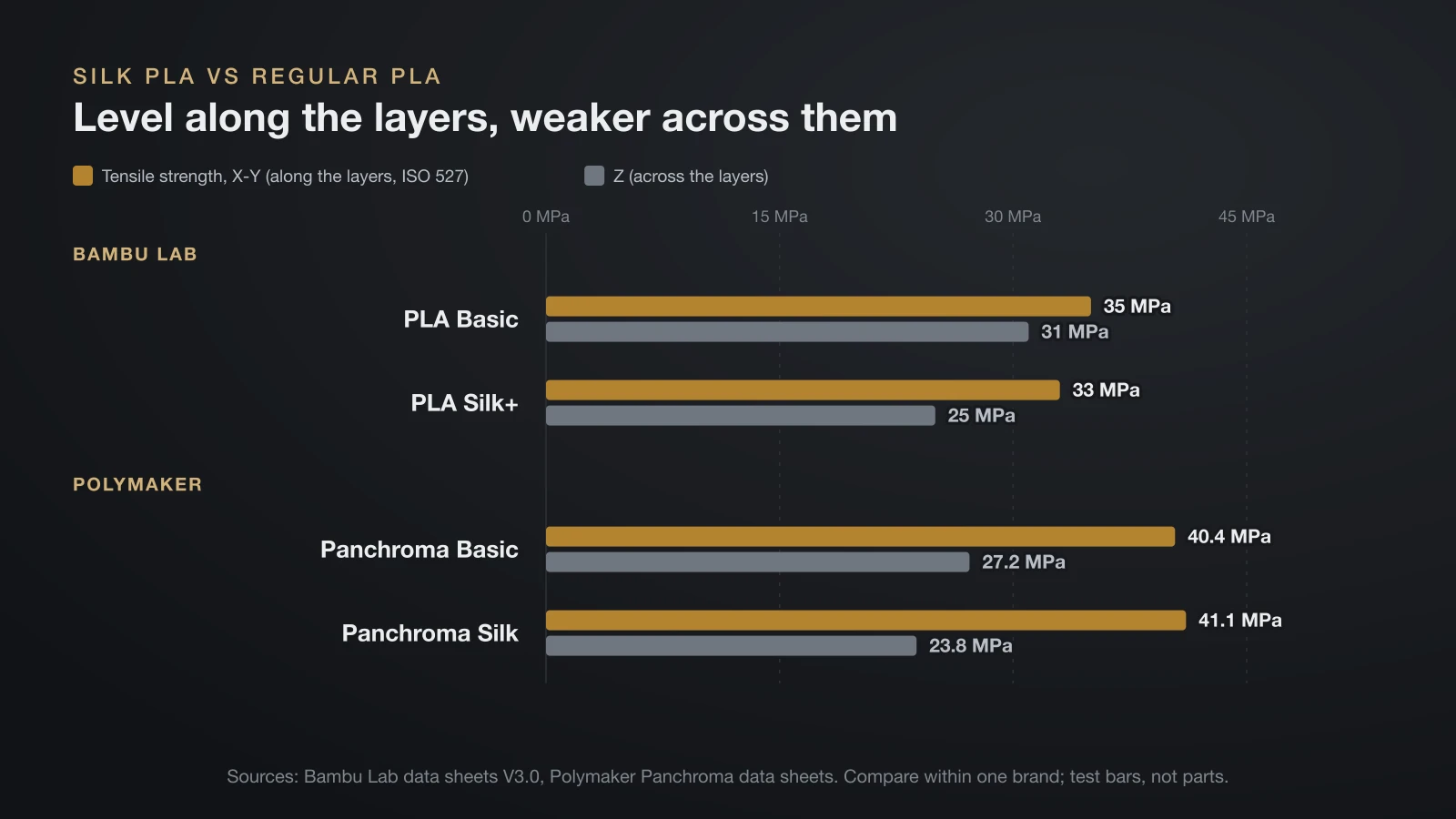
Silk PLA looks glossier than regular PLA but is usually weaker between layers and less stretchy. The fair comparison is one brand’s silk against the same brand’s standard PLA, printed and tested the same way.
| Data sheet value | Bambu Lab PLA Basic | Bambu Lab PLA Silk+ | Polymaker Panchroma Basic | Polymaker Panchroma Silk |
|---|---|---|---|---|
| Tensile strength, X-Y (ISO 527) | 35 MPa | 33 MPa | 40.4 MPa | 41.1 MPa |
| Tensile strength, Z (ISO 527) | 31 MPa | 25 MPa | 27.2 MPa | 23.8 MPa |
| Impact strength (ISO 179) | 13.8 kJ/m² (Z) | 8.5 kJ/m² (Z) | 6.76 kJ/m² (notched, X-Y) | 13.8 kJ/m² (notched, X-Y) |
| Elongation at break, X-Y | 12.2% | 2.8% | Not listed | Not listed |
| Heat deflection, 1.8 MPa (ISO 75) | 54 °C | 56 °C | Not listed | Not listed |
X-Y bars are printed flat, so the pull runs along the layers; Z bars stand upright, so the pull separates the layers. What the numbers show:
- Along the layers, silk is about as strong as regular PLA. Bambu Lab calls its X-Y strength basically equivalent, and Polymaker’s silk is level with its basic PLA.
- Across the layers, silk is weaker. Bambu Lab’s Silk+ keeps 25 of PLA Basic’s 31 MPa in Z, and Bambu Lab rates its PLA Silk at about 65% of PLA Basic’s Z strength. Polymaker’s silk drops from 27.2 to 23.8 MPa.
- Bambu Lab’s silk stretches less. At 2.8% elongation against 12.2%, Silk+ snaps rather than bends, which is why thin parts break more easily.
- Not every silk is brittle. Polymaker says its reformulated Panchroma Silk solves the brittleness and clogging of older silk, and its notched impact value is double that of Panchroma Basic.
Heat resistance is the same story as any PLA: Silk+ deflects at 56 °C (133 °F) under load, so keep silk prints out of hot cars and sunny windows.
How to get the best shine from silk PLA
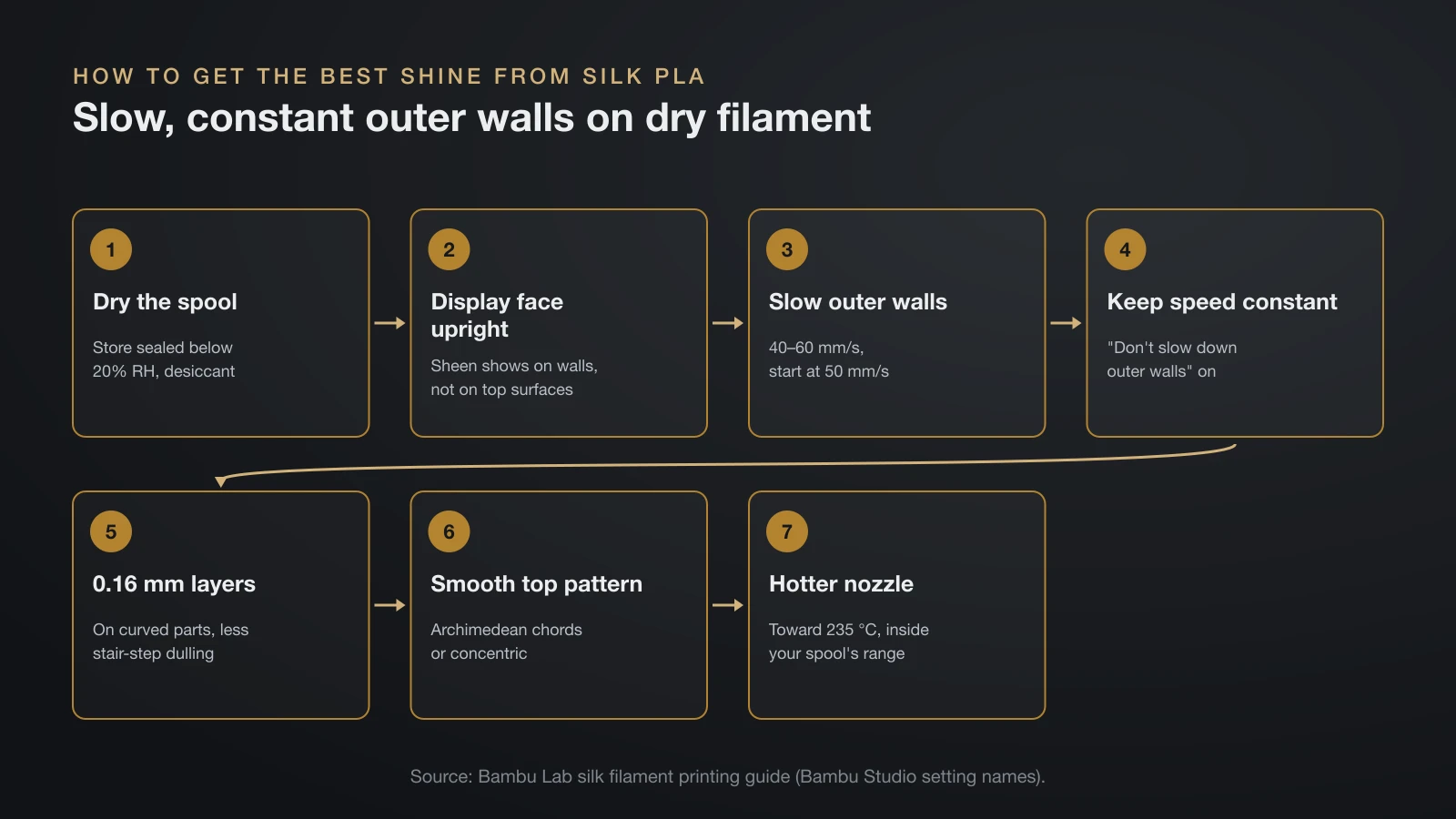
The best silk PLA shine comes from slow, constant outer walls, a slightly hotter nozzle and dry filament. Bambu Lab’s silk guide breaks gloss down into three factors (outer wall speed, nozzle temperature and speed consistency) and adds a few slicer steps:
- Dry the spool. Bambu Lab says silk filament absorbs moisture relatively easily when left out, which causes stringing and uneven gloss. Store it sealed below 20% relative humidity with desiccant.
- Orient the display surface upright. The sheen shows on walls, not on top surfaces, so stand the main face perpendicular to the plate.
- Slow the outer wall to 40–60 mm/s, starting at 50 mm/s. Low speed gives the plastic time to level out; high speed adds micro-roughness that scatters light.
- Keep that speed constant. In Bambu Studio, enable “Don’t slow down outer walls” so cooling slowdowns do not leave duller bands.
- Use thinner layers on curved parts. Bambu Lab recommends 0.16 mm to reduce the stair-step look that dulls sloped surfaces.
- Pick a smooth top pattern. Archimedean chords or concentric top surfaces give a glossier top shell.
- Raise the nozzle moderately, toward 235 °C on Bambu Lab’s silk filaments, staying inside your spool’s range.
Polymaker’s guidance is simpler: its new silk keeps its shine up to 150 mm/s, and it suggests slowing down only if the effect looks muted.
Common silk PLA problems and fixes
Most silk PLA problems are dull patches, weak or snapping parts, stringing and the occasional clog. The table pairs each symptom with the makers’ fixes.
| Problem | Likely cause | Fix |
|---|---|---|
| Patchy gloss, bright and dull areas | Outer wall speed changes across the part | Even out the speed, enable “Don’t slow down outer walls” (Bambu Lab) |
| Dull surface overall | Walls printed too fast | Outer walls at 40–60 mm/s |
| Layers split or parts snap | Weaker interlayer bonding | Turn the part so loads run along the layers; add walls and infill (Bambu Lab) |
| Thin, tall parts break mid-print | Brittleness and vibration | Print slower and add supports to slender features (Bambu Lab) |
| Stringing | Damp filament | Dry at 55 °C, then store sealed |
| Clogs or snapped filament | Some silk formulas | Polymaker names clogging and snapping as common in generic silk; try another brand’s formula |
| Uneven color on dual-color silk | Oval strand rotating | Bambu Lab advises against A-series printers for dual-color silk |
What to print with silk PLA
Silk PLA is best for objects people look at rather than load. Bambu Lab aims it at decorative parts and display models, and Polymaker lists home décor, cosplay props, flexi toys, sculptures, miniatures and gifts.
- Vases and planters: spiral vase mode prints one continuous wall, which is all surface and shows the sheen well. Add a glass insert if a single wall must hold water.
- Cosplay props and armor details: metallic silk colors imitate gold, copper and steel without paint; see our 3D printed cosplay guide for sizing and wearable parts.
- Ornaments, figurines and sculpture: curved, upright surfaces suit silk best, as our guide to 3D printed art shows.
- Gifts and decor in effect filaments: silk pairs well with other effect PLAs such as glow in the dark filament for lettering or accents.
If clarity rather than gloss is the goal, silk is the wrong spool; clear PLA covers lamp shades and light-diffusing prints.
Can you paint or sand silk PLA?
You can sand and paint silk PLA, but doing so removes the reason to print in silk. The sheen is the printed surface itself, so sanding scuffs it and primer covers it completely.
For parts you plan to paint anyway, print in a standard or matte PLA, which takes primer well and costs less. Our guide on how to paint 3D prints covers primers and finishes. If you choose silk, do the finishing in the slicer: orientation, slow walls and a smooth top pattern.
The bottom line
Silk PLA is regular PLA with pearlescent additives, printed on the same machines but a little hotter and with slow, constant outer walls for the best gloss. On Bambu Lab’s data it is about as strong as PLA along the layers but weaker across them and less stretchy, while Polymaker’s new formula narrows that gap. Use it for vases, props and display pieces, dry it before printing and compare brands on their data sheets; our overview of filament brands shows what each one publishes.
Sources
- Bambu Lab technical data sheets (PLA Silk+ V1.0, PLA Silk and PLA Basic V3.0): PLA Silk+, PLA Silk (dual-color) and PLA Basic, PLA Tough+ (composition, nozzle and bed ranges, speed, fan, drying, tensile, impact, elongation, heat deflection, Tough+ impact)
- Bambu Lab Wiki: PLA Silk / Silk+ printing guide and PLA usage guide (pearlescent additives, outer wall 40–60 mm/s, 235 °C, 0.16 mm layers, top patterns, nozzle compatibility, oval dual-color strand, drying and storage, Z strength about 65% of PLA Basic, orientation and slender-part advice)
- Polymaker: Panchroma Silk PLA product page and Panchroma technical data sheet V2.1 (190–230 °C nozzle, 25–60 °C bed, up to 250 mm/s, shine kept to 150 mm/s, drying, nozzle and plate tips, tensile and impact values, uses, reformulation claims)