

3D printed car parts work well for interior clips, cup holders, phone mounts, vent clips, knobs, covers, organizers and discontinued plastic trim, as long as the material can take the heat of a parked car. Never print safety-critical parts: brakes, steering, suspension, seat belts, airbag components, wheels or anything in the fuel system.
The line between a useful print and a dangerous one comes down to two questions: what happens if the part fails, and how hot does it get? This guide answers both with real temperature data, then shows how to measure and design a replacement part that fits. For projects beyond the car, browse our 3D print ideas.
The short answer
| Examples | Material | |
|---|---|---|
| Good to print | Trim clips, cup holder inserts, phone mounts, vent clips, organizers, covers, knobs for non-safety controls | ASA or ABS; PETG in shaded spots |
| Print with care | Parts on the dashboard or rear shelf in direct sun, exterior trim, under-hood covers away from heat sources | ASA, PC or nylon-carbon fiber; inspect often |
| Never print | Brakes, steering, suspension, seat belts, airbags, wheels, fuel system, lighting | Buy genuine or certified parts |
| Avoid PLA | Anything that stays in the car in summer | PLA softens at about 55 °C (131 °F) |
What car parts can you 3D print at home?
The best candidates are small, non-structural plastic parts that are cheap to replace if they fail, or that you can no longer buy. If a part breaking would only be annoying, it is a good project; if it could hurt someone, it is not.
| Part | Why printing works | Notes |
|---|---|---|
| Trim clips and push pins | Tiny, cheap to print, often sold only in bulk packs | Print several and keep spares |
| Cup holder inserts and adapters | Easy to customize for bottles and mugs | Round the edges; use ASA or PETG |
| Phone and dash mounts | Custom fit for your phone, case and vent | Sun-exposed, so choose ASA or ABS |
| Vent clips and air freshener holders | Clips wear out and break | Thin clips need a tough filament |
| Covers, caps and blanking plates | Fill empty switch slots or replace lost caps | Sand and paint to match the trim |
| Console, trunk and door-pocket organizers | Made to fit your exact car | Often too big for one print; split them |
| Knobs for non-safety controls | Replace cracked or missing knobs | Test-fit the shaft size in PLA first |
Restoring discontinued plastic parts
For older cars, printing is often the only way to replace a small plastic part the manufacturer no longer makes: a bezel, a clip, a console latch or a knob. Measure what is left of the original, print a quick PLA version to check the fit, then print the final part in ASA or ABS and finish it to match the surrounding trim.
If the original carried a logo or emblem, reproduce the shape but leave the branding off, especially if you plan to sell copies. Car brand logos are trademarks.
Jigs, fixtures and garage tools
Some of the most useful car-related prints never go into the car. Drilling jigs, alignment templates, socket organizers and custom holders for workshop tools are ideal projects, because a failure costs you time, not safety. Our guide to 3D printed tools covers what printed tools can and can’t handle.
Car parts you should never 3D print
Some parts should never come off a home printer, no matter how strong the filament claims to be. Federal Motor Vehicle Safety Standards (49 CFR Part 571) set requirements for many of these systems, including brakes, lamps, occupant crash protection, seat belt assemblies and fuel system integrity. A home print has never been tested against any of them.
- Brakes: calipers, brake lines, pedals, master cylinder parts and brake light switch parts.
- Steering and suspension: tie rods, bushings, mounts, links and anything that carries the car’s weight or steering load.
- Seat belts and seats: buckles, anchors, retractor parts, seat rails and seat mounts.
- Airbags and the trim that covers them: a printed cover over an airbag can change how it deploys or break into fragments.
- Wheels and wheel hardware: wheels, wheel spacers, lug nuts and anything clamped by them.
- Fuel system: fuel caps, lines, fittings and anything touching fuel or fuel vapor.
- Lighting and glazing: headlight or tail light lenses and housings, and anything replacing window glass.
- Emissions equipment: removing or modifying emissions controls is prohibited under the federal Clean Air Act.
The reasons are the same across the list. FDM parts are weakest between layers, so they can split along a layer line under loads they would survive in another direction. Plastics also creep, slowly deforming under constant load, especially when warm. A part can look fine for months and then fail without warning, and in these systems a failure can cause a crash or injury.
How hot does a parked car get?
Heat is the test that rules out most filaments. In a study by Arizona State University and UC San Diego researchers, cars parked in the sun in Tempe, Arizona, on days above 100 °F (38 °C) reached these average temperatures after one hour:
| Surface | Parked in sun | Parked in shade |
|---|---|---|
| Cabin air | 47 °C (116 °F) | about 38 °C (100 °F) |
| Dashboard | 69 °C (157 °F) | 48 °C (118 °F) |
| Steering wheel | 53 °C (127 °F) | 42 °C (107 °F) |
| Seats | 51 °C (123 °F) | 41 °C (105 °F) |
Two points matter for printed parts. Surfaces in direct sun, such as the dashboard, get much hotter than the air. And these are one-hour averages; a car left all afternoon in a hot climate can be hotter still. Treat the dashboard figure as a minimum for anything mounted on or near it.
Best material for 3D printed car parts
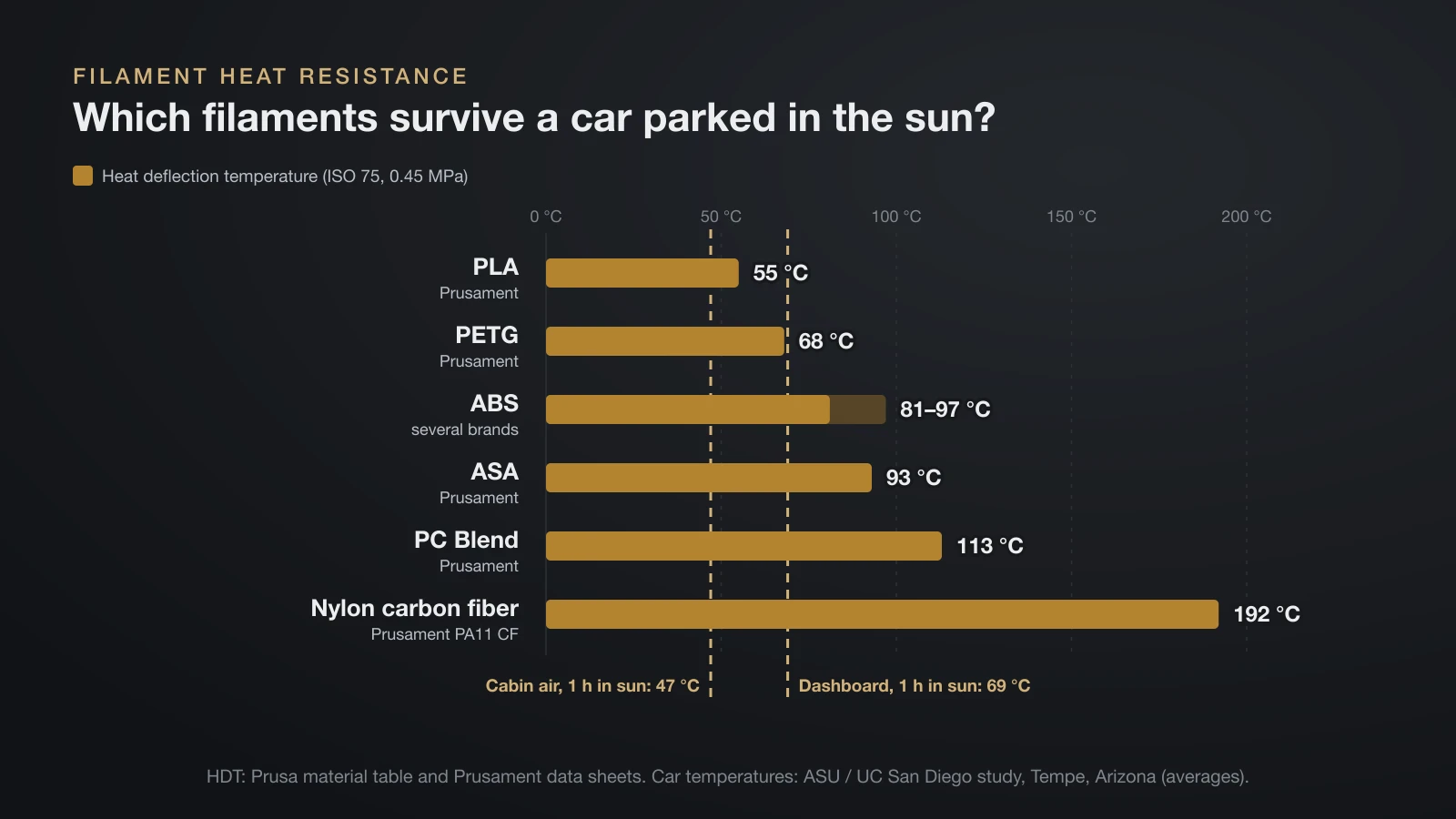
The number to compare is heat deflection temperature (HDT): the point at which a standard test bar bends under a light load (ISO 75, 0.45 MPa). Prusa’s material table and Prusament’s data sheets list these values for common filaments:
| Material | Heat deflection (ISO 75, 0.45 MPa) | Verdict for car interiors |
|---|---|---|
| PLA (Prusament) | 55 °C (131 °F); most PLAs listed at 50–58 °C | Test fits only |
| PETG (Prusament) | 68 °C (154 °F); others listed at 63–78 °C | Shaded parts only |
| ASA (Prusament data sheet) | 93 °C (199 °F) | Good default, UV resistant |
| ABS (several brands) | 81–97 °C (178–207 °F) | Good, but less UV resistant than ASA |
| PC Blend (Prusament) | 113 °C (235 °F) | Hotter spots; hard to print |
| Nylon carbon fiber (Prusament PA11 CF) | 192 °C (378 °F) | Highest heat; needs a hardened nozzle |
HDT is not a safe operating temperature. A part under constant load, like a phone mount holding a phone, starts to creep below its HDT, so leave a margin. Prusa notes that PLA parts start to lose mechanical strength above 60 °C (140 °F), below the average sun-exposed dashboard in the Arizona study.
In practice:
- ASA is the usual choice for car parts: good heat resistance and much better sunlight resistance than ABS. Our ASA filament guide covers settings and pitfalls.
- ABS works for interior parts out of the sun, and it can be smoothed with acetone.
- PETG is fine for trunk organizers and parts low in the cabin, away from windows.
- PC and nylon-carbon fiber cover hotter spots, such as under-hood covers away from the engine and exhaust. Nylon absorbs moisture from the air, so read our nylon filament guide on drying and print settings before you try it.
- PLA is for prototypes and fit checks, not parts that stay in the car.
ASA and ABS warp badly on open-frame printers and release styrene fumes while printing. They print best in an enclosure, in a ventilated room; see our guide to enclosed 3D printers.
How to measure and design 3D printed car parts
A replacement part only helps if it fits. The workflow below works for most small interior parts.
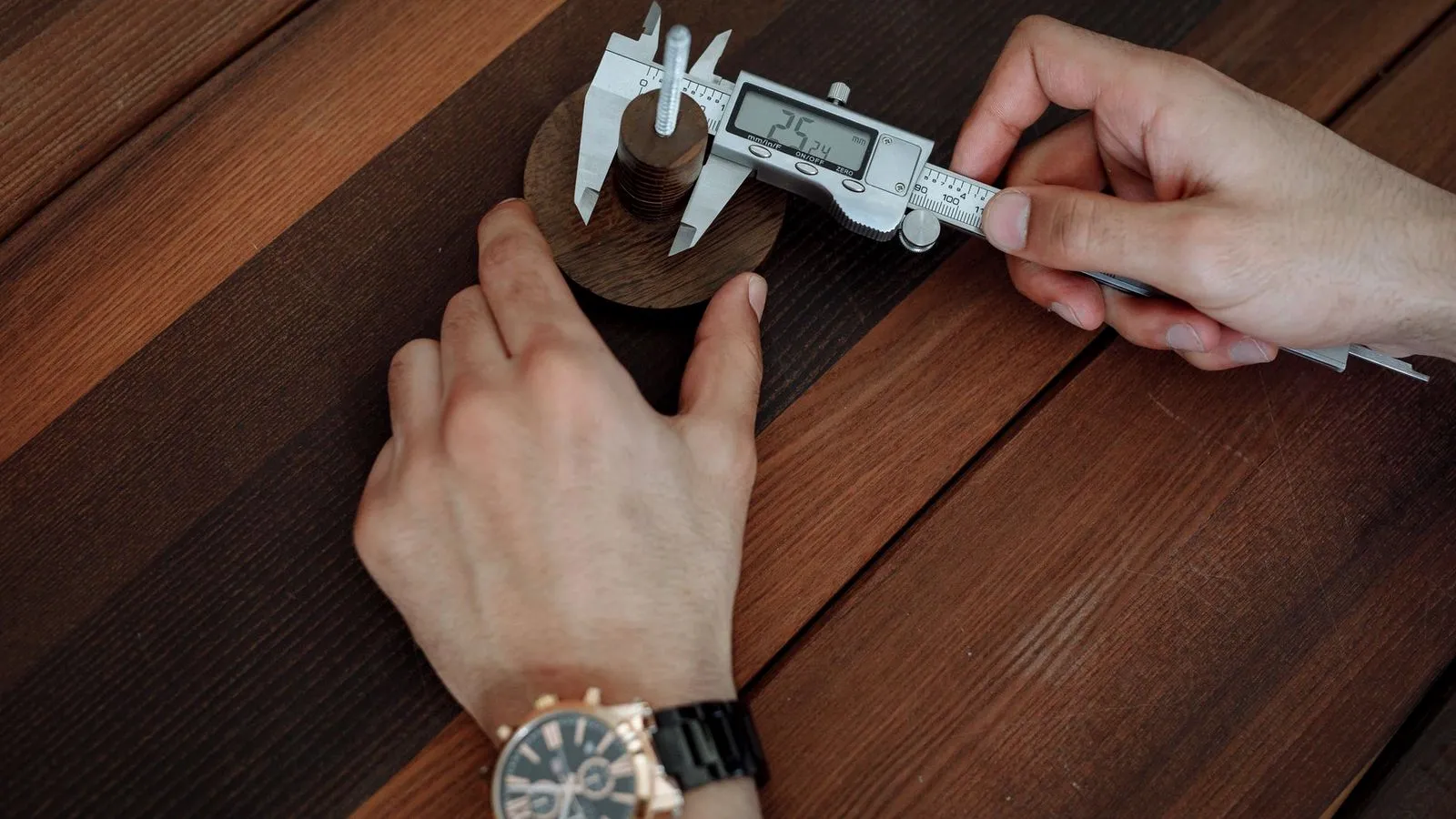
- Measure the original: use digital calipers for hole diameters, wall thicknesses, clip widths and the distance between mounting points. Measure each dimension twice.
- Photograph and sketch: take straight-on photos next to a ruler, and sketch the part with every measurement written on it.
- Model in CAD: a free parametric CAD program lets you change one dimension later without redrawing the part. Start from simple shapes and add details last.
- Print a fit test in PLA: it is fast and cheap. Check the fit in the car, adjust the model and repeat until it snaps in cleanly.
- Orient for strength: lay clips and tabs so they flex along the layers, not across them, because parts break most easily between layers.
- Print the final part: switch to ASA or ABS, add extra walls where clips flex, and test it in the car before relying on it.
For curved parts that are hard to measure, such as a bezel or a dashboard panel, a 3D scanner or phone photogrammetry app can capture the shape as a reference. Scans rarely produce a print-ready file, but they give you accurate curves to model over.
How automakers use 3D printed parts
Carmakers do use 3D printing, mostly in industrial processes and materials rather than desktop printers. General Motors says it has used additive manufacturing for decades to make functional prototypes, and it now uses it in low-volume production: the Cadillac CELESTIQ has more than 130 parts produced with additive manufacturing, including window switches, grab handles and console decor.
Those parts go through the automaker’s engineering and testing process, often with a supplier producing the final version. That is the key difference from a home print that looks similar but has never been validated.
Is it legal to 3D print car parts?
This is general information, not legal advice. Printing a replacement cup holder or clip for your own car is an everyday hobby project. The legal questions start when parts affect safety, emissions or other people.
- Safety standards: new vehicles must meet the federal safety standards. Interior materials, for example, fall under Standard No. 302, which limits how fast they may burn, to no more than 102 mm per minute in the test. Home prints are not tested to these standards.
- Emissions: tampering with emissions controls is prohibited under federal law.
- Inspection and insurance: state inspection rules differ, and a modified safety or lighting part can fail inspection or complicate a claim.
- Selling parts: selling prints raises product liability and trademark questions that do not apply to a part in your own garage.
If a part touches any of these areas, buy the genuine or certified part instead.
The bottom line
3D printed car parts are worth it for clips, holders, mounts, covers, organizers and discontinued trim, printed in a heat-resistant filament such as ASA or ABS. A dashboard in the sun averaged 69 °C (157 °F) after an hour in one Arizona study, so PLA belongs in the car only as a fit test. Anything that keeps you on the road or protects you in a crash, from brakes to seat belts to airbags, should never be printed at home.
Sources
- Prusa Knowledge Base: Filament material guide and material table (heat deflection temperatures, ISO 75 at 0.45 MPa: Prusament PLA 55 °C, PETG 68 °C, PC Blend 113 °C, PA11 Carbon Fiber 192 °C; PLA brands 50–58 °C; PETG brands 63–78 °C; ABS brands 81–97 °C)
- Prusament: ASA material page and technical data sheet (heat deflection 93 °C at 0.45 MPa) and PLA material page (PLA parts start to lose mechanical strength above 60 °C)
- Arizona State University: Hot cars can hit deadly temperatures in as little as one hour (cabin, dashboard, steering wheel and seat temperatures after one hour in sun and shade; study published in the journal Temperature)
- General Motors: Cadillac showcases 3D-printed precision with CELESTIQ (more than 130 additive manufactured parts; window switches, grab handles, console decor; prototyping use)
- eCFR: 49 CFR Part 571, Federal Motor Vehicle Safety Standards (standards for brakes, lamps, occupant crash protection, seat belts, fuel system integrity; Standard No. 302 burn rate limit of 102 mm per minute)