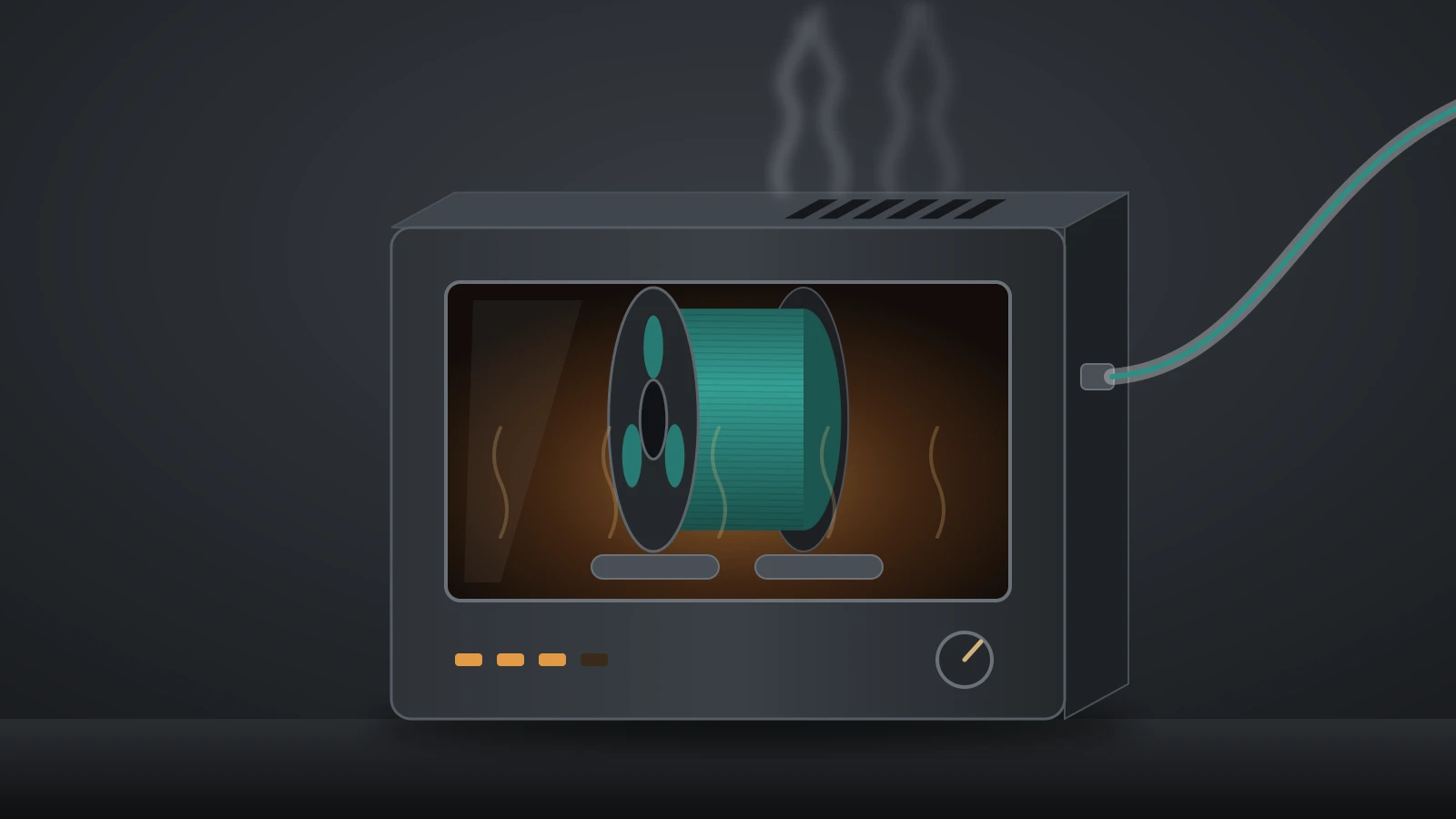
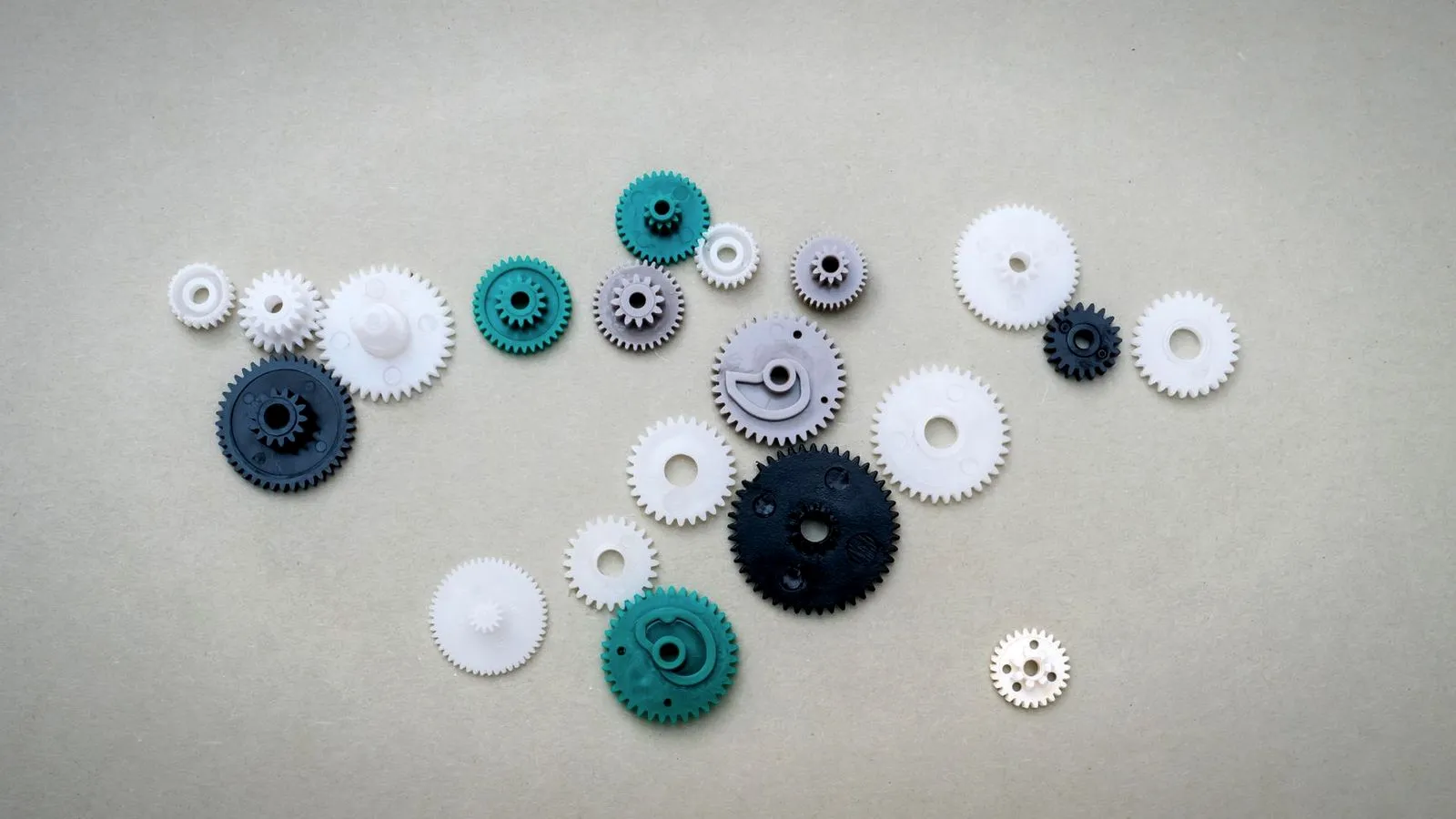
Nylon filament (polyamide, or PA) is a tough, low-friction 3D printing plastic for gears, hinges, clips and other parts that must flex, slide or take knocks. It is worth the effort when PLA or PETG would crack or wear out, but it soaks up water, needs drying before printing and prints hot, at roughly 250–300 °C (482–572 °F).
Most unfilled nylons also warp, so they print best in an enclosed 3D printer on a bed surface made for polyamides. This guide compares nylon types using data sheet numbers from Prusament and Polymaker, then covers drying, print settings, nylon vs PETG, finishing and fumes.
The short answer
| Nylon filament | |
|---|---|
| What it is | Polyamide (PA): PA6, PA6/66 copolymers, PA11, PA12, often filled with carbon or glass fiber |
| Best for | Gears, bushings, hinges, snap fits, clips, parts that flex or rub |
| Nozzle temperature | 250–270 °C (Polymaker CoPA), 275 ± 10 °C (Prusament PA11), 280–300 °C (Polymaker carbon fiber PA6 and PA12) |
| Bed temperature | From 25–50 °C (Polymaker CoPA) to 100 ± 10 °C (Prusament PA11) |
| Build surface | PA Nylon sheet with a thin glue layer (Prusa); PC or textured PEI, glue when needed (Polymaker) |
| Enclosure | Needed for unfilled grades; Prusament PA11 asks for a 55 °C chamber |
| Drying | 90 °C for 6–8 h (Prusament PA11), 100 °C for 8 h (Polymaker CoPA) |
| Storage | Below 20% relative humidity while printing (Polymaker) |
| Nozzle | Hardened for carbon or glass filled nylon; standard brass for Prusament PA11 |
| Fumes | Odor and ultrafine particles: ventilate or use a filtered enclosure |
| Skip it for | Decorative prints, hotends not rated for 250 °C and up, spools you cannot keep dry |
What is nylon filament?
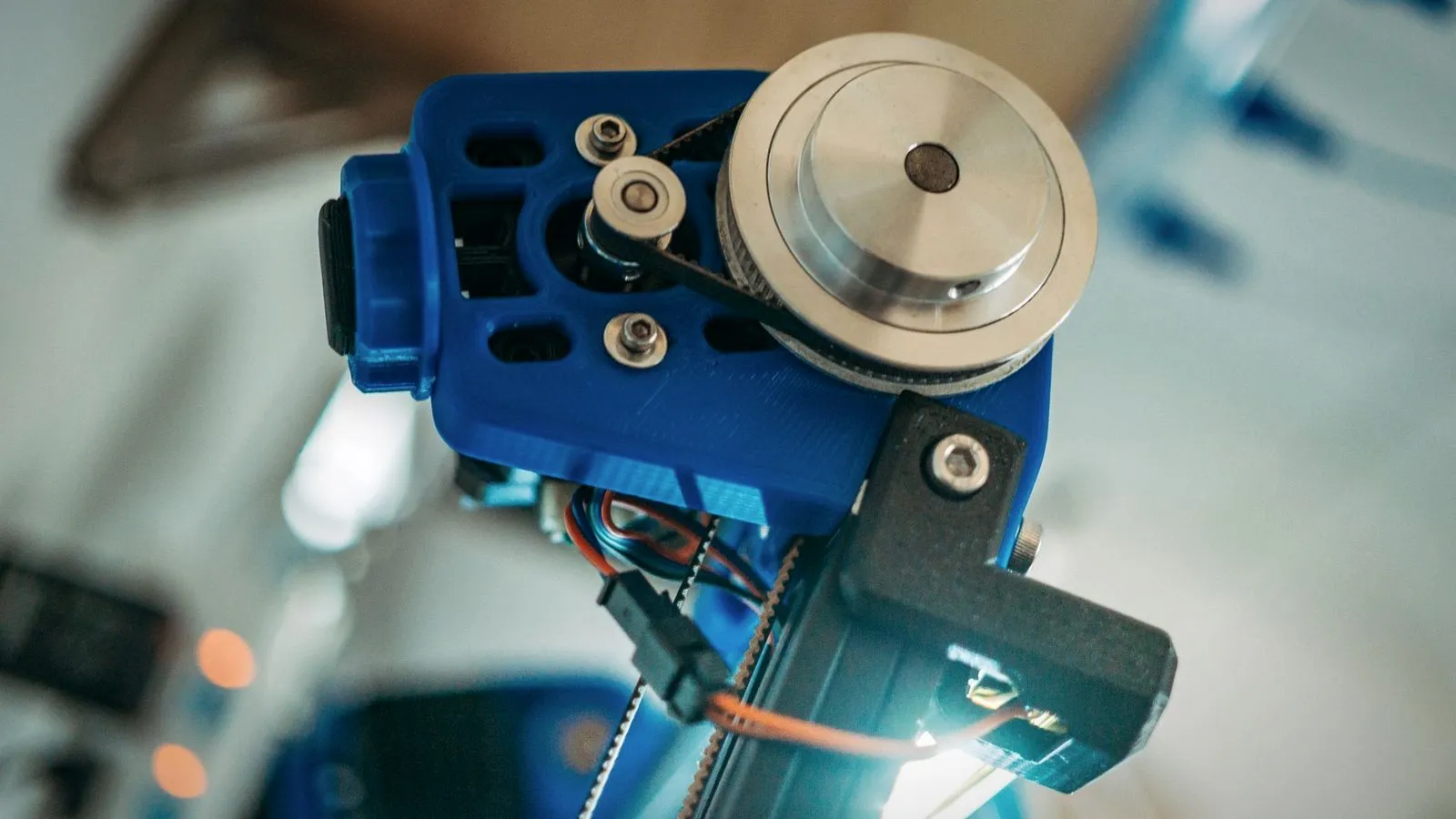
Nylon is the common name for polyamide (PA), a family of engineering plastics. Prusa describes polyamide as extremely resilient and resistant to abrasion, with excellent layer adhesion and a low coefficient of friction. Thin nylon walls stay flexible, while thick sections are strong, which is why the same material works for living hinges and for gears.
The catch is water. Prusa calls polyamide highly hygroscopic and warns that poorly stored filament can absorb water weighing up to 10% of its own weight. Moist filament prints with bubbles, uneven layers and a rough surface, and Polymaker notes that finished parts keep absorbing moisture, so their dimensions can change slightly.
What people print with nylon
- Gears and moving parts: Prusament recommends its PA11 for gears because of its low friction and good abrasion resistance.
- Hinges, clips and bendable parts: Prusa lists bendable objects among its polyamide sample prints.
- Shop fixtures: jigs and holders that get knocked around; see our guide to 3D printed tools.
- Chemical-exposed parts: Prusament lists PA11 as resistant to motor oil, petrol, diesel, acetone, toluene and alcohols.
- Hot spots in vehicles: carbon fiber nylon, as discussed in our 3D printed car parts guide.
Nylon filament types: PA6, PA6/66, PA11, PA12 and composites
“Nylon” on a spool can mean several polyamides, and the type changes how much water the plastic takes up.
| Type | Example product | What the data sheet says |
|---|---|---|
| PA6 (nylon 6) | Polymaker Fiberon PA6-CF20 | Strong and heat resistant when dry, but lost half its tensile strength after water soaking |
| PA6/66 copolymer | Polymaker PolyMide CoPA | Strong and tough; 2.82% water at equilibrium (70% humidity) |
| PA11 | Prusament PA11 | Made from castor oil; Prusa calls it noticeably less hygroscopic than other polyamides |
| PA12 | Polymaker Fiberon PA12-CF10 | Lower moisture sensitivity than PA6/66 and PA6-based materials, per Polymaker |
| PA-CF and PA-GF | Nylon filled with chopped carbon or glass fiber | Stiffer, much higher heat deflection, less warping, abrasive to nozzles |
The type matters most once water gets in. In Polymaker’s wet tests (48 hours in 60 °C water), tensile strength of PA6-CF20 fell from 109.3 to 54.7 MPa, while PA12-CF10 only dropped from 77.4 to 71.7 MPa. The PA12 grade also absorbed less water in that test, 2.92% against 5.30%.
Carbon and glass fibers make nylon stiffer and far more heat resistant, and Prusa notes that carbon filled nylons warp much less and can print without an enclosure. The price is wear: Polymaker says a brass nozzle lasts about 9 hours with its carbon fiber PA6 and PA12, and Prusa calls a hardened nozzle necessary for PA11 Carbon Fiber. Our 3D printer extruder guide explains which parts need hardening.
Nylon filament properties vs PLA, PETG and ASA
For a fair comparison, every value below comes from Prusament data sheets, with heat deflection per ISO 75 at a 0.45 MPa load. Interlayer adhesion is Prusa’s test of how strongly printed layers hold together.
| Prusament data sheet | PLA | PETG | ASA | PA11 | PA11 Carbon Fiber |
|---|---|---|---|---|---|
| Heat deflection, 0.45 MPa (ISO 75) | 55 °C | 68 °C | 93 °C | 58.7 °C | 192 °C |
| Interlayer adhesion | 17 MPa | 18 MPa | 11 MPa | 32 MPa | 20 MPa |
| Moisture absorbed in 7 days | 0.19% | 0.10% | 0.17% | 0.46%* | 0.50% |
*PA11 was measured at 25 °C and 30% humidity; the others at 24 °C and 22% humidity.
Two results stand out. Plain PA11 holds its layers together far better than the rest, yet it deflects at about the same temperature as PLA, 58.7 °C (138 °F) under the light load. The big heat numbers belong to carbon fiber nylon: 192 °C (378 °F) for Prusament PA11 Carbon Fiber.
The test load matters as well. Polymaker’s PolyMide CoPA deflects at 111 °C (232 °F) at 0.45 MPa but at 70 °C (158 °F) at 1.8 MPa, below Polymaker ASA’s 100 °C at the same load. For parts that must stay rigid when hot, compare 1.8 MPa values or choose a fiber-filled grade; for sun and weather, see our ASA filament guide.
Nylon is strong but less stiff than PLA. Polymaker lists 78.0 MPa tensile strength for dry CoPA against 52.3 MPa for its PolyLite PLA, with a lower Young’s modulus (2,703 vs 3,427 MPa). That combination of strength and give is what makes nylon clips and hinges survive repeated bending.
Why nylon filament must be dried
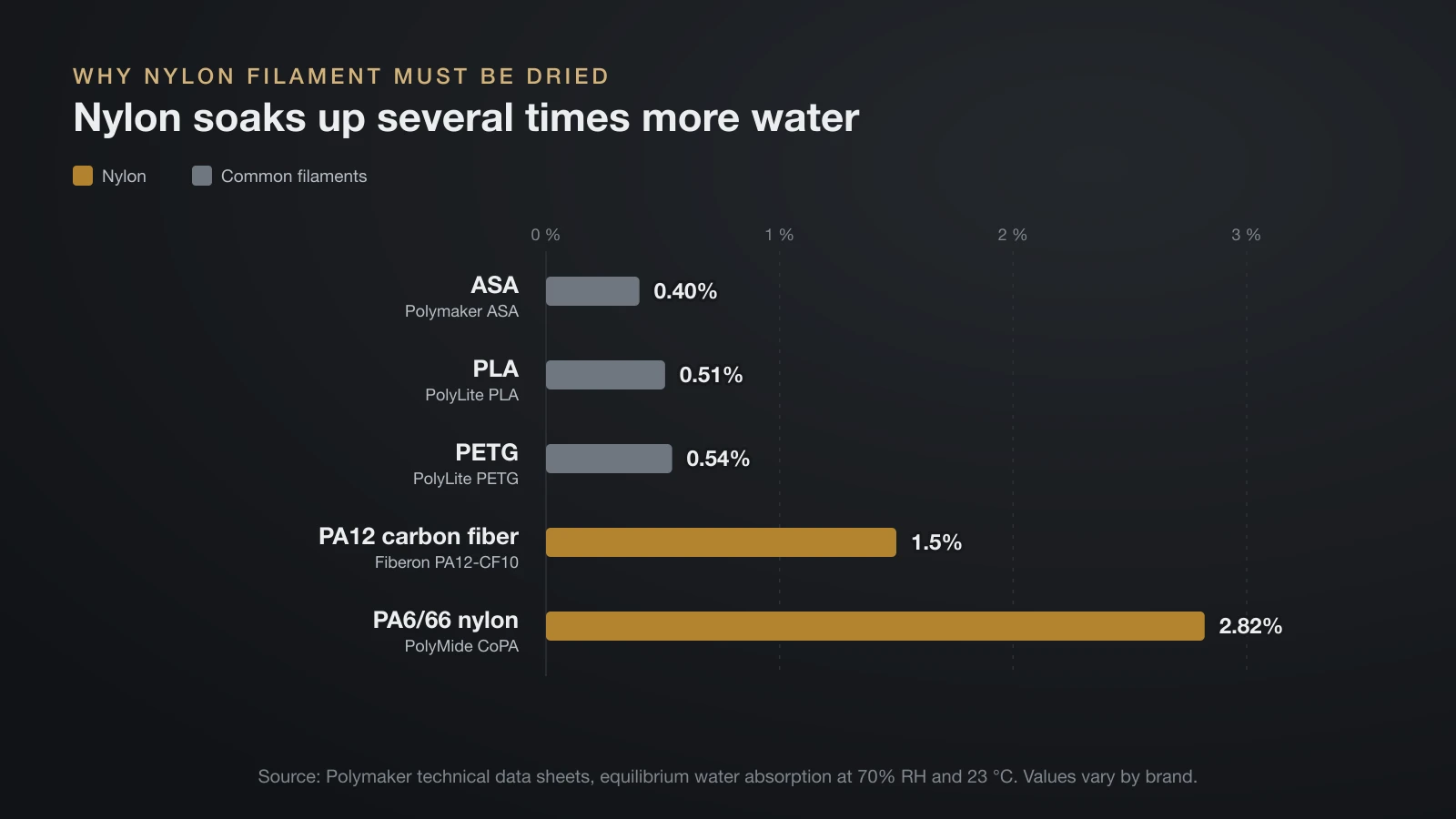
Nylon takes up far more water than common filaments. Polymaker’s equilibrium values, all measured at 70% relative humidity and 23 °C:
| Polymaker data sheet (70% RH, 23 °C) | Equilibrium water absorption |
|---|---|
| Polymaker ASA | 0.40% |
| PolyLite PLA | 0.51% |
| PolyLite PETG | 0.54% |
| Fiberon PA12-CF10 | 1.5% |
| PolyMide CoPA (PA6/66) | 2.82% |
Water also changes finished parts. After soaking to 6.16% moisture, Polymaker’s CoPA test bars kept 34.3 of their 78.0 MPa tensile strength and became far more flexible, while notched impact strength rose from 6.9 to 27.7 kJ/m². A nylon part that has absorbed water is weaker and softer but tougher, so it will not match the dry data sheet values.
A practical routine:
- Dry before printing. Prusament suggests 90 °C (194 °F) for 6–8 hours for PA11 if the bag has been open for a while. Polymaker lists 100 °C (212 °F) for 8 hours for CoPA and 10 hours for its carbon fiber PA6 and PA12.
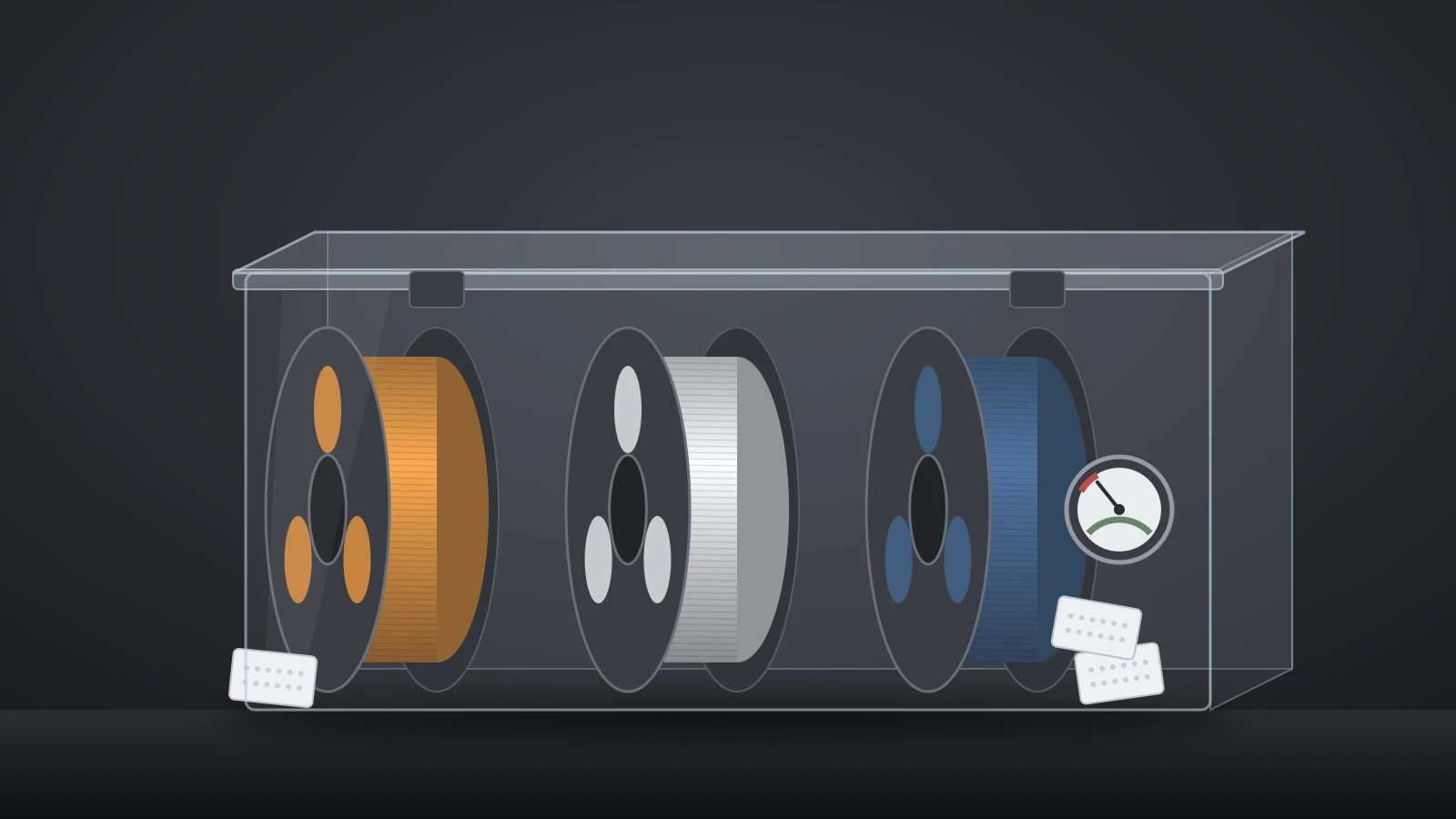
- Print from a dry box. Polymaker says its nylons should be stored and used below 20% relative humidity.
- Mind the calendar. Prusa says PA11 print quality can deteriorate anywhere from a few days to a month after the bag is opened.
- Seal it between prints. Prusa recommends an airtight container with desiccant.
Nylon filament print settings
Start from your spool’s data sheet; these three products show how far recommendations spread.
| Setting | Polymaker PolyMide CoPA | Prusament PA11 | Prusament PA11 Carbon Fiber |
|---|---|---|---|
| Nozzle | 250–270 °C | 275 ± 10 °C | 285 ± 5 °C |
| Bed | 25–50 °C | 100 ± 10 °C | 110 ± 10 °C |
| Build surface | PC or textured PEI, glue when needed | PA Nylon sheet with a thin glue layer | PA Nylon sheet cleaned with water |
| Part cooling fan | Off | 15–20% | 20% |
| Enclosure | Needed | Required, 55 ± 5 °C chamber | Optional; Prusa says CF nylons warp far less |
| Nozzle type | Wear-resistant nozzle highly recommended | Standard 0.4 mm brass | Hardened nozzle necessary |
A few rules hold across brands:
- Use the right surface. Prusa says PA11 peels and warps on conventional sheets, adheres strongly to the PA Nylon sheet and needs a thin glue layer there to protect the sheet on large parts. Wash that sheet with water or dish soap, not isopropyl alcohol or acetone.
- Keep the part warm. Apart from moisture, Prusa names warping as the main disadvantage of unfilled nylon, and a hot enclosure helps most.
- Keep the fan low. Data sheets call for 0–20% part cooling.
- Add a brim. Prusament recommends one for larger PA11 Carbon Fiber parts.
- Check the hotend. Polymaker’s wiki calls for an all-metal hotend for any nylon printed above 240 °C.
Nylon vs PETG: which should you use?
Polymaker publishes both materials with the same test methods:
| Polymaker data sheet | PolyLite PETG | PolyMide CoPA (nylon) |
|---|---|---|
| Heat deflection, 0.45 MPa | 78 °C | 111 °C |
| Heat deflection, 1.8 MPa | 75 °C | 70 °C |
| Tensile strength, X-Y (dry) | 50.8 MPa | 78.0 MPa |
| Notched Charpy impact, X-Y | 2.6 kJ/m² | 6.9 kJ/m² dry, 27.7 kJ/m² wet |
| Water absorption, equilibrium | 0.54% | 2.82% |
| Nozzle temperature | 230–260 °C | 250–270 °C |
| Enclosure | Not needed | Needed |
| Drying | 65 °C for 6 h | 100 °C for 8 h |
PETG is the better default for most functional prints: it prints cooler, needs no enclosure and barely reacts to humidity. Nylon earns its place where parts slide, wear, flex repeatedly or take impacts, and when dry it is about 50% stronger in tension in this data set (78.0 vs 50.8 MPa).
On heat, at the heavier 1.8 MPa load this PETG actually edges out the nylon. If you like how PETG prints but want more impact toughness, PCTG filament sits between the two.
Post-processing nylon parts
- Annealing: Polymaker recommends annealing CoPA at 80 °C for 6 hours and its carbon fiber PA6 and PA12 at 100 °C for 16 hours. Prusament rates PA11 for up to 122.5 °C (252 °F) after annealing.
- Support removal: Polymaker warns that nylon supports can bond permanently to the part once they absorb moisture, so remove them right after printing.
- Sanding: Polymaker’s wiki calls nylon difficult to sand or smooth, and Prusament rates PA11 post-processing as difficult.
- No acetone smoothing: Prusament lists acetone among the chemicals PA11 resists, so the vapor smoothing used on ABS and ASA does not apply.
Nylon fumes and ventilation
Printing nylon releases a noticeable smell and ultrafine particles. Prusa says polyamides emit potentially dangerous ultrafine particles (UFPs), so printing in a well-ventilated room or an enclosure is a must, and it recommends an enclosure with active filtration for PA11.
Research points the same way. A 2016 chamber study by Azimi and colleagues found caprolactam among the largest volatile emissions, released by nylon-based and some imitation wood and brick filaments at roughly 2 to 180 µg per minute, and advised caution in poorly ventilated spaces. A 2022 study by Wojnowski and colleagues measured overall volatile emissions from nylon about an order of magnitude lower than from ABS and ASA, but that comparison does not cover particles.
In practice: run the printer in a ventilated room you are not sitting in, or in an enclosure that is filtered or vented outdoors, and keep children and pets away while it prints.
The bottom line
Nylon filament is the right pick for gears, hinges, clips and parts that flex, slide or take impacts, and carbon fiber grades add stiffness and real heat resistance. Plain nylon is not automatically heat resistant, and every grade absorbs water. Dry it hot, print it from a dry box, keep it warm and ventilate the room; for most other functional parts, PETG is easier and good enough.
Sources
- Prusament technical data sheets and material pages: PA11 data sheet and PA11 page, PA11 Carbon Fiber, PETG, ASA, PLA (heat deflection, interlayer adhesion, moisture absorption, print and drying settings, chemical resistance, ventilation)
- Polymaker technical data sheets: PolyMide CoPA, Fiberon PA6-CF20, Fiberon PA12-CF10, PolyLite PLA, PolyLite PETG, Polymaker ASA and the Polymaker Wiki PA page (water absorption, dry and wet strength, heat deflection, print, drying and annealing settings, nozzle wear, hotend, sanding)
- Prusa Knowledge Base: Polyamide (Nylon) material guide (properties, water uptake, drying, warping, carbon filled grades, ultrafine particles)
- Azimi P. et al. (2016), Emissions of Ultrafine Particles and Volatile Organic Compounds from Commercially Available Desktop Three-Dimensional Printers with Multiple Filaments, Environmental Science & Technology 50: 1260–1268
- Wojnowski W. et al. (2022), Emission Profiles of Volatiles during 3D Printing with ABS, ASA, Nylon, and PETG Polymer Filaments, Molecules 27(12): 3814