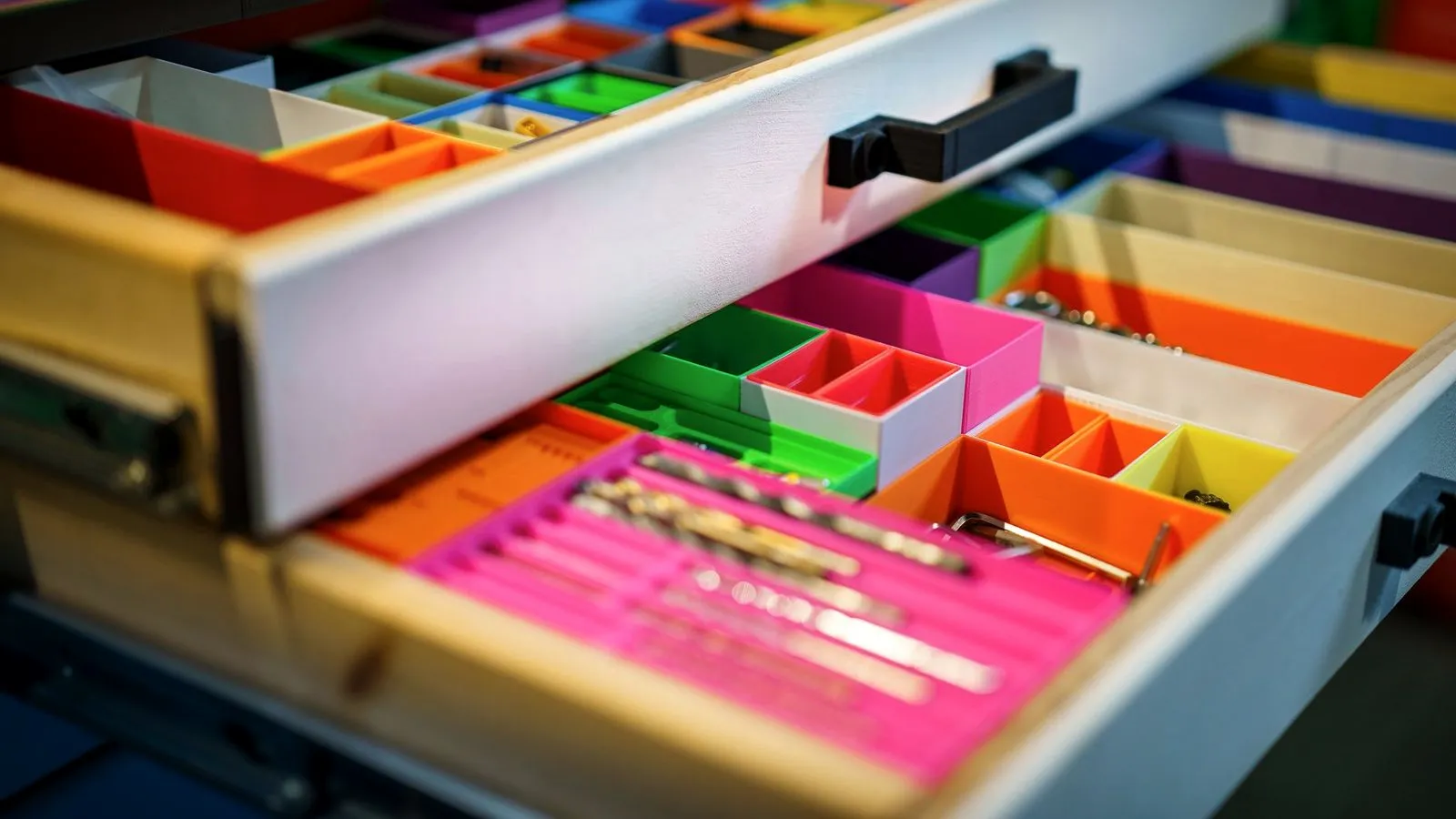
3D printed tools work best as helpers for real tools: organizers, Gridfinity bins, jigs, drill guides, soft jaws, gauges, funnels and spacers. They are the wrong choice for anything you strike, lift with or rely on for safety, like hammers, pry bars and lifting hooks. For shop use, PETG or ASA usually outlasts PLA.
This guide sorts common shop prints into what works, what needs testing and what to leave to steel, then compares materials with manufacturer data sheets. For more projects beyond the workshop, browse our 3D print ideas list.
Looking for the tools you need to run a printer, like scrapers and flush cutters? That short list is near the end, and our guide to 3D printer accessories covers it in full.
The short answer
| Verdict | Examples | Why |
|---|---|---|
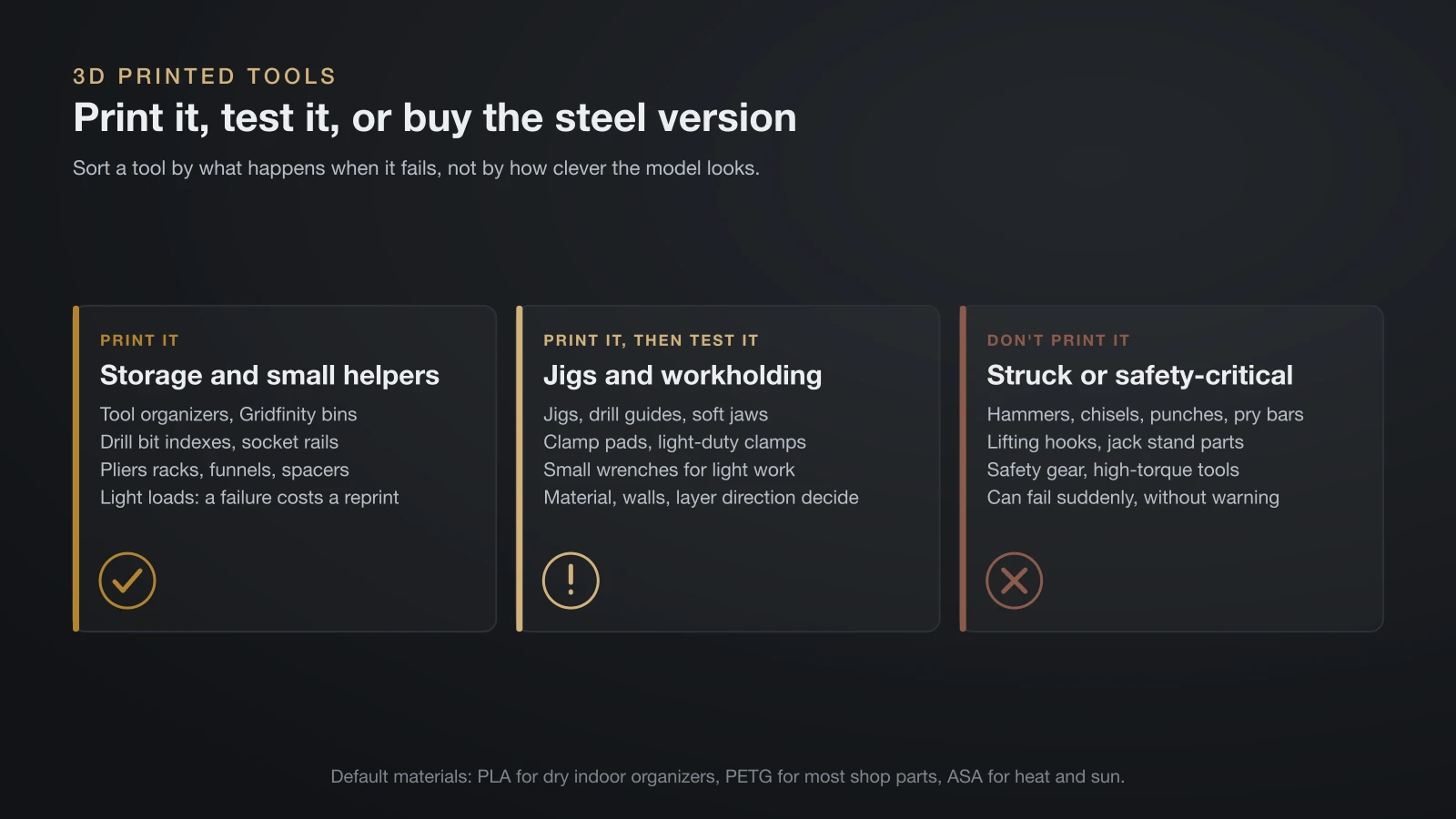
| Print it | Tool organizers, Gridfinity bins, drill bit indexes, socket rails, pliers racks, funnels, spacers | Light loads; a failure costs only a reprint |
| Print it, then test it | Jigs, drill guides, soft jaws, clamp pads, light-duty clamps, small wrenches | Real loads; material, walls and layer direction decide if it lasts |
| Don’t print it | Hammers, chisels, punches, pry bars, lifting hooks, jack stand parts, safety gear | Struck or safety-critical parts can fail suddenly |
Default materials: PLA for dry indoor organizers, PETG for most shop parts, ASA for heat and sun.
What 3D printed tools actually work
Plastic is good at locating, holding and protecting. It is poor at taking impact or transmitting large forces. The prints below stay on the right side of that line.
Storage and organizers
| Tool or helper | Material | Tip |
|---|---|---|
| Gridfinity bins and baseplates | PLA or PETG | Use the shared grid so bins from any designer fit |
| Wrench organizer | PETG | Emboss sizes so a missing wrench stands out |
| Socket rails and trays | PETG | Size the posts to your socket set’s drive |
| Pliers and screwdriver racks | PLA or PETG | Pegboard-mount versions exist for most board systems |
| Drill and driver bit index | PLA | Raised size labels read better than printed ones |
| Small parts tool box | PETG | Print hinges in place or use a metal pin |
Jigs, guides and fixtures
| Tool or helper | Material | Tip |
|---|---|---|
| Drill guide block | PETG | Press a steel bushing into the hole if you drill often |
| Dowel jig | PETG | Same idea: plastic locates, metal takes the wear |
| Corner and right-angle clamp blocks | PETG | Use them with real clamps, not instead of them |
| Router and saw setup blocks | PLA | Check every block with calipers before trusting it |
| Center finder | PLA | Verify it on a part of known size |
Workholding and measuring
| Tool or helper | Material | Tip |
|---|---|---|
| Soft jaws for a bench vise | TPU or PETG | TPU grips and protects finished surfaces |
| Clamp pads | TPU | Stops clamps from marking soft wood |
| Painting pyramids and bench cookies | PLA | Hold parts up while finish dries |
| Light-duty spring clamps | PETG | PLA is brittle and can snap when flexed |
| Thread and bolt size gauge | PLA | Confirm it against known bolts first |
| Angle and marking gauges | PLA | Check against a steel square |
A printed gauge is only as accurate as the printer that made it. If test parts come out oversized or undersized, fix that first with our guide on how to calibrate a 3D printer.
Small shop helpers
| Tool or helper | Material | Tip |
|---|---|---|
| Funnels | PETG | Check chemical compatibility before using solvents or fuel |
| Spacers, shims and standoffs | PETG | Model the exact thickness you need |
| Cable and hose hangers | PETG | Spread the load over two screws |
| Quick-connect line release tools | PETG | They only release a retaining clip; match the line size exactly |
Gridfinity: the modular storage standard
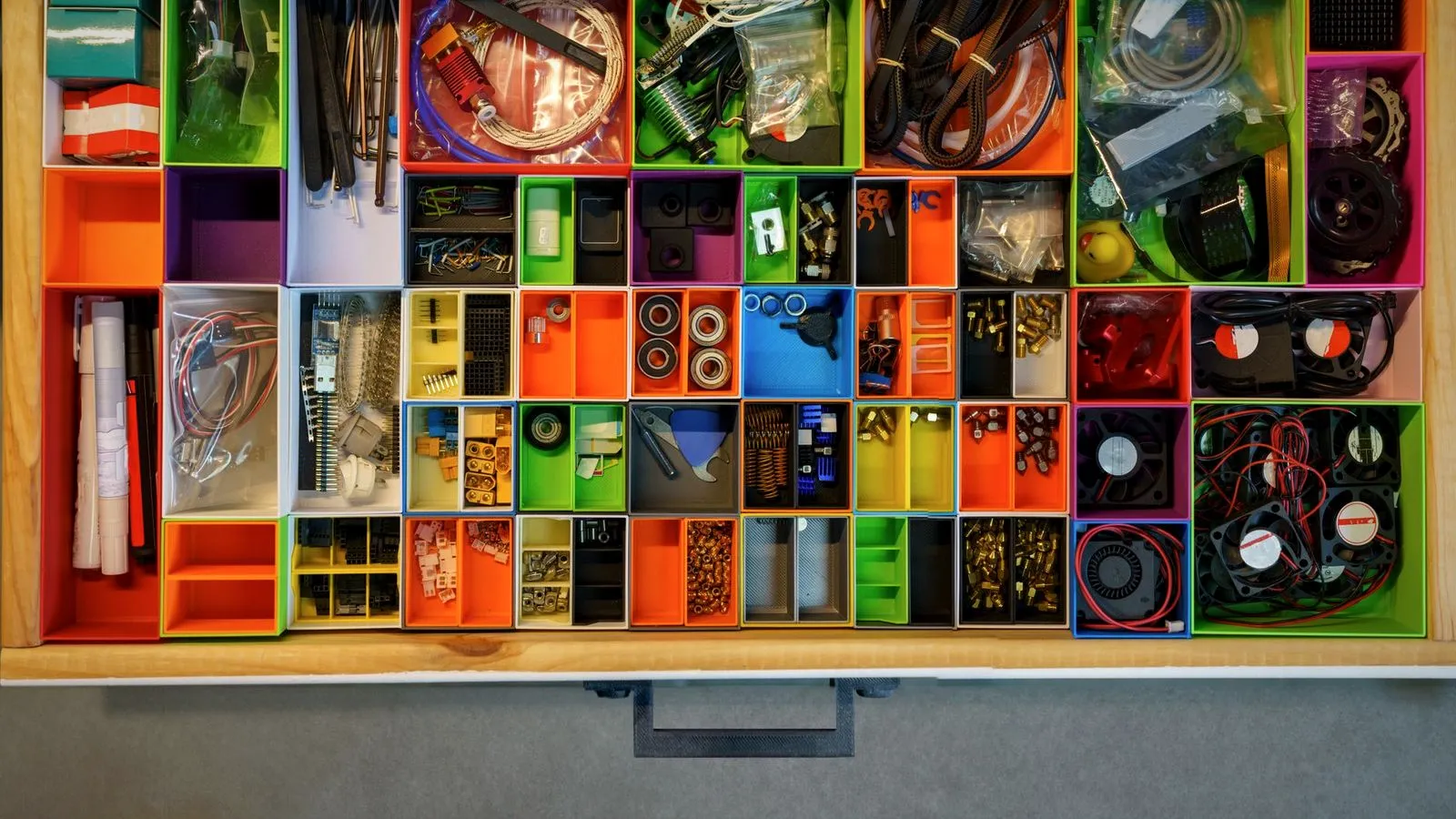
Gridfinity is a free, open-source modular storage system created by Zack Freedman, who released his designs under the MIT license. Bin width and depth are counted in 42 mm grid units and height in 7 mm units. You print baseplates that fill a drawer or shelf, then drop in bins shaped for specific tools.
The shared grid is the point. A bin from one designer fits a baseplate from another, and Freedman notes that a Prusa i3 MK3 bed fits a baseplate up to 5 × 5 units, so a large drawer takes several plates. The costs are filament and print time for the baseplates, plus some wasted space at drawer edges.
- Material: PLA is fine for bins in a dry indoor shop; PETG for a hot garage.
- Start small: print one baseplate section and two bins before committing a whole drawer.
- Label everything: choose bins with the optional label tab.
Tools you should not 3D print
Printed parts are not tested or certified for these jobs. Prusa Polymers’ own data sheets say each user has to judge whether a printed part is suitable and what could happen if it fails.
- Struck tools: hammers, mallets for metal, chisels, punches and pry bars. Impact finds the weakest layer line, and brittle PLA tends to shatter.
- Lifting and load holding: hoist hooks, jack stand parts, ramps, ladder parts and anything that holds weight over your head.
- Safety gear: eye protection, blade guards, hard hats and anything else between you and an injury.
- High-torque tools: breaker bars, sockets for impact drivers and wrenches for properly torqued bolts.
- Parts near real heat: soldering stands close to the tip, torch holders or anything near a flame, especially in PLA.
Can a 3D printed wrench work?
Yes, within limits. A printed wrench turns plastic hardware, thumb nuts and lightly tightened small fasteners, and it can reach spots a steel wrench cannot. Under real torque, the jaws spread or the handle splits along a layer. Use it as a convenience tool and keep steel for anything tight.
Best material for 3D printed tools
The table uses one manufacturer’s technical data sheets so the numbers are comparable. Heat deflection temperature (ISO 75, 0.45 MPa load) is the temperature at which a loaded test bar bends by a set amount. Interlayer adhesion is how well layers hold together when pulled apart.
| Material (Prusament) | Heat deflection | Interlayer adhesion | Impact, Charpy unnotched | Best tool use |
|---|---|---|---|---|
| PLA | 55 °C (131 °F) | 17 MPa | 13 kJ/m² | Dry indoor organizers, gauges, cool jigs |
| PETG | 68 °C (154 °F) | 18 MPa | No break | Most shop parts, clamps, anything that flexes |
| ASA | 93 °C (199 °F) | 11 MPa | 25 kJ/m² | Hot garages, sun, parts near warm machines |
| PA11 carbon fiber | 192 °C (378 °F) | 20 MPa | 30 kJ/m² | Stiff, heat-exposed, chemical-exposed parts |
Impact values are for flat-printed specimens. Prusa notes that all values depend heavily on print settings, so treat them as a comparison, not a guarantee.
Heat: where PLA gives up
PLA is stiff and strong at room temperature, but its heat deflection temperature is only 55 °C, and Prusament says PLA parts start to lose mechanical strength above 60 °C (140 °F). A rack in a car, in full sun or next to a heater can get there. For tools that ride along in a vehicle, see our guide to 3D printed car parts.
Creep: the slow sag under constant load
Heat deflection is a short test. A wall-mounted wrench rack, a shelf bracket or a clamp left tightened carries its load for months, and plastics slowly deform under constant load, faster when warm. Hobby filament data sheets rarely publish creep data, so build in margin: thicker sections, more screws and PETG or ASA for loaded parts in warm places.
Layer lines are the weak direction
Prusament PLA’s tensile yield strength is 51 MPa along the layers, but its interlayer adhesion is 17 MPa, about a third. Orient every tool so the main load runs along the layers, never across them. A wrench printed flat is much stronger than one printed standing up.
When ASA, nylon and carbon fiber are worth it
ASA brings heat and UV resistance, but it shrinks and warps on large parts, which an enclosed 3D printer or a tall skirt helps prevent; our ASA filament guide covers settings and ventilation.
Carbon fiber nylon is stiffer and handles heat, but Prusa says a hardened nozzle is necessary, and it absorbs more moisture: 0.50% in 7 days versus 0.19% for PLA in Prusa’s tests. Tougher PLA blends are another middle ground; see PLA+ vs PLA.
How to print tools that last
- Add walls, not infill. Prusament notes that most of a print’s strength comes from its outer shell, so raise the perimeter count before the infill percentage.
- Orient for the load. Keep forces running along the layers.
- Put metal where it wears. Steel bushings in drill guides, bolts through pivots and threaded inserts in place of printed threads.
- Test the fit small. Print one slot or one socket post before the full organizer.
- Match the plastic to the place. Use the table above: heat, sun and constant load all push you away from PLA.
- Use it, then revise. Real use shows where a part flexes or cracks; thicken those spots and reprint.
Tools you need for your 3D printer
The other meaning of “3D printer tools” is the kit that keeps a printer running. The essentials:
- A thin scraper or spatula for removing prints
- Flush cutters for supports and filament ends
- Tweezers for strings around the nozzle
- Hex keys and screwdrivers for maintenance
- Digital calipers for checking fit
- Isopropyl alcohol and paper towels for cleaning the bed
Holders for most of these can be printed, like a frame-mounted rack for the scraper and cutters. For what to buy first, see the full accessories checklist.
The bottom line
3D printed tools earn their place as organizers, jigs, guides, soft jaws and gauges, where loads are light and a failure costs a reprint. Leave anything struck, lifted, high-torque or safety-critical to steel. Pick PETG for most shop parts, PLA only for cool, dry spots, and ASA or carbon fiber nylon where heat is a factor.
Sources
- Zack Freedman (Gridfinity creator) on Thangs: Gridfinity Divider Bins (42 mm grid units for width and depth, 7 mm height units, MIT license) and Gridfinity Baseplates (all bins fit all baseplates; up to a 5 × 5 grid on a Prusa i3 MK3)
- Prusament: PLA (parts lose mechanical strength above 60 °C, brittle, strength comes mostly from perimeters, bed cleaning with isopropyl alcohol; the linked tech sheet gives HDT 55 °C at 0.45 MPa per ISO 75, tensile yield 51 MPa horizontal, interlayer adhesion 17 MPa, Charpy unnotched 13 kJ/m², moisture absorption 0.19% in 7 days); PETG technical data sheet (HDT 68 °C at 0.45 MPa, interlayer adhesion 18 MPa, Charpy unnotched no break, suitability disclaimer); ASA (UV stable, temperature resistance 93 °C, warping reduced by an enclosure or a tall skirt; the linked tech sheet gives HDT 93 °C at 0.45 MPa, interlayer adhesion 11 MPa, Charpy unnotched 25 kJ/m²); PA11 Carbon Fiber technical data sheet (HDT 192 °C at 0.45 MPa, flexural modulus 3.0–6.2 GPa, interlayer adhesion 20 MPa, Charpy unnotched 30 kJ/m², moisture absorption 0.50% in 7 days, hardened nozzle necessary)