
The PLA melting point is about 150–175 °C (302–347 °F): 150 °C on Polymaker’s PolyLite PLA data sheet, 160 °C on Bambu Lab’s PLA Basic and around 175 °C for Prusament PLA. Printed parts fail much sooner. PLA turns rubbery near 60 °C (140 °F), its glass transition, and starts to bend under load at about 55 °C (131 °F).
That gap explains most PLA heat problems. A part does not need to melt to be ruined; it only needs to pass the point where it softens. For nozzle and bed settings, see our guide to PLA temperature.
The short answer
| Temperature | Standard PLA | What it means |
|---|---|---|
| Glass transition (Tg) | About 60 °C | Rigid plastic turns rubbery |
| Heat deflection (HDT), 0.45 MPa | 55 °C (Prusament) | A loaded part starts to bend |
| Melting point (DSC) | 150–175 °C | Crystals in the plastic melt |
| Printing temperature | 190–230 °C | Hot enough to flow through a nozzle |
| Safe working limit | Below about 50–55 °C | Conservative margin under the HDT, not a data sheet value |
What is the melting point of PLA?
The melting point of PLA is the temperature at which its crystalline regions melt, and maker data sheets put it between 150 °C and about 175 °C for standard grades. The value is measured by differential scanning calorimetry (DSC), a lab test that heats a small sample at a fixed rate, here 10 °C per minute, and records where it absorbs heat.
PLA is a semi-crystalline plastic. Part of it is ordered into crystals and the rest is amorphous, and the share of crystals depends on the grade and how the plastic cooled. That is why melting points differ between brands rather than sitting at one fixed number. PETG is different: Polymaker classes PETG, ABS and ASA as amorphous, and Bambu Lab lists PETG’s DSC melting temperature as not applicable.
| Filament (data sheet) | Melting temperature (DSC) | Glass transition (DSC) |
|---|---|---|
| Polymaker PolyLite PLA | 150 °C | 61 °C |
| Bambu Lab PLA Basic | 160 °C | 60 °C |
| Bambu Lab PLA Wood | 156 °C | 54 °C |
| Polymaker HT-PLA | 177 °C | 60 °C |
| Prusament PLA | About 175 °C (Prusa) | Not listed |
Filled grades such as wood PLA melt in the same range, because the base polymer is still PLA. The spread matters less than it seems: every value in the table sits more than 90 °C above the point where a printed part loses its shape.
PLA melting point vs glass transition vs heat deflection
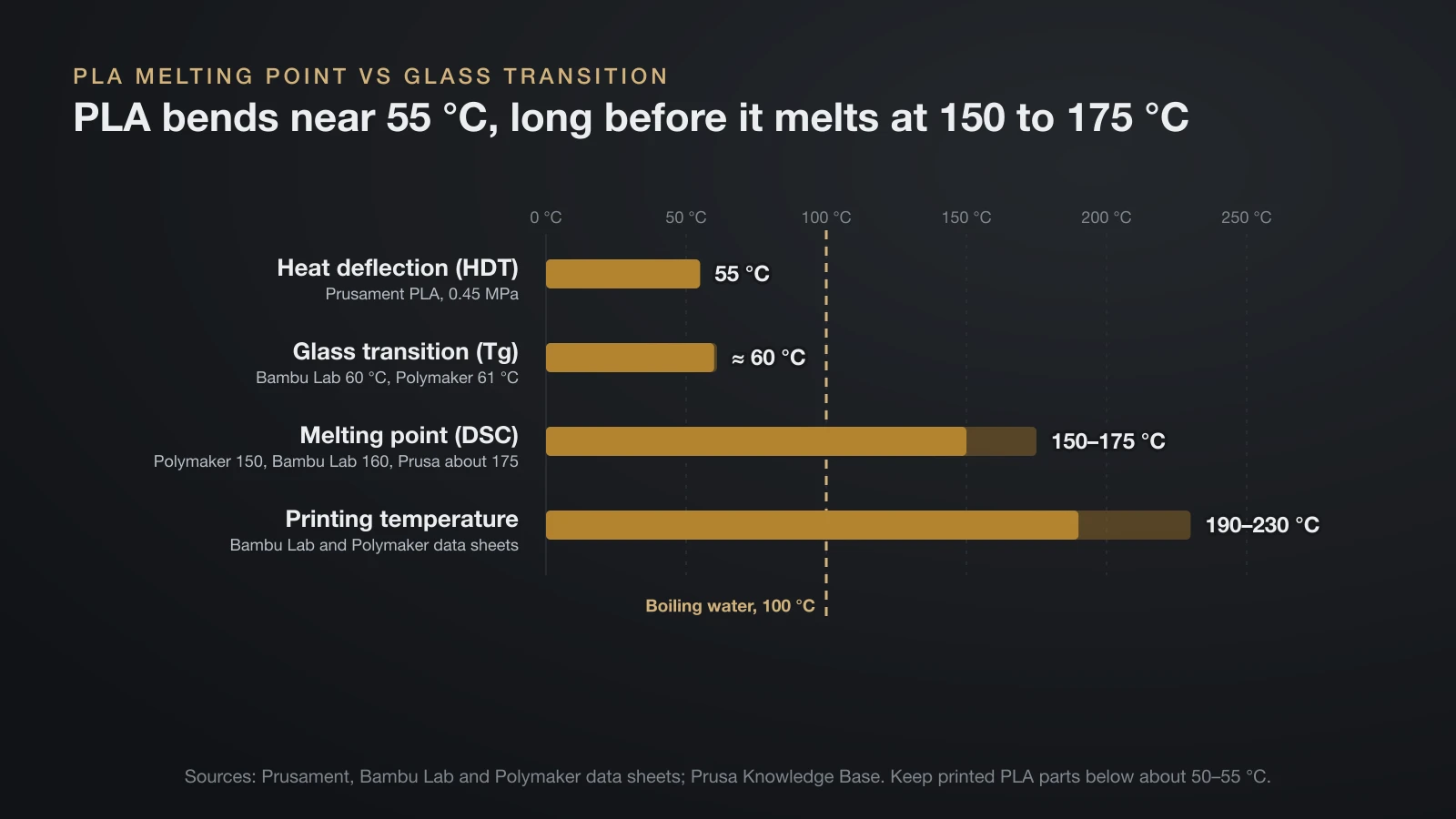
The glass transition and heat deflection temperatures set PLA’s real heat limit, while the melting point only matters inside the hotend. Each number answers a different question, so it helps to keep them apart.
- Glass transition temperature (Tg): where the amorphous part of PLA changes from glassy to rubbery. It is about 60 °C for standard PLA: 60 °C for Bambu Lab PLA Basic and 61 °C for Polymaker PolyLite PLA.
- Heat deflection temperature (HDT): where a test bar under a set load bends by a fixed amount (ISO 75). Prusament PLA lists 55 °C at 0.45 MPa, the value used across this site. Bambu Lab’s PLA Basic lists 57 °C at 0.45 MPa and 54 °C at 1.8 MPa.
- Melting temperature (Tm): where the crystals melt, about 150–175 °C.
- Printing temperature: where PLA flows well enough to extrude, 190–230 °C on Bambu Lab and Polymaker data sheets.
Why print 30–70 °C above Bambu Lab’s 160 °C melting point? At 160 °C PLA is a thick melt; it needs more heat to flow fast enough through a narrow nozzle and bond to the layer below. The exact print temperature depends on speed and brand, which our PLA filament guide covers alongside the material’s other properties.
At what temperature does PLA soften?

PLA softens noticeably from about 55–60 °C (131–140 °F), and Prusa states that it gets soft and deforms above 60 °C. Loaded or thin parts go first, because the HDT test shows bending begins near 55 °C under a light load. Thick, unloaded parts may survive a little longer, but none of them are safe much above the glass transition.
| Situation | Risk for a standard PLA part |
|---|---|
| Room temperature indoors | Fine |
| Parked car in summer | High; Prusa rules PLA out above 60 °C |
| Hot drinks and boiling water (100 °C) | Softens and sags |
| Dishwasher hot wash or heated dry | Possible warping; check cycle temperatures |
| Near a motor, heater or lamp | Test first, or use PETG, ABS or ASA |
Car interiors are the classic failure. Our guide to 3D printed car parts explains which filaments survive a parked car and which parts should never be printed at all.
Heat also stacks with load and time. A shelf bracket carrying weight can creep at a temperature an empty decoration tolerates, so treat 50 °C as a practical ceiling for functional PLA parts.
PLA heat resistance vs PETG, ABS and ASA
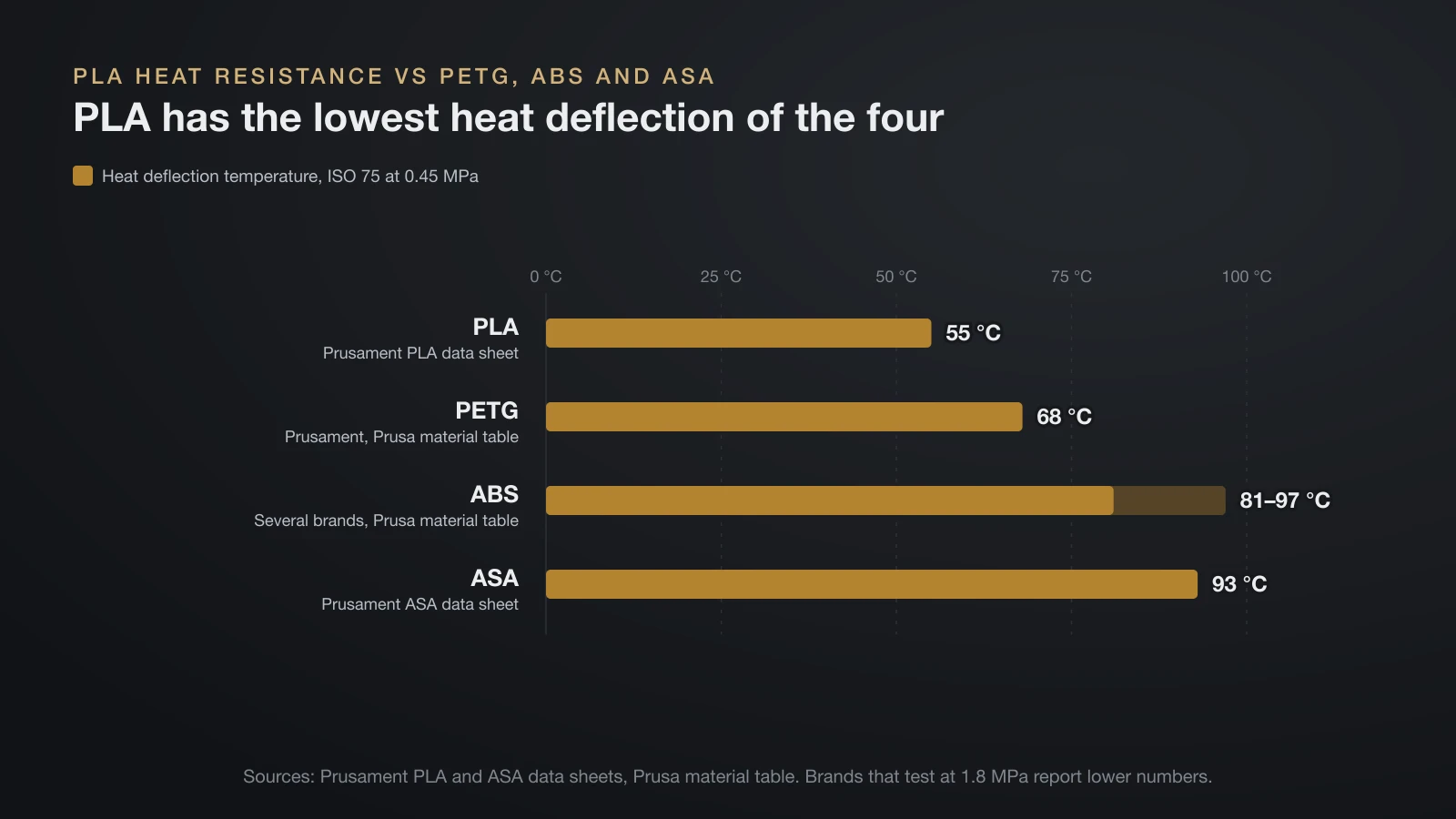
PLA has the lowest heat resistance of the common filaments, about 13 °C below PETG and 26–42 °C below ABS and ASA by heat deflection temperature. The table uses values from Prusa’s material table and data sheets, all measured to ISO 75 at the light 0.45 MPa load.
| Material | Heat deflection, 0.45 MPa (ISO 75) | Source |
|---|---|---|
| PLA (Prusament) | 55 °C | Prusament PLA data sheet |
| PETG (Prusament) | 68 °C | Prusa material table |
| ABS (several brands) | 81–97 °C | Prusa material table |
| ASA (Prusament) | 93 °C | Prusament ASA data sheet |
The comparison only holds within one test method; brands that test at 1.8 MPa report lower numbers for the same plastic. For the warm-but-easy option, see our PETG temperature guide. For parts that face real heat or sunlight, ASA filament and ABS filament need an enclosure and ventilation but hold their shape far longer.
Can you anneal PLA to raise its heat resistance?
Annealing can raise PLA’s heat resistance, but only grades designed for it gain much, and every part risks warping or shrinking in the oven. Annealing means holding a printed part at a set temperature so more of the plastic crystallizes.
The gain depends heavily on the filament:
| Filament | Annealing setting (maker) | Heat deflection, 0.45 MPa |
|---|---|---|
| Polymaker HT-PLA, as printed | None | 61 °C |
| Polymaker HT-PLA, annealed | 30 min at 80–90 °C | 107 °C |
| Bambu Lab PLA Basic | 50–60 °C for 6–12 h | 57 °C (tested after 55 °C, 8 h) |
Bambu Lab warns that some prints may deform and warp after annealing, and asks for a forced-air oven with even heat, kept away from the heater. Polymaker’s annealing tips add that thin walls are most at risk. Its suggestions:
- Preheat the oven to the target temperature before the part goes in; a slow warm-up softens parts unevenly.
- Support the shape: leave the part on the build plate with its brim and supports, or pack it in sand or salt.
- Cool slowly: let the part cool down naturally rather than quenching it.
- Expect size changes: Polymaker warns that annealing can deform a part or change its dimensions, so test a spare part and measure holes and fits afterward.
Does acetone melt PLA?
No, acetone does not melt standard PLA the way it dissolves ABS. Prusa notes only that some PLA filaments can be partly dissolved and glued with acetone; a standard PLA part dipped in it keeps its shape. Real chemical smoothing of PLA needs harsh solvents such as chloroform or tetrahydrofuran, which Prusa says is possible only in laboratory conditions.
Data sheets give only broad chemical ratings. Bambu Lab rates PLA Basic as not resistant to some organic solvents and not resistant to acids or alkalis, while it resists most oils and grease. If acetone smoothing is the goal, ABS and ASA are the materials built for it.
How to melt PLA for recycling
Melting PLA scraps at home is possible, but it is a fume and fire risk that most hobbyists should skip in favor of a filament recycling program. If you do it, keep the temperature as low as works, because NIOSH reports that 3D printer emissions rise mainly with extruder temperature.
- Use a dedicated tool or oven that will never be used for food again.
- Work in a well-ventilated space and never leave the heat unattended.
- Melt only clean PLA: other plastics need different temperatures, and colored or filled PLAs vary in emissions.
The bottom line
PLA melts at about 150–175 °C, but the number that limits a printed part is its glass transition near 60 °C and its heat deflection of about 55 °C. Keep PLA parts below roughly 50 °C, away from hot cars, dishwashers and boiling water. When a part must handle heat, anneal a heat-resistant PLA grade or switch to PETG, ABS or ASA.
Sources
- Bambu Lab technical data sheets V3.0: PLA Basic, PETG Basic and PLA Wood (DSC melting and glass transition at 10 °C/min, heat deflection at 0.45 and 1.8 MPa, nozzle range, annealing 50–60 °C for 6–12 h, oven warning, solvent, acid, alkali and oil resistance, PETG melting not applicable)
- Polymaker: PolyLite PLA data sheet, HT-PLA data sheet and wiki Annealing and Annealing tips (150 °C and 177 °C melting, 61 °C and 60 °C glass transition, 190–230 °C nozzle, HT-PLA 61 °C as printed and 107 °C annealed after 30 min at 80–90 °C, PETG, ABS and ASA amorphous, preheating, supports, sand or salt, slow cooling)
- Prusa: Knowledge Base PLA guide and material table, and Prusament PLA data sheet (melting point about 175 °C, soft and deforms above 60 °C, acetone and chloroform/THF notes, heat deflection 55 °C at 0.45 MPa for PLA, 68 °C for PETG, 81–97 °C for ABS brands), and Prusament ASA material page and data sheet (93 °C at 0.45 MPa)
- NIOSH (CDC): Approaches to Safe 3D Printing, publication 2024-103 (emissions depend mainly on extruder temperature, and also on filament brand and color)