
Metal 3D printing builds solid metal parts layer by layer, most often by melting fine metal powder with a laser inside an industrial powder bed machine. Other routes glue powder with a binder or extrude bound metal filament, then sinter the part in a furnace. None of them turns a normal home printer into a metal printer on its own.
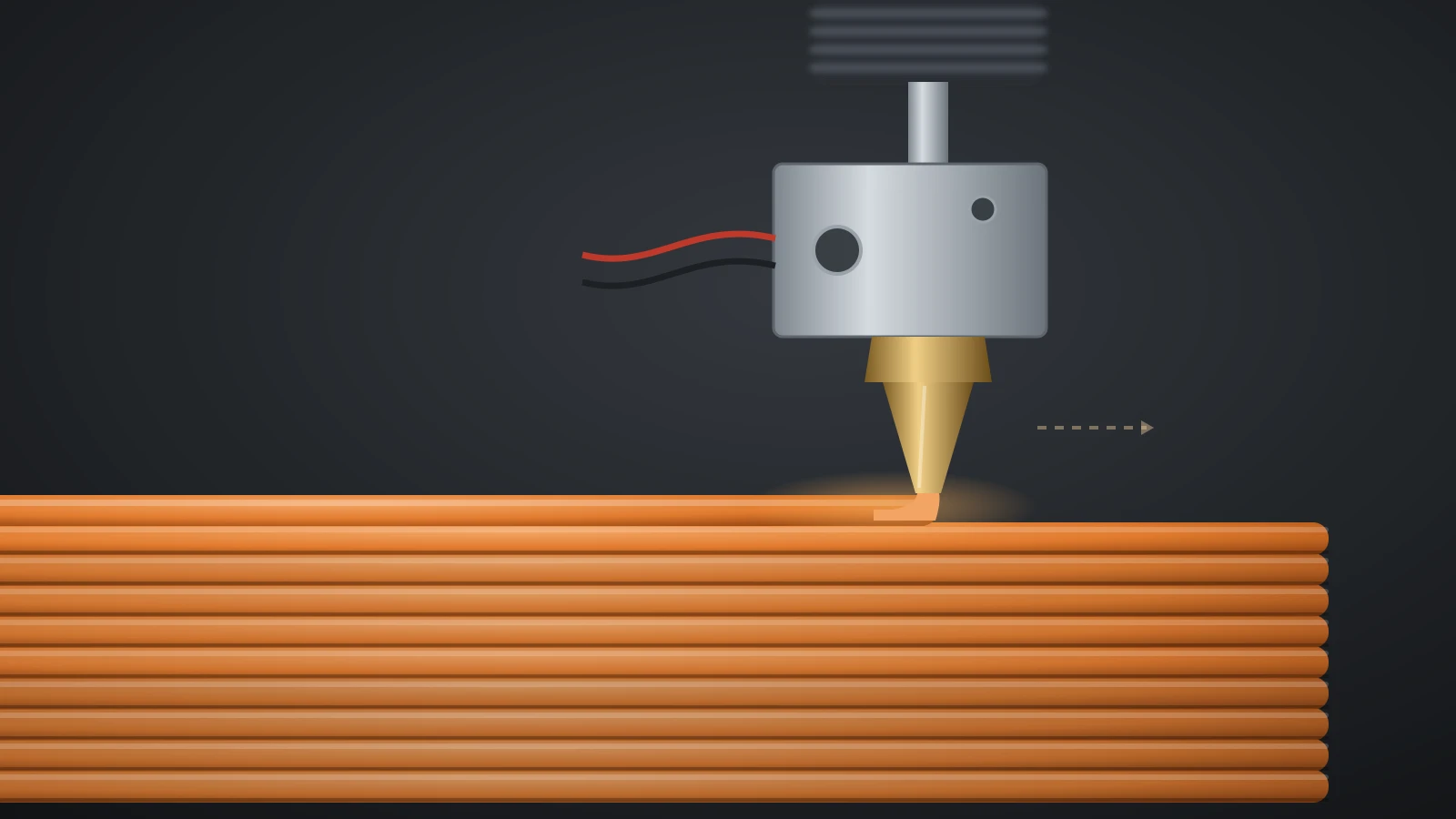
Home and hobby printers work in plastic, melting 3D printer filament or curing resin, and the process behind most of them is explained in our guide to FDM 3D printing. Filaments sold as “metal” for those machines are either plastic with metal powder or sinterable bound metal, and our metal 3D printer filament guide separates the two.
The short answer
| Process | How it makes metal parts | At home? |
|---|---|---|
| Laser powder bed fusion (direct metal laser sintering, DMLS; selective laser melting, SLM) | A laser melts thin layers of metal powder | No: industrial machine, inert gas, powder handling |
| Electron beam melting (EBM) | An electron beam melts powder in a vacuum | No |
| Binder jetting | A print head glues powder, then the part is sintered | No |
| Directed energy deposition (DED) | A nozzle on a robot arm melts wire or powder onto a part | No |
| Bound metal filament | Metal powder in a plastic binder is extruded, washed and sintered | Printing yes, sintering via a service or shop furnace |
| Metal-filled PLA | PLA with metal powder, printed like PLA | Yes, but the part is plastic |
What is metal 3D printing?
Metal 3D printing, also called metal additive manufacturing, is any process that builds a metal part by adding material layer by layer instead of cutting it from a solid block. The international terminology standard, ISO/ASTM 52900:2021, sorts all additive manufacturing into seven process categories, and metal parts come mostly from five of them.
The seven categories are vat photopolymerization, material jetting, binder jetting, material extrusion, powder bed fusion, sheet lamination and directed energy deposition. Powder bed fusion is the best-known metal route, and the FDA names it the most common process for 3D printed medical devices. Vat photopolymerization is the resin printing family that hobbyists know; our resin vs filament guide covers the home versions.
Metal additive manufacturing earns its cost where conventional methods struggle:
- Complex shapes: internal cooling channels, lattices and organic forms that a cutter cannot reach.
- Part consolidation: several joined parts redesigned as one printed part.
- No tooling: EOS notes that for low-to-medium volumes, printing removes the need for molds.
- The limits: high cost, demanding powder safety and post-processing on almost every part.
Metal 3D printing processes compared
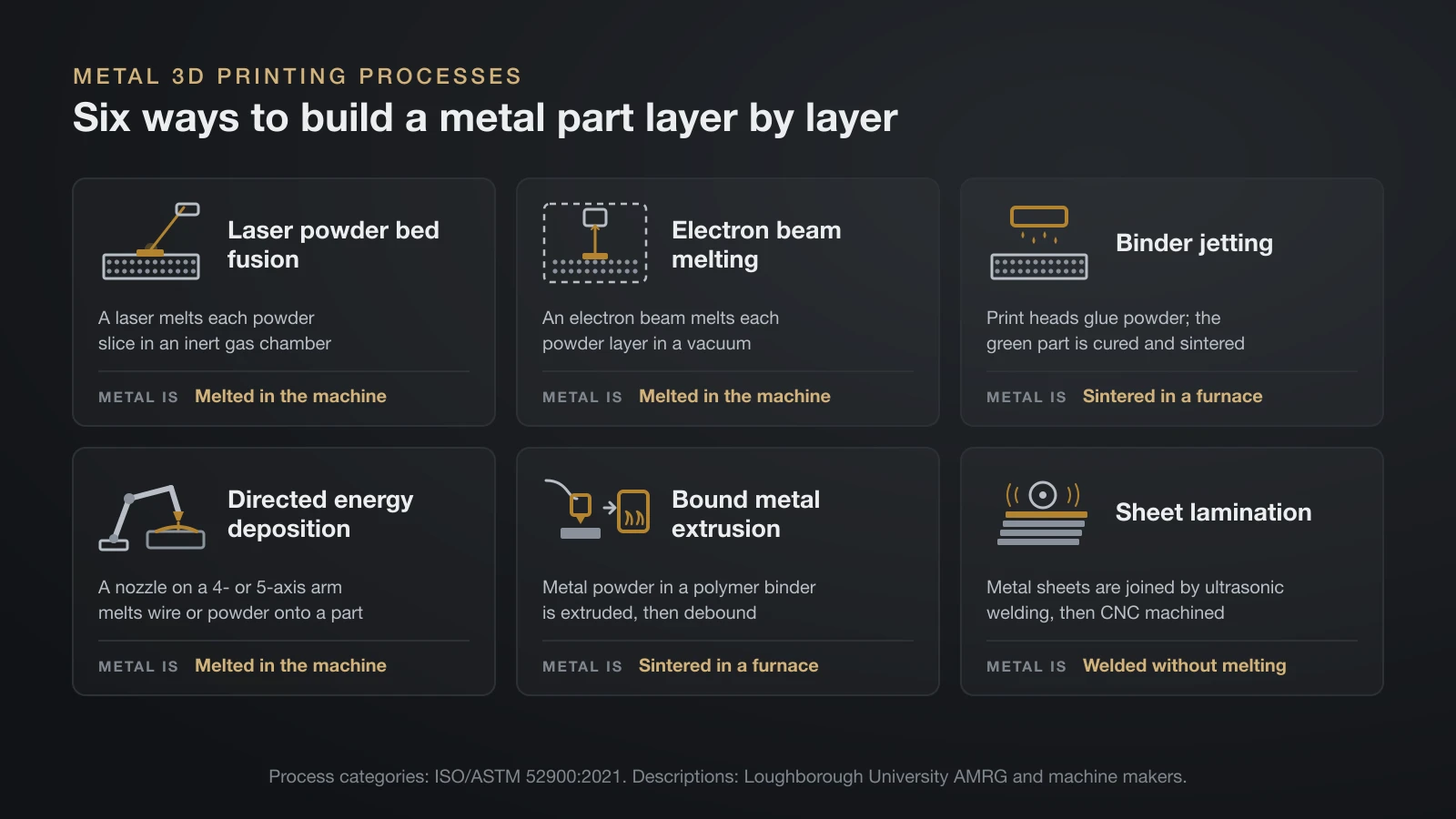
Metal 3D printing processes differ in how they deliver metal and energy, and that decides part size, accuracy and finishing work. The table follows the ISO/ASTM 52900 category names, with the trade names you will see from machine makers.
| Category (ISO/ASTM 52900) | Common names | How it works | Metals named by makers and researchers | Post-processing |
|---|---|---|---|---|
| Powder bed fusion, laser | DMLS, SLM, laser powder bed fusion | A roller or blade spreads powder; a laser melts each slice in an inert gas chamber | Stainless and tool steels, titanium, aluminum, cobalt chrome, nickel alloys | Powder removal, cleaning, machining, sometimes hot isostatic pressing |
| Powder bed fusion, electron beam | EBM | An electron beam melts each powder layer in a vacuum | Titanium, cobalt chrome, stainless steel, aluminum, copper | Powder removal, cleaning, machining |
| Binder jetting | Metal binder jetting | Print heads deposit a liquid binder on powder; the green part is cured and sintered | Stainless steel | Curing and sintering |
| Directed energy deposition | Laser metal deposition, direct metal deposition, 3D laser cladding | A nozzle on a 4- or 5-axis arm deposits wire or powder melted by a laser, electron beam or plasma arc | Mainly metals, fed as wire or powder | Machining; widely used to repair parts |
| Material extrusion | Bound metal filament, metal FFF | Filament of metal powder in a polymer binder is extruded, then debound and sintered | 316L and 17-4PH stainless, tool steels, Inconel 625, copper | Debinding (solvent or catalytic) and sintering |
| Sheet lamination | Ultrasonic additive manufacturing (UAM) | Metal sheets or ribbons are joined by ultrasonic welding without melting, then machined | Aluminum, copper, stainless steel, titanium | CNC machining |
| Powder bed fusion, polymer (for comparison) | Selective laser sintering (SLS) | A laser sinters plastic powder | None: nylon and other plastics | Powder removal |
Apart from sheet lamination, which welds solid metal sheets without melting them, the processes fall into two families. Fusion processes (powder bed fusion and DED) melt the metal directly in the machine. Sinter-based processes (binder jetting and bound metal extrusion) shape a “green part” held together by a binder, which becomes dense metal only in a furnace afterward.
How does metal 3D printing work?
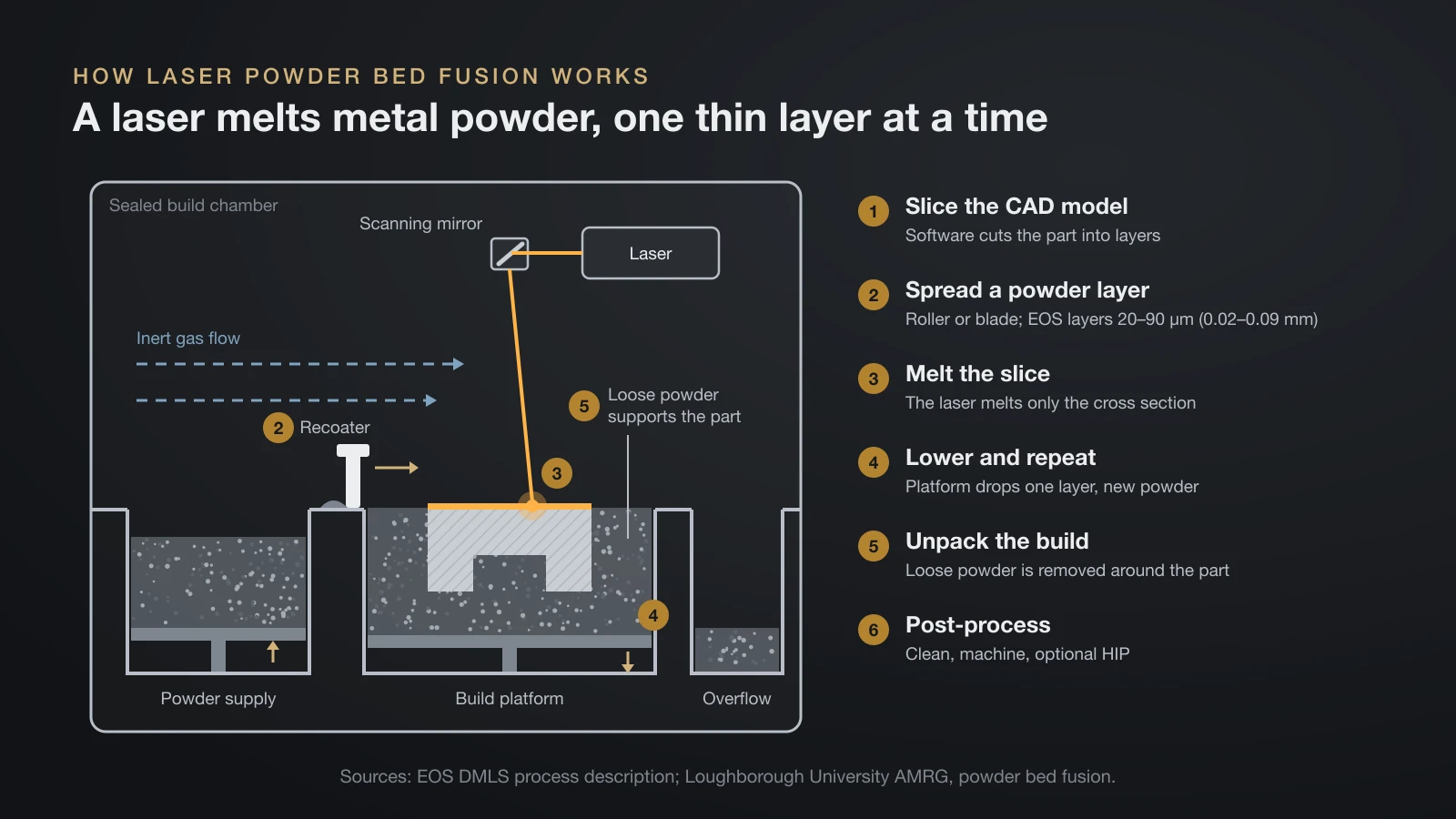
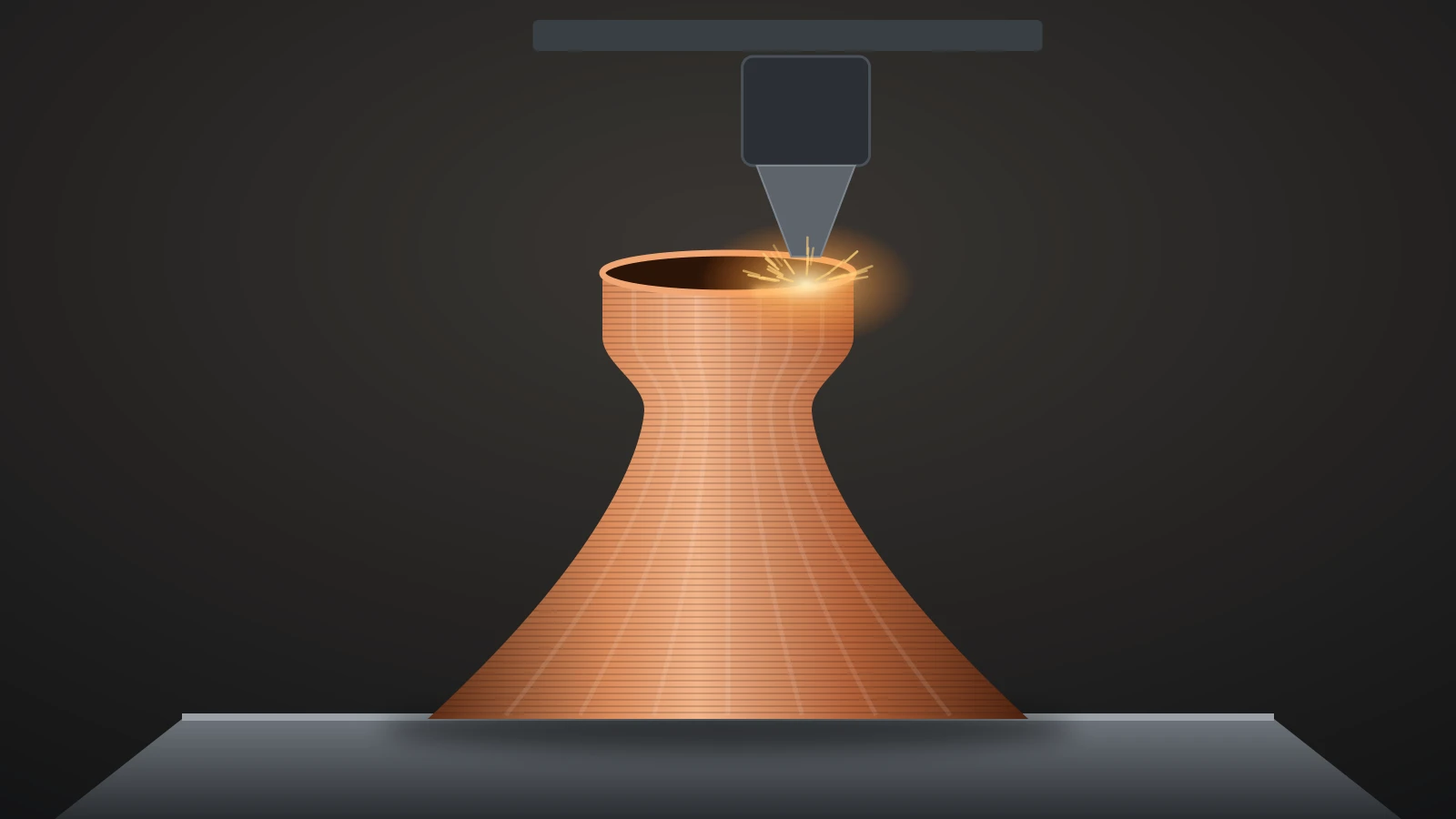
Laser powder bed fusion works by melting a thin layer of metal powder wherever the CAD model says the part should be, one slice at a time. EOS, which calls its version DMLS, describes the same basic loop that Loughborough University documents for powder bed fusion in general:
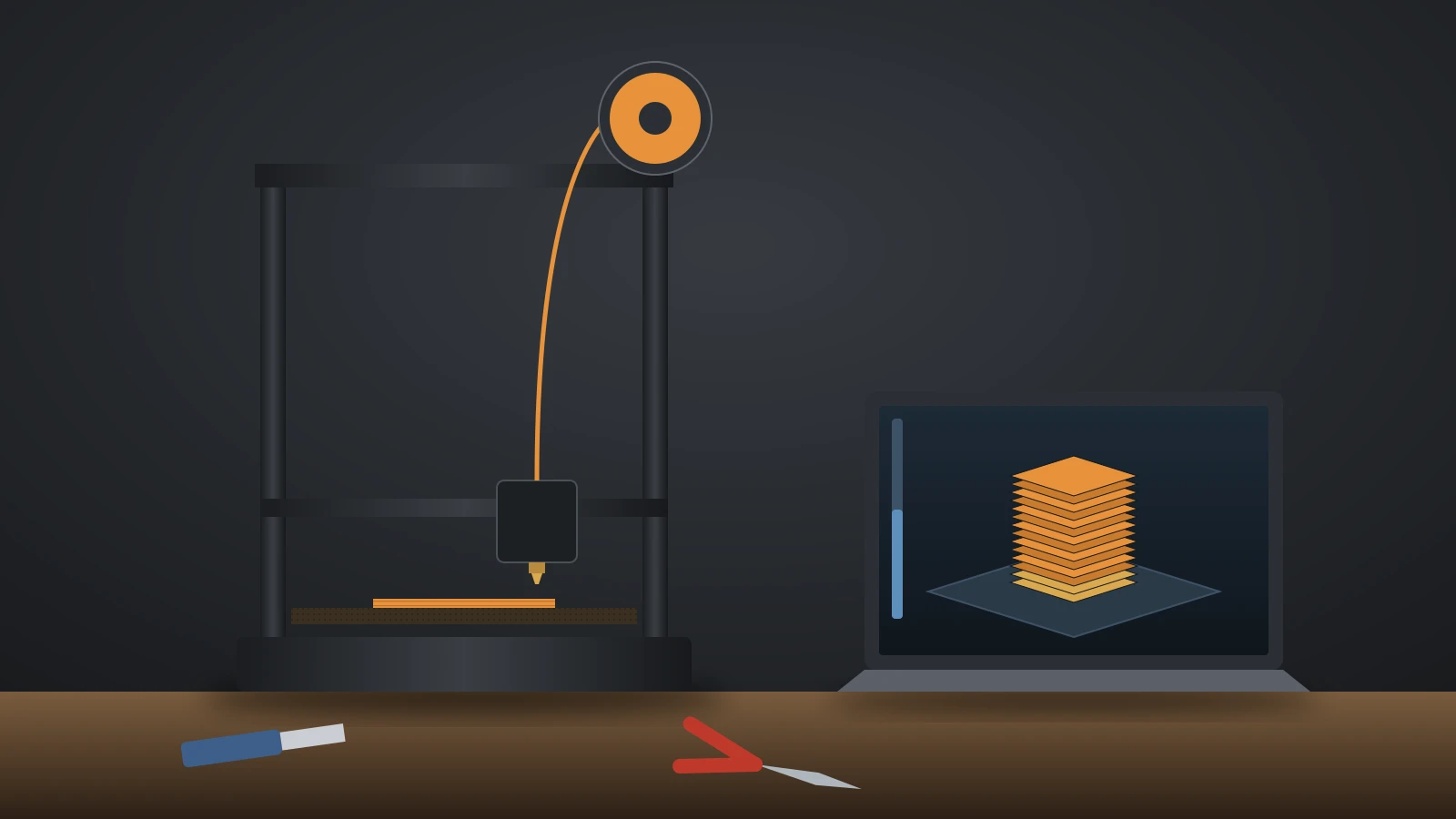
- Prepare the file: the part starts as a CAD model, which software slices into layers.
- Spread a layer of powder: a roller or blade spreads fresh powder across the build platform from a hopper or reservoir. EOS lists processes with layers of 20–90 µm (0.02–0.09 mm), depending on alloy and machine.
- Melt the slice: a laser melts the powder exactly where the model defines the cross section. Selective laser melting needs an inert gas atmosphere in the chamber.
- Lower and repeat: the platform drops by one layer, new powder is spread and the next slice is melted, until the part is complete.
- Unpack the build: loose powder that was not melted surrounds the part and is removed after the build.
- Post-process: parts are cleaned and often machined. Hot isostatic pressing (HIP), which applies high pressure and temperature in a sealed chamber, can raise density and strength at extra cost and time.
Electron beam melting follows the same loop with an electron beam in a vacuum. Binder jetting and bound metal extrusion skip the melting step: the printer only shapes the part, and the metal particles fuse later in a sintering furnace.
Which metals can you 3D print?
Most engineering metal families can be 3D printed on industrial machines, each with tested process settings. EOS lists more than 35 alloys and more than 100 qualified processes for its laser machines, including these families:
| Family | Examples (EOS powders) | Uses EOS names |
|---|---|---|
| Stainless steel | 316L, 17-4PH, PH1 (15-5), 254, SuperDuplex | Medical, oil and gas, shipbuilding |
| Titanium | Ti64 (Ti-6Al-4V), Ti64ELI, commercially pure TiCP | Aerospace, automotive and medical; Ti64 is biocompatible |
| Aluminum | AlSi10Mg and other alloys | Lightweight parts, internal cooling channels, conformal-cooled mold inserts |
| Nickel alloys | IN625, IN718, IN939, HX, HAYNES 282 | Gas turbines for aerospace and energy, oil and gas |
| Others | Cobalt chrome, copper, tool steels, refractory metals | Listed in the same portfolio |
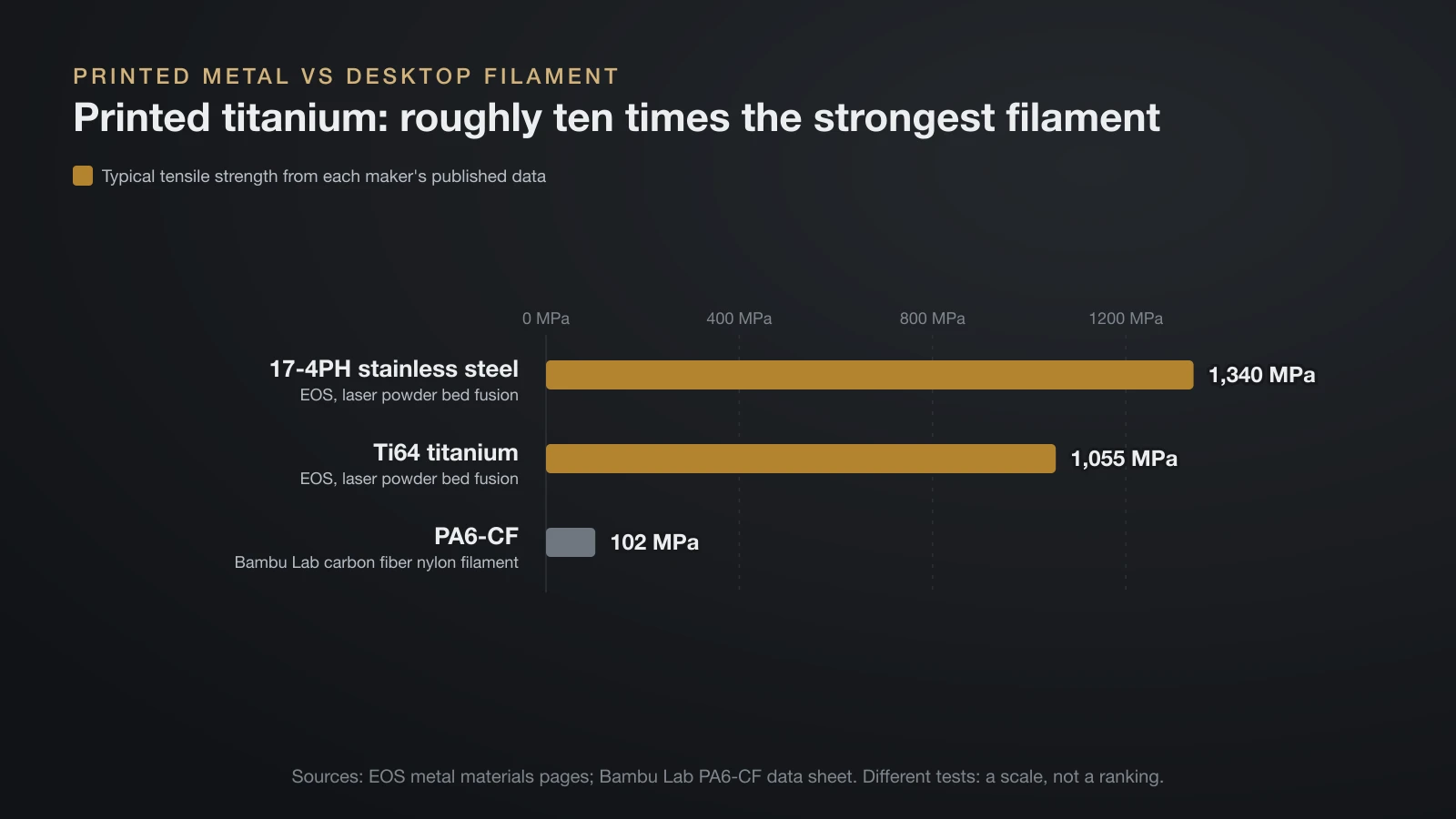
The strength gap to plastics is large. EOS lists a typical tensile strength of 1,055 MPa for parts in its Ti64 and 1,340 MPa for its 17-4PH stainless steel, while the strongest common desktop filament, carbon fiber nylon, reaches 102 MPa along the layers on Bambu Lab’s data sheet. The titanium figure is roughly ten times the filament’s (our ratio); our guide to the strongest filament has the plastic data.
Can you 3D print metal at home?
You cannot 3D print finished metal parts on a normal home printer, but you can print the first stage of a metal part. Bound metal filament is mostly metal: Forward AM’s Ultrafuse 316L contains about 90% stainless steel by mass in a polymer binder, and it prints on suitable filament printers at 245 °C on a 90–105 °C bed.
The printed “green part” is not usable metal yet. Forward AM’s process calls for catalytic debinding with nitric acid vapor at 120 °C, then sintering in hydrogen or argon with a hold at 1,380 °C (2,516 °F). Those steps belong in an industrial furnace, which is why Forward AM routes parts to debinding and sintering service partners.
Smaller metal systems exist, but they are workshop equipment. Markforged’s Metal X prints bound powder filament, washes the binder out in a solvent station for 12 to 72 hours, and sinters parts in a furnace that peaks at 1,300 °C (2,372 °F). Markforged says the bound filament removes loose powder and lasers from the process, so the system runs in a shop with minimal facility upgrades.
Two home-friendly alternatives give metal looks or metal parts without a sintering furnace:
- Metal-filled PLA: PLA packed with copper, bronze, steel or iron powder. It is heavy and polishes like metal, but stays plastic, as our guide to metal-filled filaments explains.
- Printed patterns for casting: a printed pattern can be turned into metal by lost-wax casting, usually through a casting service, as our guide to 3D printed jewelry shows.
Metal 3D printing cost and how to get parts made
Metal 3D printing is priced per part by quote, not by a simple price per gram. Industrial makers sell their systems through sales quotes, and service bureaus quote each part after checking the file, alloy, size and finishing.
What drives the quote:
- Process and alloy: each process needs different machines and furnaces, and each alloy its own powder and tested settings.
- Build time: tall parts take more layers, and each layer adds time.
- Post-processing: powder removal, HIP, sintering and machining add time and cost to every part.
- Quality documentation: EOS ships its stainless steel and titanium powders with inspection certificates, and the FDA regulates 3D printed medical devices through the same pathways as other devices.
The practical route for most people is a printing service: upload a CAD file, choose the process and alloy, and compare quotes. Our guide to 3D printing costs explains what services charge for in general and how home plastic printing compares.
Metal 3D printing safety
Metal powder is the main hazard in metal 3D printing, not the printing step itself. NIOSH lists breathing and skin contact with metals, static, fire and explosion, and high-powered lasers as potential hazards, and notes that printing usually happens inside an enclosed chamber where emission exposure is low.
The risky moments are around the machine. NIOSH names manually loading powder, sieving powder outside the machine, removing the part and powder, maintenance and changing high-efficiency particulate air (HEPA) filters as the higher-exposure tasks. Its recommended controls include:
- Containment: local exhaust ventilation or ventilated glove boxes that are HEPA-filtered and suitable for fire and explosion risks.
- Cleaning: wet methods and a fire-safe HEPA vacuum; never dry sweeping or compressed air.
- Static control: grounding and bonding of equipment.
- Protective equipment: nitrile gloves, coveralls, safety glasses or face shields, and respirators where controls are not enough.
Fine metal dust can also explode. OSHA lists aluminum, chromium, iron, magnesium and zinc among materials that are explosible as dust, names additive manufacturing among the affected industries, and cites a 2010 titanium dust explosion in West Virginia that killed 3 workers. These controls are one more reason metal powder printing stays in industrial facilities.
Where metal 3D printing is used
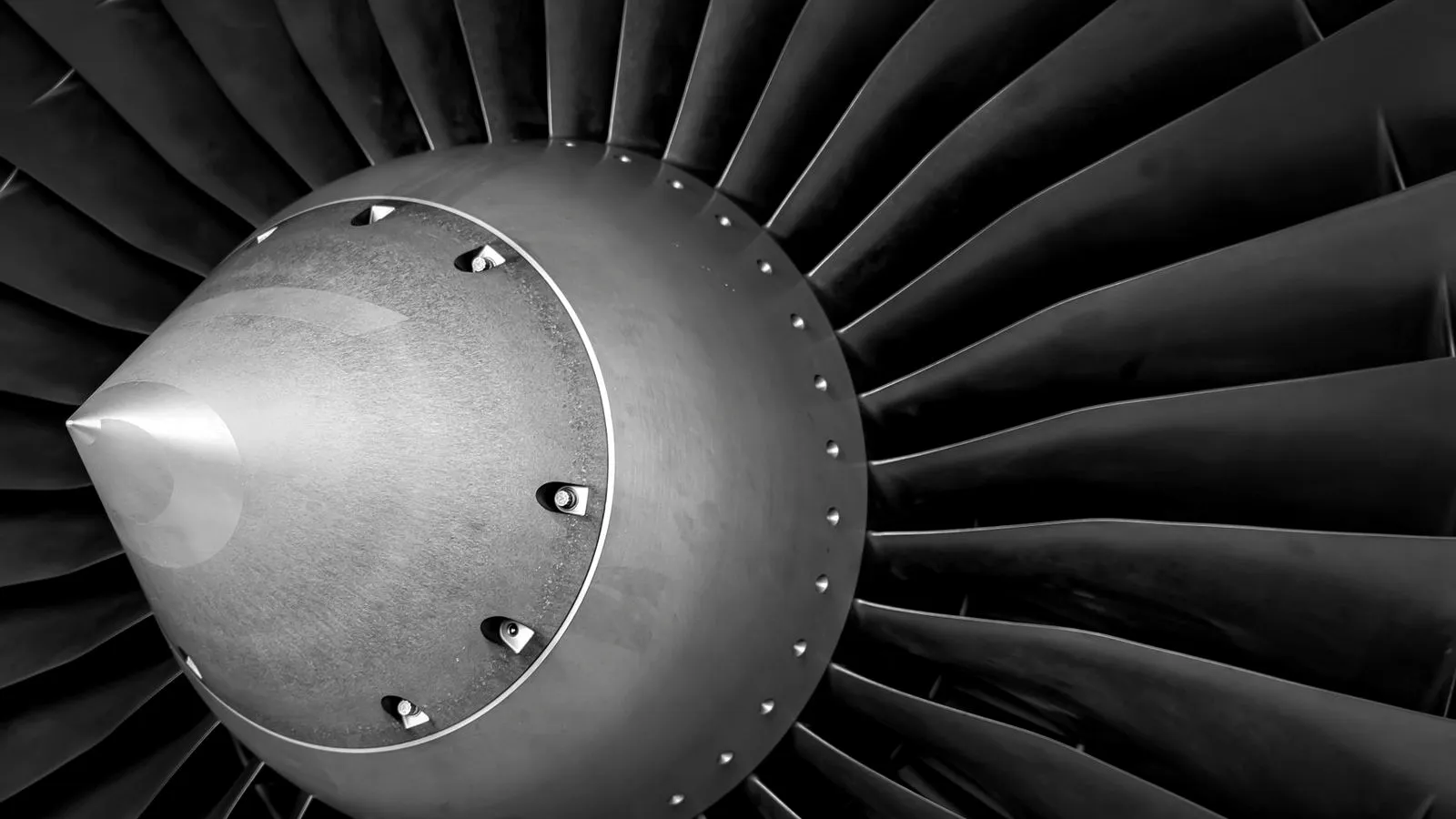
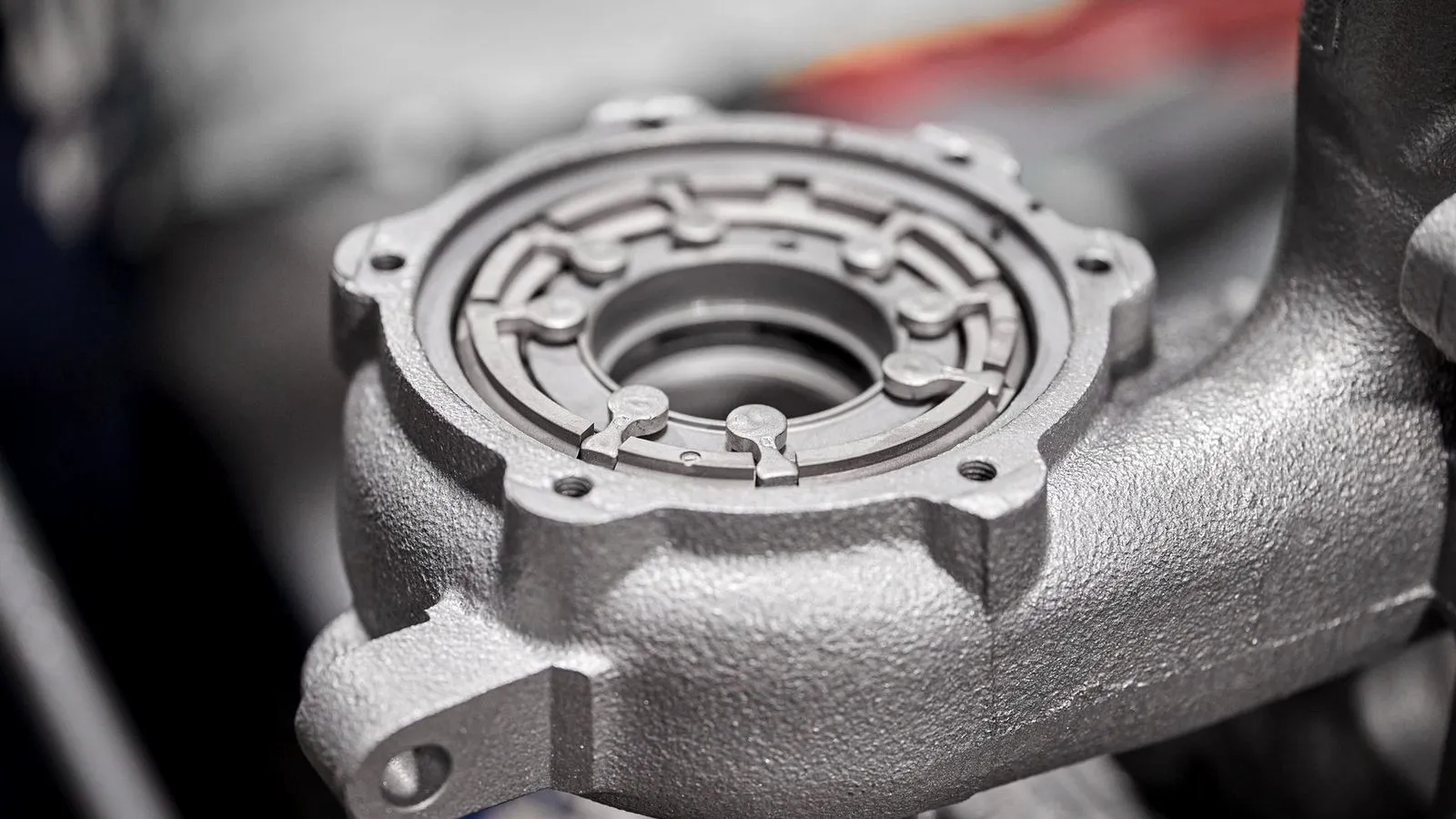
Metal 3D printing is an industrial production method today, used where complex, light or custom parts are worth the cost. EOS names aerospace, automotive, medical, tooling and turbomachinery as the main applications of its DMLS machines.
- Rocket engines: NASA’s RAMPT project reported in August 2024 that it had run 500 test firings of 3D printed injectors, nozzles and chamber hardware since it began, totaling more than 16,000 seconds, and it refined GRCop-42, a copper alloy first created at NASA Glenn.
- Medical devices: the FDA lists orthopedic and cranial implants, surgical instruments and dental restorations among 3D printed devices, and names powder bed fusion as the most common process for them.
- Tooling: EOS highlights aluminum mold inserts with conformal cooling channels that follow the part’s shape.
- Energy and turbines: nickel alloys such as IN718 go into gas turbines for aerospace and power.
For more on these programs and what changed in recent years, see our roundup of 3D printing advancements.
The bottom line
Metal 3D printing is mostly laser powder bed fusion in industrial machines, with binder jetting, DED, sheet lamination and bound metal extrusion filling other niches. It prints stainless steel, titanium, aluminum, nickel alloys and more, but the main processes need industrial machines, strict powder safety and post-processing. At home, the realistic options are bound metal filament with a sintering service, metal-filled PLA for the look, or printed patterns for casting.
Sources
- Process categories: ISO, ISO/ASTM 52900:2021 Additive manufacturing, general principles, fundamentals and vocabulary (seven process categories), and Loughborough University Additive Manufacturing Research Group pages on the 7 categories, powder bed fusion, binder jetting, directed energy deposition and sheet lamination (how each works, inert gas, vacuum for EBM, DED for repair, post-processing and HIP, metals)
- Industrial machine makers, read October 2026: EOS DMLS technology, metal materials overview and metal materials pages for stainless steel, titanium, aluminium and nickel alloys (process steps, 35+ alloys and 100+ qualified processes, 20–90 µm layers, 1,055 and 1,340 MPa typical tensile strength, applications); HP Metal Jet (binder jetting, green part cured and sintered); Markforged Metal X (bound powder filament, materials, 12–72 hour wash, 1,300 °C sintering peak)
- Forward AM (BASF): Ultrafuse 316L, Ultrafuse metal user guidelines and 316L process instructions (about 90% metal by mass, 245 °C nozzle and 90–105 °C bed, debinding at 120 °C, sintering at 1,380 °C, service partners); Bambu Lab PA6-CF technical data sheet (102 MPa tensile strength)
- Safety: NIOSH 3D Printing with Metal Powders: Health and Safety Questions to Ask, publication 2020-114, March 2020 (hazards, higher-exposure tasks, controls, PPE), and OSHA Combustible Dust: An Explosion Hazard (explosible metal dusts, additive manufacturing, 2010 titanium dust explosion)
- Applications: NASA Additive Manufacturing Project Shapes Future for Agency, Industry Rocket Makers (August 2024: 500 test firings, more than 16,000 seconds, GRCop-42) and FDA 3D Printing of Medical Devices and Medical Applications of 3D Printing (device types, powder bed fusion as the most common process)