
The biggest 3D printing advancements of recent years are faster, enclosed desktop printers that switch between several materials, metal printing trusted for rocket engine parts, houses printed almost entirely by machine, and patient-matched medical devices. Each one below comes with its year and an official source: NASA, the FDA, NIST, a university or the manufacturer itself.
Industrial and desktop printing have moved in parallel. Rocket makers and hospitals print metal and medical-grade parts, while home printers have picked up input shaping for speed, automatic material changes and heated chambers for engineering plastics.
The short answer
| Area | Advancement | Date | Source |
|---|---|---|---|
| Desktop multi-material | Up to 7 materials per print with no nozzle purging; up to 8 tools with dedicated nozzles | As of 2026 | Bambu Lab H2C, Prusa INDX |
| Workshop high-temperature | 500 °C (932 °F) nozzle and 90 °C chamber for PEEK and PEI | As of 2026 | Prusa Pro HT90 (industrial) |
| Rocket engines | 500 test firings of printed injectors, nozzles and chambers, more than 16,000 seconds in total | 2024 | NASA RAMPT |
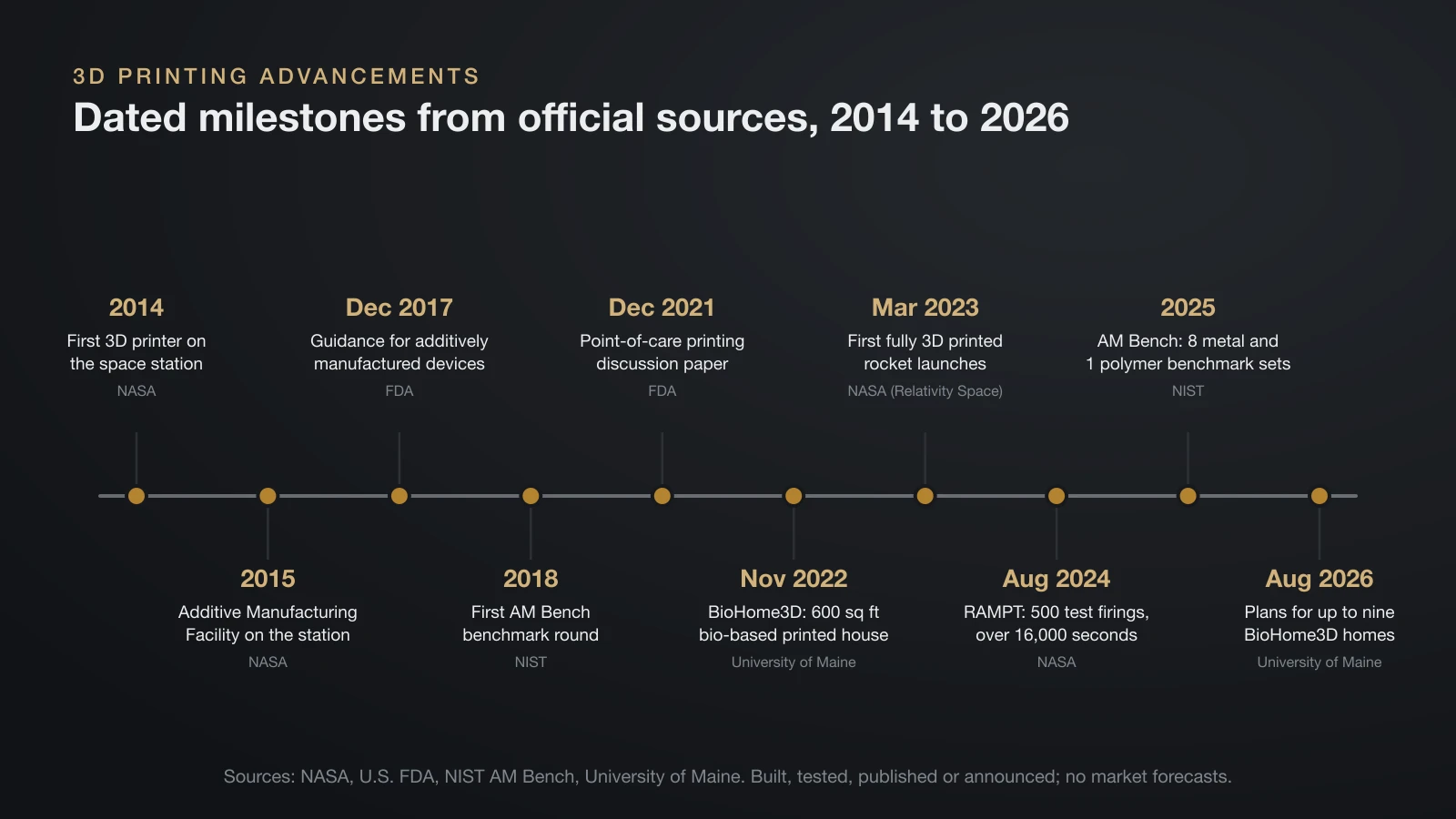
| Printing in space | First 3D printer on the International Space Station | 2014 | NASA |
| Construction | First house printed entirely from bio-based material, 600 sq ft | 2022 | University of Maine |
| Medical devices | FDA technical guidance for additively manufactured devices | 2017 | FDA |
| Metal process science | Public benchmark data for metal powder bed fusion models | 2018, 2022, 2025 | NIST AM Bench |
What is 3D printing used for?
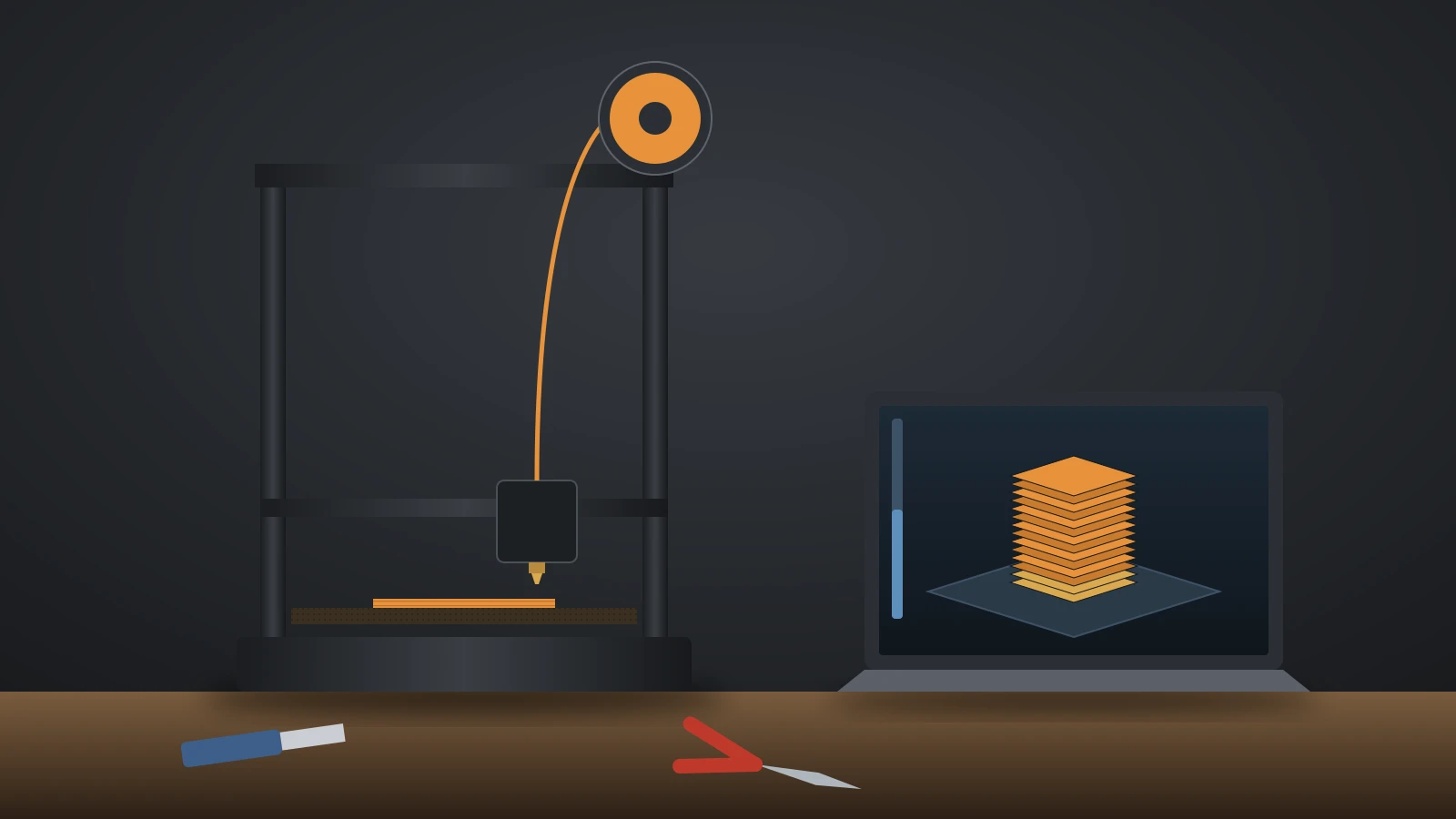
3D printing is used to make prototypes, medical devices, aerospace parts, buildings, tools and spare parts, because it builds an object layer by layer straight from a digital file. The FDA notes that this lets designers change a part without setting up new equipment or tooling, and it allows shapes matched to one person’s anatomy or with complex internal structures.
The table lists the main uses of 3D printing, with an example from an official source for each.
| Use | Example | Source |
|---|---|---|
| Prototyping | Design changes without new tooling | FDA |
| Medical devices | Surgical guides, cranial plates, hip joints, external prosthetic hands | FDA |
| Dental | Dental restorations such as crowns | FDA |
| Aerospace | Copper-alloy rocket thrust chambers, hot-fire tested | NASA |
| Construction | Printed floors, walls and roof of a 600 sq ft house | University of Maine |
| Tools and spare parts | A ratchet wrench printed on the space station from a file sent from Earth | NASA |
At home, 3D printing’s strengths go into custom brackets, replacement clips and 3D printed tools.
Desktop 3D printing advancements: speed, colors and materials
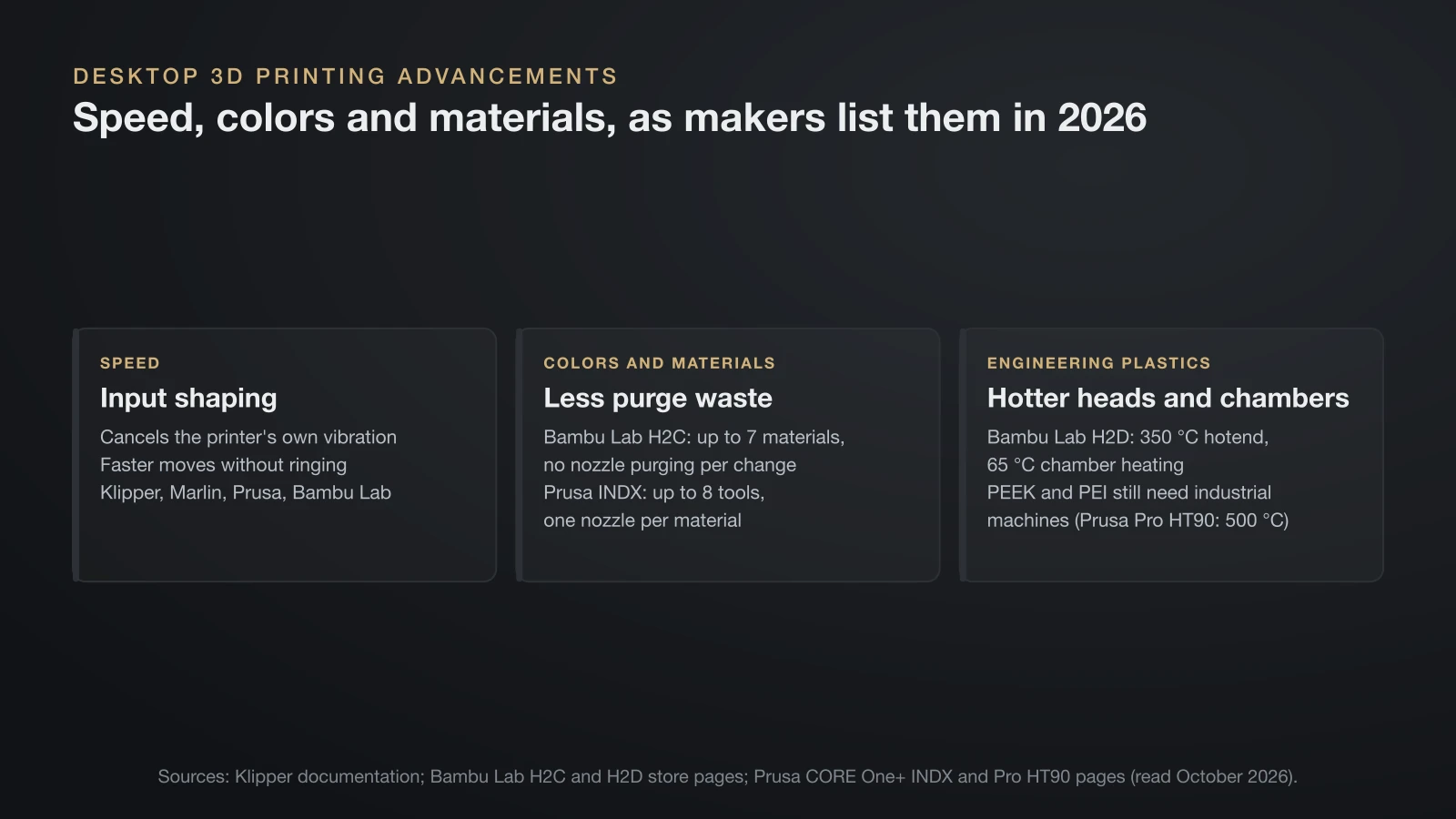
Desktop 3D printing has changed most in three areas: motion control that allows faster printing without ringing, automatic switching between several materials, and enclosed machines hot enough for engineering plastics. All three came from firmware and hardware makers, and by 2026 they appear on printers from mainstream brands such as Bambu Lab and Prusa.
Faster printing without ringing
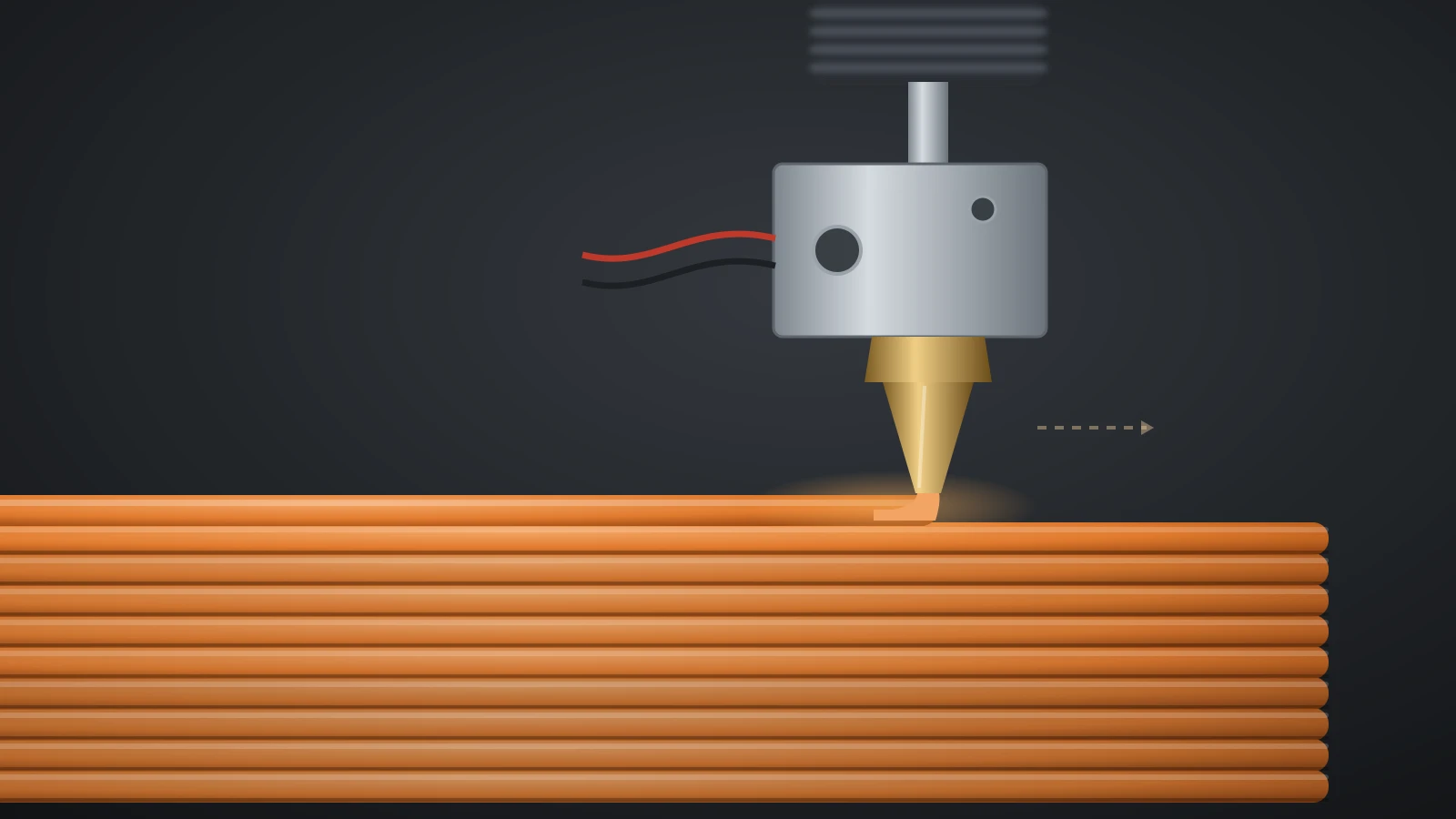
Input shaping lets a printer move faster without the ripples, or ghosting, that vibration leaves on walls. Klipper’s documentation describes it as an open-loop control technique that creates a commanding signal which cancels its own vibrations. Prusa’s HT90 product page credits Input Shaper with ultra-fast PLA and PETG prototypes, and our input shaping guide explains setup on Klipper, Marlin, Prusa and Bambu Lab.
Multi-material printing with less waste
Multi-material printers used to waste a lot of filament, because a single nozzle has to be purged every time the color changes. Prusa’s INDX page states that on complex prints, this waste usually weighs more than the finished object.
Two current designs attack that waste directly:
- Hotend changer: Bambu Lab’s H2C pairs a rack of induction hotends with a second nozzle and prints up to seven materials in one run with no nozzle purging, apart from the first purge when a new filament is loaded. Its induction hotends reach PLA temperature in 8 seconds.
- Tool changer: Prusa’s CORE One+ INDX gives each of up to 8 materials its own dedicated nozzle, which removes the purge tower.
Our guide to multi-color 3D printers compares these with simpler filament changers.
High-temperature engineering plastics
High-performance plastics such as PEEK and PEI (Ultem) moved from industrial machines toward the workshop. Prusa’s Pro HT90, a 1,050 mm (41 in) tall industrial printer, pairs a print head that reaches 500 °C with a chamber actively heated to 90 °C (194 °F), and Prusa lists PEEK, PEKK, PPS, PSU, PES and PEI among its materials. Bambu Lab’s H2D brings a 350 °C (662 °F) hotend and 65 °C (149 °F) active chamber heating to a desktop printer.
What these plastics demand is covered in our guides to PEEK filament and carbon fiber filament.
Metal 3D printing advancements in aerospace
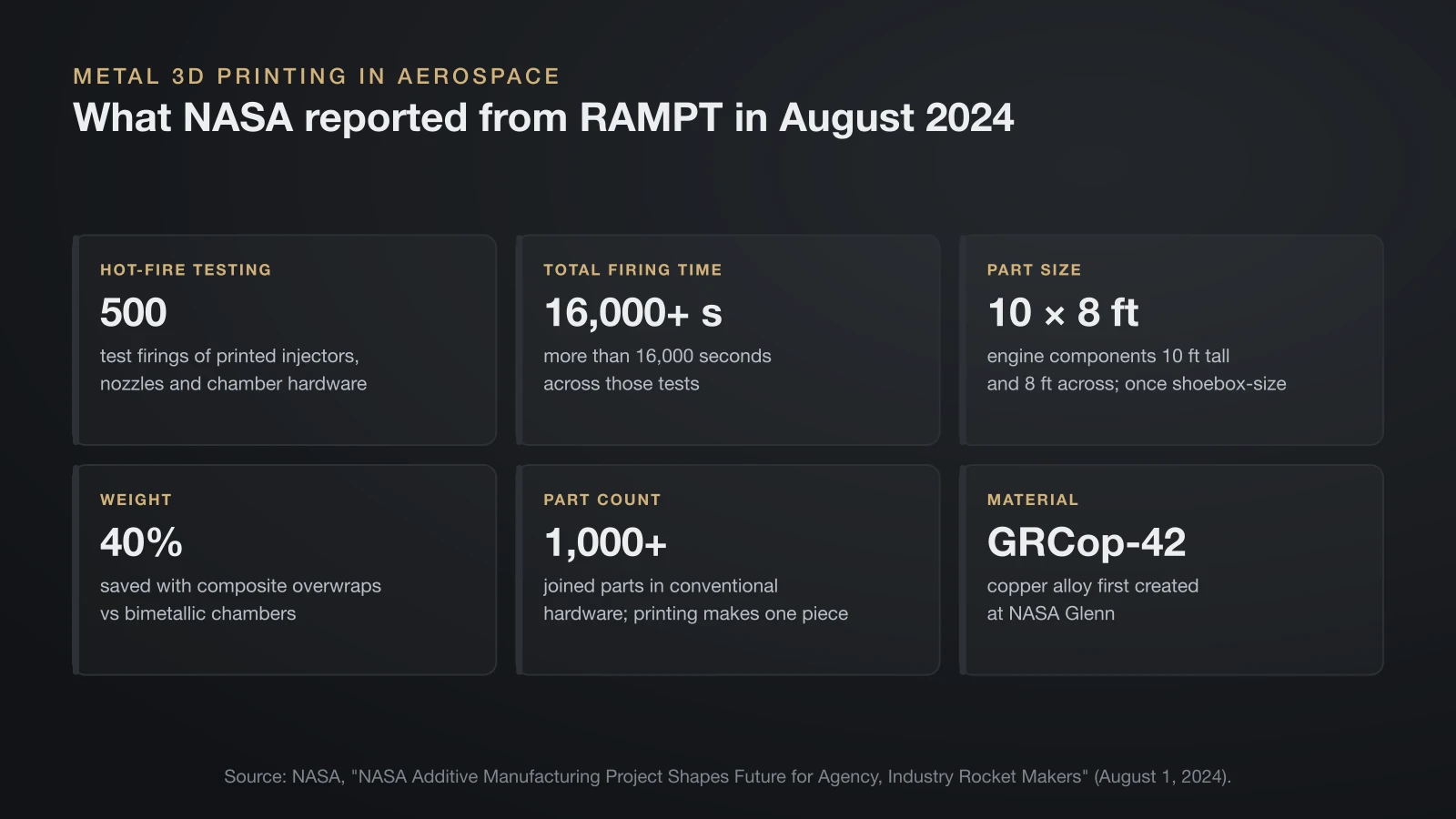
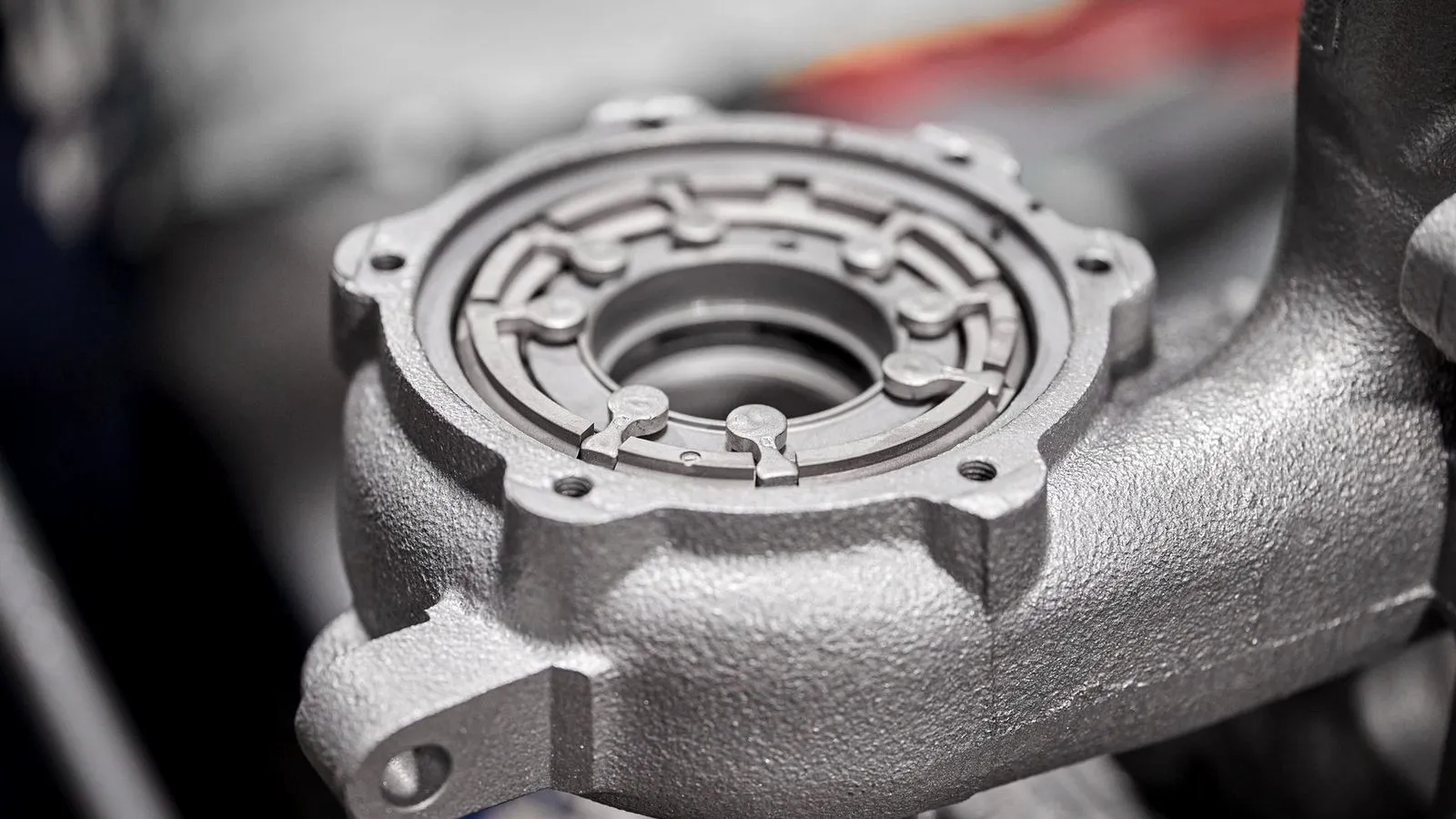
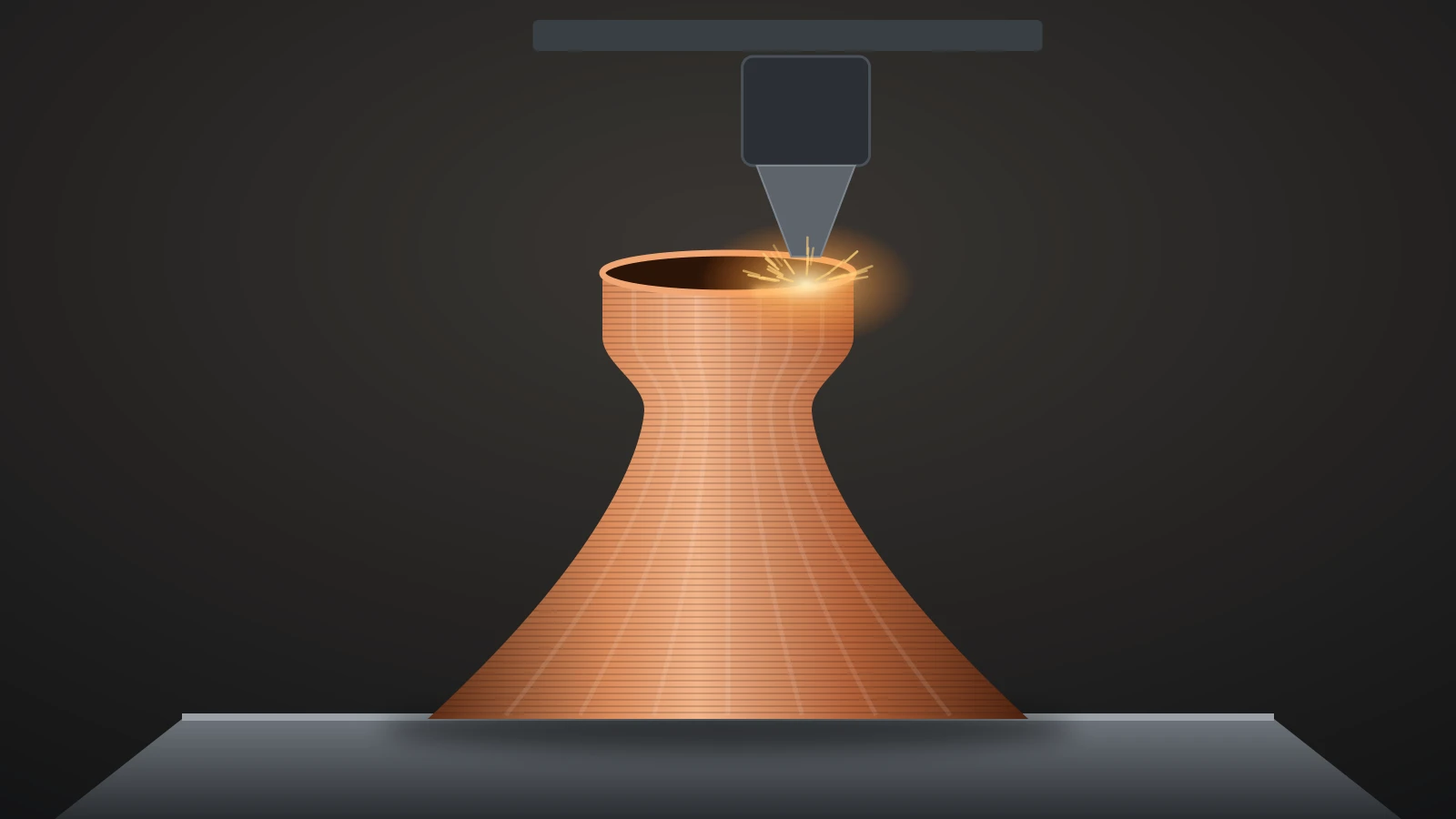
Metal 3D printing has advanced from small test parts to rocket engine hardware that survives repeated hot firing. NASA’s Rapid Analysis and Manufacturing Propulsion Technology (RAMPT) project reported in August 2024 that it had run 500 test firings of 3D printed injectors, nozzles and chamber hardware, totaling more than 16,000 seconds.
Scale has grown too. NASA says that a decade before, most 3D printed parts were no bigger than a shoebox, while researchers now help industry produce engine components 10 feet (about 3 m) tall and 8 feet (about 2.4 m) across. Printing also cuts part counts: conventional rocket hardware may need 1,000 or more individually joined parts, where printing can build complex channels as one piece.
Other RAMPT results from the same 2024 report:
- Copper alloy: NASA refined GRCop-42, an alloy first created at NASA Glenn, and says it helped Relativity Space launch the first fully 3D printed rocket in March 2023.
- Weight: composite overwraps on printed chambers saved 40% of the weight of conventional bimetallic combustion chambers.
- Recognition: the RAMPT team received NASA’s 2024 Invention of the Year award.
None of this happens on a desktop machine. If you want metal parts from a home printer, our guide to metal 3D printer filament explains what metal-filled and sinterable filaments can do.
3D printing in space
3D printing has been used on the International Space Station since 2014, when NASA’s Marshall Space Flight Center and Made In Space (now Redwire) sent the first printer there. It extruded plastic layer by layer and produced more than a dozen parts, including a ratchet wrench designed on the ground and sent to the station, more than 200 miles (about 320 km) above Earth.
Later station experiments built on that start, according to a March 2025 NASA summary:
- 2015: the Additive Manufacturing Facility arrived and printed parts with better tensile strength and flexibility than the first demonstration.
- Recycling: the Refabricator tested turning used plastic into new printed items, with some bonding issues likely caused by microgravity.
- Regolith: Redwire tested printing with simulated lunar dust as feedstock.
- Metal: the European Space Agency’s Metal 3D Printer tests small metal parts in microgravity.
The goal is practical: crews that can print a tool or part on demand do not need to launch every spare they might need.
3D printed houses and construction
In 2022 a 3D printed house was printed whole for the first time, floors and roof included, rather than just its concrete walls. On November 21, 2022, the University of Maine unveiled BioHome3D, a 600-square-foot (about 56 m²) prototype whose floors, walls and roof were printed from wood fibers and bio-resins, with U.S. Department of Energy funding through a partnership with Oak Ridge National Laboratory.
The difference from most printed homes is what gets printed. The center’s director said at the unveiling that most other technologies print concrete walls on a conventional foundation and finish the roof with ordinary wood framing. BioHome3D was printed in modules, moved to the site and secured on its foundation in about half a day.
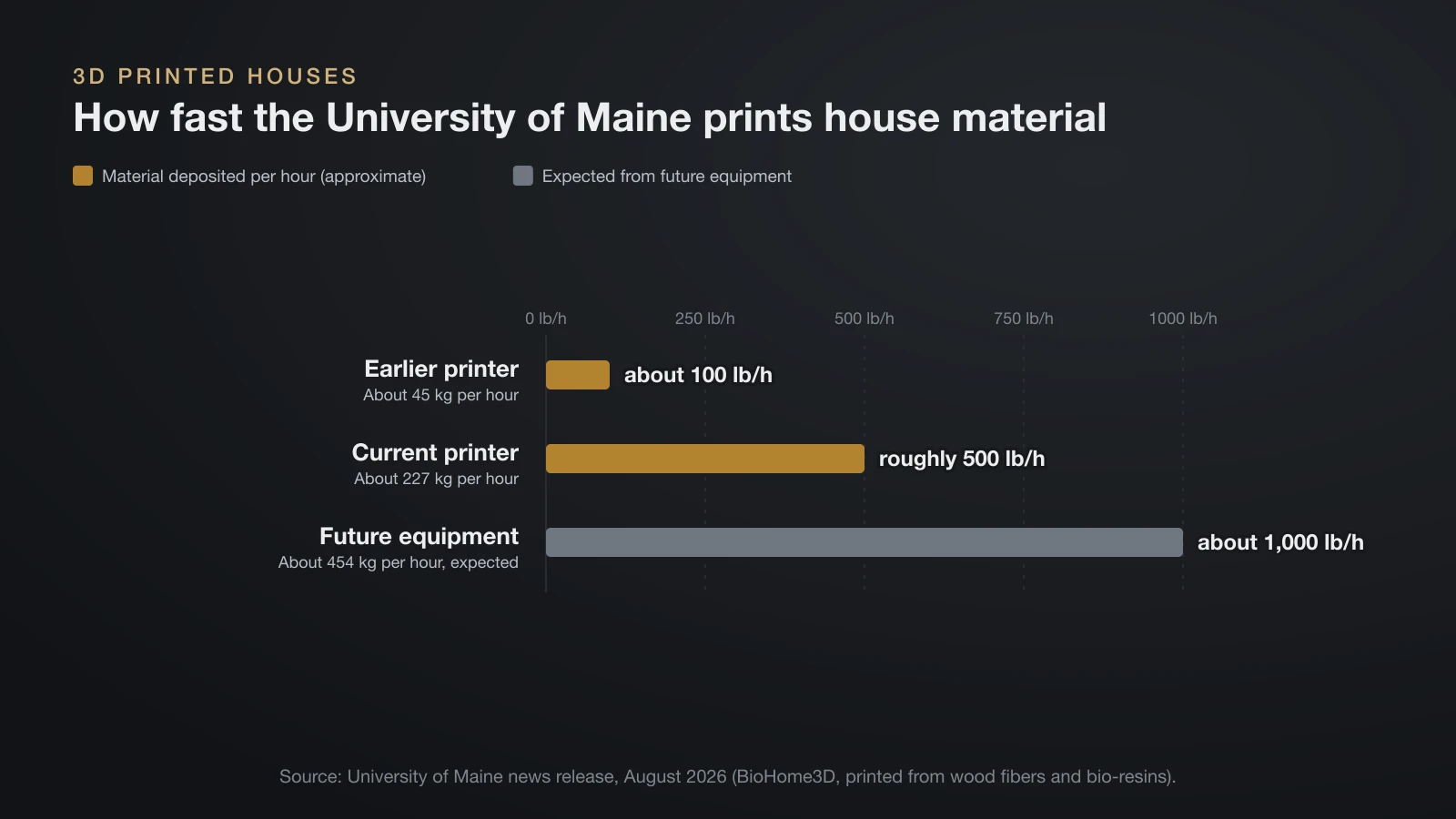
In August 2026, the university announced plans to build up to nine homes with Penquis, a Maine nonprofit. Its printing speed has grown from about 100 pounds (45 kg) of material per hour to roughly 500 pounds (227 kg), with about 1,000 pounds (454 kg) per hour expected from future equipment.
Medical and dental 3D printing
Medical 3D printing is an established, regulated field. The FDA lists orthopedic and cranial implants, surgical instruments, dental restorations such as crowns, and external prosthetics among devices produced by 3D printing, and it reviews them through the same pathways as traditionally made devices.
Key dated steps from the FDA:
- December 2017: the FDA issued its guidance on technical considerations for additively manufactured medical devices.
- December 2021: it published a discussion paper on 3D printing medical devices at the point of care and asked for public comment.
- Ongoing research: printing living organs such as a heart or liver is, in the FDA’s words, in early stages of development.
Patient-matched devices start from a patient’s imaging data, such as an MRI scan, and the FDA names powder bed fusion, which melts fine metal or plastic powder with a laser or electron beam, as the most common process for medical devices. The scan-to-print idea also exists on a hobby scale; our guide to 3D scanners for 3D printing covers it. A home printer is not a way to make medical devices.
How NIST makes 3D printed parts more predictable
Industrial 3D printing needs measurements engineers can trust, and NIST’s AM Bench program supplies them. It publishes tightly controlled benchmark measurements so that modelers can test whether their simulations predict real additive manufacturing results. Rounds were completed in 2018 and 2022, and the 2025 round included 8 sets of metal benchmarks and 1 set for polymers.
NIST says the models for laser powder bed fusion of metals have matured enough to move from simple test specimens to realistic metal components designed with industry. The first of those benchmarks are planned for AM Bench 2028.
What these 3D printing advancements mean for home users
For home users, these 3D printing advancements arrive as more automatic machines rather than new kinds of objects. Input shaping, automatic material changes and heated enclosures take over jobs that once needed manual tuning or a second printer.
Practical takeaways:
- Speed and reliability: fast printing is no longer limited to hand-tuned machines.
- Color and materials: multi-material printing is practical, but the purge-free systems are the costly ones; our 3D printer cost guide compares price tiers.
- Engineering plastics: heated chambers widen the range of printable materials; see our guide to enclosed 3D printers.
- Useful parts: tools, brackets and trim pieces are realistic; safety-critical parts are not. Our 3D printed car parts guide draws that line.
Whether all this justifies buying a printer depends on what you would make with it; our guide on whether a 3D printer is worth it works through the numbers.
The bottom line
The most significant 3D printing advancements are documented, not speculative: printed rocket engine parts with hundreds of test firings, a fully printed bio-based house, FDA-reviewed implants and dental crowns, and printers on the space station since 2014. On the desktop, faster motion, multi-material printing with less waste and hotter chambers have made home printing more capable. The industrial gains rarely reach the home directly, but they show what the process can do when it is measured and tested.
Sources
- U.S. Food and Drug Administration: 3D Printing of Medical Devices, Medical Applications of 3D Printing, Technical Considerations for Additive Manufactured Medical Devices (issued December 5, 2017) and 3D Printing Medical Devices at the Point of Care (December 2021) (device types, patient-matched devices, powder bed fusion, organ research)
- NASA: NASA Additive Manufacturing Project Shapes Future for Agency, Industry Rocket Makers (August 1, 2024: RAMPT test firings, part size, GRCop-42, weight saving) and 3D Printing: Saving Weight and Space at Launch (March 2025: station printing since 2014)
- University of Maine: First 100% bio-based 3D-printed home unveiled (November 2022) and UMaine to produce neighborhood of 3D-printed homes (August 2026) (BioHome3D size, materials, assembly, nine-home plan, print rates)
- National Institute of Standards and Technology: AM Bench (benchmark rounds and 2028 plans)
- Printer and firmware makers, read October 2026: Bambu Lab H2C and H2D store pages; Prusa CORE One+ INDX and Pro HT90 product pages; Klipper Resonance Compensation (multi-material, high-temperature and input shaping specs)