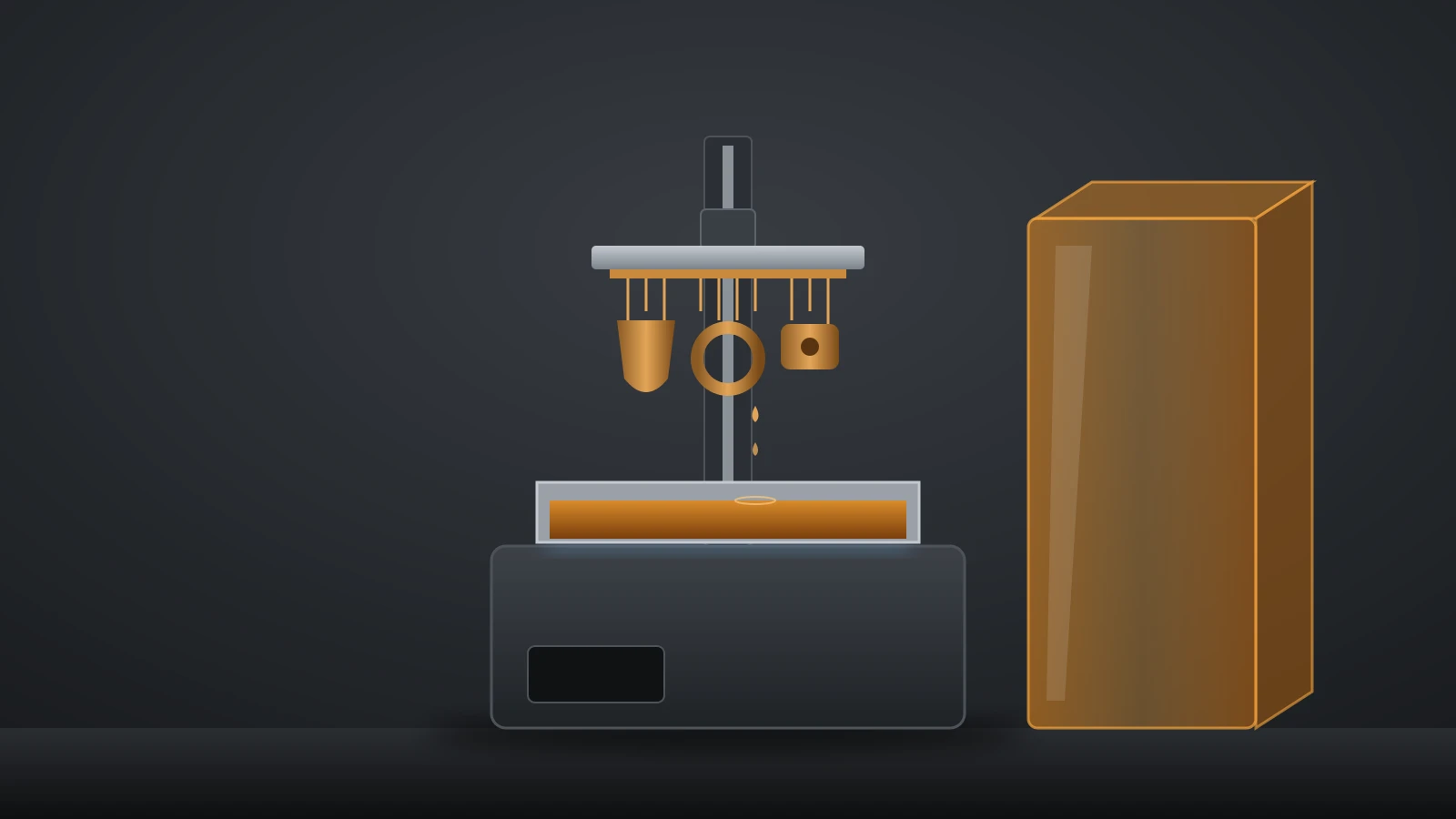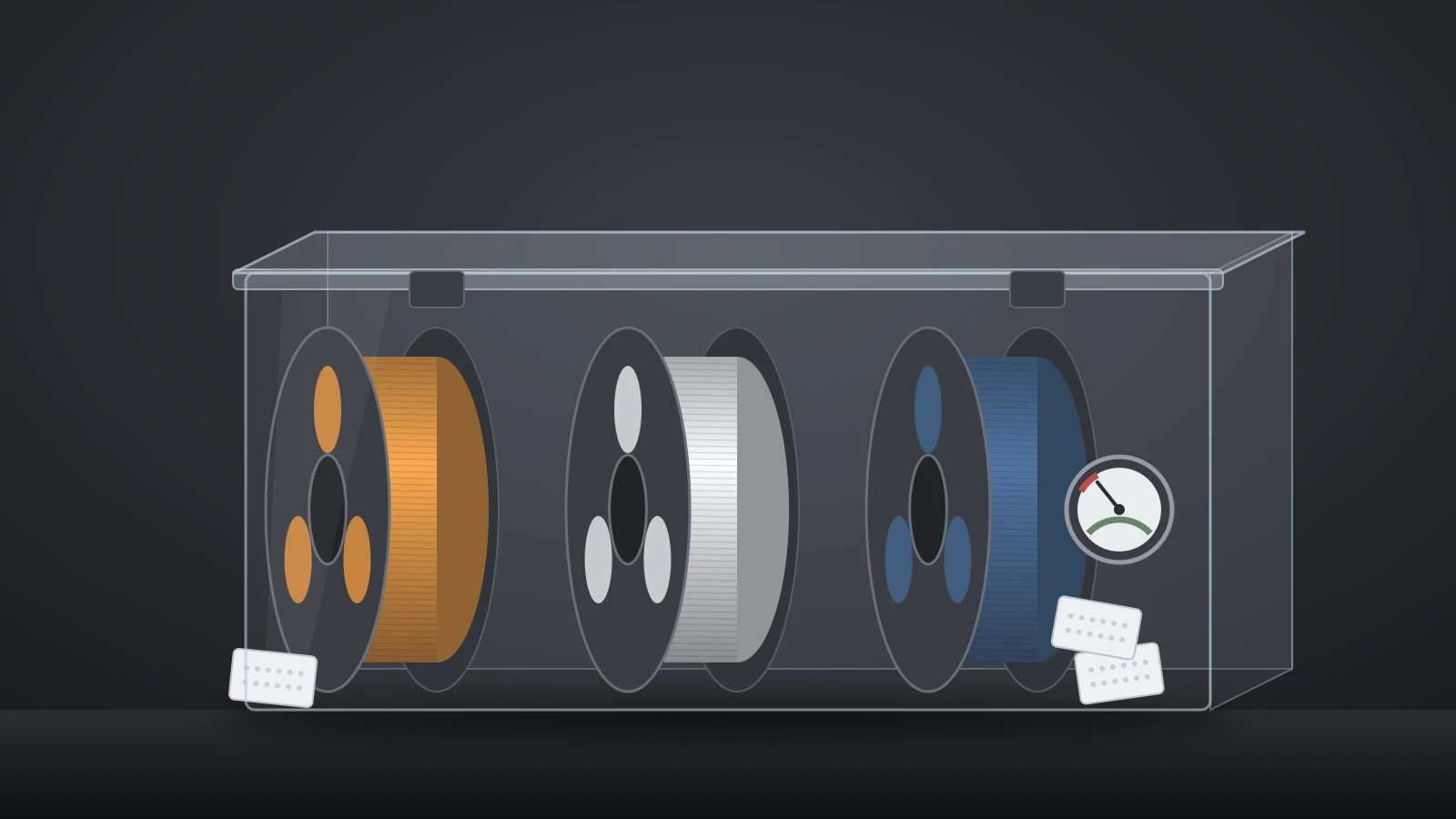

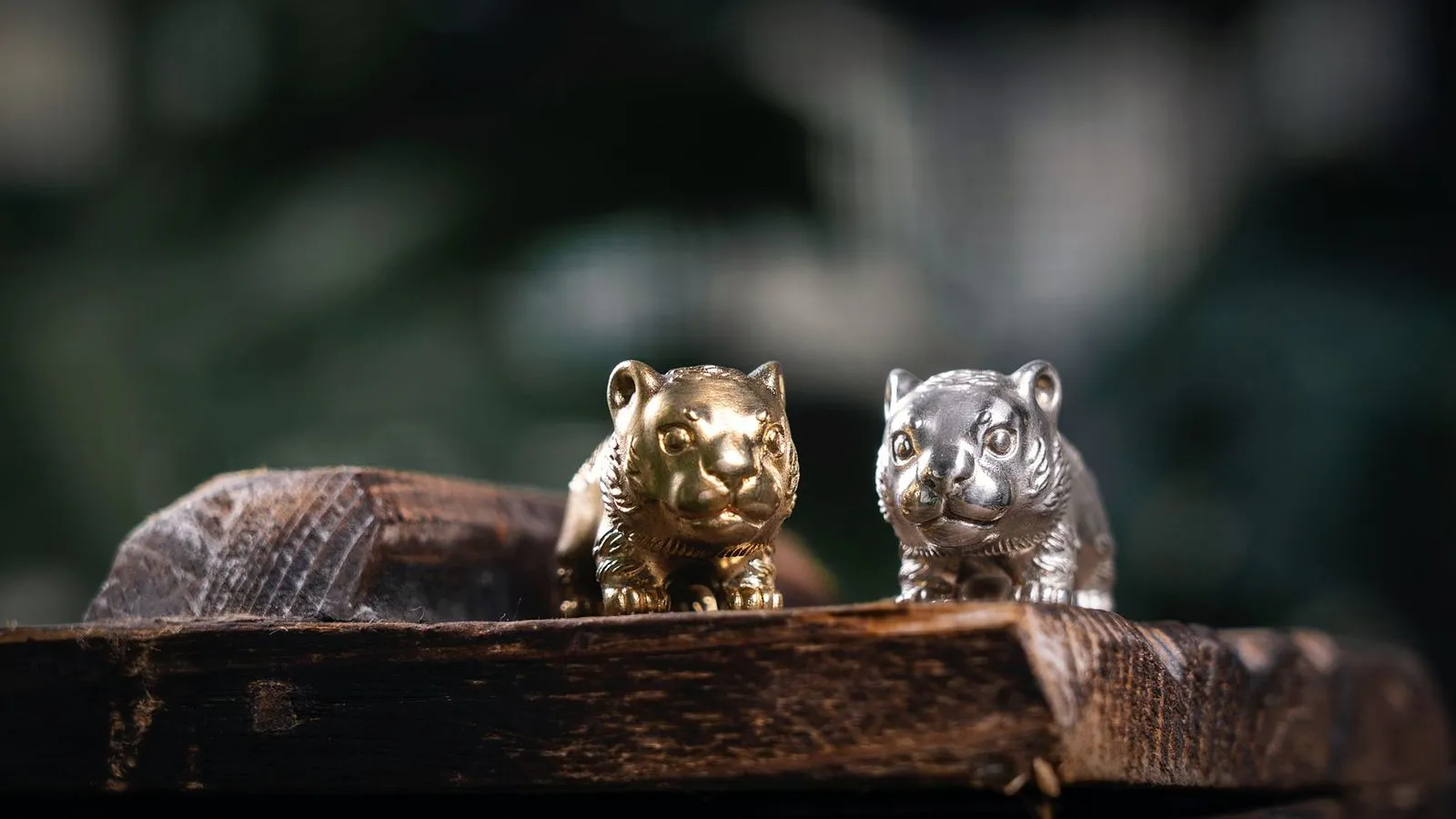
Metal 3D printer filament is usually PLA packed with fine metal powder. It prints on an ordinary FDM printer, can weigh more than three times as much as plain PLA and polishes to a real metal shine, but the finished part is still plastic. Only bound metal filaments turn into solid metal, and that takes industrial debinding and sintering.
The name covers three very different products, and mixing them up leads to disappointment. This guide separates them, compares weight and strength using manufacturer data sheets, and covers the settings that matter most. Metal powder is abrasive, so the nozzle and the rest of your 3D printer extruder matter more here than with regular PLA.
The short answer
| Metal-filled PLA | Metallic-look PLA | Bound metal filament | |
|---|---|---|---|
| What’s inside | PLA plus copper, bronze, brass, steel or iron powder | PLA plus pigments, no metal filler | About 90% stainless steel by mass in a polymer binder (Ultrafuse 316L) |
| Density (data sheets) | About 1.85–4 g/cm³ | 1.25 g/cm³ (Bambu Lab PLA Metal) | Not listed; about 90% metal by mass |
| Hardened nozzle | Recommended: abrasive | Not needed | Recommended: brass wears fast |
| Printer | Most PLA-capable printers | Any PLA printer | Hot bed (90–105 °C), enclosure recommended |
| Finished part | Heavy plastic that sands, polishes and patinates like metal | Shiny plastic | Solid 316L steel after debinding and sintering |
| Strength vs PLA | Lower (13.7–21.1 vs 57.7 MPa tensile, colorFabb) | About the same | A metal part |
| Best for | Statues, props, trophies, knobs, jewelry-style pieces | Decorative prints | Small steel parts, via a sintering service |
What is metal 3D printer filament?
Three product families share the name, and only one of them ends up as metal.
Metal-filled PLA (metal composite filament)
These filaments mix fine metal powder into a PLA base. Proto-pasta sells versions filled with iron, stainless steel, copper, brass and bronze, with particles smaller than 0.25 mm. colorFabb’s copperFill, bronzeFill and steelFill use a PLA/PHA base. Fresh off the printer they look matte, almost like clay or cast metal, and sanding and polishing expose the metal particles.
The metal changes weight, feel and finish, not the material class. Proto-pasta states that its copper composite does not contain enough copper to be electrically conductive, sintered or plated. Its iron-filled PLA is ferromagnetic, so it attracts magnets, and it can be deliberately rusted for an aged look.
Metallic-look PLA (silk and metal-effect PLA)
Silk and metallic PLA filaments have no metal filler. Their shine comes from pigments and additives. Bambu Lab, for example, says its PLA Metal “does not contain actual metal fillers,” lists a density of 1.25 g/cm³ and supports every nozzle size from 0.2 to 0.8 mm. Multicolor silk spools that shift between metallic shades belong to the same group.
These print like normal PLA and need no special hardware, which makes them the right choice when you only want the look. Silk PLA also appears in our PLA+ vs PLA comparison as a looks-first variant, not a strength upgrade.
Bound metal filament (sinterable)
Bound metal filament is mostly metal. Forward AM’s Ultrafuse 316L contains about 90% stainless steel particles by mass, held together by a polymer binder. You print a “green part,” the binder is removed to leave a porous “brown part,” and sintering fuses the powder into an almost fully dense 316L stainless steel part.
Those last two steps are not home jobs. Forward AM’s process instructions call for catalytic debinding with nitric acid vapor at 120 °C and sintering in hydrogen or argon with a hold at 1,380 °C (2,516 °F). That is why the company routes parts to debinding and sintering service partners, and it lists its 17-4 PH version as discontinued, so check availability before planning a project.
Industrial metal printers are a different technology again. Powder bed machines (DMLS and SLM) use a laser to fuse loose metal powder; Forward AM notes that bound filament keeps the powder locked in a polymer, which reduces exposure to fine metal particles.
Metal filament density and weight
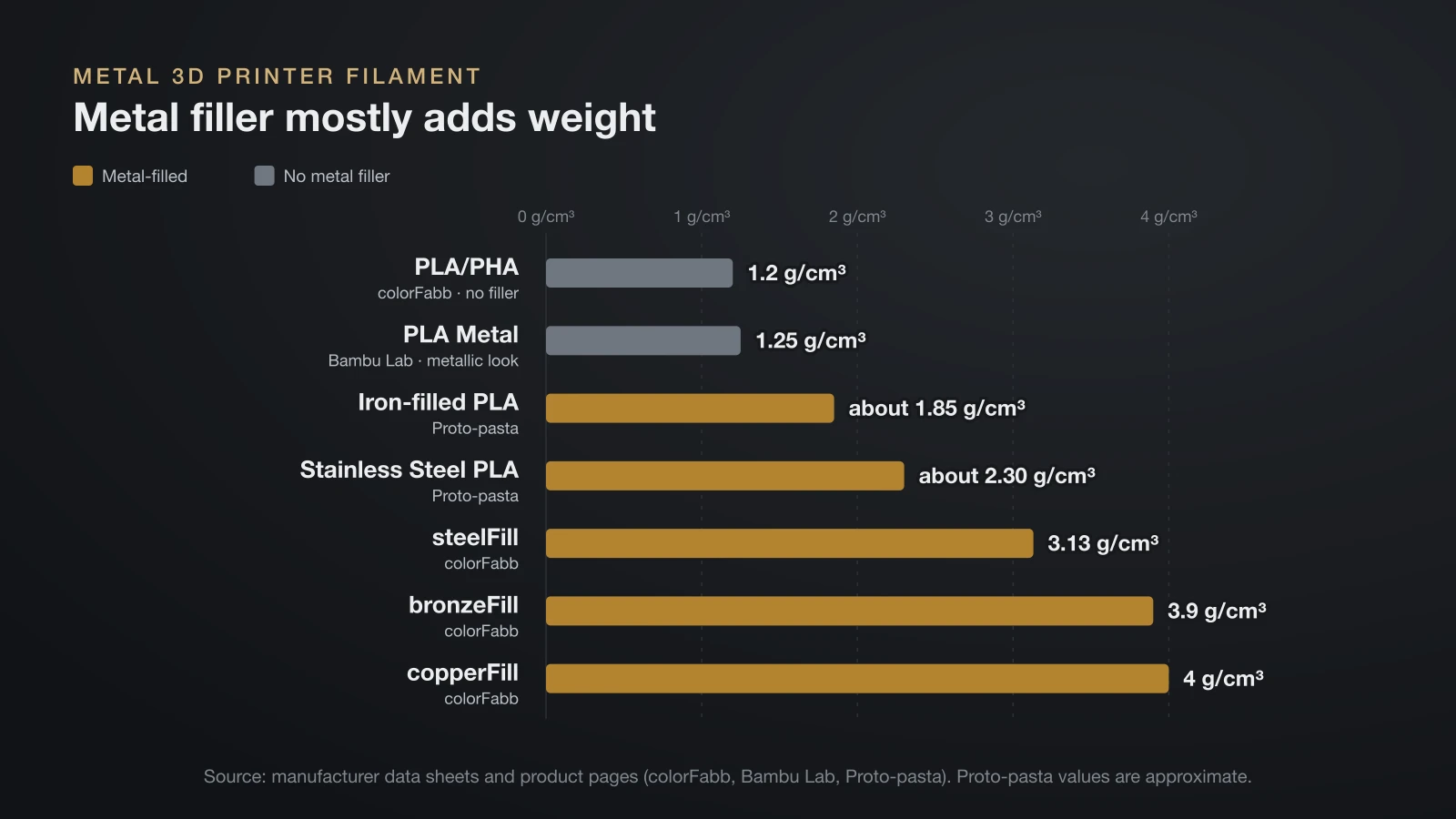
Weight is the main thing metal filler adds. Every value below is the density the manufacturer publishes for its own filament.
| Filament | Type | Density |
|---|---|---|
| colorFabb PLA/PHA | Plain PLA blend, no filler | 1.2 g/cm³ |
| Bambu Lab PLA Metal | Metallic look, no metal | 1.25 g/cm³ |
| Proto-pasta Iron-filled PLA | Metal-filled | About 1.85 g/cm³ |
| Proto-pasta Stainless Steel PLA | Metal-filled | About 2.30 g/cm³ |
| colorFabb steelFill | Metal-filled | 3.13 g/cm³ |
| colorFabb bronzeFill | Metal-filled | 3.9 g/cm³ |
| colorFabb copperFill | Metal-filled | 4 g/cm³ |
Two practical effects follow. A kilogram of bronzeFill holds only about 31% of the length of a kilogram of 1.2 g/cm³ PLA at the same diameter (estimate: 1.2 ÷ 3.9). And your slicer’s weight and cost estimates stay wrong until you enter the data sheet density in the filament profile.
All of these filaments come in 1.75 mm, with 2.85 mm versions from colorFabb, Proto-pasta and Forward AM. Our guide to 1.75 mm filament for 3D printers covers the standard diameter in more depth.
Is metal filled filament stronger than PLA?
No. Metal powder is a filler, not a reinforcement, and the data sheets show it. colorFabb publishes 3D-printed test values for its unfilled PLA/PHA and for its metal-filled versions, using the same ISO methods.
| colorFabb data sheets (3D printed) | PLA/PHA | steelFill | bronzeFill | copperFill |
|---|---|---|---|---|
| Tensile strength (ISO 527-1A) | 57.7 MPa | 21.1 MPa | 20.3 MPa | 13.7 MPa |
| Flexural strength (ISO 178) | 90.4 MPa | 35.2 MPa | 42.0 MPa | 29.6 MPa |
| Elongation at break | 6.1% | 2.4% | 6.1% | 5.9% |
| Notched Charpy impact (ISO 179) | 2.6 kJ/m² | 2.41 kJ/m² | 2.84 kJ/m² | 2.97 kJ/m² |
| Heat deflection (HDT-B, ISO 75, 0.45 MPa) | 51 °C | 50 °C | 48 °C | 49 °C |
The metal-filled versions reach about 24–37% of the unfilled material’s tensile strength (calculated from 13.7–21.1 vs 57.7 MPa). Notched impact values are similar, and heat deflection stays at PLA level, so a metal-look part softens in a hot car just like PLA. Proto-pasta adds that its steel- and iron-filled filaments are slightly more brittle than standard PLA and need extra care when handling.
Treat the table as a direction, not a guarantee. The PLA/PHA sheet says its specimens were printed at 0.15 mm layers with 100% infill, while the metal-fill sheets do not list print conditions.
Heat-treatable metal composites
Proto-pasta’s copper, brass and bronze composites use a heat-treatable PLA (HTPLA). The company lists baking at 110 °C for about 10 minutes, after which parts keep their stiffness up to about 150–175 °C instead of 50–60 °C. The trade-off is a dimension change of about 1.5% shrinkage in X and Y and 1% growth in Z, so test on a spare part first.
Metal filament print settings
Start from your filament maker’s numbers. The table shows how the metal composites compare with a bound metal filament.
| Setting | Proto-pasta metal composites | colorFabb bronzeFill / copperFill | colorFabb steelFill | Forward AM Ultrafuse 316L |
|---|---|---|---|---|
| Nozzle temperature | 185–215 °C | 195–220 °C | 190–210 °C | 245 °C |
| Bed temperature | Room temperature to 60 °C | 50–60 °C | 50–60 °C | 90–105 °C |
| Nozzle size | 0.6 mm or larger preferred, 0.4 mm okay | Not listed | Not listed | 0.3–0.8 mm |
| Print speed | 20–80 mm/s (10–20 mm/s first layer) | 40–100 mm/s | 40–80 mm/s | 25 mm/s |
| Part cooling fan | Not listed | 0–100% (bronzeFill), on (copperFill) | On | None |
| Bed preparation | Glue stick or your usual PLA prep | Glass plate, glue stick | Glass plate, glue stick, tape | Clean, level bed; enclosure recommended |
A few habits make metal composites far more reliable:
- Fit a hardened nozzle before the first spool, not after print quality has already drifted (details below).
- Go bigger: Proto-pasta prefers a 0.6 mm nozzle and calls 0.25 mm the minimum, for experts only.
- Keep the melt moving: Proto-pasta names its main challenge as keeping mass flow up, with a larger nozzle, faster printing within the listed speed range and minimal retraction, so the filament does not heat soak in the hotend.
- Keep the filament path gentle: Proto-pasta says results may be less consistent on Bowden machines and small nozzles, and the filament is more brittle than PLA.
- Stay cool on the bed: Proto-pasta warns that a bed above 60 °C can make warping worse.
If the first layer or dimensions are off, check the basics before blaming the filament. Our guide on how to calibrate a 3D printer covers temperature, flow and first layer tests in order.
Why metal filament needs a hardened nozzle
Metal particles wear soft brass nozzles. colorFabb calls steelFill abrasive to brass, says it can affect print quality after about 1.5 kg and recommends abrasion-resistant nozzles. Proto-pasta tells users of its steel and iron composites to be prepared to replace the nozzle and suggests a wear-resistant or larger one.
Even Forward AM, which says brass nozzles work with Ultrafuse, recommends replacing a brass nozzle after every 3 kg spool and notes that hardened nozzles last longer. A hardened steel nozzle is the simple fix.
Sanding, polishing and patina: finishing metal-filled prints
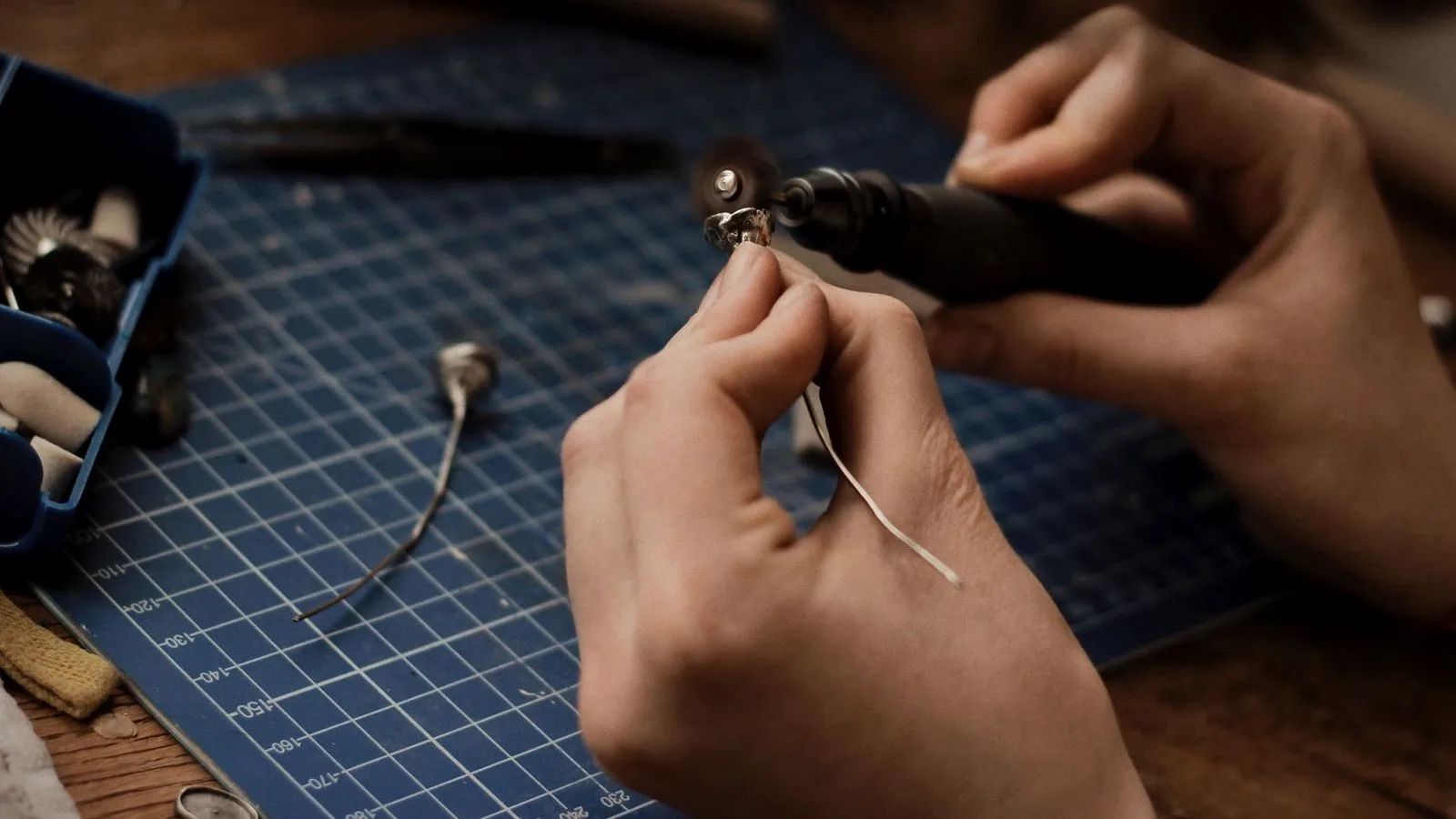
Metal-filled prints come off the bed dull; finishing is what makes them read as metal.
- Sand in steps. colorFabb suggests 120–180 grit until the print lines vanish, then 240–320, then 600 or finer. The material sands easily, so watch small details.
- Polish. colorFabb finishes with a soft cloth and copper polish. Proto-pasta suggests a rotary tool with a cotton buff and polishing compound for bright high spots, a wire brush for a satin look, or a rock tumbler with steel shot for a darker shine.
- Add contrast. Proto-pasta suggests painting the part, black for example, so recesses take a contrasting color; polishing then brightens only the high spots.
- Patina or rust. Copper, brass and bronze fills oxidize naturally. Proto-pasta speeds this up with a 50/50 vinegar and hydrogen peroxide mix saturated with salt, in a sealed plastic bag. Its iron-filled PLA can be rusted on purpose.
- Seal it. A clear coat preserves the finish you worked for.
For primers, clear coats and paint choices, see our guide on how to paint 3D prints. Silk and metallic-look PLAs are different: their shine is the printed surface itself, so there is no metal underneath to polish.
Metal filament safety
Printing metal-filled PLA is much like printing PLA, with a few extra precautions.
- Printing fumes and particles: NIOSH notes that emissions depend on the filament, its color and the nozzle temperature, and lists metal dust among substances detected in 3D printer emissions. Print in a ventilated room, and NIOSH advises the lowest printing temperature that gives the result you need.
- Sanding dust: the dust contains metal particles. Sand wet where possible, wear safety glasses, and clean up by wet wiping or with a HEPA vacuum; NIOSH advises against dry sweeping or compressed air.
- Patina chemicals: treat vinegar, hydrogen peroxide and salt mixes as chemicals, not kitchen ingredients. Wear gloves and eye protection, work in a ventilated space and label the container.
- Debinding and sintering: nitric acid vapor, hydrogen and furnace temperatures belong in an industrial facility, not a garage.
- Load-bearing parts: metal-filled PLA is weaker than plain PLA in colorFabb’s data. Do not use it for anything whose failure could hurt someone.
The bottom line
Most metal 3D printer filament is PLA with metal powder: heavy, polishable and great for statues, props and decorative hardware, but weaker than plain PLA and no more heat resistant. Metallic-look PLA gives the shine without the weight or the nozzle wear. Only bound metal filament becomes real steel, and it needs an industrial debinding and sintering service.
Sources
- colorFabb: technical data sheets for bronzeFill, copperFill, steelFill and PLA/PHA, plus the steelFill product page (density, tensile, flexural, impact, HDT-B, print settings, sanding grits, nozzle wear after 1.5 kg)
- Proto-pasta: product pages for Iron-filled PLA, Stainless Steel PLA and Copper-filled HTPLA (particle size, density, magnetism, rusting, not conductive, print settings, heat treating, finishing and patina)
- Bambu Lab: PLA Metal product page and PLA Metal technical data sheet V3.0 (no metal fillers, 1.25 g/cm³, nozzle sizes 0.2–0.8 mm)
- Forward AM (BASF): Ultrafuse 316L, Ultrafuse metal user guidelines and 316L process instructions (about 90% metal, green/brown/sintered stages, print settings, nozzle wear, debinding at 120 °C, sintering at 1,380 °C, 17-4 PH discontinued)
- NIOSH: Approaches to Safe 3D Printing, publication 2024-103 (emission factors, metal dust, wet cleaning and HEPA vacuums, eye protection for sanding)