
The major 3D printer brands for home use are Bambu Lab, Prusa Research, Creality, Elegoo, Anycubic, Flashforge, QIDI Tech, Sovol and Snapmaker, while Formlabs, UltiMaker, MakerBot, Raise3D and LulzBot lean toward professional and school buyers. Most consumer brands are based in China; Prusa is Czech, UltiMaker Dutch, and Formlabs, Raise3D and LulzBot are US companies.
This guide compares the brands on facts from their own official pages, checked in October 2026: where each is based, what it makes, how open its software is and which printers are made in the USA. There is no ranking, and prices stay in our guide to how much a 3D printer costs.
The short answer
| If you want | Brands to look at |
|---|---|
| Open firmware, kits and published parts | Prusa Research, LulzBot, Voron-based designs |
| An integrated app and cloud ecosystem | Bambu Lab, Creality’s K series |
| Low entry prices across filament and resin | Creality, Elegoo, Anycubic |
| Enclosed printers with heated chambers | QIDI Tech, Prusa, Bambu Lab |
| Professional resin or powder (SLS) printing | Formlabs |
| School and classroom systems | MakerBot, UltiMaker |
| A printer built in the USA | LulzBot; Prusa says its XL+ is made in Prague and Delaware |
Major 3D printer brands compared
The table below lists 13 major 3D printer brands with the facts each one publishes about itself. “Based in” is what the company’s own pages state; where a page gives only a company address, the table says so.
| Brand | Based in (official pages) | What it makes | Own software |
|---|---|---|---|
| Bambu Lab | Shenzhen and Shanghai, China; site in Austin, Texas | Filament (FDM) | Bambu Studio |
| Prusa Research | Prague, Czech Republic (since 2012) | Filament | PrusaSlicer |
| Creality | Shenzhen, China (founded 2014, listed in Hong Kong) | Filament, resin, scanners, laser engravers | Creality Print |
| Elegoo | Shenzhen, China (founded 2015) | Filament and resin | ElegooSlicer, SatelLite (resin) |
| Anycubic | Company address in Hong Kong | Filament and resin | Not covered here |
| Flashforge | China (Zhejiang, founded 2011) | Filament, resin, wax | Flash Studio |
| QIDI Tech | China (since 2014), Hong Kong business address | Enclosed filament printers | QIDI Studio |
| Sovol | Not stated (founded 2018) | Filament | Not covered here |
| Snapmaker | Shenzhen, China | Filament (U1 toolchanger), 3-in-1 machines with laser and CNC | Snapmaker Orca, Luban |
| Formlabs | Boston, Massachusetts (global HQ) | Resin (SLA) and powder (SLS) | PreForm |
| UltiMaker | Netherlands (Ultimaker B.V.), office in New York | Professional filament | UltiMaker Cura |
| MakerBot | Part of UltiMaker | Classroom filament printers | CloudPrint |
| Raise3D | Irvine, California (HQ) | Professional filament, resin, SLS, metal | ideaMaker |
| LulzBot | Fargo, North Dakota | Filament, open-source hardware | Cura LulzBot Edition (Cura LE) |
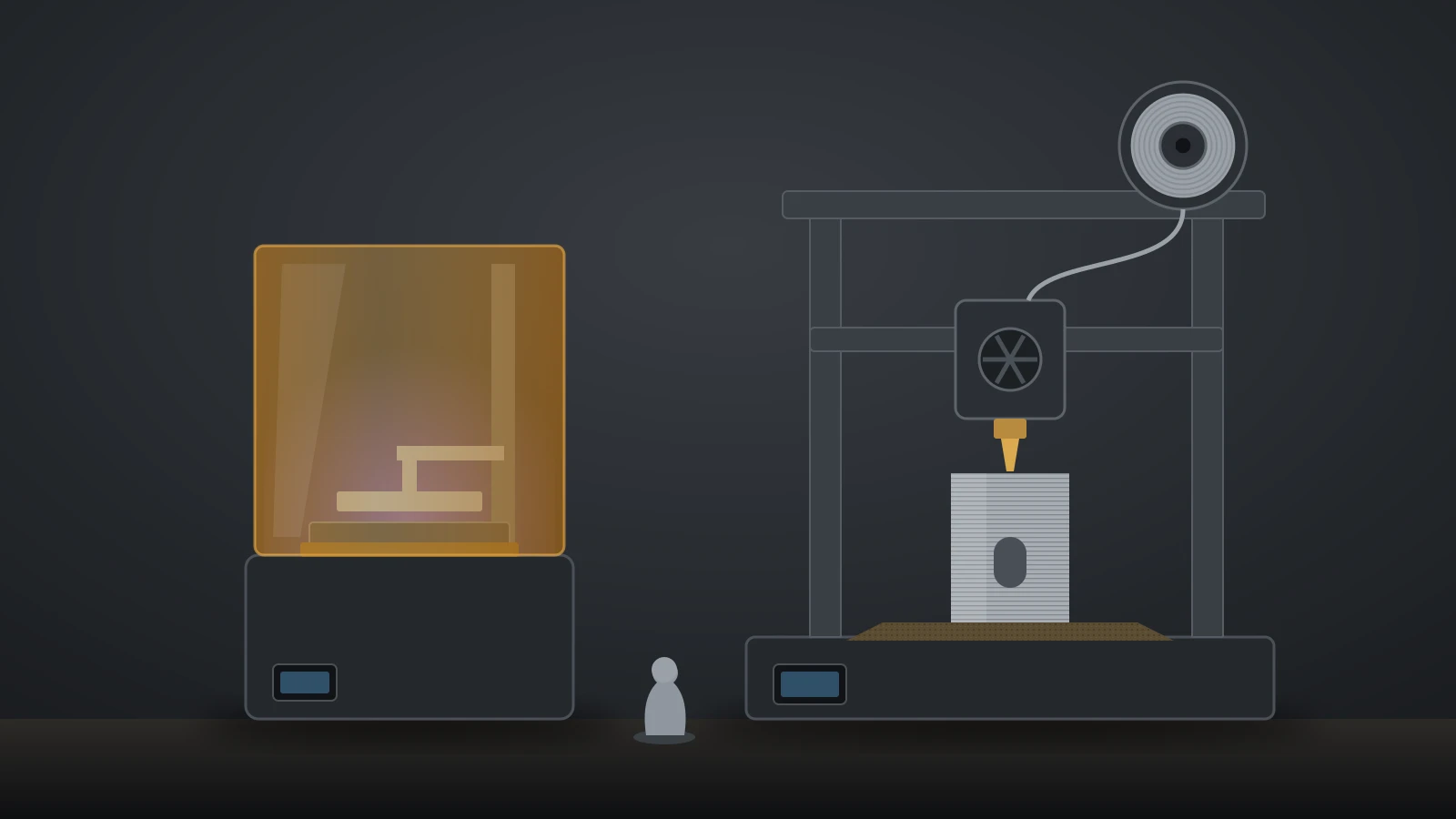
FDM (fused deposition modeling) printers melt filament; SLA (stereolithography) printers cure liquid resin with light; SLS (selective laser sintering) fuses nylon powder. MakerBot and Ultimaker merged into UltiMaker, and MakerBot now runs as UltiMaker’s education sub-brand.
Filament and resin 3D printer brands
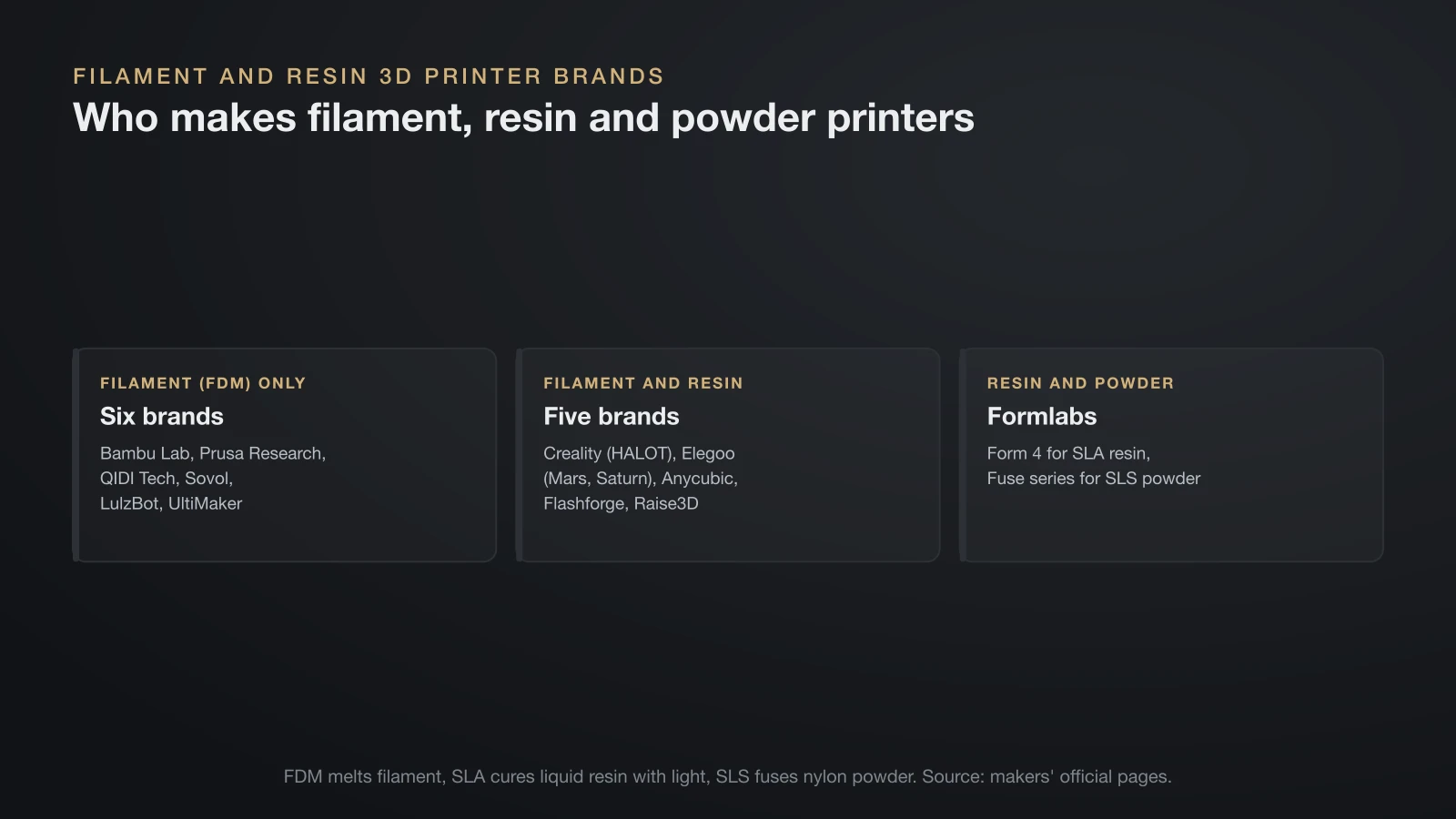
Filament brands dominate home printing, while a smaller group sells resin printers for fine detail. Several makers do both. If you are shopping for the plastic rather than the printer, see our guide to the best filament brands.
- Filament only: Bambu Lab, Prusa Research, QIDI Tech, Sovol, LulzBot and UltiMaker.
- Filament and resin: Creality (HALOT resin printers), Elegoo (Mars and Saturn), Anycubic, Flashforge and Raise3D.
- Resin and powder: Formlabs, with the Form 4 for SLA and the Fuse series for SLS.
If you are still deciding between the two technologies, our comparison of resin vs filament printers explains the trade-offs in detail, part size, cleanup and fumes.
Open vs closed ecosystems
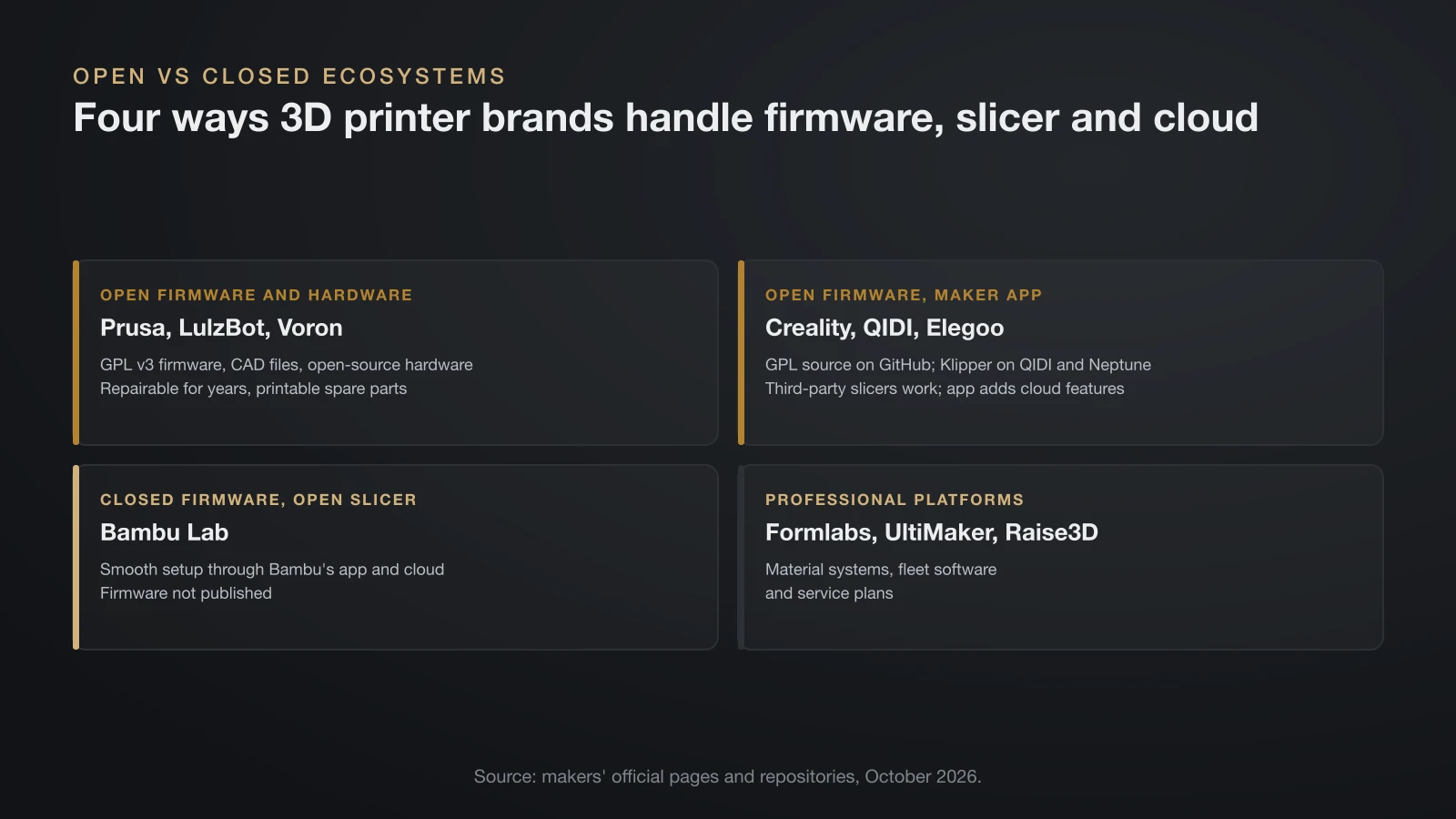
A brand’s ecosystem decides how much you can repair, modify and control after the purchase. The difference is mostly about firmware, slicer and cloud.
| Approach | Brands | What it means for you |
|---|---|---|
| Open firmware and hardware | Prusa (firmware under GPL v3, CAD files), LulzBot (open-source hardware), Voron designs | Repairable for years, printable spare parts, full control |
| Open firmware, maker ecosystem | Creality (GPL source on GitHub), QIDI and Elegoo Neptune (Klipper firmware) | Third-party slicers work; the maker’s app adds cloud features |
| Closed firmware, open slicer | Bambu Lab | Smooth setup through Bambu’s app and cloud; firmware not published |
| Professional platforms | Formlabs, UltiMaker, Raise3D | Material systems, fleet software and service plans |
Most consumer slicers share one family tree: Bambu Studio derives from PrusaSlicer, OrcaSlicer from Bambu Studio, and Creality Print, ElegooSlicer, QIDI Studio and Flashforge’s Flash Studio from those. That shared base is why profiles and settings feel familiar across brands. Our Prusa vs Bambu Lab comparison covers the open-versus-closed debate in depth, including Bambu’s 2025 firmware authorization change.
3D printer brand profiles
Each profile sticks to what the brand states about itself, with links to our full guides where we have them.
Bambu Lab
Bambu Lab sells fast, mostly CoreXY filament printers from the A1 mini to the H2 series, with AMS filament changers for multi-color printing. Its wiki lists sites in Shenzhen, Shanghai and Austin. Printing runs through Bambu Studio and the Bambu Handy app, with a LAN-only mode for local use.
Prusa Research
Prusa Research, based in Prague, makes the MK4S, CORE One+, CORE One L+ and XL+, has made printers since 2012 and says it opened a factory in Delaware, USA. It sells the MK4S and CORE One+ as kits as well as assembled, and publishes firmware, printable parts and CAD files. Our guide to 3D printer kits compares Prusa’s kit and assembled prices.
Creality
Creality makes the Ender, K, Hi and SPARKX filament series and HALOT resin printers, plus scanners, filament dryers and laser engravers. The company says it has shipped more than 6 million printers to over 140 countries. Our Ender 3 comparison covers its best-known entry line.
Elegoo, Flashforge and QIDI
These three Chinese makers each have a focus. Elegoo spans low-cost resin printers and Klipper-based Neptune and enclosed Centauri filament printers; Flashforge, founded in 2011, sells consumer and industrial machines with ISO 9001 certification; QIDI builds enclosed printers, four of five with 65 °C (149 °F) heated chambers. See our guides to Elegoo 3D printers, Flashforge 3D printers and QIDI 3D printers.
Anycubic, Sovol and Snapmaker
Anycubic sells filament and resin printers and lists a Hong Kong company address. Sovol, founded in 2018, makes the SV06 and SV08 series; it says the SV08 was inspired by the open-source Voron 2.4 and set up a donation program with the Voron team. Snapmaker says design, firmware, engineering and manufacturing all happen in-house in Shenzhen, and its U1 changes between four toolheads.
Formlabs, UltiMaker, MakerBot and Raise3D
These brands sell mainly to businesses and schools. Formlabs, headquartered in Boston, makes the Form 4 resin printer and Fuse SLS printers. UltiMaker’s S series uses 2.85 mm filament, and it calls the S8 a professional printer made in Europe; MakerBot’s Sketch printers target classrooms. Raise3D, which names Irvine, California, as its headquarters, sells Pro3 and E3 filament printers, the DF2 resin printer, the RMS220 SLS printer and MetalFuse metal printing.
3D printers made in the USA
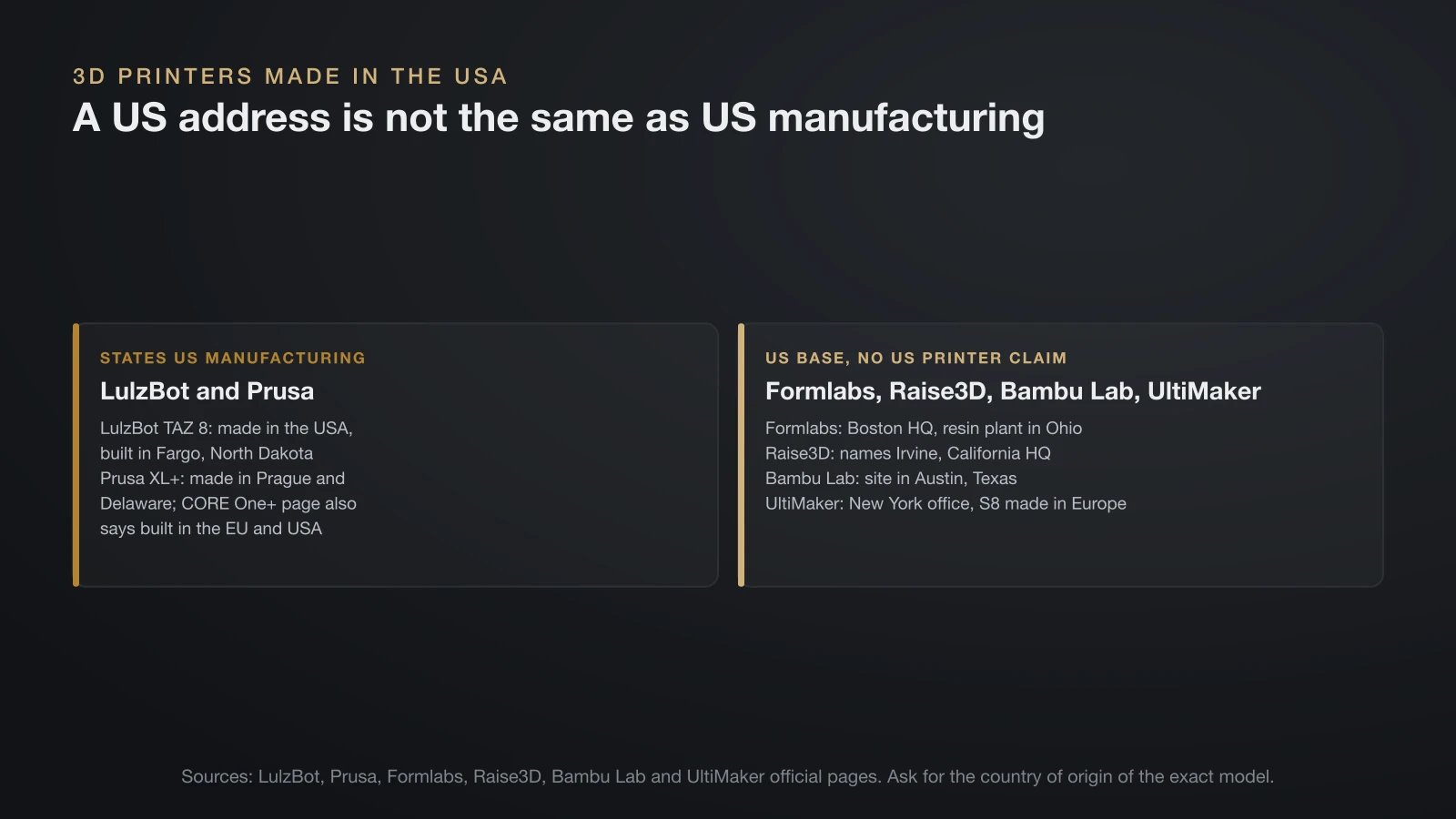
Only a few consumer and professional brands state that their printers are made in the USA. We list a brand here only when its own page says so; a US headquarters or office is not the same as US manufacturing.
| Brand | What its official page says |
|---|---|
| LulzBot | TAZ 8: “Made in the USA”, designed, built and supported in Fargo, North Dakota; country of origin USA |
| Prusa Research | XL+: “Made in Prague, EU & Delaware, USA”, with its own circuit board production in Prague; the CORE One+ page says “Designed and built in the EU and USA” in one place and “manufactured in the EU” in another |
Other brands with American bases do not make that claim on the pages we checked:
- Formlabs is headquartered in Boston and says it produces resins at a manufacturing facility in Ohio, but its pages do not say where its printers are assembled.
- Raise3D names Irvine, California, as its headquarters, without a US manufacturing claim.
- Bambu Lab lists a site in Austin, Texas, without saying what is built there.
- UltiMaker has a New York office, and it describes the S8 as made in Europe.
If American-made matters for procurement, ask the maker for the country of origin of the exact model, because it can differ between models from the same brand.
How to choose a 3D printer brand
The most reliable way to choose a 3D printer brand is to judge the support around the printer, not the logo on it. Check these points on the maker’s own site before you buy:
- Parts: are nozzles, hotends, build plates, belts and fans sold individually on the maker’s store?
- Documentation: is there a complete online manual and troubleshooting wiki for your exact model?
- Firmware and software: is the firmware open or closed, does the printer work offline, and can you use a third-party slicer such as OrcaSlicer?
- Materials: does the printer have an enclosure or heated chamber for ABS and ASA, if you need them?
- Warranty and service: how long is the warranty, and which parts are excluded?
- Community: are there active user groups and model profiles for the printer?
A brand that scores well on parts and documentation is easier to keep running for years. If you plan to print for money, the same checks matter even more; our guide to starting a 3D printing business explains why reliability and enclosures matter for small production runs.
The bottom line
Most consumer 3D printer brands are based in China, with Prusa in the Czech Republic, UltiMaker in the Netherlands, and Formlabs, Raise3D and LulzBot in the United States. The clearest difference between them is openness: Prusa and LulzBot publish firmware and hardware, while Bambu Lab keeps firmware closed behind a polished app. Only LulzBot and Prusa state US manufacturing on their own pages: LulzBot for the TAZ 8, Prusa for the XL+ and, less consistently, the CORE One+.
Sources
- Bambu Lab Wiki: About us (Shenzhen, Shanghai and Austin sites); Prusa Research: CORE One+ kit (Prague, making printers since 2012), XL+ (designed and manufactured in the EU and USA) and Open source at Prusa Research
- Chinese consumer makers: Creality About (founded 2014, HKEX listing, 6 million printers, 140 countries) and Ender-3 V3 SE manual (company name), Elegoo About, Flashforge About, QIDI About, Anycubic About, About Sovol and Snapmaker About
- Professional makers: Formlabs company page (Boston HQ, Ohio locations) and investment casting (Ohio resin manufacturing), UltiMaker contact page (Ultimaker B.V., Netherlands and New York offices) and S series, MakerBot About (merger into UltiMaker), Raise3D About (Irvine HQ, product lines)
- LulzBot: TAZ 8 product page (made in the USA, Fargo, country of origin) and LulzBot home (Fargo Additive Manufacturing Equipment 3D, open-source hardware)
- Firmware and slicer sources: Creality on GitHub, Bambu Studio on GitHub (AGPL-3.0, based on PrusaSlicer) and Prusa Firmware Buddy (GPL v3)