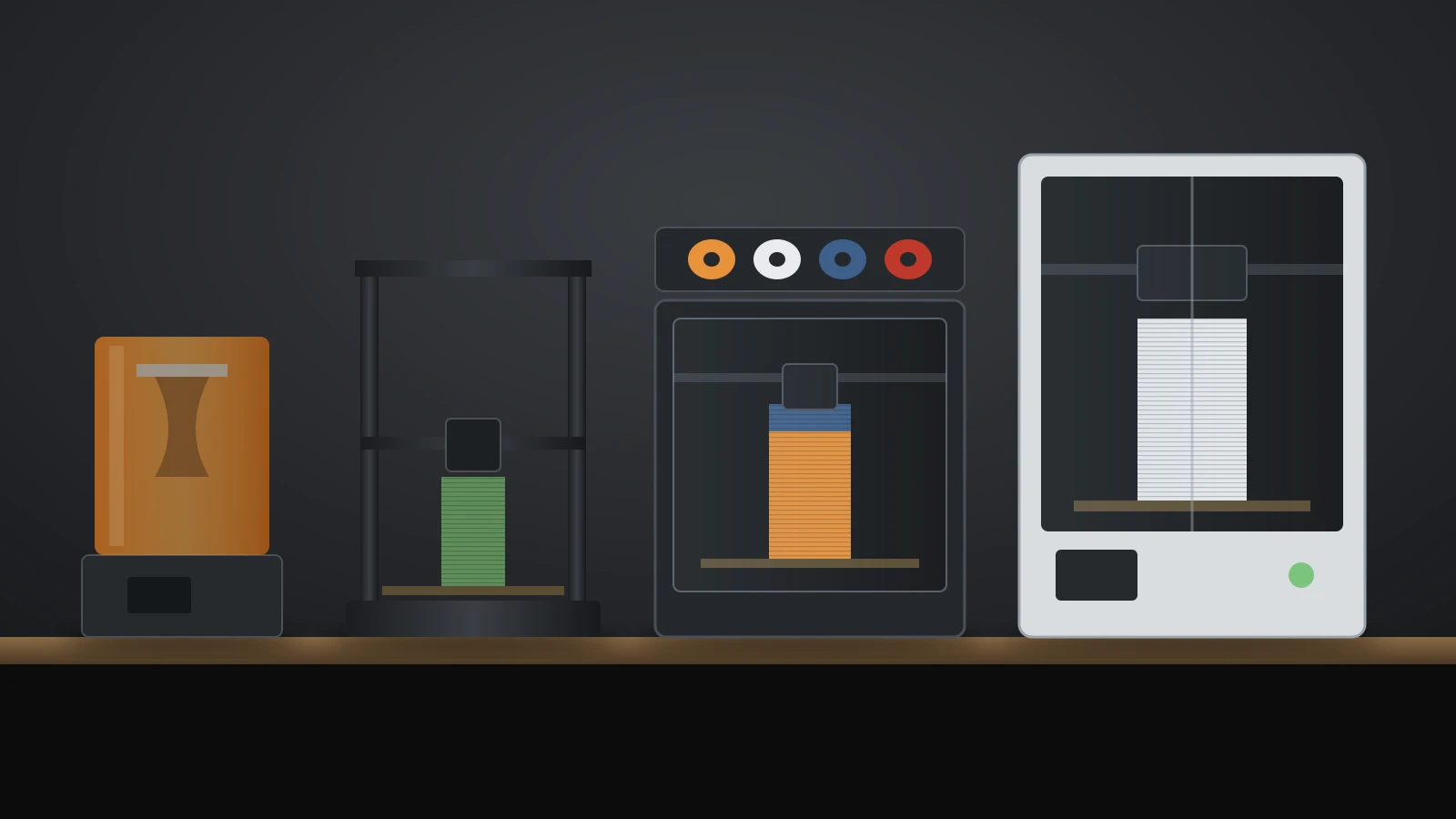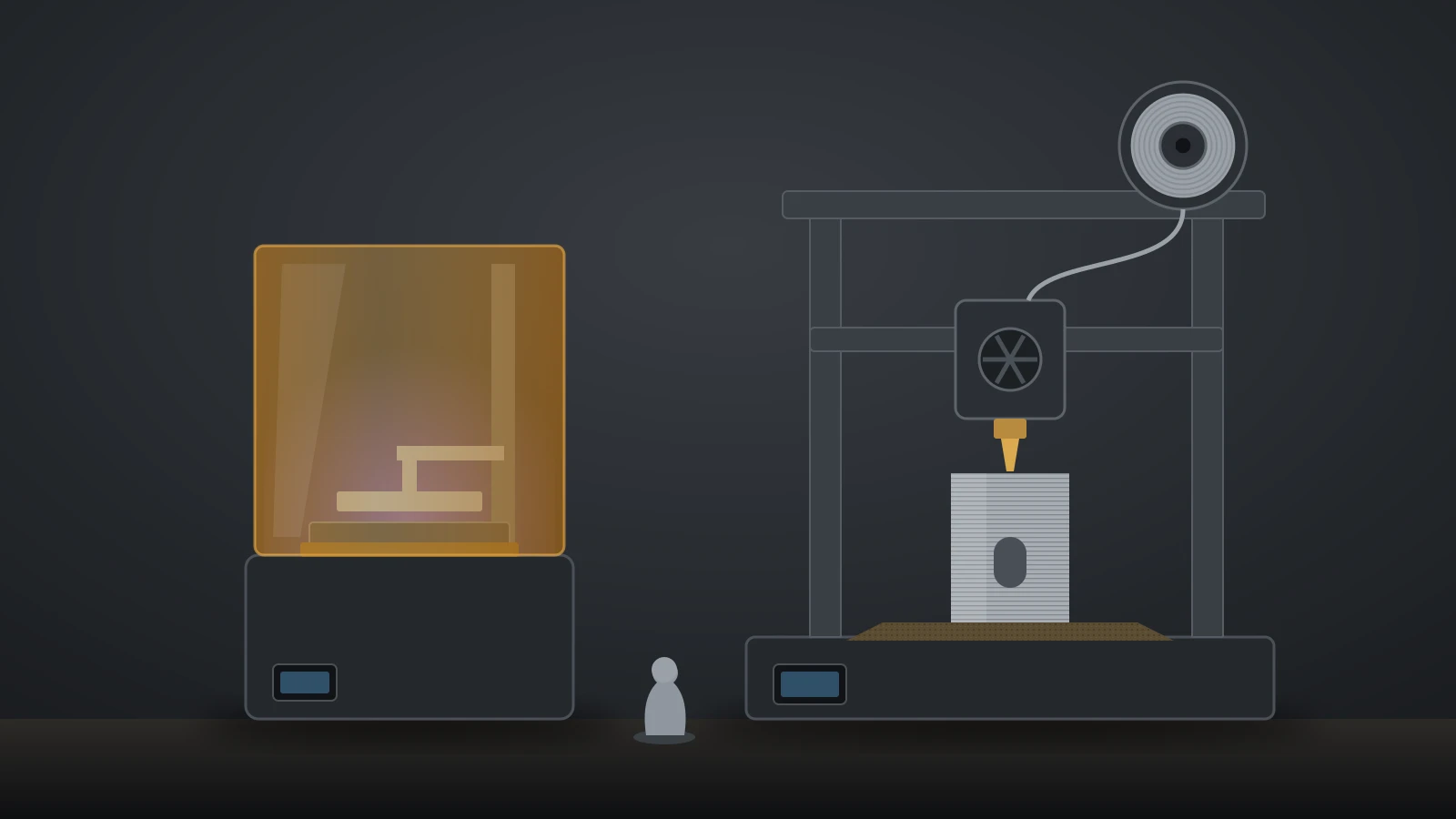

A Bambu Lab 3D printer is a filament (FDM) machine from one of four families: the open A series (A1 mini, A1, A2L), the enclosed P series (P1S, P2S), the dual-nozzle X2D and the large, heated H2 series (H2S, H2D, H2C). On October 19, 2026, Bambu Lab’s US store priced the cheapest editions from $219 to $2,199.
Bambu Lab printers share one slicer, one app and one family of filament changers, so the real choice is size, enclosure and how many materials you want in one print. If you are comparing ecosystems, our guide to Bambu Lab vs Prusa covers openness, repairs and the A1 vs P1S vs X1C question.
The short answer
| If you want to | Look at | Why |
|---|---|---|
| Print PLA and PETG on a small budget | A1 mini or A1 | Open frame, from $219 and $299 |
| Print big parts without an enclosure | A2L | 330 × 320 × 325 mm on an open frame |
| Print ABS, ASA and other warping plastics | P1S or P2S | Enclosed, 256 mm cube |
| Use two materials or many colors efficiently | X2D or H2D | Two nozzles and a heated chamber |
| Print large engineering parts | H2S, H2D or H2C | 350 °C nozzle, 65 °C chamber |
Who makes Bambu Lab 3D printers?
Bambu Lab 3D printers come from a consumer technology company that focuses on desktop 3D printers, according to its official wiki. The same page lists three sites: Shenzhen and Shanghai in China, and Austin, Texas.
Bambu Lab started with the X1 series and describes its team as 3D printing fans with backgrounds in robotics, artificial intelligence, materials science and internet industries. All of its 3D printers are filament machines, and its store also sells filament, AMS filament changers and laser and crafting products.
Bambu Lab 3D printer lineup in October 2026
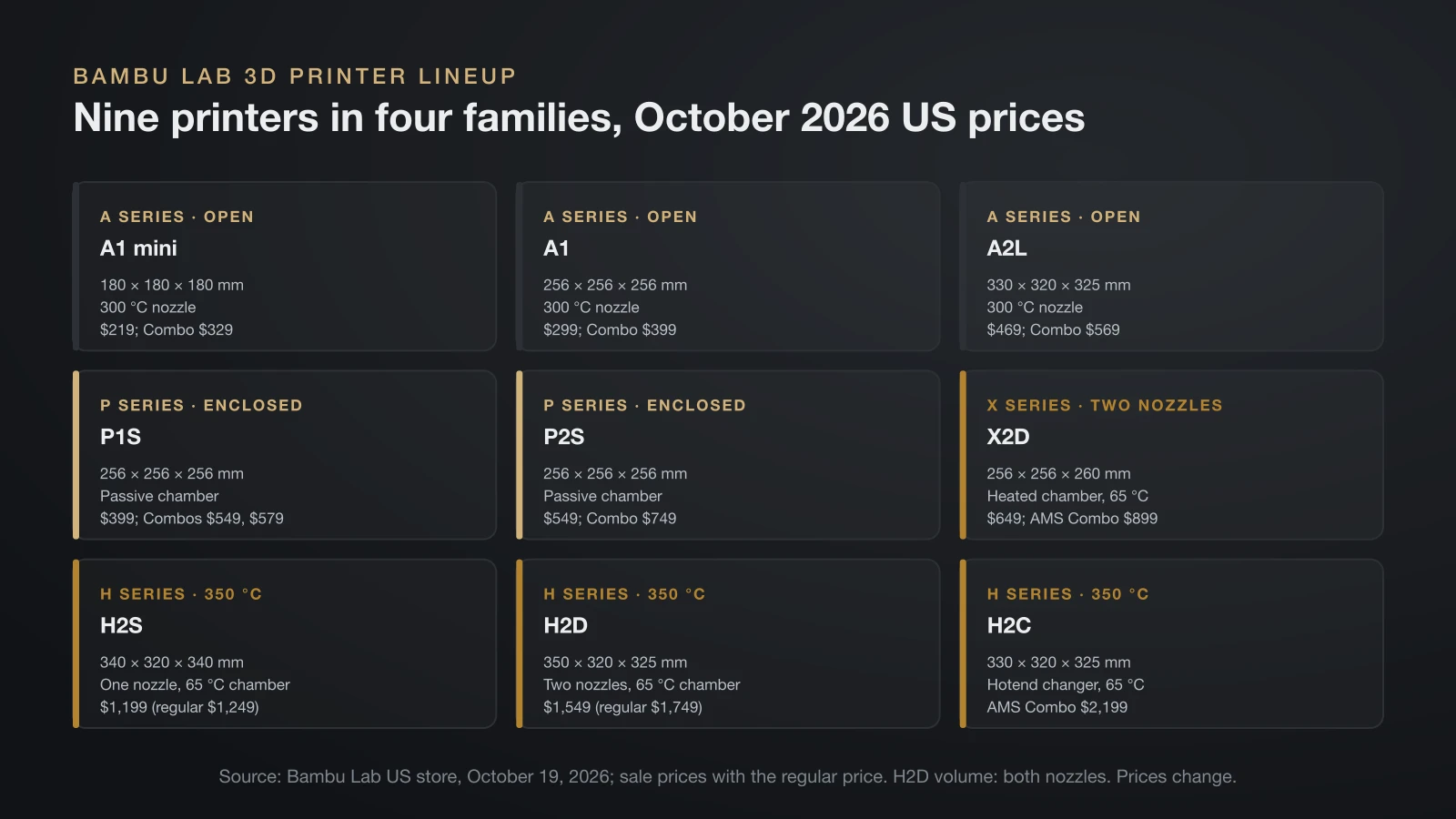
Bambu Lab’s US store listed nine new printers on October 19, 2026. Specs come from each product page; prices are the ones shown that day, with the store’s regular (typical) price in parentheses where a sale was running. When we checked again on October 30, 2026, a store-wide sale had cut prices further: the A1 mini was $199, the P1S $349, the H2S $1,049 and the H2D $1,399. Sale prices change often, so confirm on the store before you buy.
| Model | Frame and toolhead | Build volume (mm) | Max nozzle | Chamber | Multi-material option | US store price, October 2026 |
|---|---|---|---|---|---|---|
| A1 mini | Open, one nozzle | 180 × 180 × 180 | 300 °C | Open | AMS lite (Combo) | $219; Combo $329 |
| A1 | Open, one nozzle | 256 × 256 × 256 | 300 °C | Open | One AMS lite (Combo) | $299; Combo $399 |
| A2L | Open, one nozzle | 330 × 320 × 325 | 300 °C | Open | AMS lite (Combo) or second-gen AMS | $469; Combo $569 |
| P1S | Enclosed, one nozzle | 256 × 256 × 256 | 300 °C | Passive | AMS or AMS 2 Pro Combo; up to 16 colors | $399; Combos $549 and $579 |
| P2S | Enclosed, one nozzle | 256 × 256 × 256 | 300 °C | Passive | AMS 2 Pro (Combo) | $549; Combo $749 |
| X2D | Enclosed, two nozzles | 256 × 256 × 260 | 300 °C | Heated, 65 °C | AMS Combo; up to 25 colors | $649; AMS Combo $899 |
| H2S | Enclosed, one nozzle | 340 × 320 × 340 | 350 °C | Heated, 65 °C | AMS Combo | $1,199 (regular $1,249); AMS Combo $1,399 (regular $1,499) |
| H2D | Enclosed, two nozzles | 350 × 320 × 325 (both nozzles) | 350 °C | Heated, 65 °C | AMS 2 Pro Combo; up to 25 colors | $1,549 (regular $1,749); AMS Combo $1,749 (regular $1,999) |
| H2C | Enclosed, hotend changer | 330 × 320 × 325 | 350 °C | Heated, 65 °C | Swaps up to six hotends; AMS 2 Pro included | AMS Combo $2,199 |
The X1C, from the X1 series Bambu Lab started with, was offered only as a refurbished unit and showed as sold out; the store calls the X2D the X1C’s next chapter. Refurbished P1S, P2S and H2D units were also listed, with the same warranty as new. The H2D has its own page in our Bambu H2D guide.
A, P, X and H series: how the families differ
The four Bambu Lab families step up in enclosure, heat and nozzle count rather than in print quality alone. Each family targets a different kind of material and part.
- A series (A1 mini, A1, A2L): open-frame printers. Bambu Lab’s wiki describes the A series as an i3 layout that moves the heated bed back and forth. Bambu Lab lists PLA, PETG, TPU and PVA as ideal for the A1 and does not recommend ABS, ASA, PC or nylon. The A2L offers 105% more space than the 256 mm class, per Bambu Lab.
- P series (P1S, P2S): enclosed 256 mm printers with passive chambers warmed by the bed, which adds ABS and ASA to the material list.
- X series (X2D): an enclosed 256 mm class printer with two nozzles and a chamber heated to 65 °C (149 °F).
- H series (H2S, H2D, H2C): larger enclosed printers with a 350 °C (662 °F) nozzle and a 65 °C heated chamber, plus optional laser and cutting modules.
How to choose a Bambu Lab 3D printer
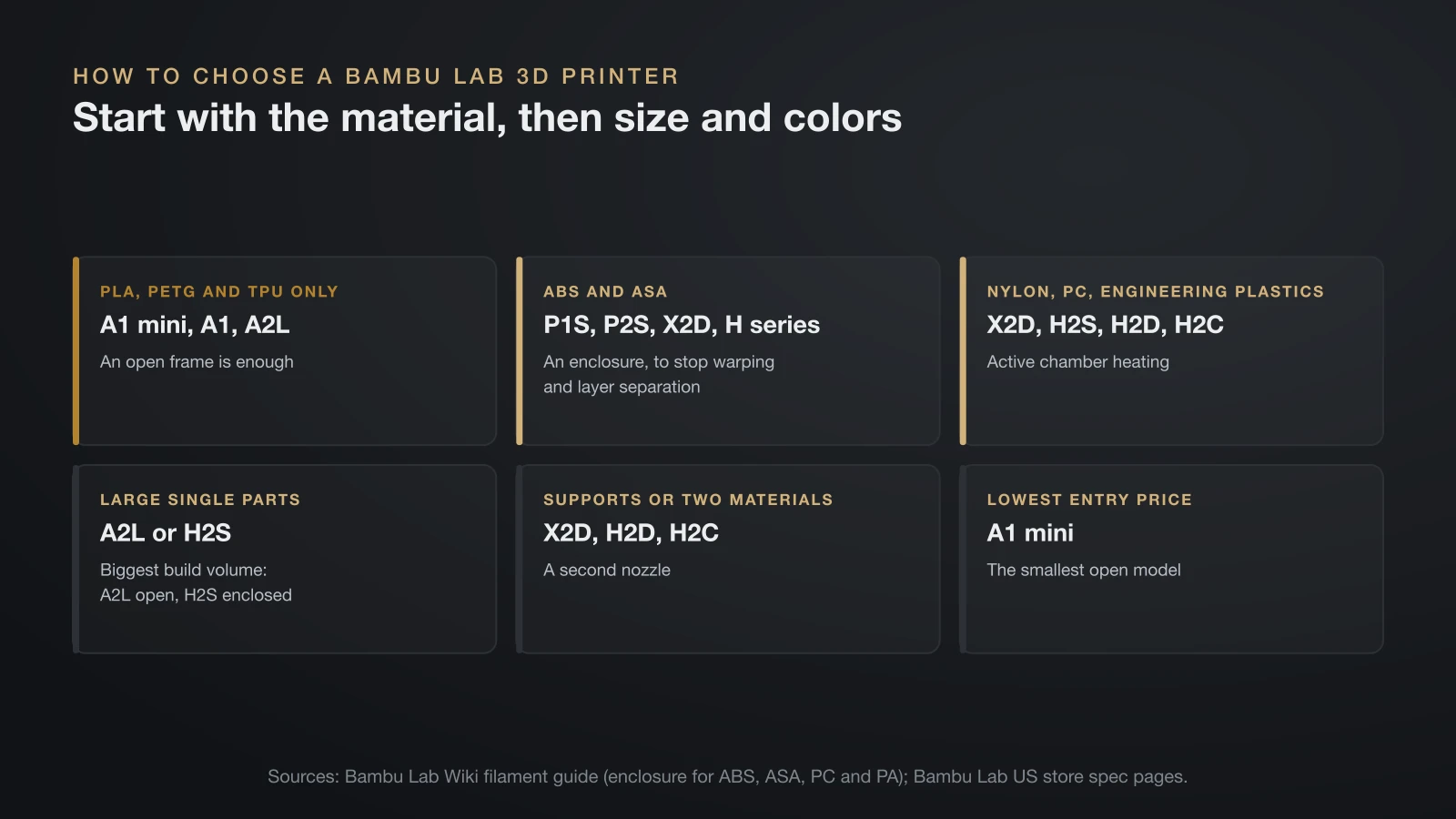
Choose a Bambu Lab 3D printer by the materials you will print first, then by part size and by how many colors or materials one print needs. Bambu Lab’s filament guide recommends an enclosed printer for ABS, ASA, PC and nylon (PA), because they need a warmer bed and chamber to avoid warping and layer separation, while PLA, PETG and TPU print on open frames.
| Your priority | What to look for | Models that fit |
|---|---|---|
| PLA, PETG and TPU only | Open frame is enough | A1 mini, A1, A2L |
| ABS and ASA | An enclosure | P1S, P2S, X2D, H series |
| Nylon, PC and other engineering plastics | Active chamber heating | X2D, H2S, H2D, H2C |
| Large single parts | Biggest build volume | A2L (open), H2S (enclosed) |
| Supports or two materials | A second nozzle | X2D, H2D, H2C |
| Lowest entry price | Smallest open model | A1 mini |
For warping-prone plastics, our guide to enclosed 3D printers explains passive versus heated chambers. If you are new to the process itself, start with our explainer on FDM 3D printing.
Multi-color printing on Bambu Lab 3D printers
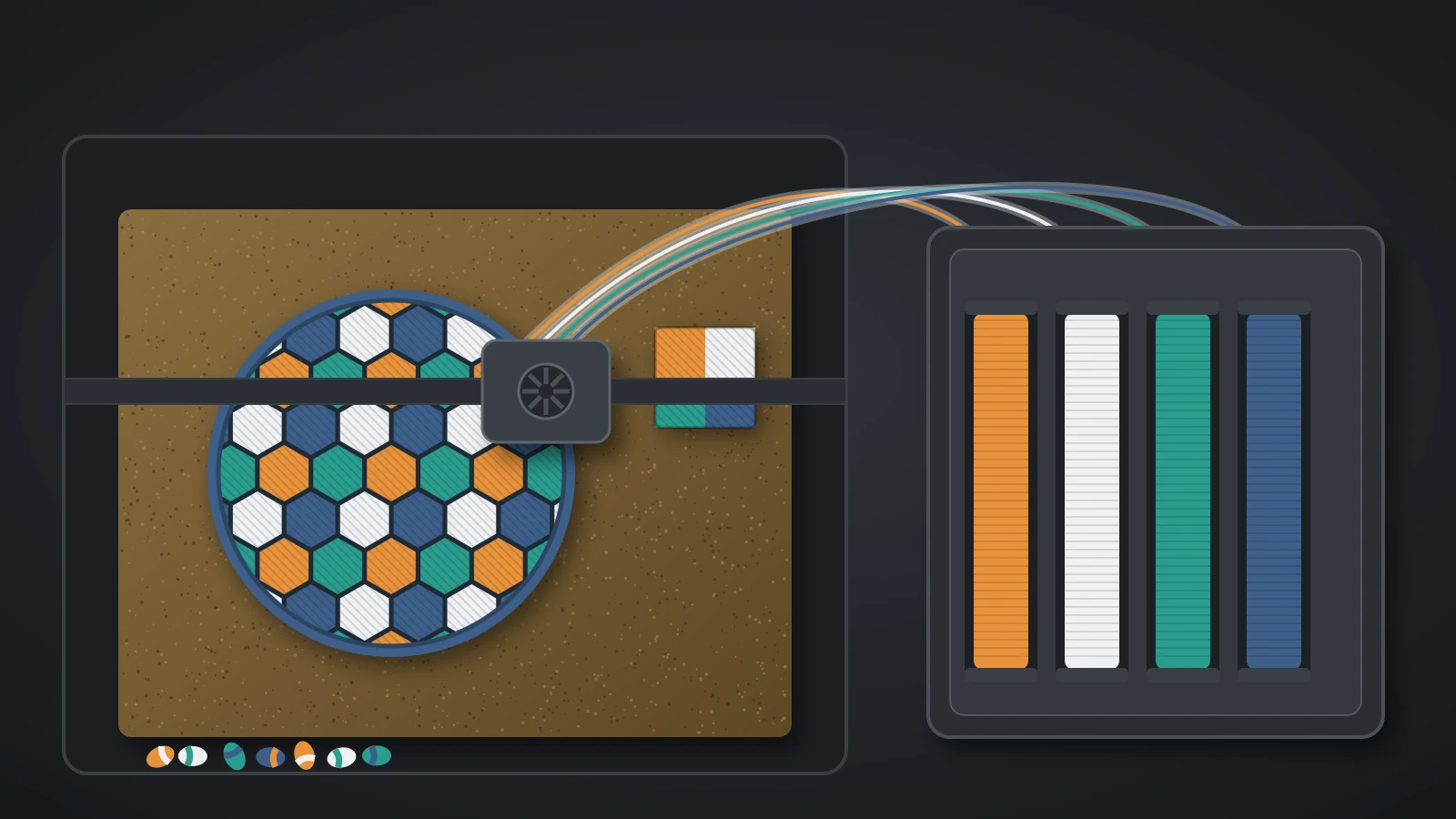
Every current Bambu Lab printer can print in several colors, either with an AMS (Automatic Material System) filament changer or with a second nozzle. A single-nozzle printer flushes the old color at every change, which wastes filament, while two nozzles or swappable hotends cut most of that purge.
- AMS lite: a four-spool changer for the A series. The A1 supports one AMS lite, so it prints up to four colors; the A1 mini and A1 need an AMS HUB to connect an AMS, AMS 2 Pro or AMS HT.
- AMS and AMS 2 Pro: four-spool units for the enclosed printers and the A2L; the AMS 2 Pro also dries filament. The P1S reaches 16 colors with four AMS units.
- Two nozzles: the X2D and H2D keep two filaments hot and are rated for up to 25 colors.
- Hotend changer: the H2C’s Vortek system swaps hotends on its right side to cut purge waste on many-color prints.
Our guide to multi-color 3D printers compares these methods with other brands’ filament changers and toolchangers.
The Bambu Lab software ecosystem
Bambu Lab printers run on three connected pieces of software: the Bambu Studio slicer, the Bambu Handy phone app and the MakerWorld model library. Bambu Lab built MakerWorld so a model, a print profile and a filament preset combine into one-click printing through Bambu Studio and Bambu Handy.
Bambu Studio is open source under AGPL-3.0 and based on PrusaSlicer. The store pages say third-party slicers that export standard G-code, such as PrusaSlicer and Cura, also work, though some advanced features may not; OrcaSlicer, which was forked from Bambu Studio, is compared in our guide to Orca Slicer vs Bambu Studio.
Cloud, LAN mode and the 2025 firmware change
Bambu Lab printers connect through Bambu’s cloud by default, and a LAN Only mode keeps jobs on your local network at the cost of the Handy app and remote printing. In Auto mode, print files pass through the cloud and are deleted automatically after 90 days.
In January 2025, Bambu Lab announced firmware that accepts control commands only from official or authorized software, which reached the P1 and A1 series on June 3, 2025. Third-party slicers now send jobs through Bambu Connect, and a Developer Mode in LAN mode switches the check off; our Bambu Lab vs Prusa comparison covers the details.
Can you use third-party filament on a Bambu Lab printer?
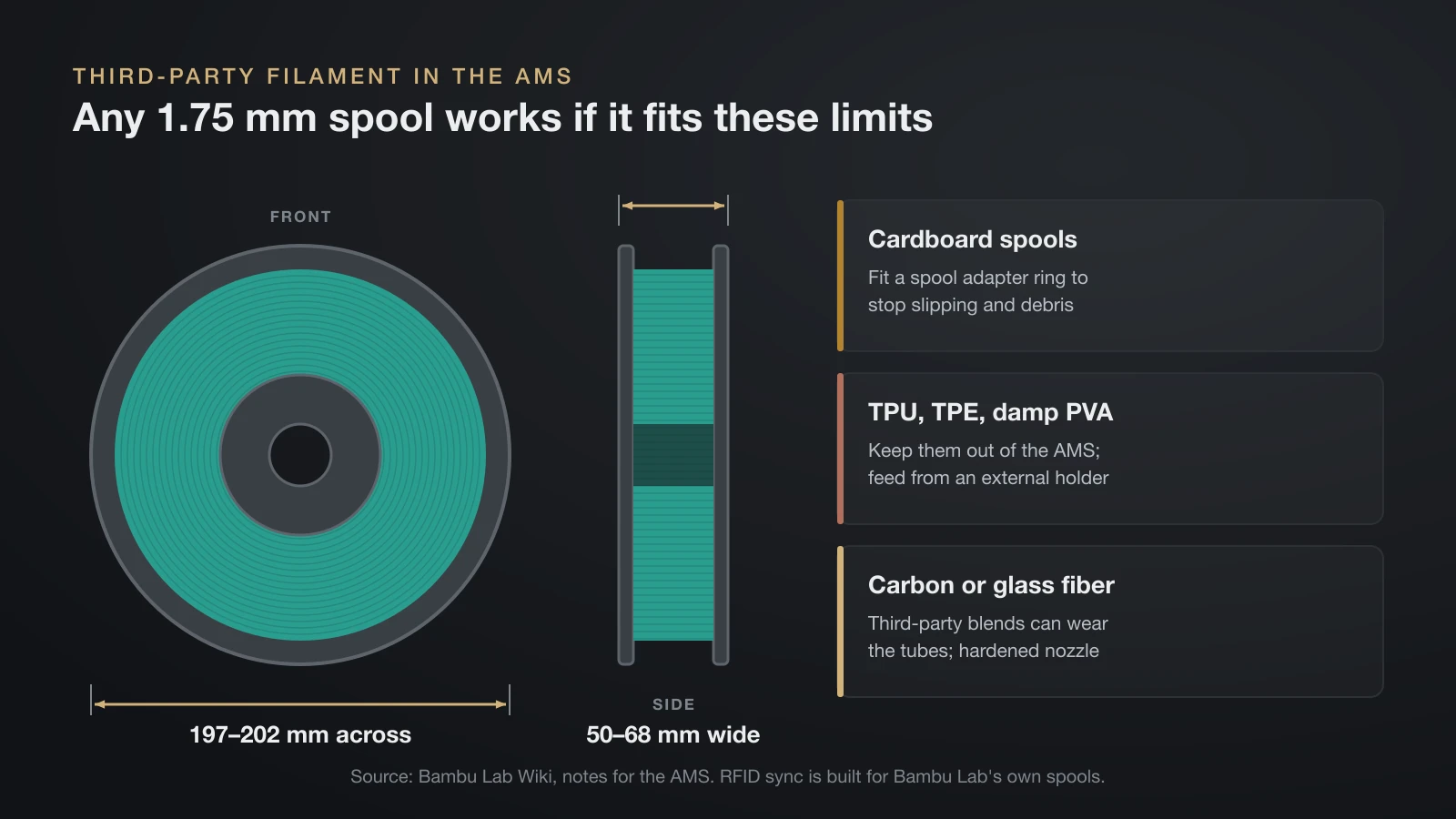
Yes, Bambu Lab printers print third-party 1.75 mm filament, but the AMS has spool and material limits. Bambu Lab recommends its own filament because it is tested with the AMS, and RFID sync, which loads print and drying settings automatically, is built for Bambu Lab’s own spools.
- Spool size: the AMS takes spools 50–68 mm wide and 197–202 mm in diameter.
- Cardboard spools: Bambu Lab strongly advises a spool adapter ring to stop slipping and debris.
- Soft filament: keep TPU, TPE and damp PVA out of the AMS; feed them from an external spool holder.
- Fiber-filled blends: Bambu Lab warns that third-party carbon or glass fiber filaments can wear the AMS tubes, and any fiber-filled filament needs a hardened steel nozzle.
Our pillar guide to 3D printer filament explains the materials and what to check before you buy a spool.
Buying from the Bambu Lab US store: warranty, returns and shipping
Bambu Lab’s US store lists a 2-year warranty, 30-day returns and 30-day price protection on its printers. Refurbished units carry the same warranty as new ones.
Orders leave a US warehouse within 1–3 business days once processed. Printers and AMS units ship free to the 48 contiguous states, while filament and accessory orders ship free above $59 and cost $6.99 below that. The store does not ship to P.O. boxes or APO/FPO addresses, and H series printers cannot ship to Hawaii, Puerto Rico, Guam or several other US territories because of their weight.
Is Bambu Lab a good 3D printer brand?
Bambu Lab is a good fit when its strengths match your priorities, so judge it on criteria rather than reputation. These questions decide it:
- Do you want an integrated app and model library? Bambu Studio, Bambu Handy and MakerWorld are built to work together.
- Do you need open firmware? Bambu Lab does not publish printer firmware; check our 3D printer brands guide for brands that do.
- Do you print engineering plastics? Only the X2D and H series have heated chambers.
- Do you want many colors? Every current model works with an AMS unit or a second nozzle.
The bottom line
Bambu Lab 3D printers run from the open A1 mini at $219 to the hotend-swapping H2C at $2,199 on the US store in October 2026, all sharing one slicer, one app and the AMS filament changers. Pick the frame for your materials first, then the build volume, then the multi-material method. Check the store on the day you buy, because several H series prices were temporary sale prices.
Sources
- Bambu Lab US Store product pages, specs and prices read October 19, 2026: A1 mini, A1, A2L, P1S, P2S, X2D, H2S, H2D, H2C, refurbished X1C and the 3D printer collection (build volumes, temperatures, chambers, AMS options, typical and sale prices, 2-year warranty, 30-day returns)
- Bambu Lab US Store: Shipping policy (free shipping rules, $59 threshold, $6.99 fee, P.O. box and territory limits) and product page order notes (US warehouse, 1–3 business days)
- Bambu Lab Wiki: About Us, Notes for AMS, filament guide, A series timelapse, LAN mode, remote control and A1 firmware history (sites, spool sizes, materials, enclosures, i3 layout, 90-day cloud files, June 3, 2025 firmware)
- Bambu Lab blog: authorization control system (January 16, 2025) and MakerWorld launch (one-click printing with Bambu Studio and Bambu Handy)
- GitHub: Bambu Studio README (AGPL-3.0, based on PrusaSlicer) and Bambu Lab repositories (no printer firmware published)