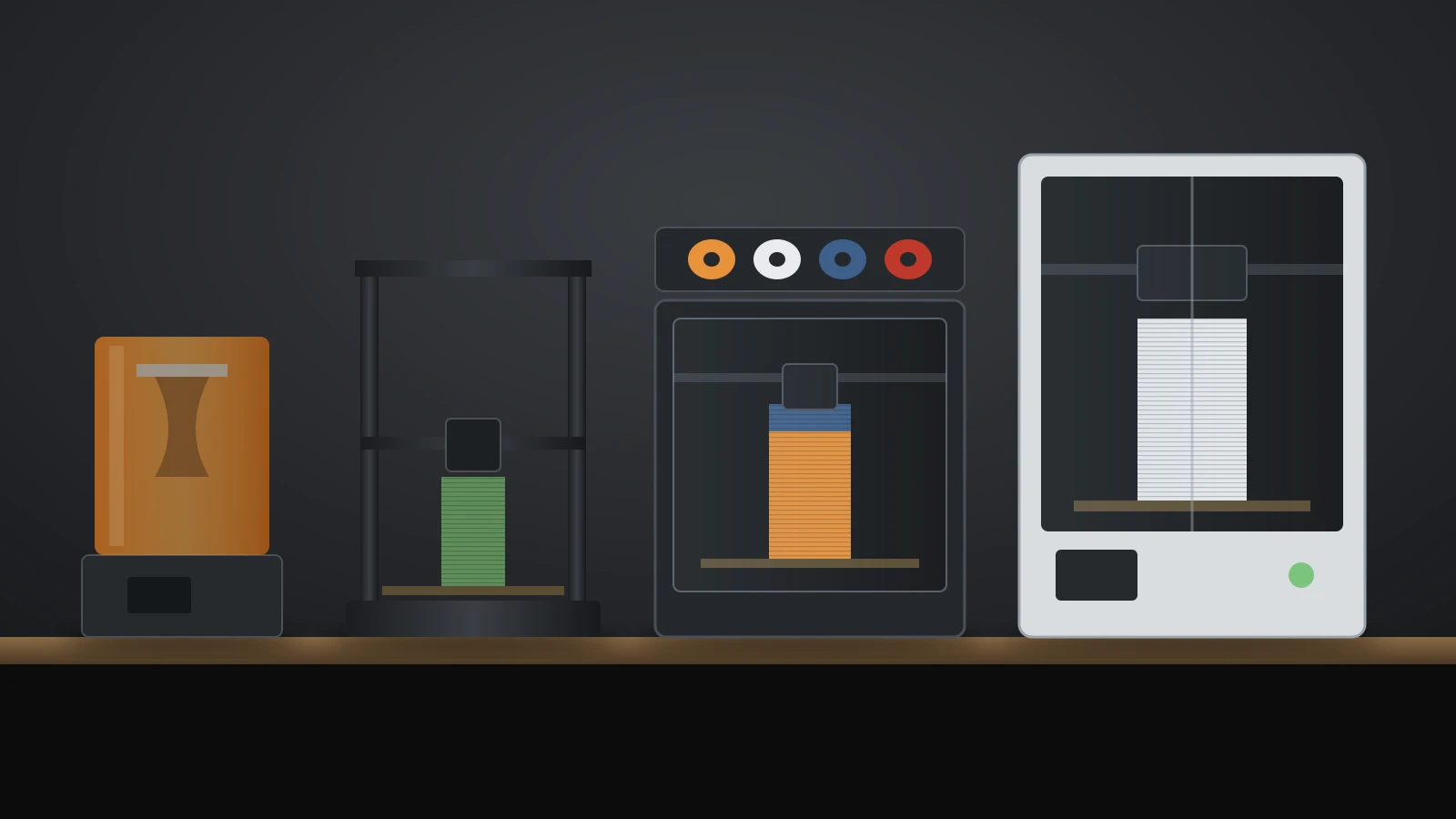

An Elegoo 3D printer is either a resin (MSLA, masked stereolithography) machine from the Mars, Saturn or Jupiter lines or a filament (FDM, fused deposition modeling) machine from the Neptune, Centauri or OrangeStorm Giga lines. On October 22, 2026, Elegoo’s US store priced its current printers from $184 to $2,499.
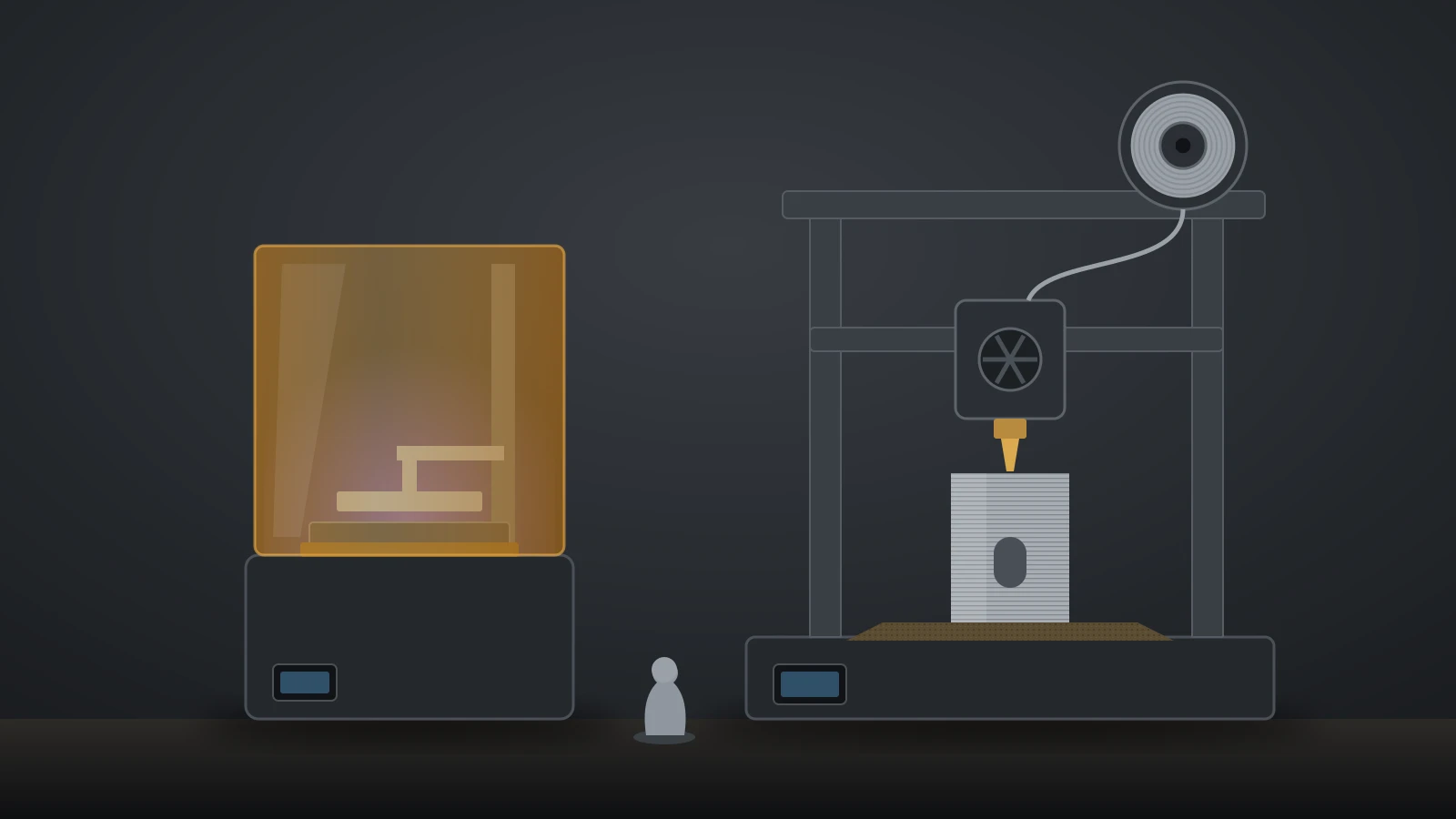
The first decision is the technology, not the model. Resin printers cure liquid photopolymer layer by layer and suit small, detailed parts, while filament printers melt plastic and suit larger and functional parts; our resin vs filament comparison covers the trade-offs in detail.
The short answer
| If you want to | Look at | Why |
|---|---|---|
| Print miniatures and fine detail cheaply | Mars 5 or Mars 5 Ultra (resin) | Smallest and lowest-priced resin models |
| Print bigger resin parts or batches | Saturn 4 family or Jupiter 2 (resin) | 10-inch screens on the Saturn; 302 × 162 × 300 mm on the Jupiter 2 |
| Print PLA and PETG parts on a budget | Neptune 4 Pro, 4 Plus or 4 Max (FDM) | Klipper firmware, up to 420 × 420 × 480 mm |
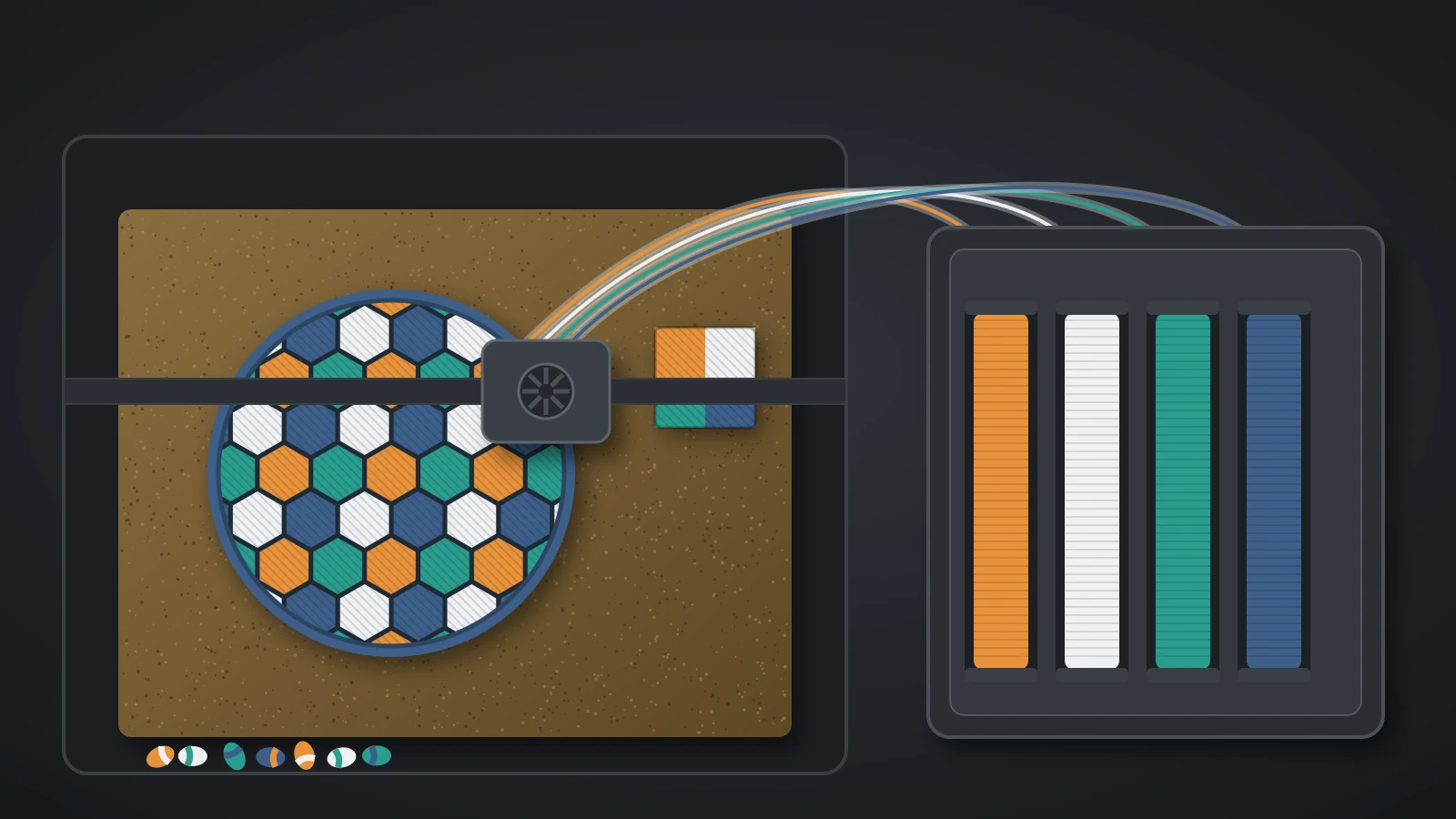
| Print in four colors or use engineering filaments | Centauri 2 or Centauri Carbon 2 (FDM) | CoreXY, 350 °C nozzle, CANVAS upgrade |
| Print furniture-sized parts | OrangeStorm Giga (FDM) | 800 × 800 × 1,000 mm build volume |
Who makes Elegoo 3D printers?
Elegoo is a Shenzhen, China, company that Chris Hong founded in 2015, according to its official About page. It began with electronics and STEM kits for makers and students, and it still sells Arduino-compatible starter kits and robot kits alongside its printers.
The same page credits co-founder Kevin Wang with guiding its move into 3D printing. Today the US store also carries Phecda laser engravers, Mercury wash-and-cure stations, resins and a wide filament range, so most of what a printer needs comes from one shop.
Elegoo 3D printer lineup in October 2026
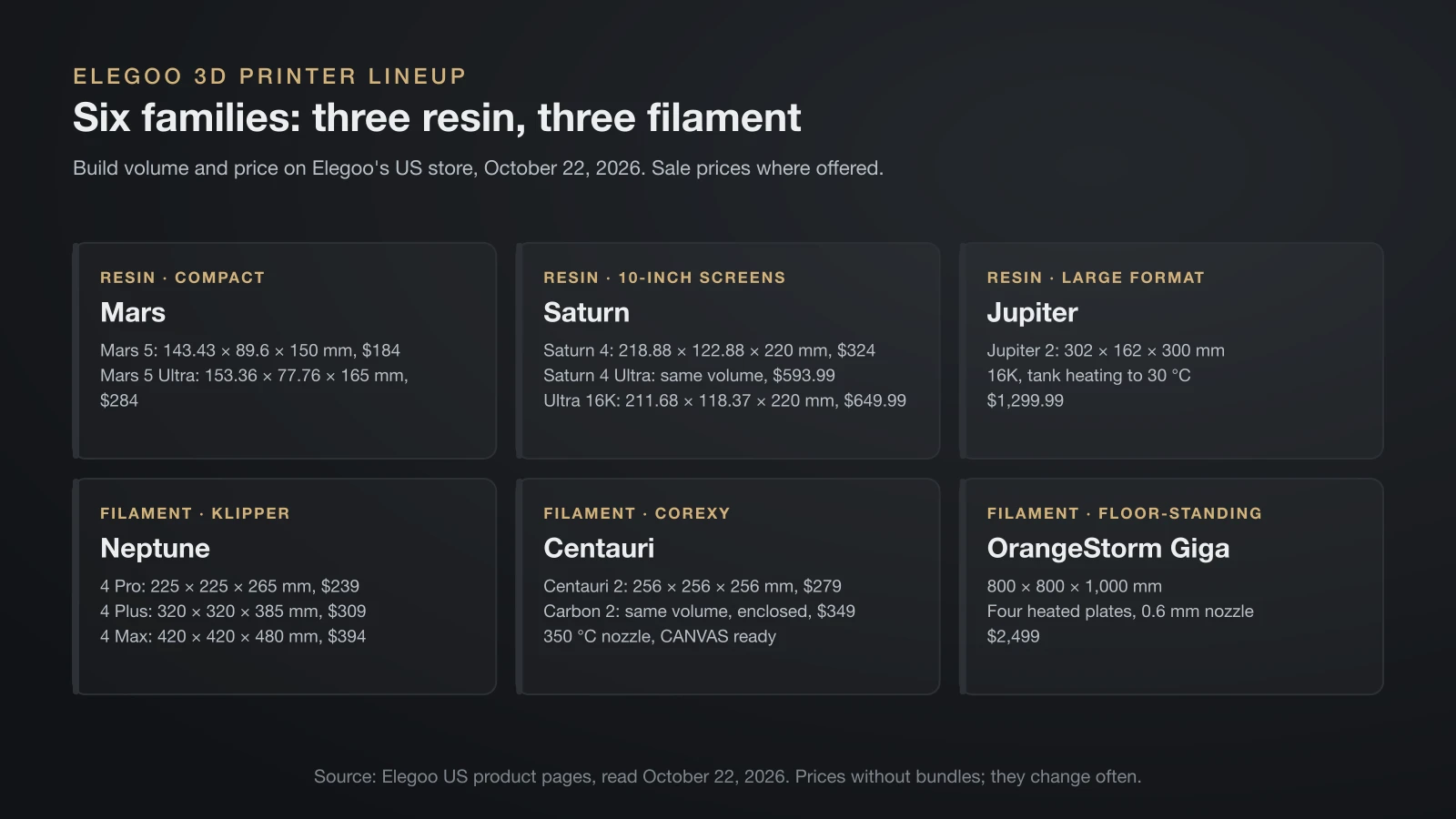
Elegoo’s US store listed six filament printers and six resin printers as current models on October 12, 2026. The specs below come from each product page, and the prices are as of October 22, 2026. Where a model was on sale, the regular price follows in brackets; check the store before buying.
Filament (FDM) printers
| Model | Build volume | Key features | US store price |
|---|---|---|---|
| Neptune 4 Pro | 225 × 225 × 265 mm | Klipper firmware, 300 °C nozzle, 110 °C bed, up to 500 mm/s | $239 (regular $274) |
| Neptune 4 Plus | 320 × 320 × 385 mm | Klipper, 300 °C nozzle, up to 500 mm/s (250 mm/s default) | $309 (regular $425) |
| Neptune 4 Max | 420 × 420 × 480 mm | Klipper, 300 °C nozzle, up to 500 mm/s (250 mm/s default) | $394 (regular $559.99) |
| Centauri 2 | 256 × 256 × 256 mm | CoreXY, 350 °C nozzle, CANVAS ready | $279 (regular $299); Combo $329 (regular $379) |
| Centauri Carbon 2 | 256 × 256 × 256 mm | CoreXY, enclosed, 350 °C hardened steel nozzle, HEPA and carbon filter | $349 (regular $359); Combo $399 (regular $449) |
| OrangeStorm Giga | 800 × 800 × 1,000 mm | Floor-standing, four heated plates, 0.6 mm nozzle | $2,499 (regular $3,125) |
Resin (MSLA) printers
| Model | Build volume | Screen and XY resolution | US store price |
|---|---|---|---|
| Mars 5 | 143.43 × 89.6 × 150 mm | 6.6-inch 4K, 35 µm | $184 (regular $225) |
| Mars 5 Ultra | 153.36 × 77.76 × 165 mm | 7-inch 9K, 18 µm, tilt release | $284 (regular $338) |
| Saturn 4 | 218.88 × 122.88 × 220 mm | 10-inch 12K, 19 × 24 µm | $324 (regular $399) |
| Saturn 4 Ultra | 218.88 × 122.88 × 220 mm | 10-inch 12K, 19 × 24 µm, tilt release | $593.99 |
| Saturn 4 Ultra 16K | 211.68 × 118.37 × 220 mm | 16K, 14 × 19 µm, tank heating to 30 °C | $649.99 |
| Jupiter 2 | 302 × 162 × 300 mm | 16K, 20 × 26 µm, tank heating to 30 °C | $1,299.99 |
Earlier generations, including the Neptune 3 Pro, Mars 4 Ultra and Saturn 3 Ultra, were still listed in stock, while the base Neptune 4 showed as sold out. Bundles with resin, filament or a Mercury wash station cost more than the printer alone.
Where to buy an Elegoo printer and what to check
Elegoo sells direct through its US store. Shipping is free on orders of $50 or more within the 48 contiguous states and Washington, D.C., and the store does not ship to P.O. boxes.
Check these points before you order:
- The exact version. Some Neptune 4 models come in a ribbon-cable and a Type-C version, and Elegoo’s download page lists separate firmware for each.
- New or pre-owned. Elegoo lists pre-owned machines with no warranty, which matters more than the discount; our guide to buying a used 3D printer covers what to inspect.
- Combo or printer only. A Centauri Combo adds the four-color CANVAS unit, while resin bundles add resin or a wash-and-cure station.
- Return window. Non-defective returns are possible within 14 calendar days of receipt, with return costs paid by you.
- Your region. Elegoo does not provide support outside the original country of purchase.
Resin or FDM: which type of Elegoo printer fits you?
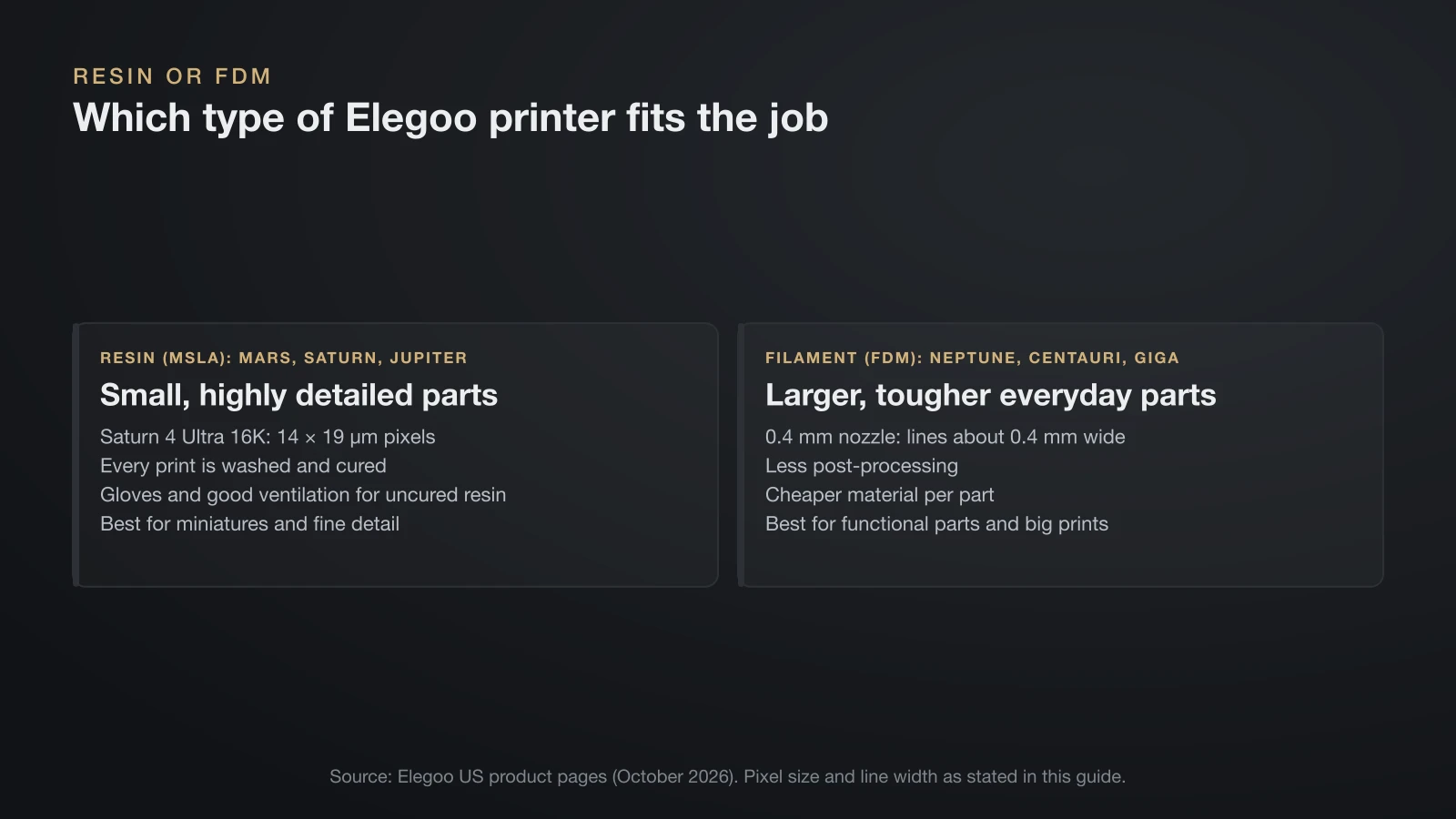
Choose a resin Elegoo for small, highly detailed parts and an FDM model for larger, tougher or everyday functional parts. A Saturn 4 Ultra 16K resolves 14 × 19 µm pixels, while a 0.4 mm filament nozzle lays lines roughly 0.4 mm wide.
Resin printing also adds steps and handling. Every print needs washing and curing, and uncured resin requires gloves and good ventilation; our guide to 3D printing resin explains the types and the safe workflow. Filament printers need less post-processing and use cheaper material per part.
Mars vs Saturn vs Jupiter: choosing an Elegoo resin printer
The three resin families differ mainly in screen size, which sets the build area, and in a few speed and comfort features. Mars printers are the compact entry point, Saturn models use 10-inch screens, and the Jupiter 2 is the large-format option.
- Tilt release: the Mars 5 Ultra and Saturn 4 Ultra models tilt the resin tank to peel each layer, and Elegoo rates them at up to 150 mm per hour, against 70 mm per hour for the Mars 5 and Saturn 4.
- Tank heating: the Saturn 4 Ultra 16K and Jupiter 2 keep resin at 30 °C (86 °F), which Elegoo says improves resin fluidity and layer adhesion.
- Resolution: a 9K, 12K or 16K label describes the screen; compare the XY resolution in micrometers, since screen size changes how small each pixel is.
Neptune vs Centauri: choosing an Elegoo FDM printer
The Neptune 4 series offers more build volume per dollar, while the Centauri series adds CoreXY motion, a 350 °C nozzle and a path to four-color printing. Every current Elegoo FDM model levels its bed automatically.
The Neptune 4 printers run Klipper firmware, use a direct-drive extruder and reach 300 °C at the nozzle. Elegoo recommends an enclosure for ABS and ASA on these open machines. The Max has a 430 × 430 mm PEI plate, but its bed is rated to 85 °C at a 25 °C room temperature.
The Centauri Carbon 2 is the only current Elegoo FDM model whose product page lists an enclosed chamber, plus a HEPA and activated carbon filter, so it is the closer fit for PC, PET and fiber-filled filaments. Both Centauri models accept the CANVAS unit; our guide to multi-color 3D printers compares filament changers like it with toolchangers. For parts beyond a 420 mm bed, the Giga is covered in our large 3D printers guide.
Elegoo slicer software
Elegoo’s own slicer for filament printers is ElegooSlicer, which its GitHub page describes as open source, licensed under AGPL-3.0 and based on OrcaSlicer. It imports models in one click from Nexprint, Elegoo’s model library, and the ELEGOO Matrix app starts and monitors prints remotely.
Resin printers use ELEGOO SatelLite, Elegoo’s resin slicer, and the download page also lists Chitubox, Cura, OrcaSlicer, Tango and Autodesk Fusion. Because ElegooSlicer shares its base with OrcaSlicer, our OrcaSlicer guide applies to most of its settings and calibration tools.
Elegoo filament and resin
Elegoo sells both the filaments and the resins its printers use. Its US store lists PLA in many finishes, PLA Plus, Rapid PLA Plus, PETG, ABS, ASA, TPU 95A, PC, PAHT-CF and other fiber-filled blends.
Standard 1 kg PLA spools with an RFID tag cost $13.99 on October 12, 2026, and Elegoo states a diameter tolerance of ±0.02 mm. The RFID tag lets CANVAS recognize the filament type and color automatically. On the resin side, Elegoo sells standard, ABS-like and water-washable resins for 405 nm printers.
Elegoo warranty and support
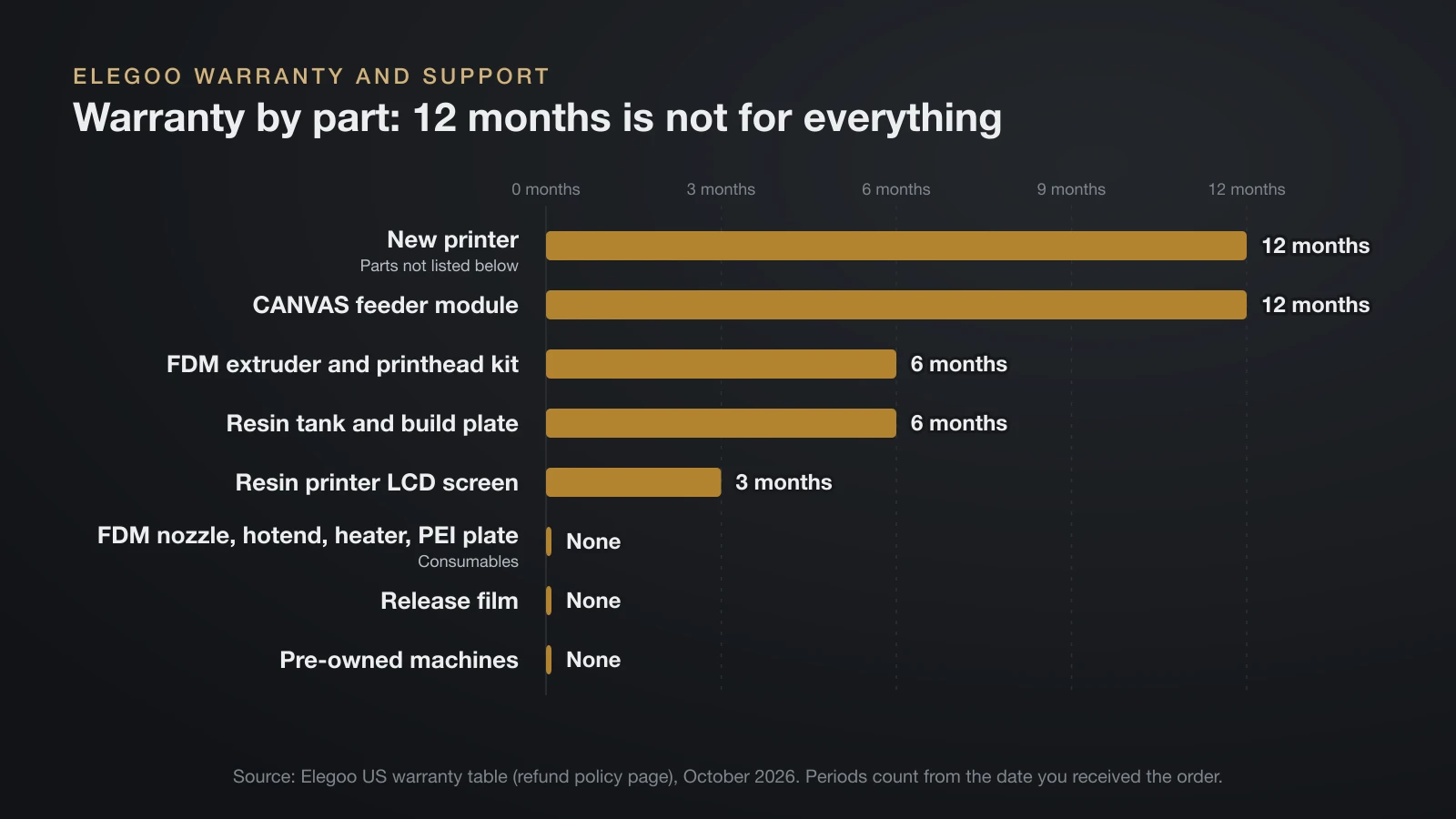
Elegoo gives new printers a 12-month warranty, but several wear parts get shorter coverage or none, according to its warranty table. Periods count from the date you received the order.
| Part | Warranty |
|---|---|
| New printer, parts not listed below | 12 months |
| FDM nozzles, hotend, heater, PEI plate, PTFE tube | None (consumables) |
| FDM extruder and printhead kit | 6 months |
| Resin printer LCD screen | 3 months |
| Resin tank and build plate | 6 months |
| Release film | None |
| CANVAS feeder module | 12 months |
| Pre-owned machines | None |
Elegoo says it will still replace a consumable that fails from a manufacturing defect while the printer is under warranty. Support runs through an AI chat, a ticket system and a wiki at wiki.elegoo.com.
Is Elegoo a good 3D printer brand?
Elegoo is a good fit if its strengths match your needs, so judge it on criteria rather than reputation. These are the questions that decide it:
- Do you want resin and filament from one brand? Elegoo sells current resin and filament lines from the same store.
- Is the starting price your main limit? Four of its twelve current printers were priced under $300 on October 22, 2026.
- Do you need engineering filaments? The Centauri Carbon 2 is the model that pairs an enclosure and filtration with a 350 °C hardened steel nozzle.
- Will you need parts after year one? Check the short LCD and extruder coverage in the table above.
To see how Elegoo sits against Bambu Lab, Prusa, Creality and the rest, read our comparison of 3D printer brands.
If you are comparing enclosed machines for engineering plastics, our guide to QIDI 3D printers covers a brand with actively heated chambers. For whole-market budget numbers, see how much a 3D printer costs.
The bottom line
Elegoo makes both resin printers (Mars, Saturn, Jupiter) and filament printers (Neptune, Centauri, OrangeStorm Giga), priced from $184 to $2,499 on its US store in October 2026. Pick the technology first, then the size, then features such as tilt release, tank heating or the four-color CANVAS unit. Read the warranty table before buying, because screens, films and nozzles get less coverage than the machine.
Sources
- Elegoo US store product pages (specs October 4, prices October 22, 2026): Neptune 4 Pro, Neptune 4 Plus, Neptune 4 Max, Centauri 2, Centauri Carbon 2, OrangeStorm Giga, PLA filament, Standard Resin V2.0 (405 nm)
- Elegoo US store resin printer pages: Mars 5, Mars 5 Ultra, Saturn 4, Saturn 4 Ultra, Saturn 4 Ultra 16K, Jupiter 2
- Elegoo company and policy pages: About Elegoo, warranty and returns, shipping policy
- Elegoo software: download center (compatible slicers) and ElegooSlicer on GitHub (license and OrcaSlicer base)