
A QIDI 3D printer is an enclosed filament (FDM, fused deposition modeling) printer from QIDI Tech, and four of the five current models heat their chamber to 65 °C (149 °F) for engineering plastics. On October 4, 2026, QIDI’s US store sold the Q2C, Q2, Plus4, Plus5 and Max4 for $349 to $1,099.
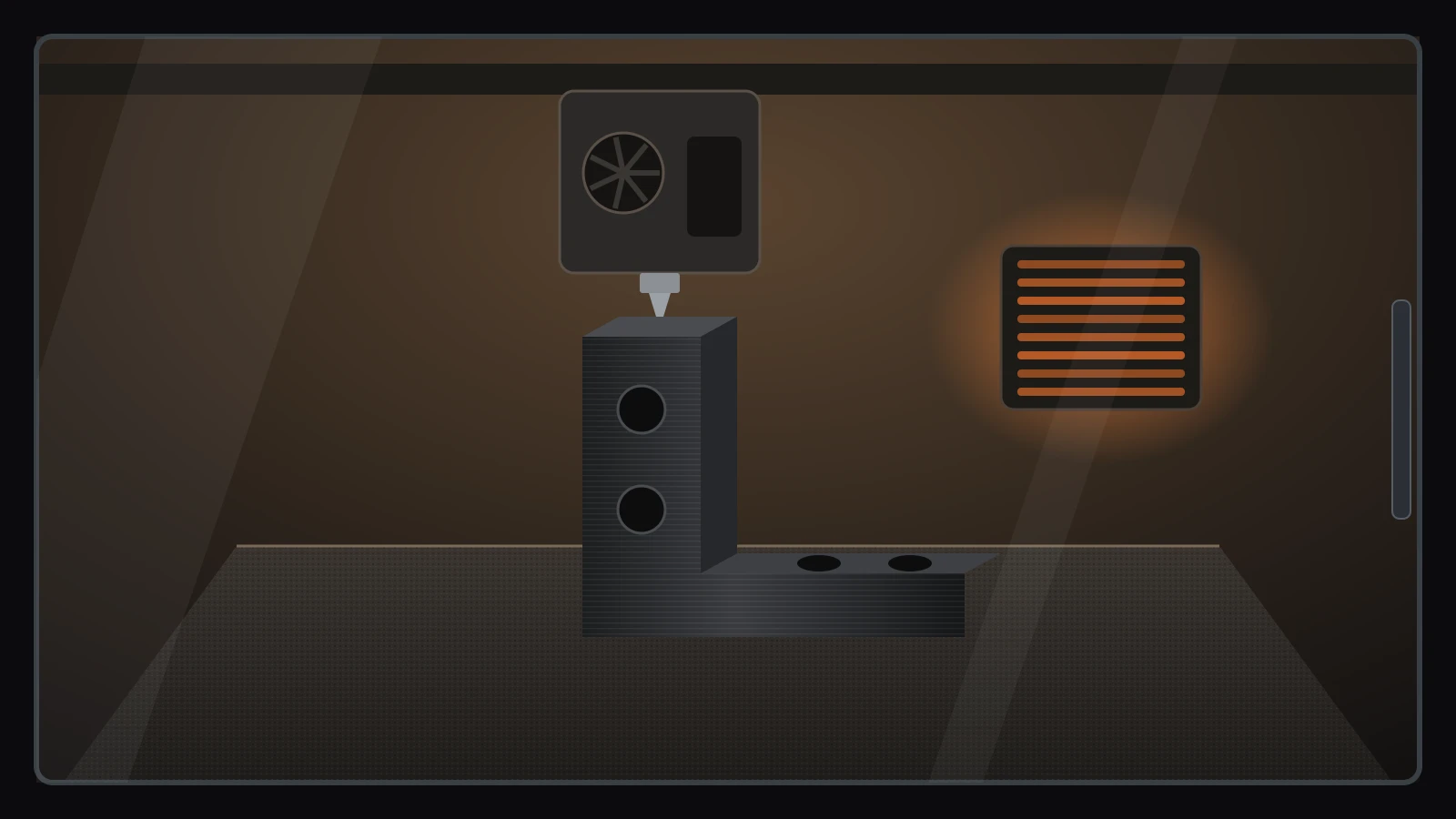
That heated chamber is what sets the brand apart. It keeps warp-prone filaments such as ABS, nylon and polycarbonate warm while they print; our guide to enclosed 3D printers explains how heated and passive enclosures differ.
The short answer
| If you want | Look at | Key numbers |
|---|---|---|
| The lowest price, mainly PLA and PETG | Q2C | 270 × 270 × 256 mm, no chamber heater |
| Heated-chamber printing on a desk | Q2 | 270 × 270 × 256 mm, 65 °C chamber |
| A larger heated printer | Plus5 (or Plus4) | 320 × 320 × 300 mm, 65 °C chamber |
| The biggest QIDI | Max4 | 390 × 390 × 340 mm, up to 800 mm/s |
| Four to sixteen colors | Any model plus the QIDI Box | Four spools per box, up to four boxes |
Who makes QIDI 3D printers?
QIDI Tech is a Chinese printer maker whose official About page says its story began in 2014 with a small team of engineers. It lists a Hong Kong business address and says its products have passed MET, CE, FCC and RoHS certification.
The company sells printers, filament and spare parts through regional stores, including a US store. It also runs an official wiki at wiki.qidi3d.com with manuals for current and older models.
QIDI 3D printer lineup in October 2026
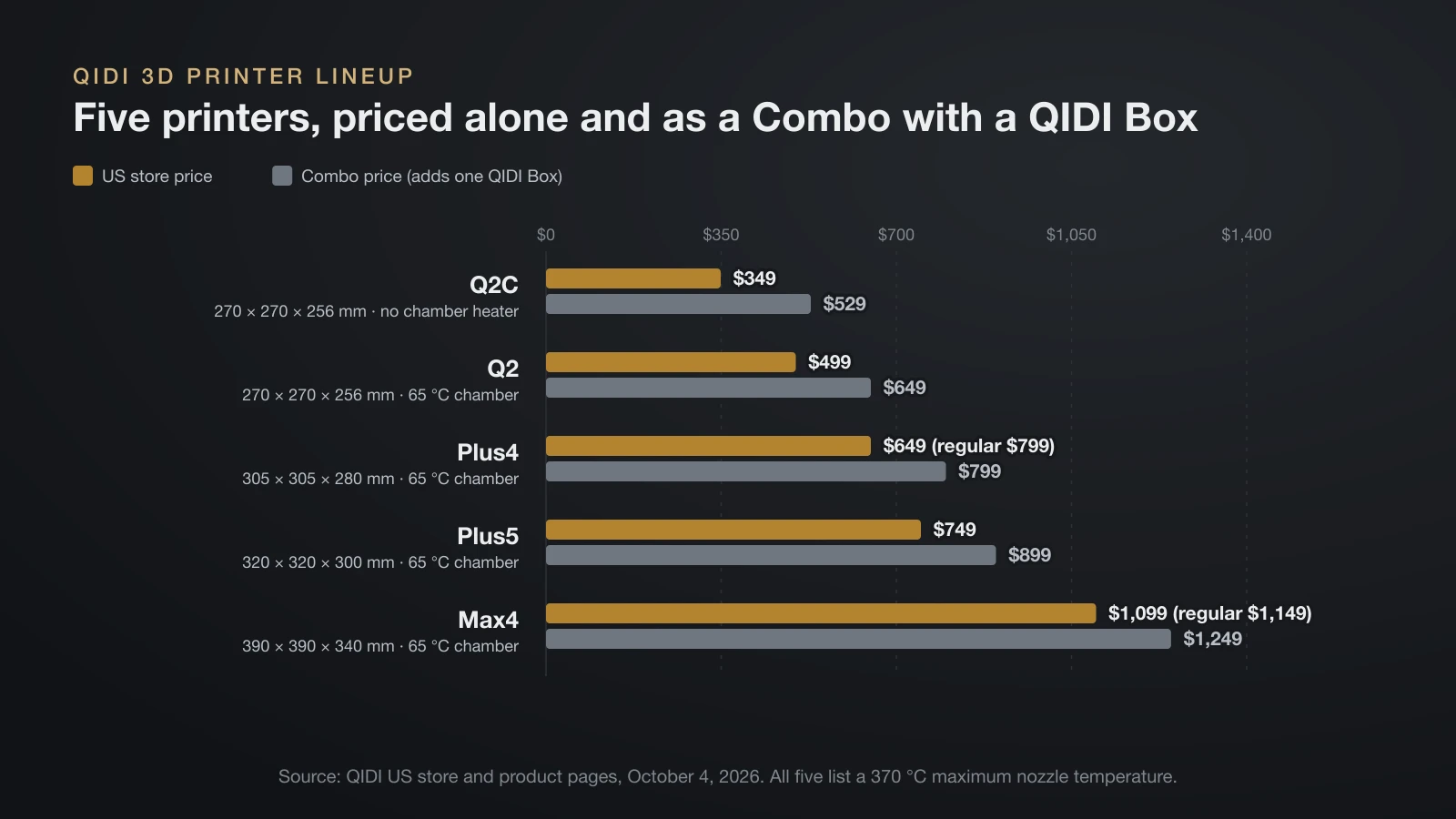
QIDI’s US store listed five current printers on October 4, 2026, all with a 370 °C maximum nozzle temperature. Specs come from each product page and the QIDI wiki; prices are those shown on the store that day, and a Combo adds one QIDI Box.
| Model | Build volume | Chamber heating | Bed | Max speed | US price | Combo |
|---|---|---|---|---|---|---|
| Q2C | 270 × 270 × 256 mm | None | 120 °C | 600 mm/s | $349 | $529 |
| Q2 | 270 × 270 × 256 mm | Active, up to 65 °C (2nd gen) | 120 °C | 600 mm/s | $499 | $649 |
| Plus4 | 305 × 305 × 280 mm | Active, up to 65 °C (2nd gen) | 110 °C | Not listed | $649 (regular $799) | $799 |
| Plus5 | 320 × 320 × 300 mm | Active, up to 65 °C (3rd gen) | 120 °C | 600 mm/s | $749 | $899 |
| Max4 | 390 × 390 × 340 mm | Active, up to 65 °C (3rd gen) | 120 °C | 800 mm/s | $1,099 (regular $1,149) | $1,249 |
The Max4 price includes the Polar Cooler extruder cooler, which the Q2 and Plus5 offer as a bundle. The Q2C, Q2, Plus5 and Max4 list hardened steel extruder gears and hands-free leveling with a loadcell sensor in the hotend. The Q2C ships without the chamber heater and AI camera, and its air filter is optional, while the Q2, Plus5 and Max4 use a G3 pre-filter, H12 HEPA and activated carbon.
Where to buy a QIDI printer and what to check
QIDI sells direct through us.qidi3d.com, which ships most printers from a US warehouse within 1 to 3 business days after processing; the Plus5 ships from QIDI’s China warehouse. QIDI’s warranty statement allows returns within 14 days of receipt.
Check these points before you order:
- Printer or Combo. A Combo adds one QIDI Box for multi-color printing and drying, which also sells alone for $228.
- The right QIDI Box version. The box is sold per printer model; a Max4 box works on the Plus5 directly, while a Plus4 or Q2 box needs an extra hub and cable on the Plus5.
- Discontinued models. The US store marks the Q1 Pro and X-Max 3 as discontinued, pointing buyers to the Q2 and the Max4 instead.
- Where you live. QIDI does not offer cross-regional warranty service, so buy from the store for your own region.
QIDI Plus4 vs Q2 vs Max4 (and the new Plus5)
The Q2, Plus4 and Max4 differ mainly in build volume, while all three heat the chamber to 65 °C and reach 370 °C at the nozzle. The newer Plus5 sits between the Plus4 and Max4 in size and price.
| Q2 | Plus4 | Plus5 | Max4 | |
|---|---|---|---|---|
| Build volume | 270 × 270 × 256 mm | 305 × 305 × 280 mm | 320 × 320 × 300 mm | 390 × 390 × 340 mm |
| Outer size | 402 × 438 × 494 mm | Not listed | 500 × 488 × 558 mm | 558 × 578 × 612 mm |
| Net weight | 18.1 kg | Not listed | 29 kg | 40 kg |
| Chamber heater | 2nd gen PTC | 2nd gen | 3rd gen, 550 W | 3rd gen |
| Acceleration | 20,000 mm/s² | Not listed | 20,000 mm/s² | 30,000 mm/s² |
Pick the Q2 if your parts fit a 270 mm footprint and desk space matters. The Plus5 gives 18% more volume than the Plus4 in about the same footprint, according to QIDI, at a regular price below the Plus4’s. The Max4 is the choice for large single parts, with faster motion from closed-loop (FOC) stepper motors, but it weighs 40 kg and measures 558 × 578 × 612 mm.
QIDI Box: multi-color printing and filament drying
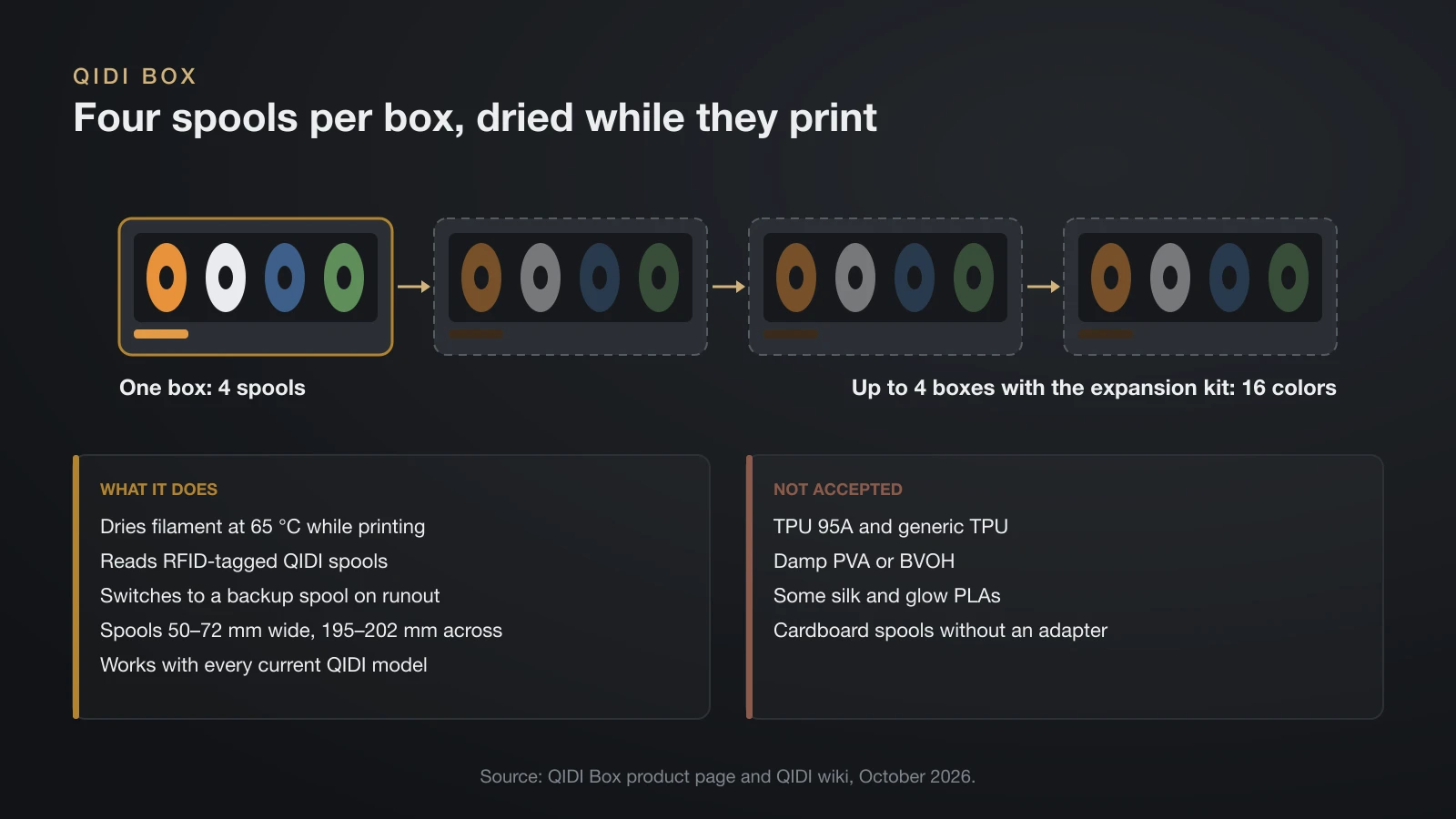
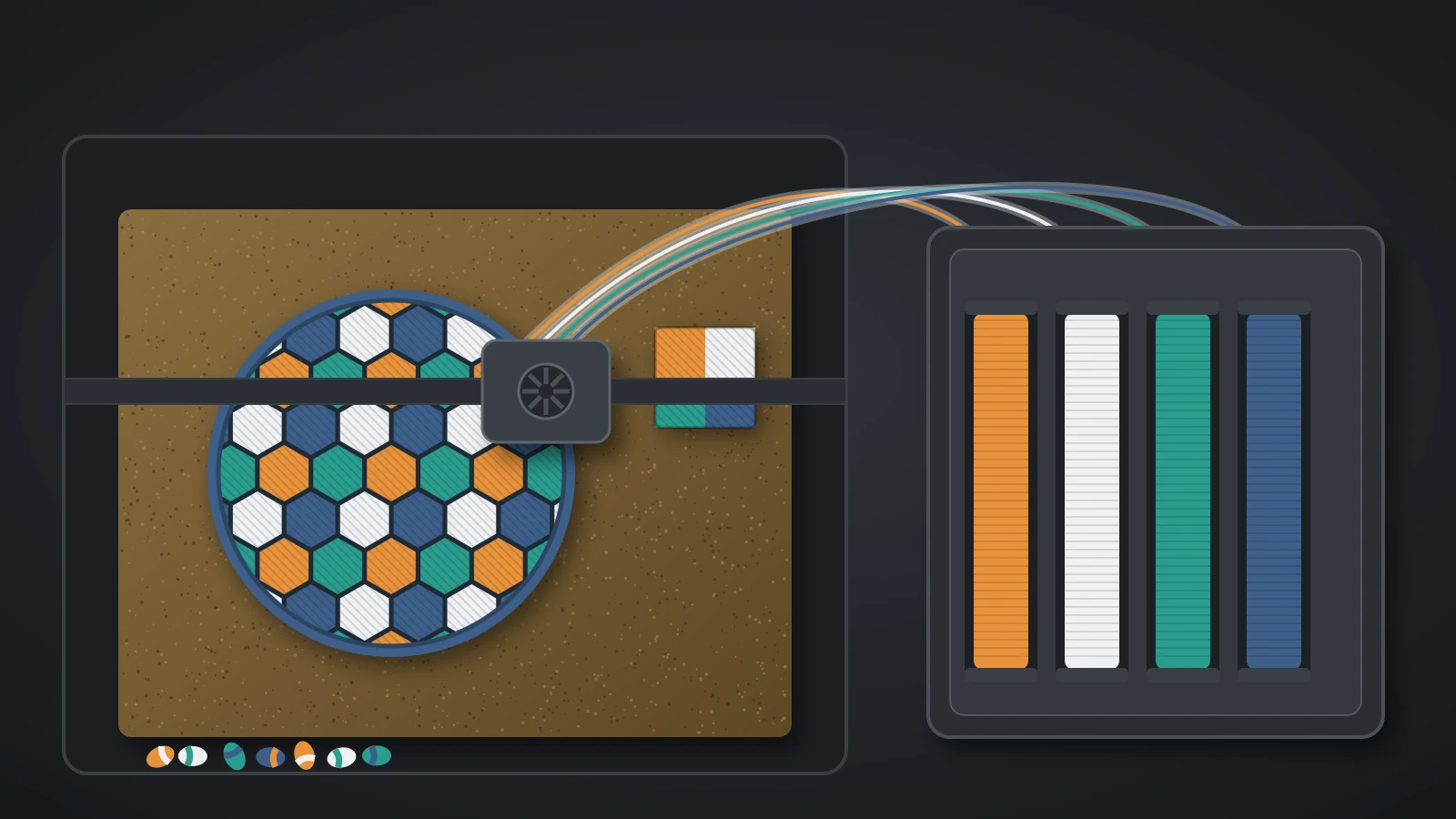
The QIDI Box is a four-spool unit that feeds filament for multi-color and multi-material prints and dries it while printing. It works with every current model and is sold alone or in Combo bundles.
One box holds four spools, and up to four boxes chain together for 16 colors with QIDI’s expansion kit. It heats its chamber to 65 °C to dry filament, reads RFID-tagged QIDI spools and switches to a backup spool when one runs out. It does not accept TPU 95A, generic TPU, damp PVA or BVOH, some silk and glow PLAs, or cardboard spools without an adapter.
Spools must be 50 to 72 mm wide and 195 to 202 mm in diameter. Drying temperatures and times per material are covered in our filament dryer guide, and our guide to multi-color 3D printers compares the QIDI Box with other filament changers.
Engineering filaments on QIDI’s heated chambers
QIDI’s heated-chamber models are rated for engineering filaments such as nylon (PA), polycarbonate (PC) and carbon or glass fiber blends. QIDI lists PLA, ABS, ASA, PETG, TPU, PA, PC and fiber-reinforced polymers, and names PPS-CF for the Q2 and Plus5.
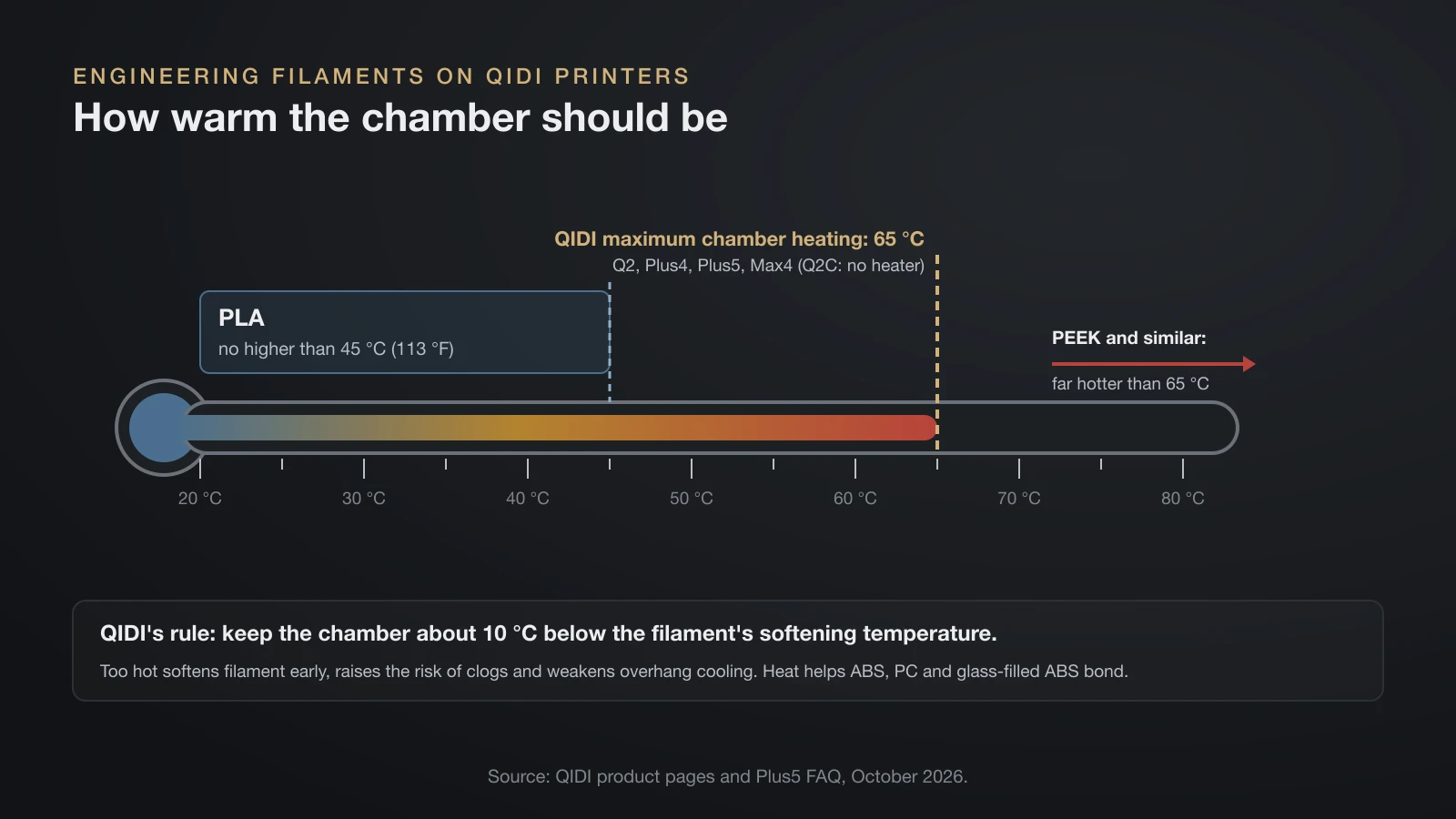
Chamber heat helps layers of ABS, PC and glass-filled ABS bond, according to QIDI. It also gives a rule for setting it: keep the chamber about 10 °C below the filament’s softening temperature, and no higher than 45 °C (113 °F) for PLA. A hotter chamber can soften filament early, raise the risk of clogs and weaken overhang cooling.
For abrasive carbon fiber and glass fiber blends, QIDI points to its hardened steel extrusion gears for durable, stable feeding. Before printing them, read our guides to carbon fiber filament and nylon filament; filaments such as PEEK need far hotter chambers than 65 °C, as our PEEK filament guide explains.
QIDI Studio and other slicers
QIDI Studio is QIDI’s own slicer for Windows and macOS, with a Linux build on GitHub. QIDI’s download page says it is based on Bambu Studio, which in turn comes from PrusaSlicer and Slic3r.
Because the printers run Klipper firmware, QIDI also lists OrcaSlicer and PrusaSlicer as compatible. The slicer accepts STL, OBJ, 3MF and STEP files, and it can open the printer’s Fluidd web page for monitoring over the network. Our OrcaSlicer guide covers the main open alternative.
QIDI warranty and support
QIDI covers its printers for one year from the date of receipt, or up to two years where local law requires it, as in the EU. The warranty applies to manufacturing defects.
Consumable parts, including the hot end, nozzles, extruder, belts, PTFE tubes, wipers, the filament cutter and the build plate, have no warranty. QIDI may still replace one that fails from a defect while the printer is covered. Damage from third-party accessories or unofficial firmware is excluded, and the warranty clock pauses while a printer is in transit for repair.
Is QIDI a good 3D printer brand?
A QIDI printer is a good fit when you need what its design is built around, so judge it on these criteria:
- Do you print ABS, ASA, nylon or PC? Four current models heat the chamber to 65 °C, so check whether your filaments need that heat.
- Do you need a large build volume? The Plus5 and Max4 reach 320 mm and 390 mm per side.
- Do you want open firmware? Klipper and listed support for OrcaSlicer and PrusaSlicer leave room to tinker.
- Can you live with wear-part coverage? Nozzles, hot ends and extruders have no warranty.
- Mostly PLA? The Q2C costs less, and the heated chamber adds little for PLA.
To compare prices across brands, see our guide to how much a 3D printer costs. For other options, Flashforge 3D printers include a heated four-toolhead model, and Elegoo 3D printers cover both resin and filament.
The bottom line
QIDI’s current lineup is five filament printers from 270 mm to 390 mm, and four of them heat the chamber to 65 °C for engineering plastics. Choose by build volume first: Q2C or Q2 for a 270 mm footprint, Plus4 or Plus5 for 305 to 320 mm, and Max4 for 390 mm. Add the QIDI Box only if you need colors, soluble supports or drying while printing.
Sources
- QIDI US store product pages (specs and prices, October 4, 2026): Q2C, Q2, Plus4, Plus5, Max4, QIDI Box
- QIDI US store pages for discontinued models: Q1 Pro, X-Max 3
- QIDI company and policy pages: About QIDI, warranty statement
- QIDI software: QIDI Studio download page (Bambu Studio base, platforms)
- QIDI Wiki: home and model index, X-Plus 4 introduction (bed temperature)