
The Bambu H2D is Bambu Lab’s enclosed dual-nozzle FDM (fused deposition modeling) printer. It prints two materials or colors with separate hotends, heats its chamber to 65 °C (149 °F), reaches 350 °C (662 °F) at the nozzle and fits single parts up to 325 × 320 × 325 mm. Optional laser and cutting modules add crafting work.
If you are still choosing a brand, our comparison of Bambu Lab vs Prusa covers ecosystems and firmware.
The short answer
| Bambu Lab H2D | |
|---|---|
| What it is | Enclosed dual-nozzle printer with optional laser, blade cutting and pen modules |
| Build volume | 325 × 320 × 325 mm one nozzle, 300 × 320 × 320 mm both, 350 × 320 × 325 mm combined |
| Temperatures | 350 °C nozzle, 120 °C bed, 65 °C heated chamber |
| Multi-material | Two hotends, up to 24 AMS slots, up to 25 colors |
| Size and weight | 492 × 514 × 626 mm, 31 kg |
| US list price (October 1, 2026) | $1,749 printer, $1,999 AMS Combo |
| Skip it if | You mostly print single-color PLA or have a small desk |
What is the Bambu Lab H2D?
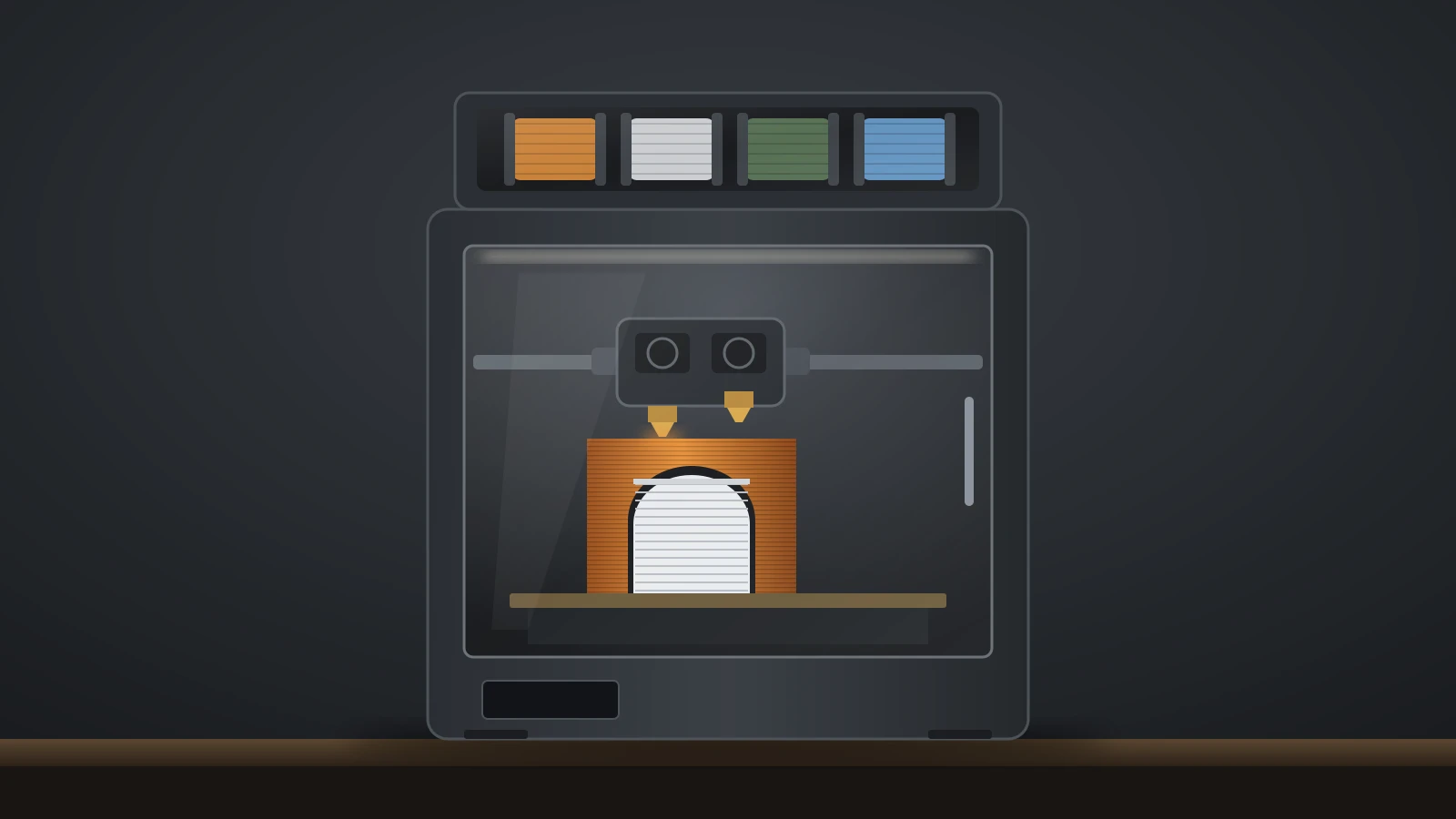
The Bambu Lab H2D is a large enclosed printer built around two identical hotends on one toolhead, so each nozzle can hold a different filament. Bambu Lab confirms that the left and right hotends share the same structure and can be swapped between sides.
A single-nozzle printer must cut and purge filament at every material change, while the H2D can switch nozzles instead. Bambu Lab names three uses: a dedicated support material, rigid and flexible materials in one part, and multi-color prints with fewer purges. Our guide to multi-color 3D printers compares this with filament changers and toolchangers.
The 65 °C chamber and 350 °C hotend target warping-prone and high-temperature filaments. The spec sheet lists PC, nylon (PA), PPS and carbon or glass fiber blends, including PPA-CF/GF.
Bambu Lab H2D specs
The Bambu Lab H2D is a 31 kg dual-nozzle printer with a 350 °C hotend, a 120 °C bed and a 65 °C heated chamber, according to Bambu Lab’s spec sheet and US store page for the 100–120 V model.
| Spec | Bambu Lab H2D |
|---|---|
| Hotend and nozzles | All-metal, hardened steel nozzle and gear; 0.4 mm included, 0.2/0.6/0.8 mm supported |
| Extruder | Closed-loop servo with a permanent magnet synchronous motor |
| Max temperatures | Nozzle 350 °C, bed 120 °C, chamber 65 °C |
| Speed | Up to 1,000 mm/s and 20,000 mm/s² |
| Max flow | 40 mm³/s standard hotend, 65 mm³/s high-flow hotend (Bambu Lab ABS at 280 °C) |
| Air filtration | G3 pre-filter, H12 HEPA, coconut shell activated carbon |
| Cameras | Live view, nozzle and toolhead cameras; BirdsEye camera on the Laser Edition |
| Max power | 1,320 W at 110 V |
| Slicers | Bambu Studio; third-party slicers that export standard G-code, minus some features |
Two footnotes matter. The 50 µm motion accuracy needs the Vision Encoder, sold separately, and full power lasts no more than 3 minutes while the bed heats. Bambu Lab’s power table lists about 197 W on average for PLA, roughly 3.6 cents per hour at the US average residential rate (estimate: 0.197 kWh × 18.31 cents).
H2D editions and US prices
The H2D comes in three main editions, and the right one depends on whether you need multi-color printing or laser work. Bambu Lab’s US store listed these prices on October 1, 2026, with temporary sale prices below them:
| Edition | What it adds | US list price |
|---|---|---|
| H2D | Printer, textured PEI plate, spool holder | $1,749 |
| H2D AMS Combo | One AMS 2 Pro (four spools, with drying) | $1,999 |
| AMS HT bundle | AMS Combo plus one AMS HT single-spool unit | $2,099 |
| Dual AMS 2 Pro bundle | Two AMS 2 Pro units (AMS Combo plus a second) | $2,249 |
| Laser Full Combo, 10 W | Laser Edition printer, AMS 2 Pro, 10 W laser, cutting module, emergency stop | $2,549 |
| Laser Full Combo, 40 W | The same with the 40 W laser | $3,199 |
The Laser Edition has laser safety windows, a built-in air assist pump and a BirdsEye camera. A standard H2D can be converted with Bambu Lab’s Laser Upgrade Kit, which uses an external air pump and performs the same, per Bambu Lab. An H2D Pro for businesses is sold only through resellers, adding tungsten carbide nozzles, Ethernet and a physical network kill switch.
How the H2D’s two nozzles work
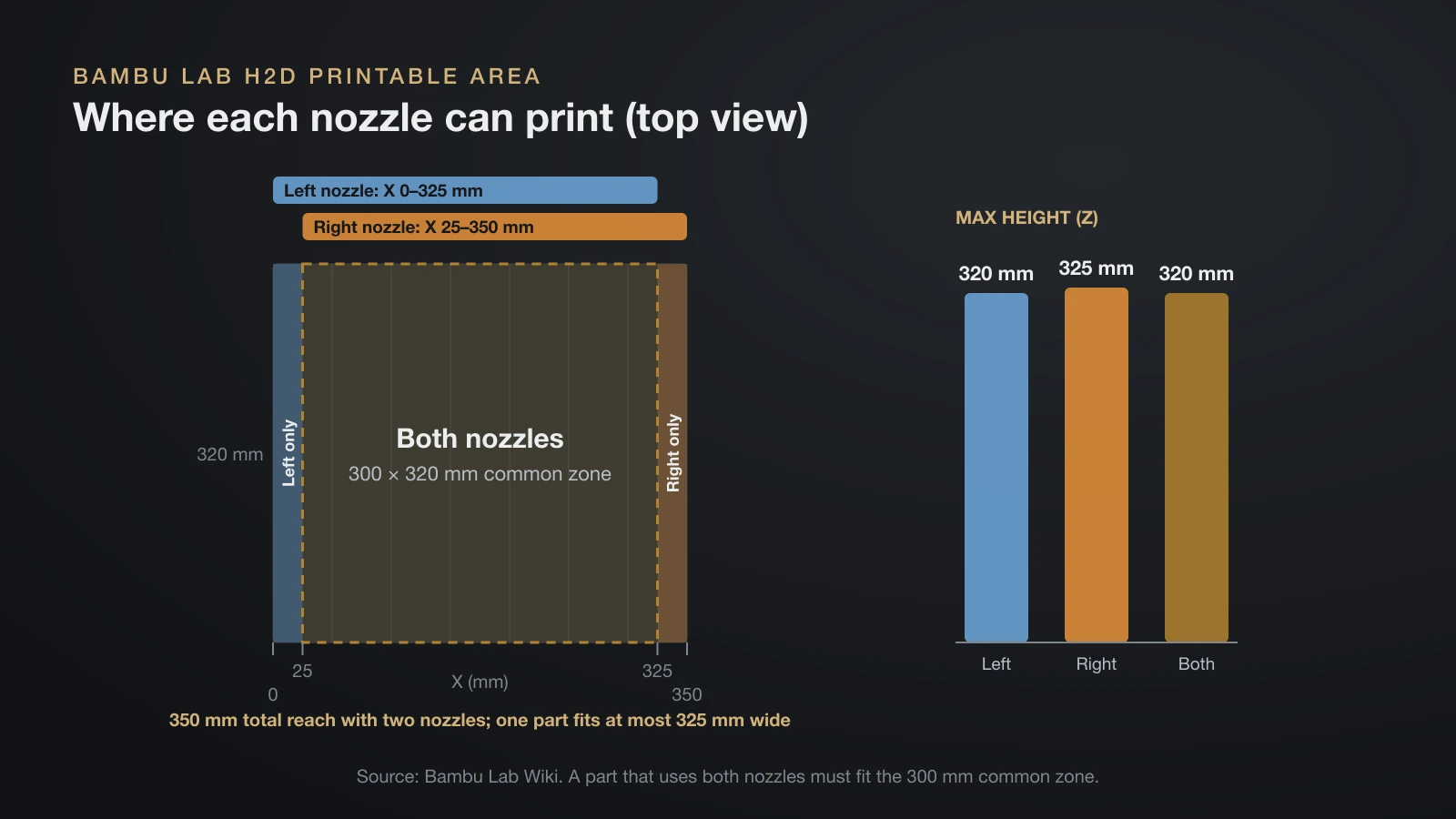
The H2D’s two nozzles sit side by side, so each one reaches a slightly different part of the bed. Bambu Lab’s wiki gives the exact ranges:
- Left nozzle only: X from 0 to 325 mm, up to 320 mm tall.
- Right nozzle only: X from 25 to 350 mm, up to 325 mm tall.
- Both nozzles: a common 300 × 320 mm area, up to 320 mm tall.
A part that needs both materials must fit the 300 mm common zone, and no single part can be wider than 325 mm; the 350 mm total width only lets you spread several parts toward both edges. Bambu Studio marks the left-only and right-only strips and refuses to slice when a filament cannot reach its area.
What the second nozzle is good for
The clearest win is support material: one nozzle prints the model while the other lays a support or interface filament. Our guide to 3D printing supports explains which pairs separate cleanly, such as PLA with a PETG interface. The second nozzle also helps with rigid parts that need flexible grips and with multi-color models. Between swaps the firmware cools the idle nozzle and preheats it in time, skipping the cool-down when the gap is under 30 seconds.
Limits to know
- TPU on the right only. The manual says the left hotend is not suitable for TPU, and TPU of 95A or softer should not go through the AMS 2 Pro or AMS HT.
- One nozzle size. The firmware does not yet support two different nozzle diameters in one print.
- No AMS lite. The first-generation AMS works without drying; the A1’s AMS lite is not supported.
- AMS limit: 4 AMS 2 Pro plus 8 AMS HT, or 24 slots; more than two units need a 4-in-1 PTFE adapter.
Laser, cutting and pen modules
The optional modules turn the H2D into a laser engraver, a vinyl or paper cutter and a pen plotter. Both lasers are blue diode lasers (455 nm on the spec sheet) for wood, leather, rubber, dark acrylic, stone and metal sheets.
| 10 W laser | 40 W laser | |
|---|---|---|
| Max cut, basswood plywood | 5 mm | 15 mm |
| Max engraving speed | 400 mm/s | 1,000 mm/s |
| Working area | 310 × 270 mm | 310 × 250 mm |
The blade module cuts paper, vinyl and leather up to 0.5 mm thick over 300 × 285 mm. Treat the laser as a fire risk: the module is a Class 4 laser, and the machine rates Class 1 only with its protective windows and covers intact. Bambu Lab advises never leaving it unattended during laser jobs, keeping flammables away and venting smoke through the supplied pipe.
Bambu H2S vs H2D vs H2C
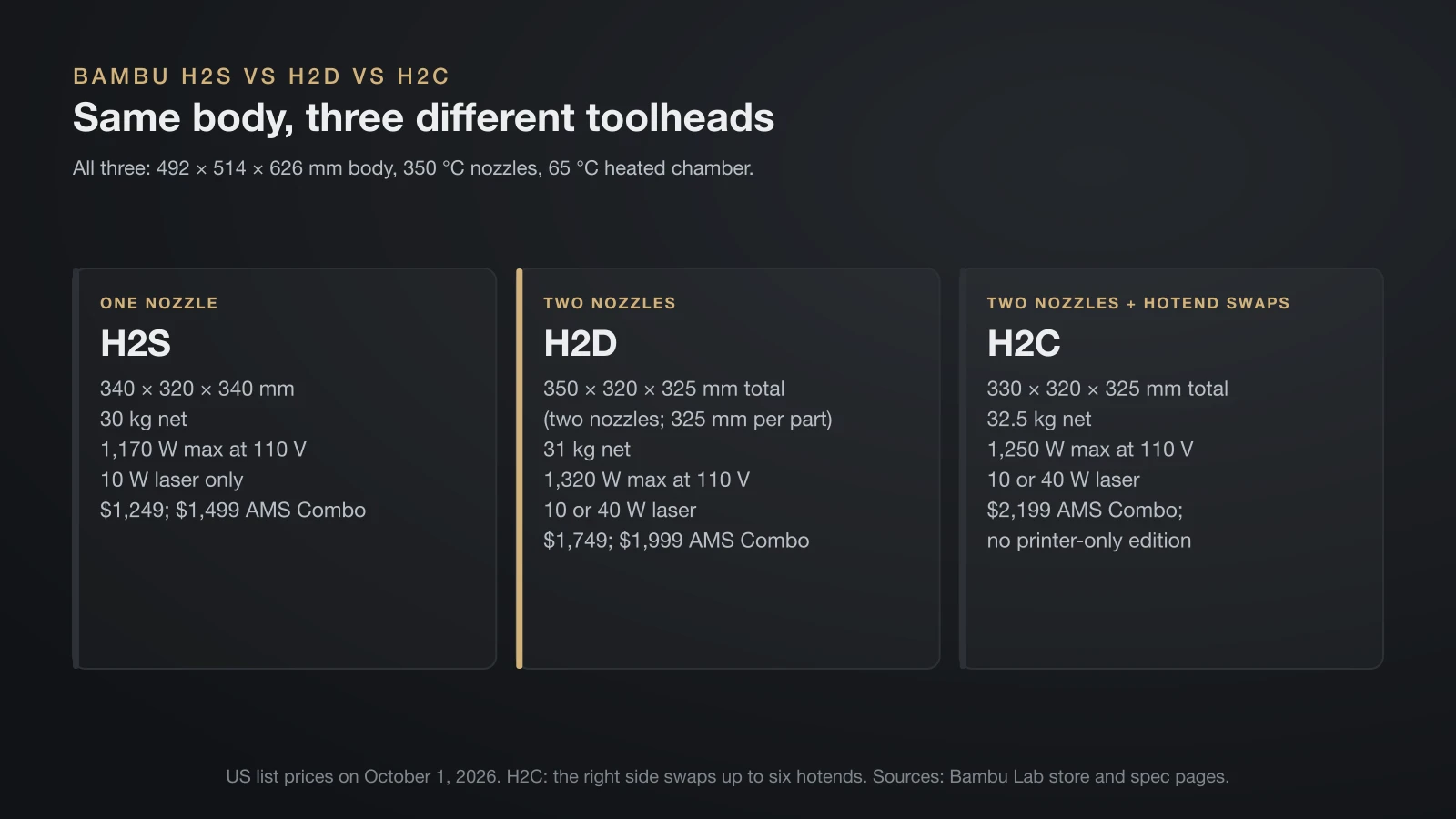
The H2S, H2D and H2C share the same 492 × 514 × 626 mm body, 350 °C nozzles and 65 °C heated chamber; the difference is the toolhead. The H2S has one nozzle, the H2D two, and the H2C adds Vortek, a rack of induction-heated hotends that its right side swaps automatically.
| H2S | H2D | H2C | |
|---|---|---|---|
| Toolhead | One nozzle | Two nozzles | Two nozzles, right side swaps up to six hotends |
| Build volume | 340 × 320 × 340 mm | 350 × 320 × 325 mm total | 330 × 320 × 325 mm total |
| Net weight | 30 kg | 31 kg | 32.5 kg |
| Max power at 110 V | 1,170 W | 1,320 W | 1,250 W |
| Laser options | 10 W only | 10 or 40 W | 10 or 40 W |
| US list price (October 1, 2026) | $1,249; $1,499 AMS Combo | $1,749; $1,999 AMS Combo | $2,199 AMS Combo (no printer-only edition) |
Pick by your most common job. The H2S has the largest single-material volume and costs least, and the H2D adds a true second material. The H2C targets many-color work: on one six-color model, Bambu Lab lists 532 g of purge waste on the H2C, 3,032 g on the H2D and 3,917 g on the H2S. That is one manufacturer example, so your numbers will differ.
Upgrades are limited. Bambu Lab says an H2S cannot become an H2D, and although it mentions a Vortek Upgrade Kit for H2D and H2S owners, it recommends buying an H2C outright.
H2D vs the X1 and P1 family
Compared with Bambu Lab’s 256 mm printers, the H2D buys more volume, more heat and a second nozzle at several times the price. Specs come from Bambu Lab’s spec sheets, prices from the US store on October 1, 2026.
| P1S | P2S | X2D | X1C | H2D | |
|---|---|---|---|---|---|
| Build volume (mm) | 256 cube | 256 cube | 256 × 256 × 260 | 256 cube | 350 × 320 × 325 total (325 per part) |
| Nozzles | 1 | 1 | 2 | 1 | 2 |
| Max nozzle | 300 °C | 300 °C | 300 °C | 300 °C | 350 °C |
| Chamber heater | No | No | 65 °C | No | 65 °C |
| US price | $399 | $549 | $649 | $649, refurbished Combo only | $1,749 list |
The X2D is the closest relative, with two nozzles and a 65 °C chamber in the 256 mm class. If your parts fit and 300 °C is enough, it covers most of what the H2D does. Choose the H2D for parts up to about 325 mm, the hottest filaments or the 40 W laser; for other brands, see our guide to large 3D printers.
Who the H2D suits and who should skip it
The H2D suits makers who will use both nozzles and the heated chamber often enough to justify its price and size.
- Good fit: PC, nylon or fiber-filled parts that warp without chamber heat (see our guide to enclosed 3D printers), support-heavy models, rigid parts with TPU grips, and small studios that also want laser engraving.
- Better elsewhere: single-color PLA and PETG (P1S or P2S), large single-material parts (H2S), many colors with little waste (H2C), or a small, light desk.
Bambu Studio is the native slicer, and our comparison of Orca Slicer vs Bambu Studio covers the main alternative.
Space, power and setup for the H2D
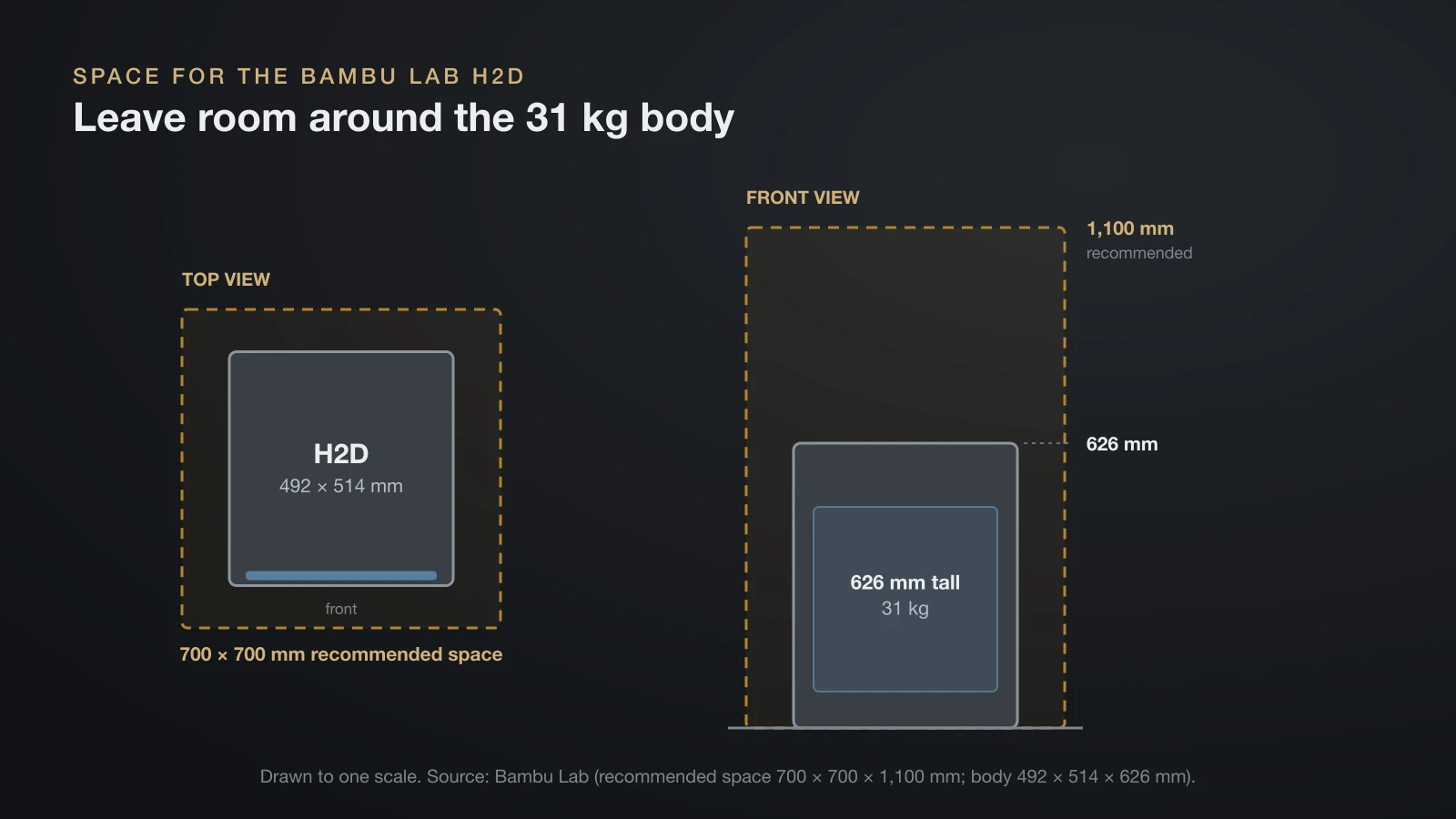
Plan the H2D’s spot before it arrives: Bambu Lab recommends a 700 × 700 × 1,100 mm space for the 31 kg machine. The manual asks for a stable, sturdy surface, and soft anti-vibration feet let the body rock slightly without hurting the print. Our guide to choosing a 3D printer table turns those numbers into a checklist.
- Calibrate after placing it. Moving the printer after calibration can affect print quality.
- Use a dedicated outlet. It can draw 1,320 W at 110 V while the bed heats.
- Add a USB drive. None is included, and time-lapse and LAN printing need one.
- Plan the exhaust. Laser jobs need the vent pipe; Bambu Lab suggests disconnecting it when the laser sits unused, so the chamber reaches its target temperature.
The bottom line
The Bambu H2D is a large, heated-chamber printer whose real advantage is its second nozzle: cleaner supports, two-material parts and fewer purges. It fits buyers who print engineering plastics or mixed materials on big parts. For single-material printing the H2S or a 256 mm P-series model costs far less, and the H2C wastes less filament on many-color prints.
Sources
- Bambu Lab US Store, read October 1, 2026: H2D and H2D spec sheet, H2D Pro
- Bambu Lab US Store: H2S and spec sheet, H2C and spec sheet
- Bambu Lab US Store: P1S, P2S and spec sheet, X2D and spec sheet, refurbished X1C
- Bambu Lab Wiki: H2D FAQ, Printable range for dual nozzles, power parameters; H2D User Manual V1.0
- U.S. Energy Information Administration: Electric Power Monthly, Table 5.6.A (18.31 cents per kWh, July 2026)