
Carbon fiber filament is a base plastic, such as PLA, PETG or nylon (PA), filled with short chopped carbon fibers. The fibers make printed parts stiffer, matte and dimensionally stable, but they usually weaken the bond between layers and quickly wear out soft nozzles, so every carbon fiber grade needs a hardened nozzle.
The base plastic matters more than the fiber: PLA-CF prints like PLA, while carbon fiber nylon needs the heat, drying and care described in our nylon filament guide. This guide compares PLA-CF, PETG-CF and PA-CF using Bambu Lab and Prusament data sheets tested to the same ISO methods, then covers the 3D printer nozzle you need, print settings, dust safety and where glass fiber fits.
The short answer
| Bambu Lab data sheet | PLA-CF | PETG-CF | PA6-CF (carbon fiber nylon) |
|---|---|---|---|
| Main gain over the base plastic | Stiffness, matte finish | Stiffness, lower stringing | Stiffness, strength, heat resistance |
| Bending modulus, X-Y (ISO 178) | 3,950 MPa | 2,910 MPa | 5,460 MPa |
| Heat deflection, 1.8 MPa (ISO 75) | 54 °C | 68 °C | 164 °C |
| Nozzle temperature | 210–240 °C | 240–270 °C | 260–290 °C |
| Chamber temperature | 25–45 °C | 35–50 °C | 45–60 °C (enclosure) |
| Drying | 55 °C for 8 h | 65 °C for 8 h | 80 °C for 8–12 h |
| Nozzle | Hardened; stainless steel not recommended, no 0.2 mm | Same; 0.6 mm recommended, 0.4 mm usable | Same; 0.6 mm recommended |
| Best for | Stiff prototypes with a matte look | Functional parts that need some toughness | Fixtures, clamps, mechanical parts near heat |
What is carbon fiber filament?
Carbon fiber filament is an ordinary thermoplastic with short carbon fibers blended in. Polymaker names PLA, PETG, nylon, ABS and PC as common base plastics, and Bambu Lab’s data sheets list the composition simply as the base polymer plus carbon fiber.
The fibers act as a stiff skeleton inside the plastic. Bambu Lab says they improve the hardness and bending modulus of its PLA-CF, and Prusa credits them with better dimensional stability, better temperature resistance and a higher modulus of elasticity in its PETG Carbon Fiber. The surface changes too: Bambu Lab describes a matte finish with almost invisible layer lines.
What carbon fiber changes: data sheet numbers
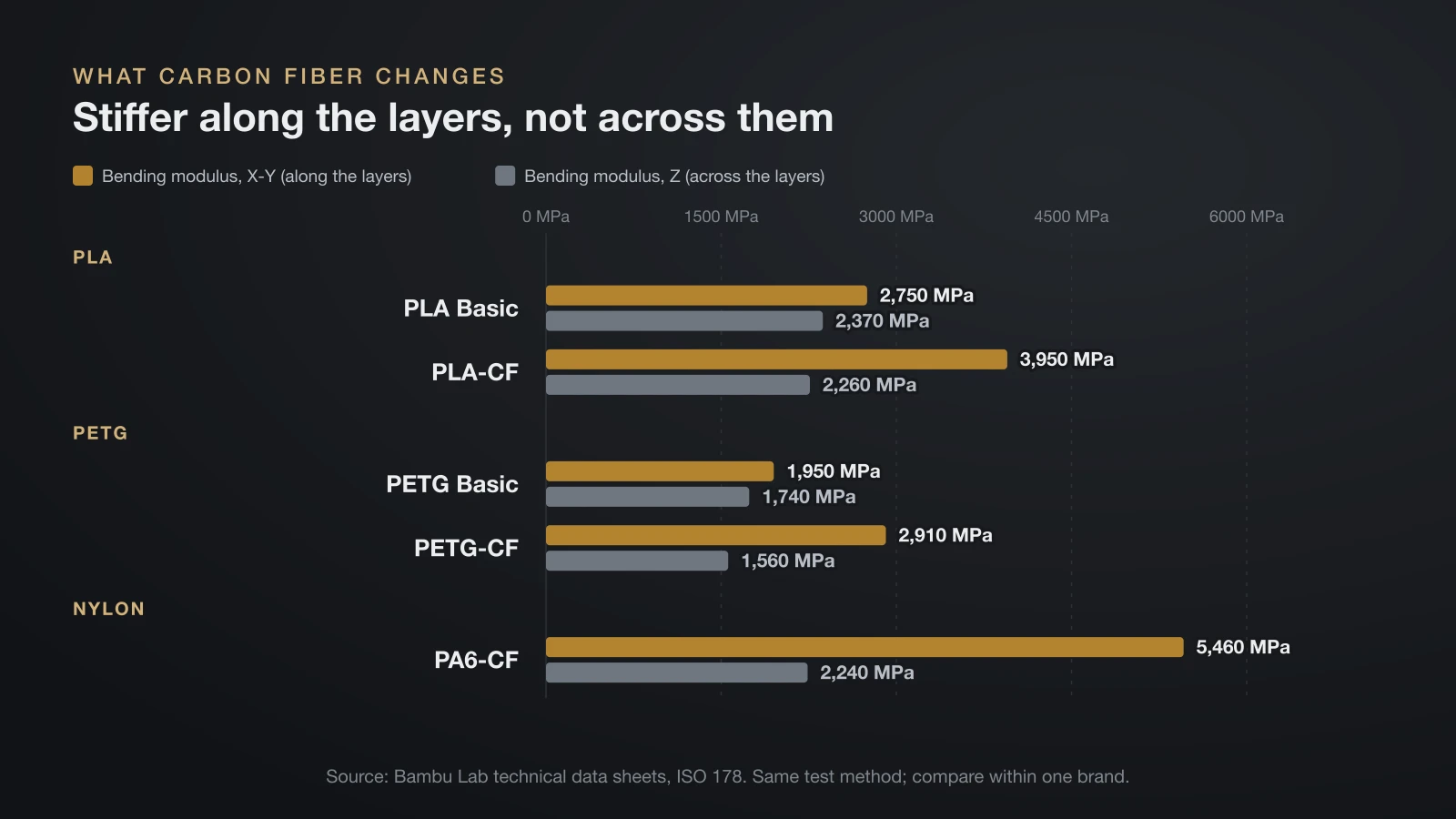
Carbon fiber makes parts much stiffer along the layers but not across them, and it rarely adds tensile strength to PLA or PETG. Bambu Lab tests its plain and carbon fiber filaments with the same ISO methods, so every value below comes from its data sheets. X-Y is along the printed layers; Z is across them.
| Bambu Lab data sheet | PLA Basic | PLA-CF | PETG Basic | PETG-CF | PA6-CF |
|---|---|---|---|---|---|
| Bending modulus, X-Y (ISO 178) | 2,750 MPa | 3,950 MPa | 1,950 MPa | 2,910 MPa | 5,460 MPa |
| Bending modulus, Z | 2,370 MPa | 2,260 MPa | 1,740 MPa | 1,560 MPa | 2,240 MPa |
| Tensile strength, X-Y (ISO 527) | 35 MPa | 38 MPa | 51 MPa | 35 MPa | 102 MPa |
| Tensile strength, Z | 31 MPa | 26 MPa | 35 MPa | 29 MPa | 48 MPa |
| Impact strength, X-Y (ISO 179, unnotched) | 26.6 kJ/m² | 23.2 kJ/m² | 34.2 kJ/m² | 41.2 kJ/m² | 40.3 kJ/m² |
| Impact strength, Z | 13.8 kJ/m² | 7.8 kJ/m² | 10.5 kJ/m² | 10.7 kJ/m² | 15.5 kJ/m² |
| Heat deflection, 1.8 MPa (ISO 75) | 54 °C | 54 °C | 68 °C | 68 °C | 164 °C |
Three patterns stand out:
- Stiffer along the layers. PLA-CF’s bending modulus is about 44% higher than PLA Basic’s, and PETG-CF’s about 49% higher than PETG Basic’s (percentages calculated from the table).
- Not stiffer across the layers. In the Z direction both carbon fiber grades are slightly less stiff than their plain versions, and PLA-CF’s Z tensile and impact values drop. Orient parts so the load runs along the layers.
- No free heat resistance for PLA and PETG. Heat deflection at 1.8 MPa stays at 54 °C (129 °F) and 68 °C (154 °F). Only carbon fiber nylon jumps, to 164 °C (327 °F).
Prusament data tells the same story
Prusament’s data sheets compare plain and carbon fiber versions of PETG and PA11 (nylon 11), with 3D printed test bars in horizontal orientation:
| Prusament data sheet | PETG | PETG Carbon Fiber | PA11 | PA11 Carbon Fiber |
|---|---|---|---|---|
| Flexural modulus (ISO 178) | 1.7 GPa | 2.3 GPa | 1.1 GPa | 3.0 GPa |
| Heat deflection, 0.45 MPa (ISO 75) | 68 °C | 96 °C | 58.7 °C | 192 °C |
| Heat deflection, 1.8 MPa (ISO 75) | 68 °C | 80 °C | 49.9 °C | 152 °C |
| Unnotched Charpy impact (ISO 179-1) | No break | 29 kJ/m² | Not listed | 30 kJ/m² |
| Interlayer adhesion (Prusa test) | 18 MPa | 18 MPa | 32 MPa | 20 MPa |
Prusa’s own summary of PETG Carbon Fiber lists lower toughness than plain PETG among the cons. The two PA11 sheets were printed on different Prusa printers, so read that pair as a trend. Here the fibers raise PETG’s heat resistance more than in Bambu Lab’s data, so compare materials within one brand. The nylon result is the clearest: carbon fiber lifts PA11 from PLA-like heat resistance to 192 °C (378 °F) under light load, while interlayer adhesion falls from 32 to 20 MPa.
PLA-CF vs PETG-CF vs PA-CF: which carbon fiber filament to choose
The right carbon fiber filament is the base plastic you would choose anyway, made stiffer. Start from where the part will live and what load it carries.
- Choose PLA-CF for stiff prototypes and display parts with a matte look that stay indoors, away from heat. It prints on a cool plate with the fan on, like PLA. If you mainly need a less brittle PLA rather than a stiffer one, a toughened blend is simpler; see our PLA+ guide.
- Choose PETG-CF for functional parts that need more toughness and heat resistance than PLA-CF. It prints a little hotter than plain PETG; our PETG temperature guide covers the base settings.
- Choose PA-CF for fixtures, clamps and mechanical parts that are stiff, strong and near heat. Bambu Lab rates its PA6-CF for use in dry environments, because nylon loses much of its stiffness when wet.
- Choose something else for outdoor parts in full sun, where ASA filament is made for UV, or for extreme heat, where PEEK filament and similar high-temperature polymers take over.
What about PETG-GF and other glass fiber filaments?
Glass fiber filaments such as PETG-GF use chopped glass instead of carbon, and they suit a slightly different job. UltiMaker’s comparison gives carbon fiber the edge in stiffness, tensile strength and low weight, and glass fiber the edge in cost, flexibility and color choice. UltiMaker also lists electrical conductivity potential for carbon fiber composites, so do not assume a carbon fiber part is an insulator.
Glass fiber is abrasive too. Polymaker requires an abrasion-resistant nozzle for its glass fiber and carbon fiber Fiberon filaments alike.
Why carbon fiber filament needs a hardened nozzle
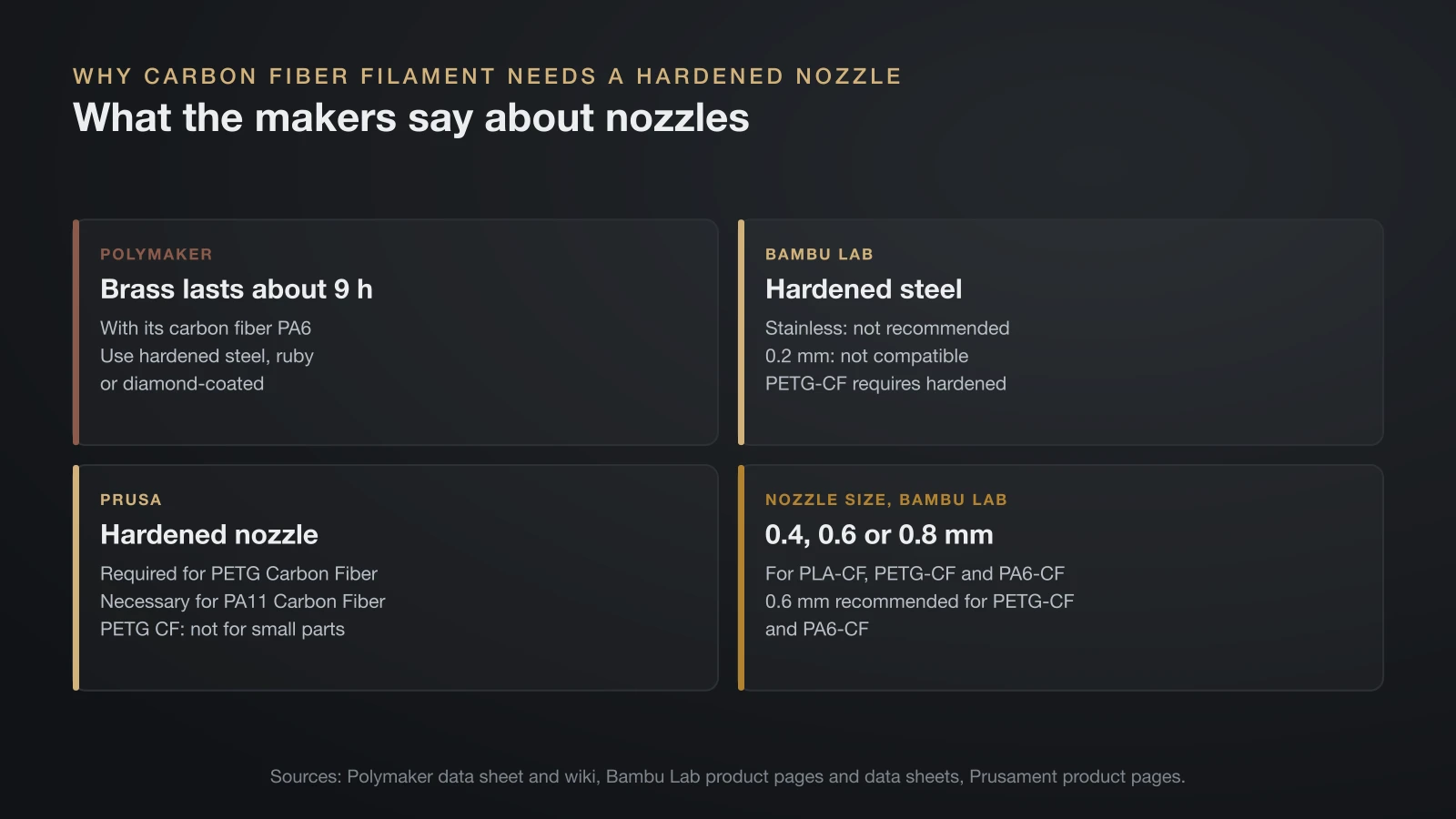
Carbon fiber filament wears soft nozzles quickly, because the fibers are abrasive. Polymaker’s data sheet for its carbon fiber PA6 puts the life of a brass nozzle at about 9 hours and recommends a wear-resistant nozzle such as hardened steel or ruby. Its wiki lists hardened steel, ruby and diamond-coated nozzles for fiber filaments.
The major printer makers say the same:
- Bambu Lab marks stainless steel nozzles as not recommended and 0.2 mm nozzles as not compatible for its PLA-CF, PETG-CF and PA6-CF, and says PETG-CF requires a hardened steel nozzle.
- Prusa lists a hardened nozzle as required for Prusament PETG Carbon Fiber and necessary for PA11 Carbon Fiber, and calls PETG Carbon Fiber unsuitable for small parts.
- Nozzle size: Bambu Lab lists 0.4, 0.6 and 0.8 mm nozzles for all three and recommends 0.6 mm for PETG-CF and PA6-CF to lower the clog risk.
Our 3D printer nozzle guide compares hardened steel, stainless steel, brass and ruby-tipped nozzles.
How to print carbon fiber filament: settings
Carbon fiber filament prints close to its base plastic, a little hotter and a little slower. These are the manufacturers’ starting points:
| Setting | Bambu Lab PLA-CF | Bambu Lab PETG-CF | Prusament PETG Carbon Fiber | Bambu Lab PA6-CF | Prusament PA11 Carbon Fiber |
|---|---|---|---|---|---|
| Nozzle | 210–240 °C | 240–270 °C | 265 ± 10 °C | 260–290 °C | 285 ± 5 °C |
| Bed | 35–45 °C | 65–75 °C | 90 ± 10 °C | 80–100 °C | 110 ± 10 °C |
| Part cooling fan | On | 0–60% | 50% | 0–60% | 20% |
| Speed | Under 200 mm/s | Under 200 mm/s | Up to 200 mm/s | Under 100 mm/s | Up to 100 mm/s |
| Plate | Glue on textured PEI or cool plate | Glue on engineering or PEI plate | Satin, textured, or smooth PEI with glue | Glue on engineering or PEI plate | PA Nylon sheet |
| Drying | 55 °C for 8 h | 65 °C for 8 h | Not listed | 80 °C for 8–12 h | Not listed |
A first-print routine:
- Fit a hardened nozzle, 0.4 mm or larger, and check that it is rated for the nozzle temperature.
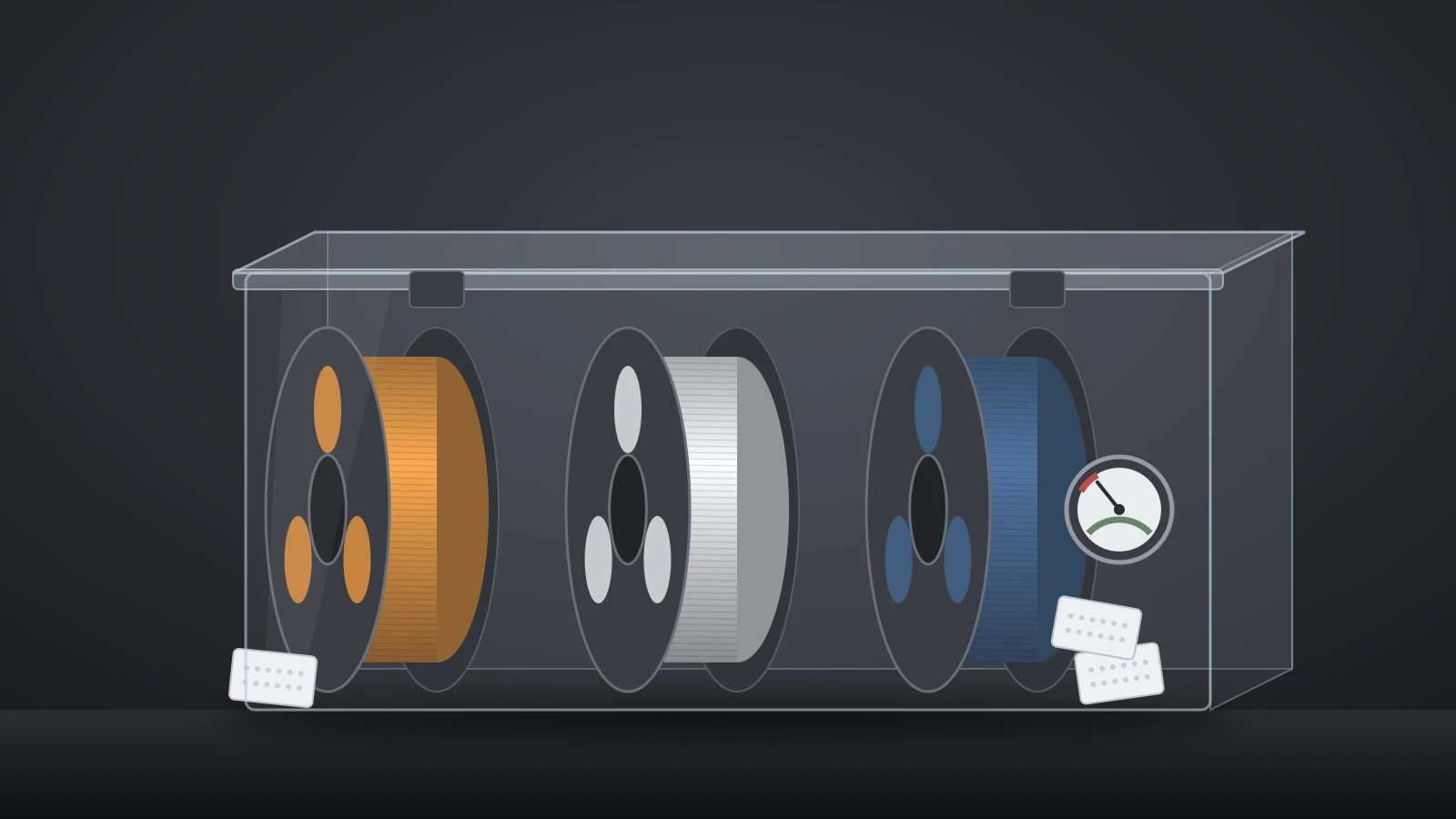
- Dry the spool at the data sheet temperature, then print from a sealed box; Bambu Lab asks for under 20% relative humidity for all three of its grades.
- Prepare the plate with a thin layer of glue where the maker calls for it.
- Use an enclosure for carbon fiber nylon. Bambu Lab lists a 45–60 °C chamber for PA6-CF.
Moisture matters most for nylon. Bambu Lab’s PA6-CF page shows its bending modulus falling from 5,460 MPa dry to 3,560 MPa wet, and its bending strength across layers from 80 to 45 MPa. Bambu Lab lists saturated water absorption of 2.35% for PA6-CF versus 0.42% for PLA-CF and 0.30% for PETG-CF.
Is carbon fiber filament safe? Dust and fumes
Carbon fiber filament calls for at least the precautions of its base plastic, plus care with dust when you sand or cut parts.
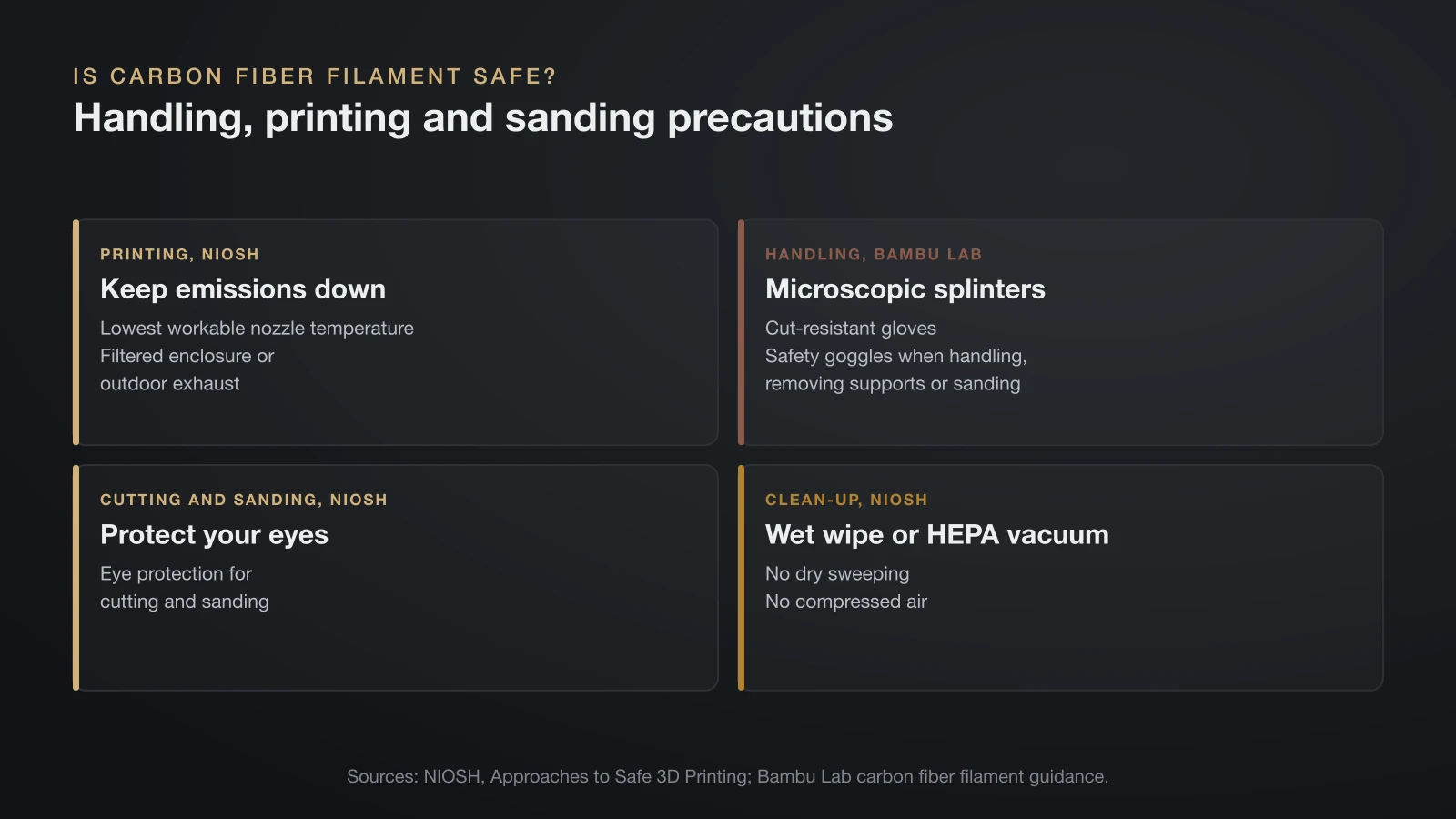
NIOSH, the US workplace safety institute, notes that emissions depend on the filament and rise with extruder temperature, and that filaments with added nanomaterials release particles that contain them. Its guide to safe 3D printing recommends:
- Lowest workable temperature: hotter nozzles release more emissions.
- Enclosure with filtration or outdoor exhaust: a filtered enclosing hood cut particle emissions by 97–99% in a study NIOSH cites.
- Post-processing dust: wear eye protection for cutting and sanding, and clean up with wet wiping or a HEPA vacuum rather than dry sweeping or compressed air.
Bambu Lab adds that carbon fiber filament can carry microscopic splinters, and recommends cut-resistant gloves and safety goggles when handling the filament, removing supports or sanding parts.
For carbon fiber nylon, the base plastic’s own fumes apply too; the nylon guide linked above covers ventilation.
What is carbon fiber filament used for?
Carbon fiber filament is used for parts that must stay rigid and hold their shape. Bambu Lab lists fixtures, clamps, automotive and mechanical components and structural parts in dry environments for PA6-CF, functional prototypes and high-stress models for PETG-CF, and prototypes that need a premium non-glossy look for PLA-CF. UltiMaker points to lightweight automotive and aerospace work.
Printed carbon fiber is still a short-fiber plastic, not a carbon fiber laminate. Data sheet values come from ideal test bars, and layers remain the weak direction, so no printed part should carry a load where failure could hurt someone.
The bottom line
Carbon fiber filament gives you stiffer, matte, dimensionally stable parts, but in Bambu Lab’s and Prusa’s data it does not make PLA or PETG much stronger, and the layers stay the weak point. PLA-CF is the easy entry, PETG-CF adds toughness and PA-CF adds real heat resistance at the cost of drying and an enclosure. Whatever you choose, fit a hardened nozzle first and control the dust.
Sources
- Bambu Lab: technical data sheets for PLA Basic, PETG Basic, PLA-CF, PETG-CF and PA6-CF, plus the PLA-CF, PETG-CF and PA6-CF product pages (bending, tensile and impact values, heat deflection, density, water absorption, settings, nozzle compatibility and size, wet vs dry stiffness, uses, splinter and glove safety notes)
- Prusa: Polyamide (nylon) material guide, Prusament PETG data sheet, PETG Carbon Fiber page and data sheet, PA11 data sheet and PA11 Carbon Fiber data sheet (flexural modulus, heat deflection, impact, interlayer adhesion, settings, hardened nozzle, pros and cons, lower warping of carbon filled nylon)
- Polymaker: Carbon fiber reinforced filaments wiki, Fiberon wiki and Fiberon PA6-CF20 data sheet (definition, base polymers, nozzle materials, 9-hour brass nozzle life, abrasion-resistant nozzle for glass and carbon fiber)
- UltiMaker: Glass vs. carbon fiber composites (stiffness, strength, weight, cost, color, conductivity, applications)
- NIOSH (CDC): Approaches to Safe 3D Printing, publication 2024-103, and 3D printing (additive manufacturing) topic page (emissions by filament and temperature, nanomaterial-containing filaments, lowest temperature, 97–99% particle reduction with a filtered hood, wet wiping, HEPA cleanup, eye protection)