
PEEK 3D printer filament (polyether ether ketone) is an ultra-high-temperature plastic that melts at 343 °C (649 °F). Printing it takes a 380–400 °C (716–752 °F) nozzle, a bed of at least 100 °C (212 °F) and, for standard PEEK, a chamber above 150 °C (302 °F). That means a dedicated high-temperature 3D printer, not a hobby machine.
The machines in our enclosed 3D printer comparison top out at 370 °C at the nozzle and 65 °C in the chamber, short of those numbers. This guide explains why PEEK is so demanding, what a PEEK-capable printer needs, and how PEEK compares with PEKK, PEI (ULTEM) and polycarbonate 3D printer filament on manufacturer data sheets.
The short answer
| PEEK filament | |
|---|---|
| What it is | Polyether ether ketone, a semi-crystalline polymer of the PAEK family |
| Melting point | 343 °C (Victrex PEEK 450G) |
| Nozzle temperature | 380–400 °C as a starting point; never above 450 °C (Victrex) |
| Chamber | Above 150 °C for crystalline parts, typically 175–200 °C (Victrex) |
| Bed | At least 100 °C, often 20–40 °C above the chamber (Victrex) |
| Drying | 120 °C overnight (Victrex), 150 °C for 3 h (3DXTech) |
| Annealing | At least 170 °C for 2–3 h for Victrex’s easier-printing AM 200 grade |
| Printer | A dedicated high-temperature machine with a heated chamber |
| Close relatives | PEKK (lower melting grades available), PEI/ULTEM (amorphous, flame-rated grades) |
| Skip it if | Your part stays below PC’s heat limit or you lack a high-temperature printer |
What is PEEK filament?
PEEK filament is made from polyether ether ketone, a member of the polyaryletherketones (PAEK), a family of high-temperature polymers that also includes PEKK. Victrex’s unreinforced PEEK 450G softens at a glass transition of 143 °C (289 °F), melts at 343 °C and, in molded test bars, reaches 98 MPa tensile yield strength. Victrex positions its PEEK and PAEK filaments for aerospace, automotive and industrial parts that need strength, chemical resistance and thermal stability.
Its long-term heat ratings are the real draw. Underwriters Laboratories’ relative thermal index (RTI) for PEEK 450G is 240 °C for mechanical strength without impact, 180 °C with impact and 260 °C for electrical properties. Those ratings are for molded material, not printed parts, but they show how far PEEK sits above everyday filaments.
Semi-crystalline: why color tells you something
PEEK-family polymers can solidify in two states. For its AM 200 filament, Victrex describes amorphous printed parts as translucent and amber, with under 10% crystallinity, and crystalline parts as opaque and beige, usually above 20% and close to 30%. Crystalline PEEK is the one with the full heat and chemical resistance, so a translucent amber part is a sign it has not fully crystallized yet.
Why is PEEK 3D printer filament so hard to print?
Victrex sums it up bluntly: printing traditional PEEK “is challenging and requires specialised machines and knowledge.” Four problems stack up.
- Heat at the nozzle. Victrex recommends starting at least 50 °C above the melting point, which puts PEEK at 380–400 °C. It advises never exceeding 450 °C (842 °F), because degradation starts well below the roughly 570 °C at which the polymer loses weight in lab tests.
- Time in the hot end. Victrex gives a residence time of about 30 minutes at 380 °C. Melt that sits longer carbonizes into black specks and eventually clogs the nozzle, so lower the temperature if a print pauses.
- Crystallization. Standard PEEK crystallizes fast and shrinks as it does. Victrex does not recommend printing it in a cool chamber, because the result is typically weak parts.
- Adhesion both ways. PEEK bonds strongly to itself, which makes self-supports hard to remove, yet it needs help sticking to the bed.
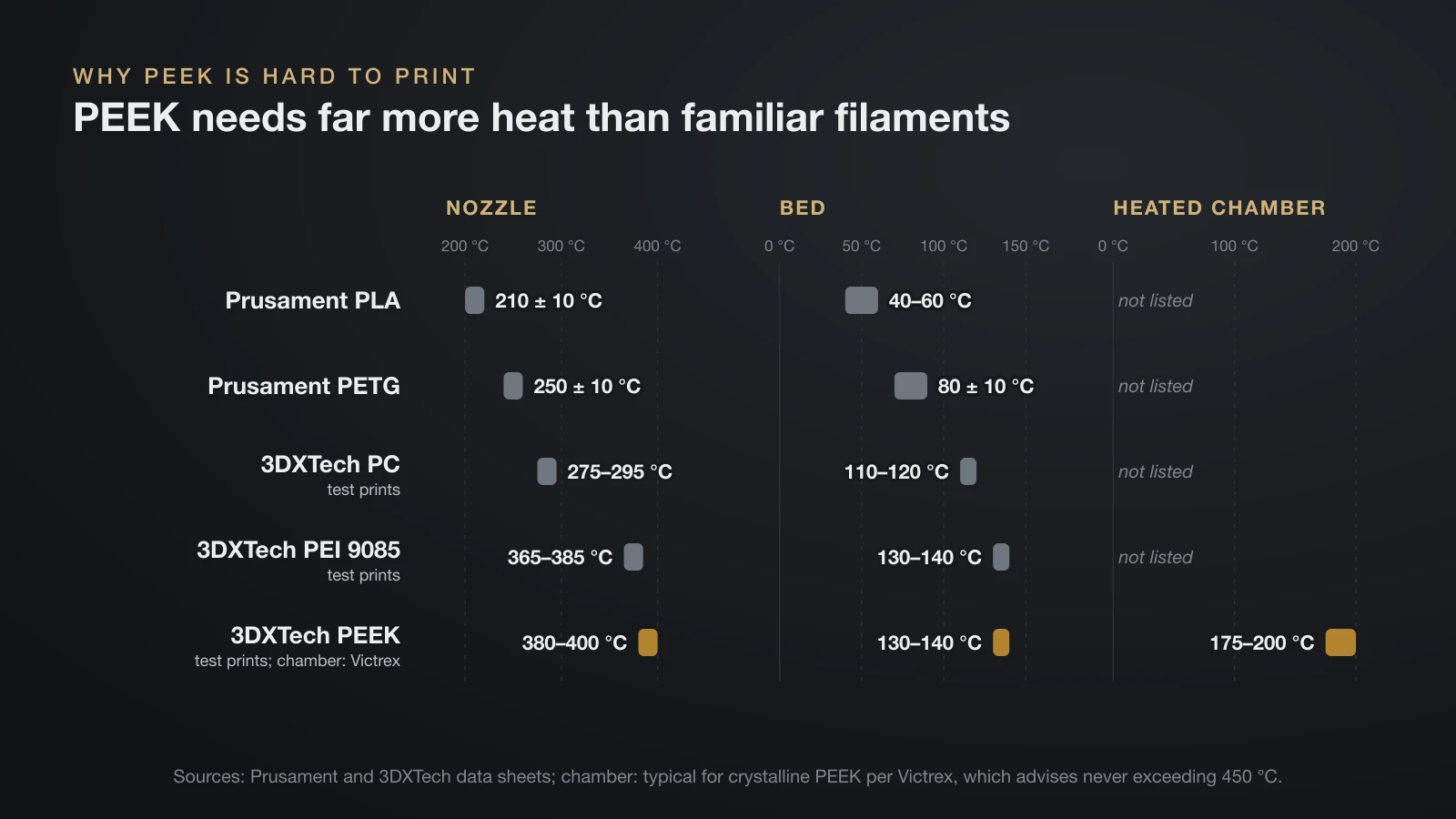
Here is how far PEEK’s temperatures sit above familiar filaments:
| Data sheet | Nozzle | Bed | Heated chamber |
|---|---|---|---|
| Prusament PLA | 210 ± 10 °C | 40–60 °C | Not listed |
| Prusament PETG | 250 ± 10 °C | 80 ± 10 °C | Not listed |
| 3DXTech PC (test prints) | 275–295 °C | 110–120 °C | Not listed |
| 3DXTech PEI 9085 (test prints) | 365–385 °C | 130–140 °C | Not listed |
| 3DXTech PEEK (test prints) | 380–400 °C | 130–140 °C | 175–200 °C typical for crystalline PEEK (Victrex) |
What 3D printer do you need for PEEK?
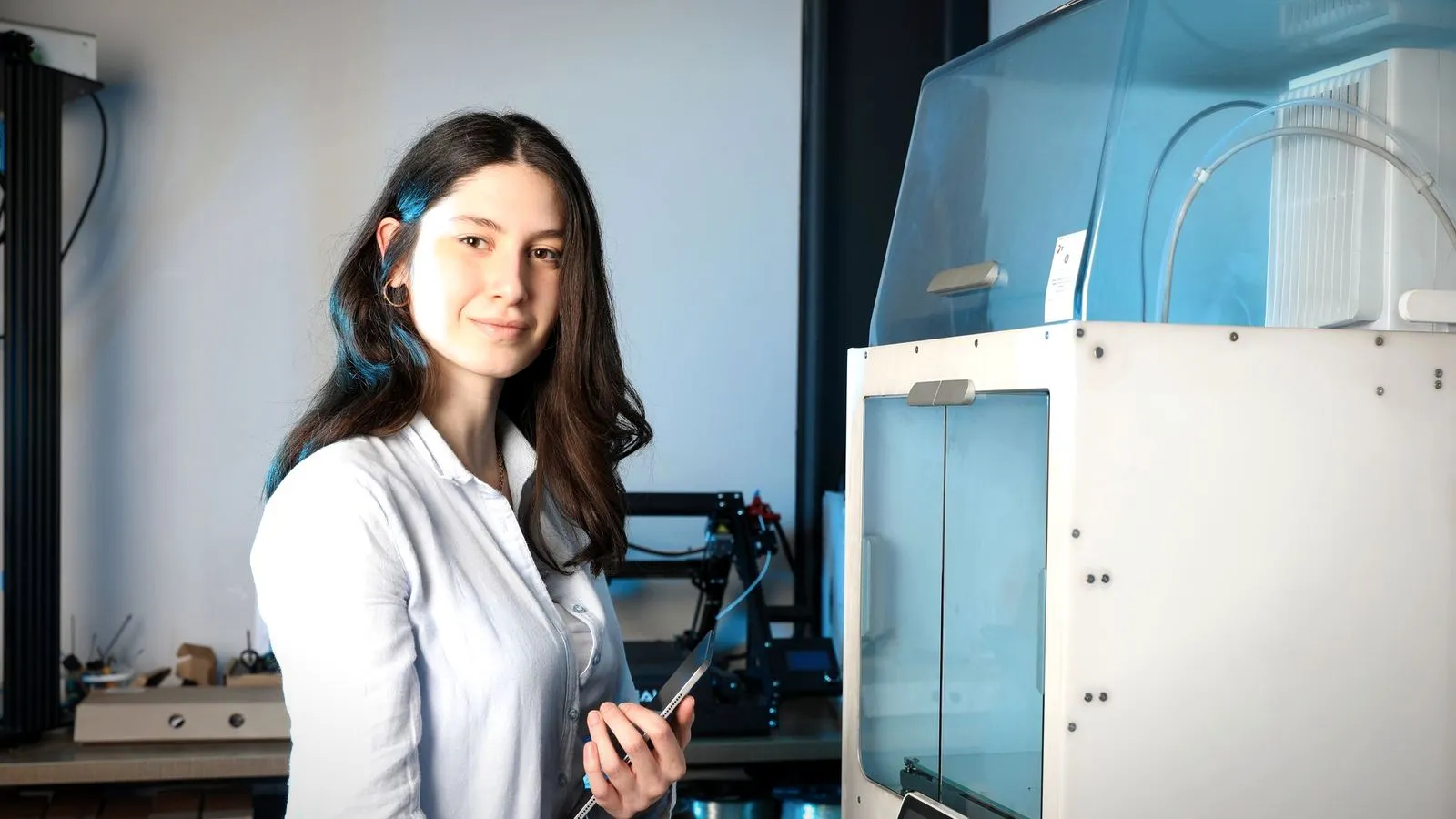
A PEEK-capable machine is a high-temperature 3D printer built around the melt, the chamber and the materials that touch both. Victrex’s guidance translates into this checklist:
| Part | What PEEK needs |
|---|---|
| Hot end | Holds 380–400 °C steadily, with headroom toward 450 °C |
| Melt path | No copper or copper alloys (brass included), no nitride coatings; care with aluminium |
| Chamber | Actively heated above 150 °C for crystalline printing of standard PEEK |
| Bed | At least 100 °C, ideally 20–40 °C above the chamber |
| Build plate | Metal or carbon fiber plate; tempered glass has been reported to crack |
| Enclosure | Enclosed chamber for safety, even when chamber heat is limited |
| Filament dryer | 120 °C overnight; above 120 °C only on a metal spool |
Victrex explains that aluminium parts can be heat treated at temperatures below PEEK’s processing range, and that PEEK sticking to a nitride coating can lift it off the steel. Our 3D printer extruder guide explains how the hot end and melt path fit together.
How real printers compare
Manufacturer specifications show the gap between PEEK-class machines and hot consumer printers:
| Printer (maker’s specs) | Max nozzle | Max bed | Chamber |
|---|---|---|---|
| INTAMSYS FUNMAT HT | 450 °C | 160 °C | 90 °C, constant |
| CreatBot PEEK-250 | 480 °C | 200 °C | 200 °C |
| QIDI Q2 (consumer, for contrast) | 370 °C | 120 °C | Up to 65 °C |
INTAMSYS sells the FUNMAT HT as a desktop PEEK printer with an all-metal hot end. Its 90 °C chamber sits below Victrex’s 150 °C threshold; Victrex’s general advice is to start from the printer maker’s optimized profiles, and it points to slower-crystallizing grades such as its AM 200 for cooler chambers. CreatBot says the PEEK-250’s 200 °C chamber also allows annealing inside the printer. Larger industrial systems exist too, but they are beyond the scope of this guide.
PEEK vs PEKK vs PEI (ULTEM) vs PC
In short, PEEK stretches furthest before breaking and is among the strongest of these materials, but as printed it is not the most heat resistant. 3DXTech publishes data sheets for all of them, tested on printed bars with ISO methods, so the numbers below compare like with like:
| 3DXTech data sheet | 3DXMAX PC | PEI 9085 | PEI 1010 | PEKK-A | PEEK |
|---|---|---|---|---|---|
| Glass transition | 147 °C | 186 °C | 217 °C | 162 °C | 143 °C |
| Heat deflection, 0.45 MPa (ISO 75) | 135 °C | 158 °C | 208 °C | 150 °C | 140 °C |
| Tensile strength (ISO 527) | 62 MPa | 54 MPa | 56 MPa | 105 MPa | 100 MPa |
| Elongation at break | 7% | 3% | 3% | 5% | 28% |
| Density | 1.2 g/cm³ | 1.34 g/cm³ | 1.27 g/cm³ | 1.27 g/cm³ | 1.30 g/cm³ |
| Extrusion temperature (test) | 275–295 °C | 365–385 °C | 380–400 °C | 350 °C | 380–400 °C |
| Drying (3DXTech) | 120 °C, 4+ h | 130 °C, 4–6 h | 150 °C, 4–6 h | 120 °C, 6–8 h | 150 °C, 3 h |
The surprise is heat deflection. As printed, 3DXTech’s PEEK bars deflect at 140 °C (284 °F), below both PEI grades and PEKK-A, and the data sheet lists no annealing step. PEEK’s advantages show up elsewhere: nearly twice the tensile strength of PEI, 28% elongation instead of 3% and, once crystallized, the melting point and long-term heat ratings covered above.
- PEKK is PEEK’s closest relative. 3DXTech’s PEKK-A melts at 305 °C and was printed at 350 °C in a 140 °C chamber; its PEKK-C melts at 335 °C, deflects at 182 °C and was printed at 370 °C in a 160 °C chamber.
- PEI (ULTEM): SABIC describes ULTEM 9085 as amorphous, so it avoids the crystallization step that makes PEEK tricky. SABIC designs ULTEM 9085 for aircraft cabin interiors, where it meets the FAR 25.853 and OSU 55/55 heat release requirements, and says main aerospace OEMs have approved it.
- PC prints at far lower temperatures on well-equipped enclosed printers. Brands differ widely: Prusament PC Blend lists 113 °C at 0.45 MPa against 3DXTech’s 135 °C, as our polycarbonate guide explains.
3DXTech also lists UL 94 V-0 flame ratings for the base resins of its PEEK, PEKK and PEI filaments.
How to print PEEK: settings and annealing
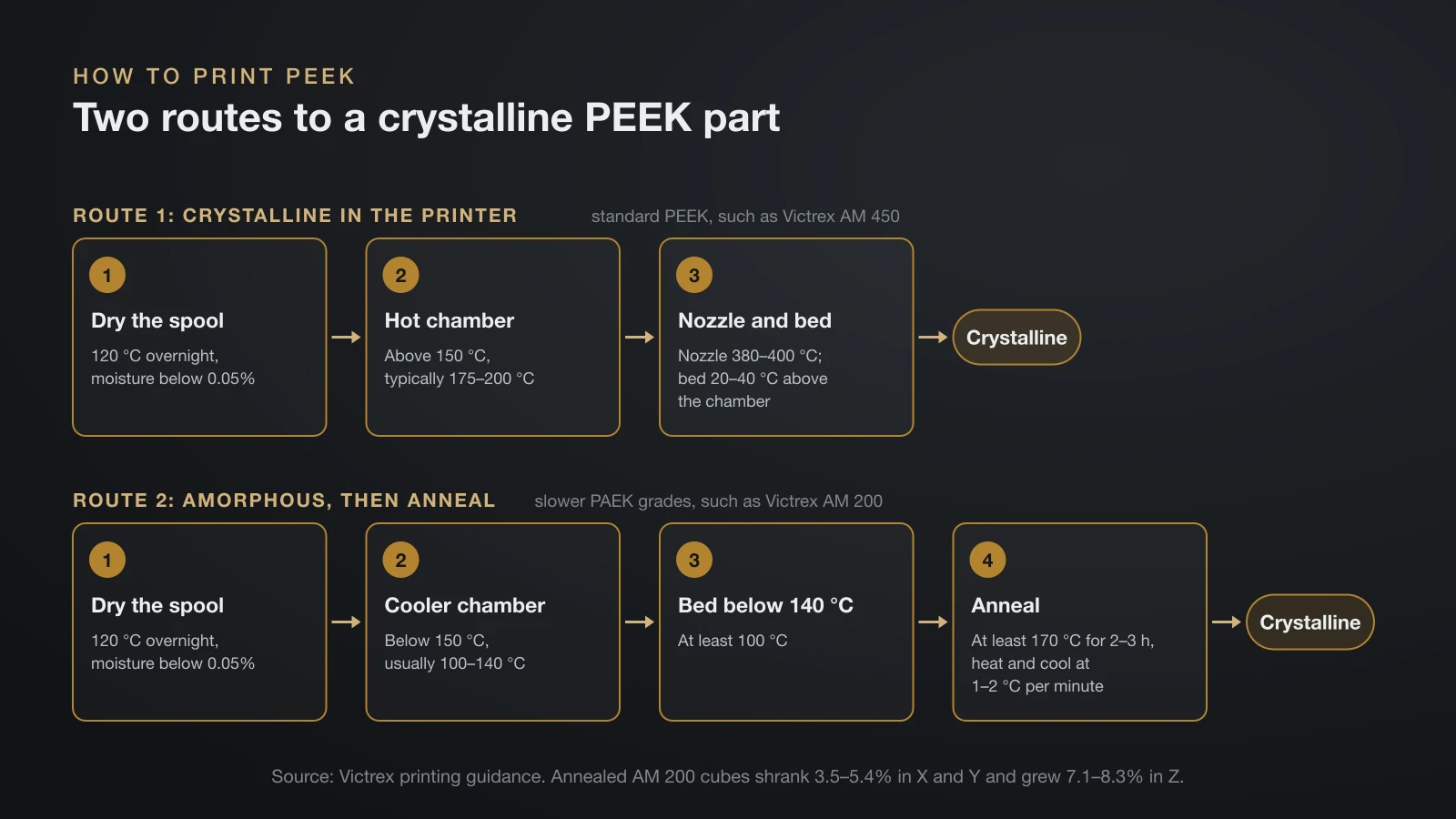
To print PEEK, dry the spool, run the nozzle at 380–400 °C and follow one of the two routes Victrex describes: crystalline printing in a very hot chamber, or amorphous printing followed by annealing.
Route 1 prints standard PEEK crystalline in a chamber above 150 °C, typically 175–200 °C, and starting at 180 °C for its AM 450 PEEK filament. Route 2 prints amorphous parts in a chamber below 150 °C, usually 100–140 °C, but only with slower-crystallizing PAEK grades such as Victrex AM 200, which melts at 303 °C.
A starting routine based on Victrex’s guidance:
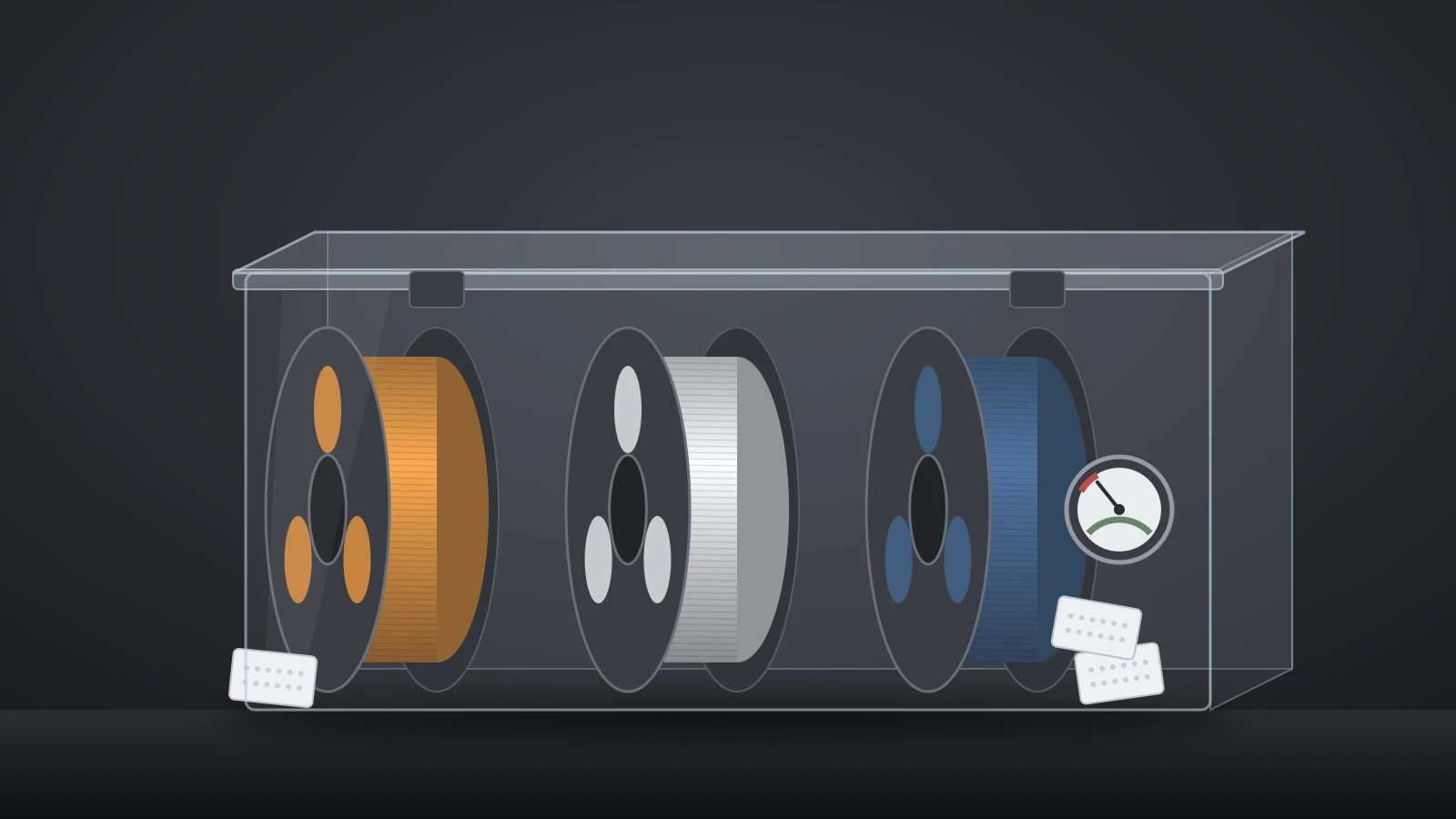
- Dry the spool at 120 °C (248 °F) overnight, aiming for moisture below 0.05%. 3DXTech notes that PEEK, PEKK and PEI pick up moisture slowly but also release it slowly.
- Start from the printer maker’s PEEK profile if one exists.
- Set the nozzle to 380–400 °C. Hotter gives stronger layer bonding but shorter nozzle life.
- Heat the chamber for your route, and set the bed 20–40 °C above it, at least 100 °C. For amorphous printing, keep the bed below 140 °C.
- Help the first layer with an adhesive made for high-temperature printing, a raft or a skirt, and print the first layers hotter and slower.
- Print slowly: 10–30 mm/s is common for standard PEEK.
- Use breakaway supports made for PEI, PEEK or PEKK; soluble supports only work on the amorphous route.
- Anneal. For AM 200, Victrex recommends at least 170 °C (338 °F) for 2–3 hours, heating and cooling at 1–2 °C per minute, or 20 °C above the part’s maximum service temperature if that is higher.
Annealing changes dimensions. When Victrex annealed amorphous AM 200 cubes in air, they shrank 3.5–5.4% in X and Y and grew 7.1–8.3% in Z. Packing the part in sand, salt or gypsum reduces distortion, and a small Victrex study found annealing raised strength in the X-Y direction by about 10%.
Where PEEK filament is used, and its limits
PEEK filament is used for aerospace and transport parts, hot and chemically harsh environments and parts that must be sterilized, but ordinary grades are not approved for medical implants.
- Aerospace and transport: Victrex targets aerospace and automotive parts, and SABIC’s ULTEM 9085 is made for aircraft cabin interiors and rail.
- Harsh chemical and hot environments: Victrex says its AM 200 filament suits higher-temperature applications and chemically aggressive environments, with low outgassing.
- Sterilized parts: Victrex describes AM 200 as suitable for sterilization.
- Not implants: Victrex states its materials are not approved for medical implants; implant grades from its Invibio business go only to medical device manufacturers.
Nothing about PEEK makes a printed part safe for loads where failure could hurt someone. Data sheet values come from test bars, and Victrex stresses that results vary widely from machine to machine.
As for cost, the filament is only part of it: PEEK also needs a printer with a 400 °C class hot end and a heated chamber, plus a dryer and an oven for annealing. If a part truly has to be metal, our guide to metal 3D printer filament explains what sinterable filaments can and cannot do.
When an easier material is enough
- Below roughly PC’s heat range: polycarbonate or a carbon fiber nylon filament on an enclosed printer.
- Flame, smoke and toxicity rules: PEI 9085, which also prints without PEEK’s crystallization step.
- Top heat plus chemical resistance and toughness: PEEK or PEKK, on a machine built for them.
The bottom line
PEEK 3D printer filament delivers a 343 °C melting point, long-term heat ratings above 200 °C for molded grades and far more elongation than PEI, but only on a printer with a 380–400 °C hot end, a copper-free melt path and a chamber well above 150 °C. Most users are better served by PC, carbon fiber nylon or a PEI grade, and PEEK makes sense when a part must survive heat and chemicals none of those can.
Sources
- Victrex: AM filament fusion processing guidelines (2024), VICTREX AM 200 FIL data sheet and VICTREX PEEK 450G data sheet (nozzle, chamber, bed, drying, residence time, melt path materials, supports, annealing and shrinkage, crystallinity, thermal and mechanical properties, UL RTI, uses, implant statement)
- 3DXTech technical data sheets: ThermaX PEEK, ThermaX PEKK-A, ThermaX PEKK-C, ThermaX PEI 9085, ThermaX PEI 1010, 3DXMAX PC and filament drying instructions (properties, test print settings, flame ratings, drying)
- SABIC: ULTEM Resin 9085 data sheet (amorphous PEI blend, aerospace and rail approvals)
- Printer makers’ specifications: INTAMSYS FUNMAT HT, CreatBot PEEK-250, QIDI Q2 (nozzle, bed and chamber temperatures)
- Prusa Polymers: Prusament PLA and Prusament PETG technical data sheets (nozzle and bed temperatures)