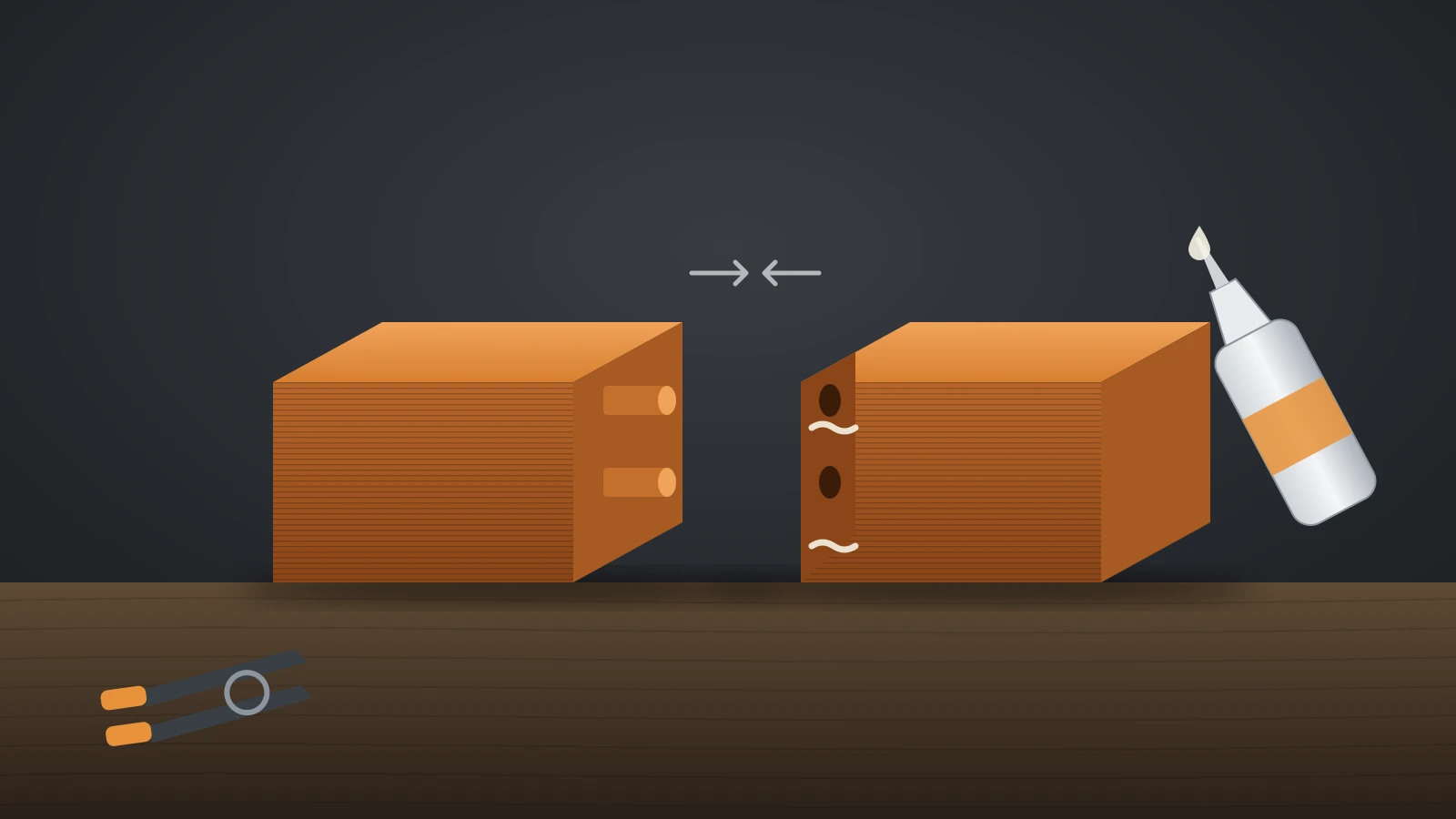
The best glue for PLA is a cyanoacrylate (CA) super glue gel for small, tight-fitting joints and a two-part epoxy for large, gappy or load-bearing joints. Lightly sand both surfaces, remove the dust, hold or clamp the parts until the glue sets, and let the bond cure for up to 24 hours before you stress it.
PLA bonds well because it is a hard, rigid plastic, unlike polyethylene or polypropylene, which most glue makers exclude. This guide compares glue types with the manufacturers’ own set and cure times, gives a decision table by job and a step-by-step method, and covers PETG, TPU and bed adhesive glue. For the material itself, see our PLA filament guide.
Good gluing starts with good design. Pegs, keys and larger contact areas do more for strength than any adhesive, as our guide to 3D printed joints shows.
The short answer
- Small parts, tight fits: CA super glue gel. Sets in under a minute, full strength in up to 24 hours.
- Gaps, broken parts, load: two-part epoxy. Fills gaps and cures harder, with a short mixing step.
- Parts that get knocked: a rubber-toughened super glue, which Loctite says resists impact, shock and vibration.
- Avoid: acetone (it does not weld PLA well) and any solvent glue whose SDS lists dichloromethane, which the US bans for consumer use.
- Always: sand lightly, keep surfaces clean and dry, and test on scrap before gluing a finished print.
Which glue works on PLA?
Cyanoacrylate, two-part epoxy and polyurethane glues all bond PLA, along with solvent-based adhesives made for 3D printing plastics. Each one trades speed, gap filling and cleanliness differently, so the table compares them using the manufacturers’ published figures.
| Glue type (example) | Sets in | Full cure | Gap filling | Watch for |
|---|---|---|---|---|
| CA gel (Loctite Super Glue Gel Control) | 30–45 s | Up to 24 h | Poor | Rigid; not for joints that flex |
| Rubber-toughened CA (Loctite Ultra Gel Control) | Quickly | 12–24 h | Poor | Made for impact, shock and vibration |
| CA, general (Gorilla Super Glue) | 10–45 s | 24 h | Poor | Needs tight-fitting, clean joints |
| Two-part epoxy (J-B Weld PlasticWeld syringe) | 5 min | 1 h | Good | Mixing; heat from curing |
| Polyurethane (Original Gorilla Glue) | Clamp 1–2 h | 24 h | Good, foams about 3x | Needs a damp surface; messy squeeze-out |
| Solvent-based 3D print glue (3D Gloop PLA) | About 10 min between coats | Not stated | Some | SDS lists methylene chloride; not for home use |
These are not structural ratings for printed parts: glue makers test on their own substrates, and a printed part can split along a layer line next to a sound joint.
Best glue for PLA by job
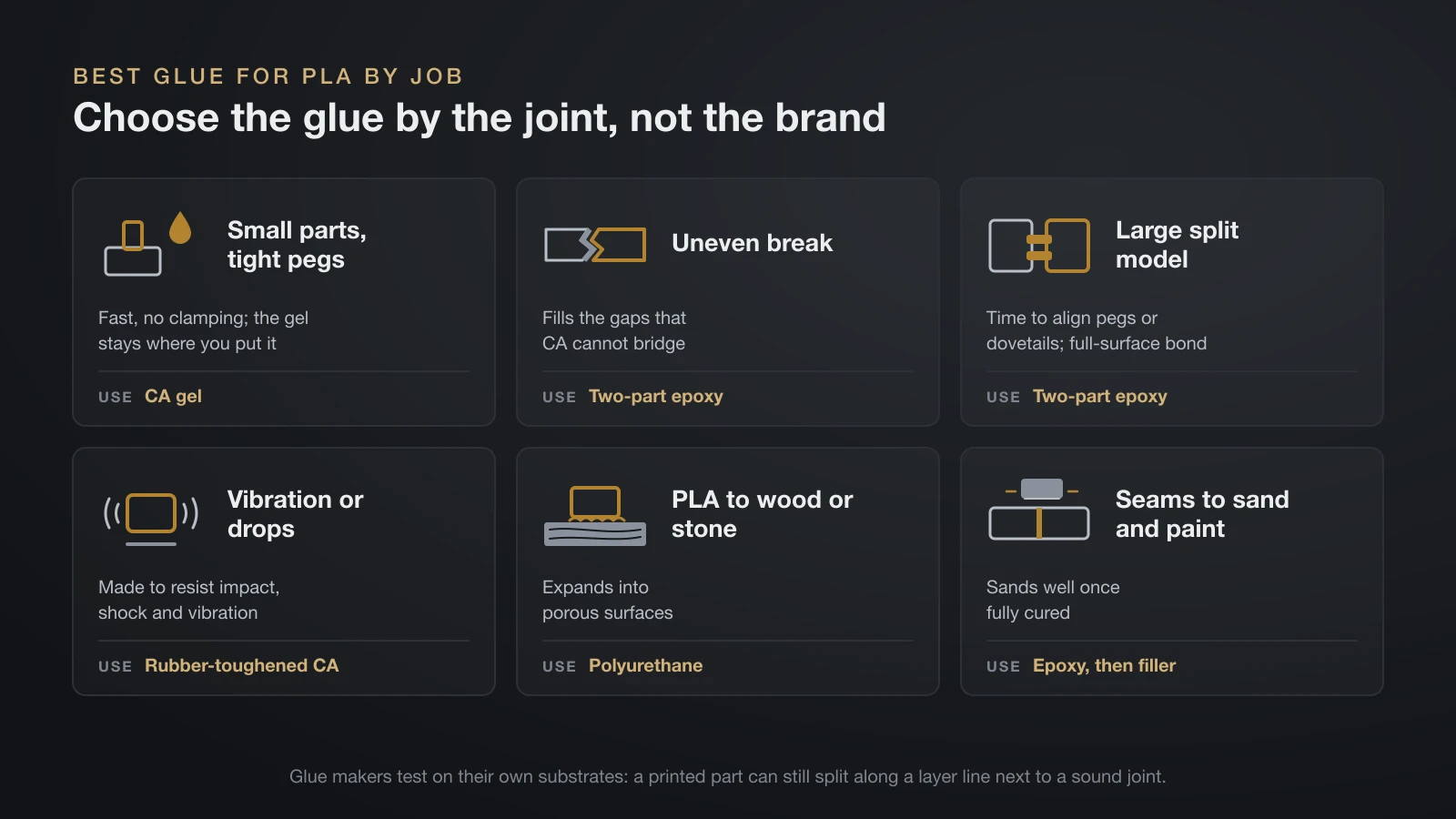
The best glue for PLA depends on the joint, so choose by the job rather than by brand. This decision table covers the common cases.
| Job | Glue | Why |
|---|---|---|
| Small figure parts, cosplay details, tight pegs | CA gel | Fast, no clamping, gel stays where you put it |
| Snapped print with an uneven break | Two-part epoxy | Fills the gaps that CA cannot bridge |
| Large split model joined with pegs or dovetails | Two-part epoxy | Longer working time to align, strong full-surface bond |
| Parts that vibrate or get dropped | Rubber-toughened CA | Made to resist impact, shock and vibration |
| Gluing PLA to wood or stone | Polyurethane | Expands into porous surfaces |
| Wide seams you plan to sand and paint | Epoxy, then filler | Sands well once fully cured |
Cosplay armor and props are a typical mix: CA for fast tacking of small parts, epoxy for the load-bearing joints and straps. Our guide to 3D printed cosplay armor covers splitting and assembling large pieces.
Does super glue work on PLA?
Super glue works very well on PLA, and it is the first choice for small, close-fitting parts. Loctite calls its Super Glue Gel Control one of the best ways to glue PLA, and Prusa lists superglue as a way to join PLA prints.
Choose a gel rather than a thin liquid. Loctite’s gels are no-drip formulas that stay put on vertical surfaces, which keeps glue off visible faces. Loctite’s routine: apply a small drop to one surface, press the parts together and hold for about 15–30 seconds, then leave the glue overnight because full cure takes up to 24 hours.
Super glue has two weak points. It needs a tight fit, because it fills gaps poorly, and Loctite does not recommend its standard gel where high flexibility is needed. Loctite’s rubber-toughened Ultra Gel Control is the better pick for parts that get knocked. CA accelerator sprays speed up curing on awkward joints that are hard to hold; follow the label and use them sparingly.
When to use epoxy on PLA
Epoxy is the right glue for PLA when the joint has gaps, carries a load or covers a large area. A two-part epoxy cures by chemical reaction rather than drying, so it fills voids and bonds the full surface. J-B Weld’s PlasticWeld syringe, for example, mixes 1:1, sets in 5 minutes, cures in 1 hour and is rated at 3,900 PSI tensile strength on the maker’s own tests.
Watch the heat. Loctite warns that some epoxies heat up as they set and cure, which risks damaging PLA, a plastic that softens at about 55–60 °C (131–140 °F). Mix small batches, apply thin layers and do not speed up curing with a hair dryer or heat gun on PLA parts.
Epoxy also sands well once fully cured, which makes it a good filler for seams that will be painted; our guide on how to paint 3D prints covers primer and clear coats.
Does Gorilla Glue work on PLA?
Gorilla says Original Gorilla Glue works on many plastics, and PLA is not on its exclusion list, but it behaves very differently from super glue. It is a water-activated polyurethane: you dampen one surface, apply a thin layer to the other, and it foams to about three times its volume as it cures. Gorilla recommends clamping for 1–2 hours and allowing 24 hours for a full cure.
The foam grips rough, porous surfaces, which suits joining PLA to wood or stone, but on visible printed seams the expanding squeeze-out must be trimmed and sanded. Gorilla does not recommend it for polypropylene, polyethylene or oily rubbers.
Gorilla Super Glue is a separate product: a cyanoacrylate that sets in 10–45 seconds and needs no clamping.
How to glue PLA parts together
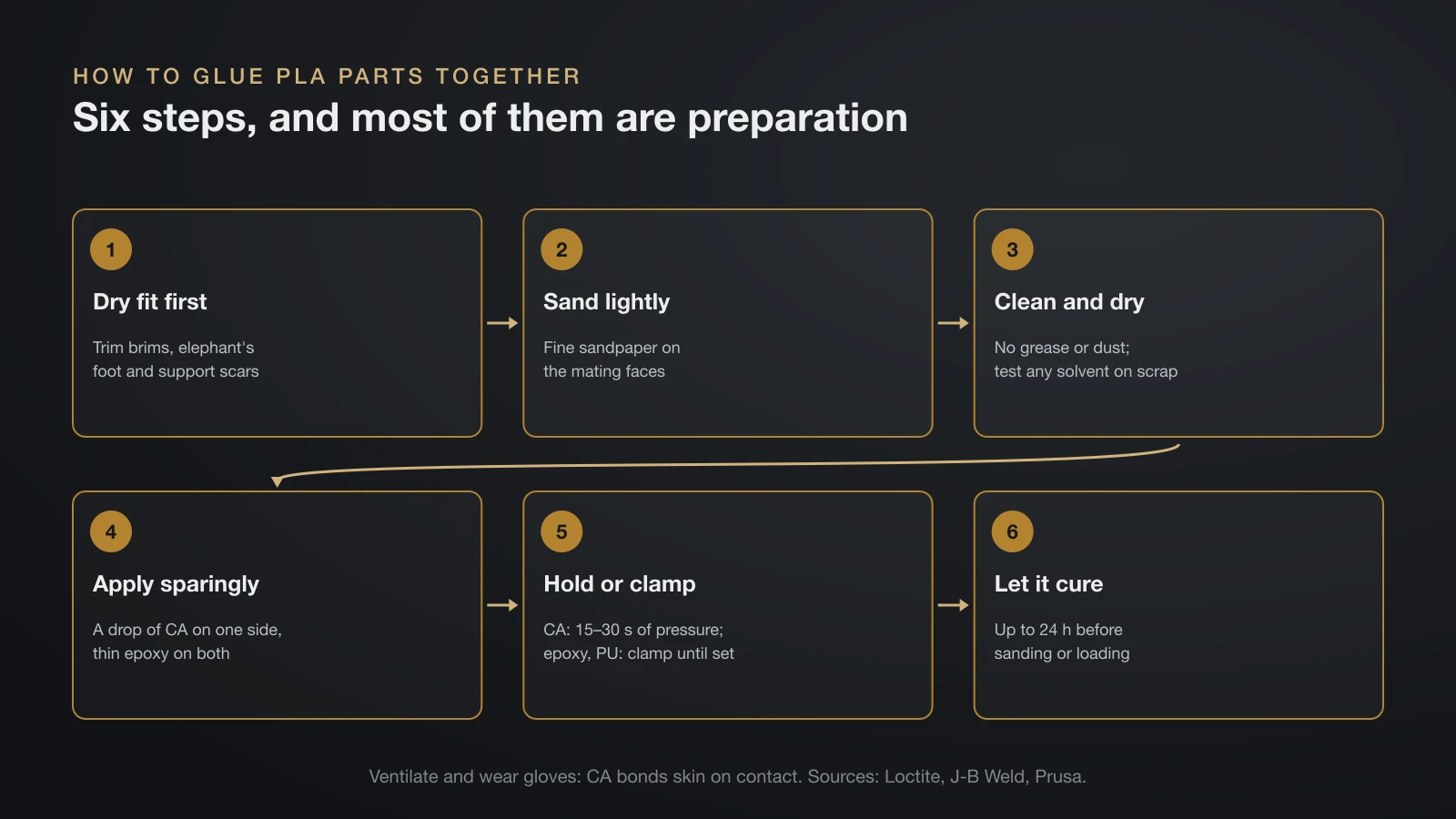
Gluing PLA parts together takes a few minutes of preparation that decide whether the joint holds. This routine combines Loctite’s, J-B Weld’s and Prusa’s instructions:
- Dry fit first. Check that the parts meet cleanly. Trim brims, elephant’s foot and support scars from the mating faces.
- Sand lightly. J-B Weld recommends roughing up surfaces with light sandpaper, and Loctite suggests fine sandpaper for PLA. Prusa notes that light sanding can improve adhesion.
- Clean and dry. Prusa says glued surfaces should be smooth and free of grease or dirt. Blow or wipe off the dust; if you degrease with a solvent, test it on scrap, since Loctite warns that acetone can mark PLA.
- Apply sparingly. A small drop of CA on one side, or a thin, even coat of epoxy on both, is enough. Excess glue weakens the joint and leaves residue.
- Hold or clamp. CA needs 15–30 seconds of pressure; epoxy and polyurethane need clamping until set. Rubber bands, painter’s tape and printed clamps work well.
- Let it cure. Wait the full cure time, up to 24 hours, before sanding, painting or loading the part.
Work in a ventilated area and wear gloves: Loctite says to do both with super glue or other adhesives, which includes mixing epoxy, and Gorilla recommends gloves because Original Gorilla Glue can be a skin sensitizer. Keep CA off your skin and away from your eyes.
Design joints that glue well
A well-designed joint matters more than the choice of glue. Prusa suggests splitting models so each part prints in its best orientation and adding pegs for alignment and strength.
- Add pegs, keys or dovetails so the parts align themselves and the glue is not the only thing carrying the load.
- Make the contact area large. Glue on two flat faces is stronger than glue along a thin edge.
- Leave room for epoxy. A small, even gap suits epoxy; a tight press fit suits CA.
- Load the glue in shear, not peel. Joints that slide past each other hold better than joints pulled apart at one edge.
Do not trust a glued printed joint in anything that carries a person’s weight or protects someone from injury.
Solvent welding and 3D pen welding PLA
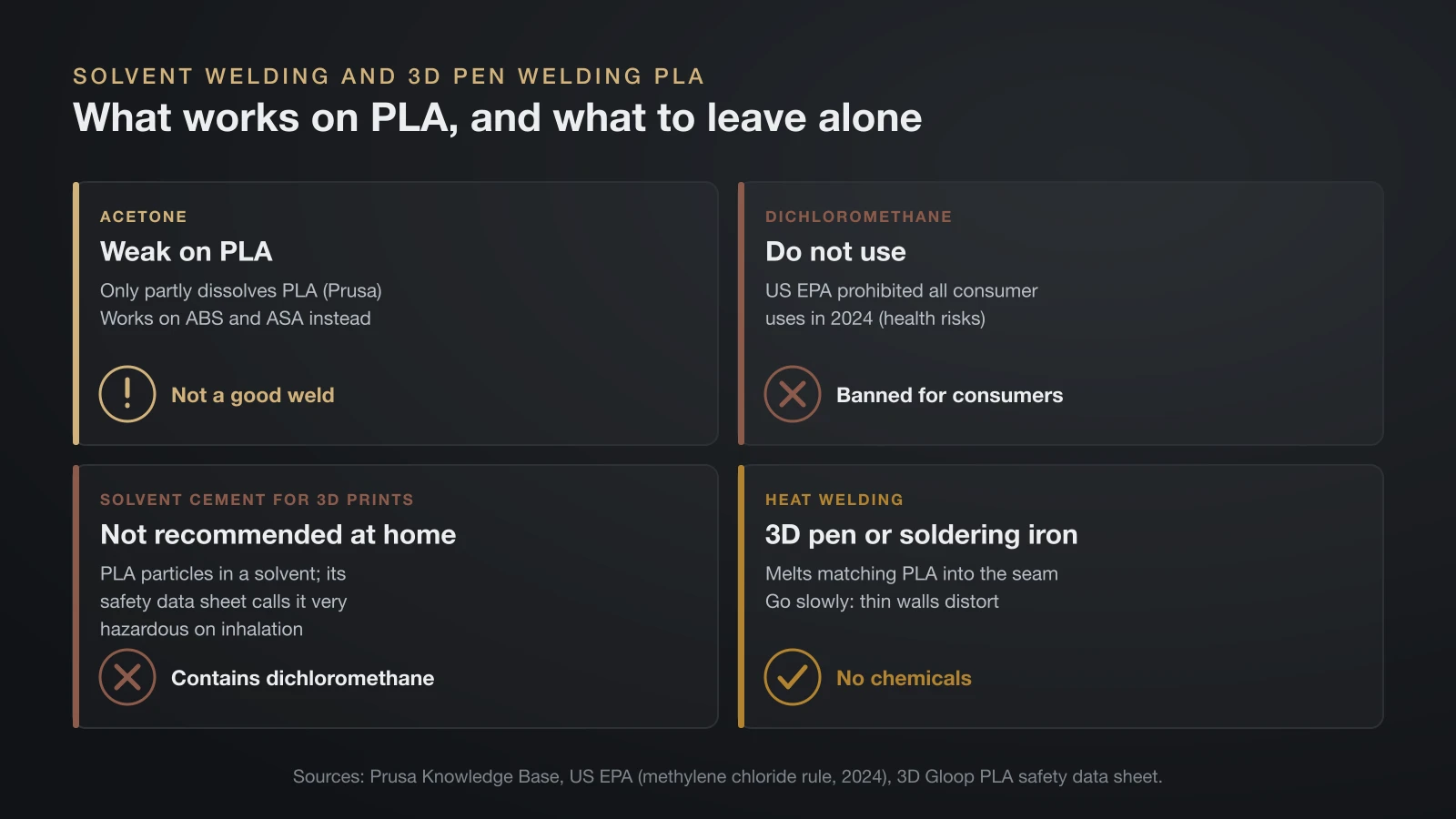
Solvent welding, the acetone trick used on ABS and ASA, does not work well on PLA. Prusa says only some PLA filaments partly dissolve in acetone, and Prusa Polymers rates PLA as very difficult to dissolve, naming chloroform and hot benzene, both hazardous chemicals.
Do not use dichloromethane (methylene chloride), even though it dissolves PLA. In 2024 the US Environmental Protection Agency (EPA) prohibited its manufacture, processing and distribution for all consumer uses after finding unreasonable risks to human health.
Ready-made solvent glues for 3D prints exist, but read the safety data sheet (SDS) first. The SDS that 3D Gloop publishes for its PLA version lists methylene chloride (dichloromethane) at 20–60% by weight, warns that it is harmful if inhaled and calls for a NIOSH-approved respirator when ventilation is inadequate; its PET and ABS sheets list methylene chloride too. For that reason this guide does not recommend solvent glues for home use: CA or epoxy does the same job.
The heat-based alternative needs no chemicals. A 3D pen or a soldering iron with a spare tip can melt matching PLA filament into a seam, which fuses the parts and fills the gap at the same time. Go slowly, because thin printed walls soften and distort quickly.
PETG glue: what bonds PETG
PETG glues with the same adhesives as PLA: super glue for tight joints and two-part epoxy for gaps and loads. Its surface is smoother and slicker than PLA, so light sanding matters even more.
Solvent welding is not an option at home. Prusa says dissolving PETG is possible only in a laboratory with dangerous chemicals, naming dichloromethane. 3D Gloop’s PET version for PETG is solvent-based too, and its SDS also lists methylene chloride. Test any glue on a scrap joint, because PETG blends vary between brands.
TPU glue: bonding flexible prints
TPU needs a glue that stays somewhat flexible, because a rigid bond cracks when the part bends. Loctite recommends its rubber-toughened Ultra Gel Control for rubber repairs and its Shoe Glue for flexible bonds, and it advises degreasing rubber with rubbing alcohol and pre-fitting the parts.
Solvents are no help: Prusa notes that flexible materials show great resistance against various solvents. Where possible, design TPU parts to clip, press or print in place instead of gluing. Our TPU filament guide covers grades and print settings.
Glue stick as a 3D printing bed adhesive
Glue stick on a build plate is a different job from gluing parts: it is a thin film that helps the first layer stick or, on some plates, stops it sticking too hard. Prusa lists glue stick, alongside PEI, glass and painter’s tape, among the print surfaces for Prusament PLA.
For PETG and TPU on smooth PEI, glue stick works the other way, as a release layer. Prusa warns that these materials can bond to smooth sheets so strongly that removing the print damages the surface, and recommends glue stick as a separator. Wash the film off regularly; our guide on how to clean a 3D printer bed shows how, and the 3D printer build plate guide lists which plates need glue.
The bottom line
The best glue for PLA is a super glue gel for small, tight joints and a two-part epoxy for gaps, breaks and loads, with polyurethane for bonding PLA to porous materials. Sand lightly, keep surfaces clean, apply sparingly and let the bond cure fully. Skip acetone and never use dichloromethane; when chemicals are not wanted, melt matching filament into the seam instead.
Sources
- Loctite (Henkel): How to glue PLA, Super Glue Gel Control, Super Glue Ultra Gel Control and Gluing rubber with super glue (PLA method, 15–30 s hold, 30–45 s set, up to 24 h and 12–24 h cure, epoxy heat warning, acetone discoloration, rubber-toughened formula, flexible bonds, unsuitable plastics, high-flexibility limit, ventilation and gloves)
- Gorilla Glue: Original Gorilla Glue and Gorilla Glue vs Super Glue (water-activated polyurethane, foams about 3x, 1–2 h clamping, 24 h cure, 10–45 s super glue set, PE and PP exclusions, gloves and skin-sensitizer note)
- J-B Weld: PlasticWeld syringe and FAQ (1:1 mix, 5 min set, 1 h cure, 3,900 PSI, surface roughening, PE and PP exclusions)
- Prusa: Knowledge Base PLA, PETG, Flexible materials and Modeling with 3D printing in mind, plus the Prusament PLA page (superglue and acetone on PLA, solubility, PLA softening, dichloromethane for PETG, solvent resistance of flex, glue stick as surface and separator, splitting, pegs and surface prep)
- Solvent safety: US EPA Risk management for methylene chloride (2024 rule prohibiting all consumer uses) and 3D Gloop product page and safety data sheets (solvent-based formula, PLA, PET and ABS versions, 10 minutes between coats, methylene chloride 20–60% in the PLA SDS, harmful if inhaled, respirator if ventilation is inadequate)