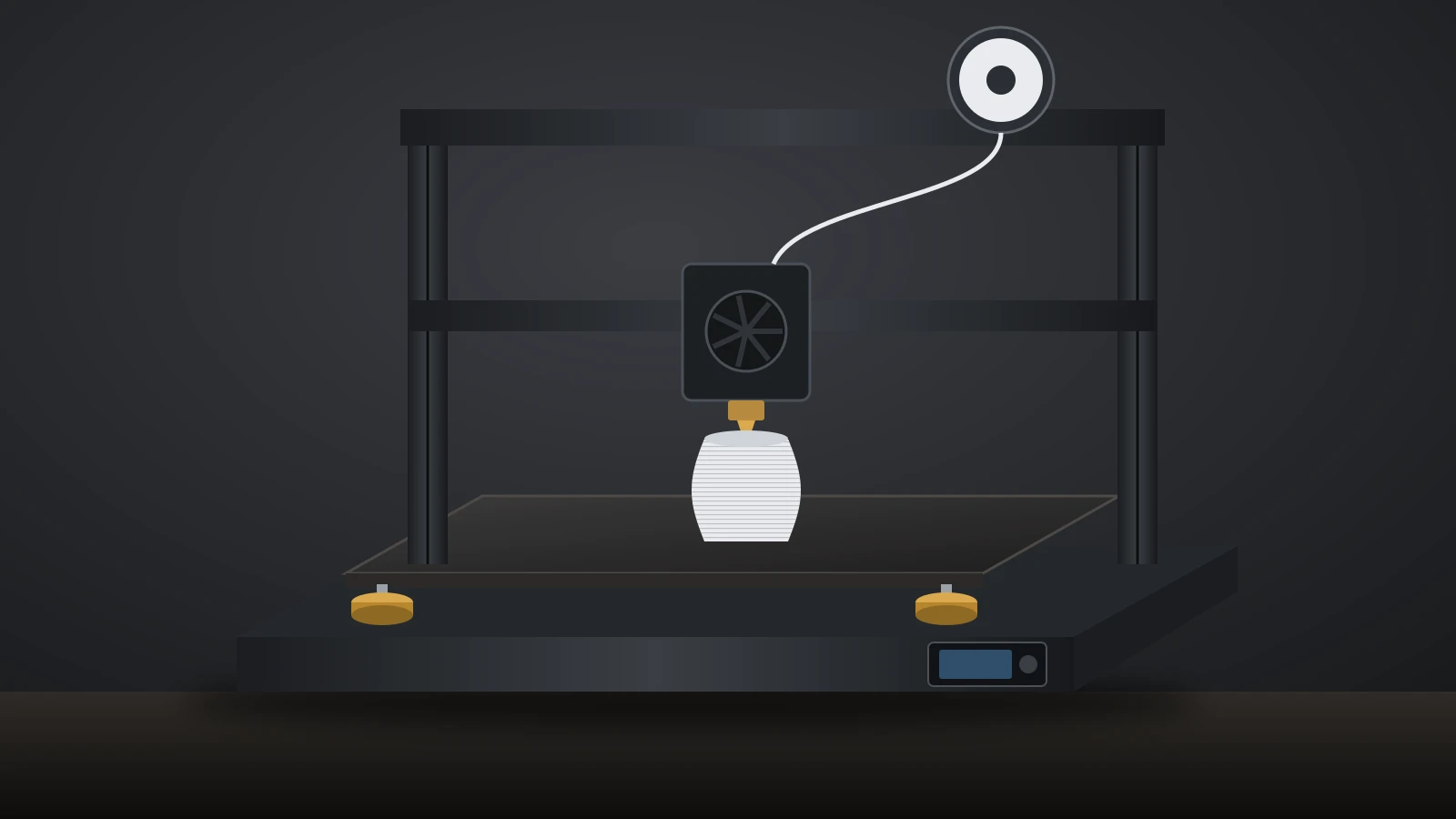

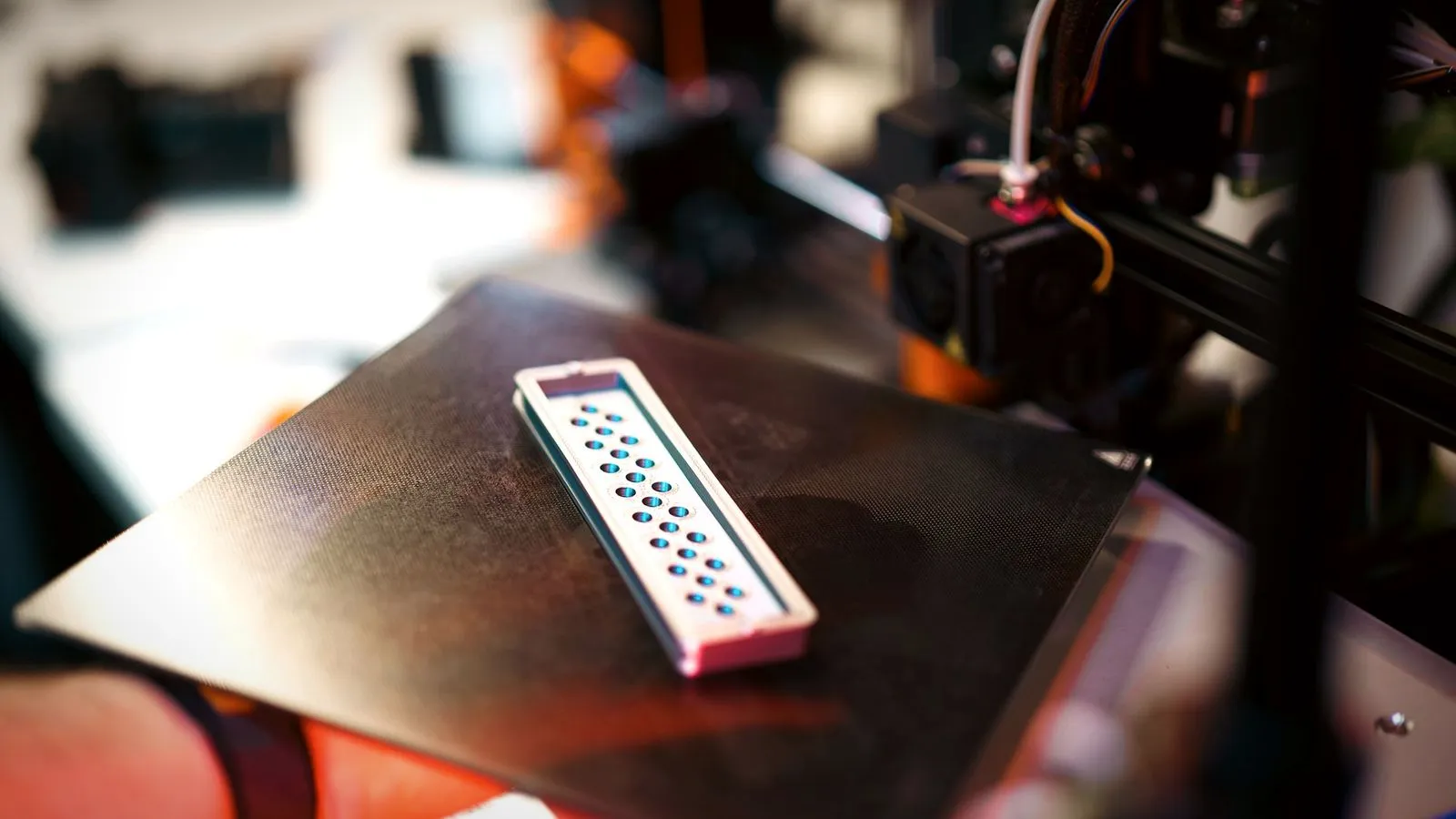
A 3D printer build plate is the removable surface a print sticks to, often a flexible spring steel sheet held on the heated bed by magnets. Textured PEI is the easiest all-rounder, smooth PEI gives a glossy bottom but can bond too strongly to PETG, and specialty plates exist for nylon, engineering plastics and low-temperature PLA printing.
Changing surfaces changes the nozzle height, so check your bed leveling and Z offset after switching to a different plate type. This guide compares the common surfaces using official guidance from Bambu Lab, Prusa, Polymaker and BuildTak.
The short answer
| Surface | Best for | Glue needed? | Watch out for |
|---|---|---|---|
| Textured PEI (powder-coated) | PLA, PETG, TPU; the standard plate on Bambu Lab printers | Glue stick for ABS, ASA, PC, nylon | Acetone damages it; no metal scrapers |
| Smooth PEI | PLA, glossy bottoms, precise fits | Yes for most materials other than PLA | PETG and TPU can tear the PEI |
| Satin / dual-texture | PLA and PETG, with a matte finish | Depends on the material | Plate-specific guidance |
| Glass | PLA, mirror-smooth bottoms | Yes for PETG, ABS and TPU | Brittle; can’t be flexed |
| G10 (garolite) | Nylon and fiber-filled filaments | Often not | Rough, matte finish |
| BuildTak-type sheet | PLA, ABS, PC | Thin glue for nylon | Large TPU prints fuse to it |
| Bambu Engineering Plate | ABS, ASA, PC, nylon | Always | Old versions not for PLA |
| Bambu Cool Plate SuperTack | PLA and PETG at low bed temperatures | No | Other materials can damage it |
What is a 3D printer build plate?
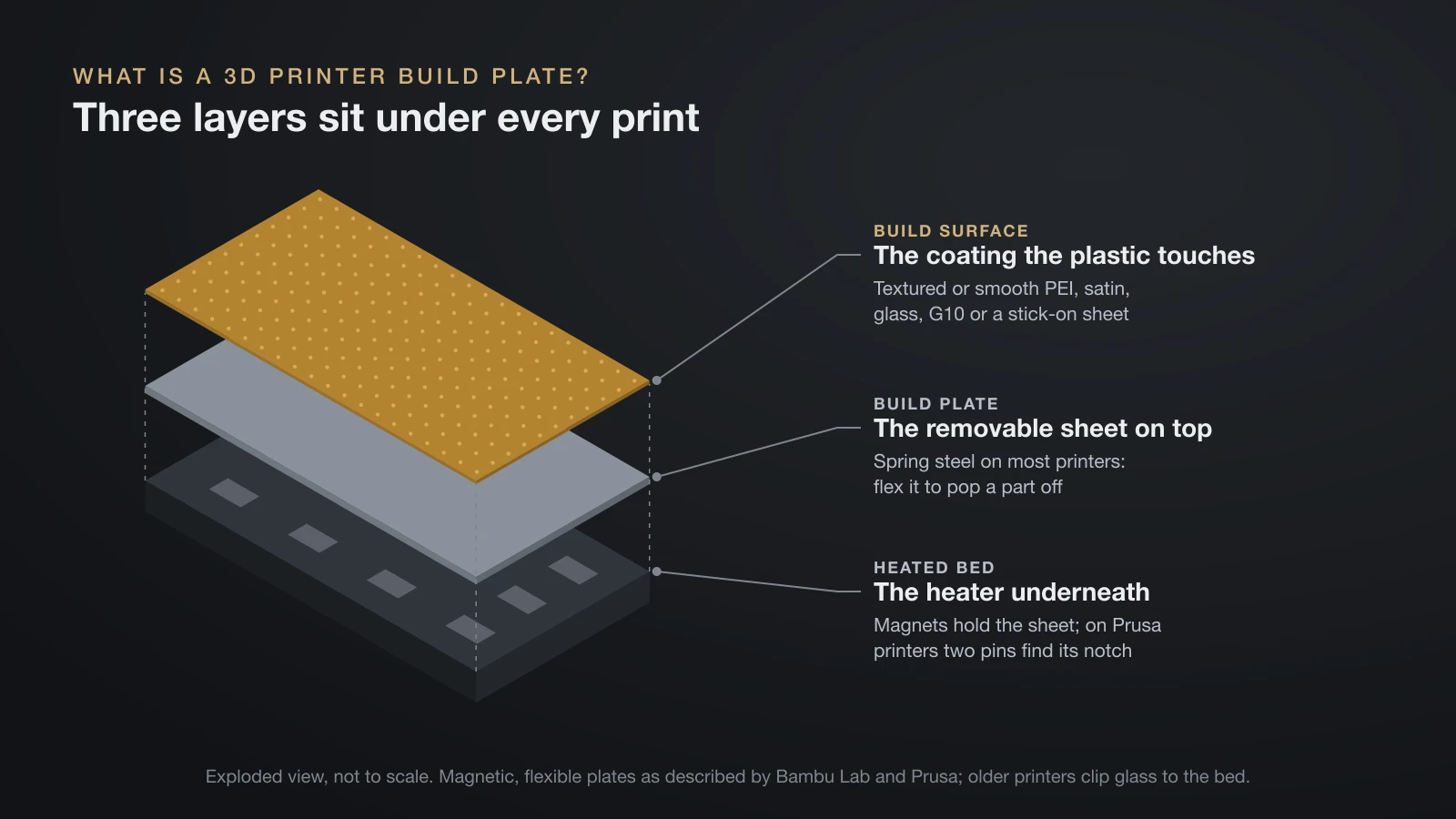
Three parts sit under your print. The heated bed is the heater underneath, the build plate is the removable sheet on top of it, and the build surface is the coating the plastic touches. People also call the whole assembly the bed or the platform.
Most current printers use a magnetic system. Bambu Lab describes its plates as magnetically secured to the heatbed and flexible, so you bend the plate to pop a finished part off. Prusa’s spring steel sheets are held by magnets glued under the heatbed, and two pins line up with a notch in the sheet so it always sits in the same place.
Older and budget printers may use a fixed surface, such as glass clipped to the bed or a sheet glued directly onto it. They print fine but make part removal slower.
Types of 3D printer build plates
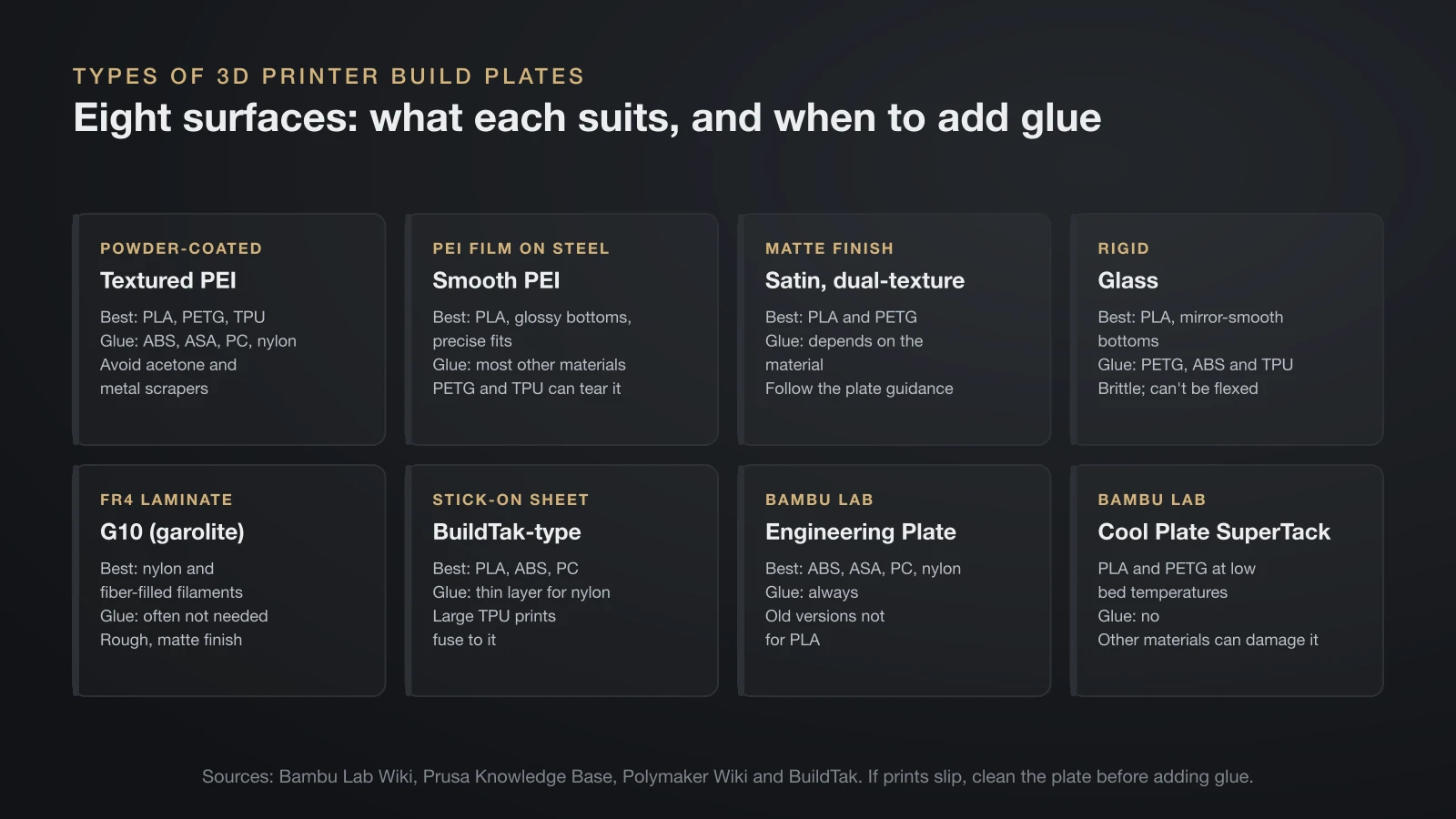
The common types of 3D printer build plate are textured PEI, smooth PEI, satin, glass, G10, BuildTak-type sheets and specialty engineering plates. They differ in which filaments stick without glue, how parts release and the finish they leave on the bottom of a print.
Textured PEI
Bambu Lab makes its standard plate by spraying PEI powder onto both sides of a stainless steel sheet. It grips most filaments without adhesive and leaves a textured finish on the bottom of the part. Prints release as the plate cools, and Bambu Lab recommends waiting until it is at 35 °C (95 °F) or lower.
Prusa calls its version the powder-coated or textured sheet and recommends it for PETG and flexible TPU. It still wants a glue stick for ASA, ABS, nylon and PC blend. Small PLA parts may need a brim, the surface isn’t scratch-resistant, and acetone permanently damages it.
Smooth PEI
A smooth PEI plate is a PEI film bonded to spring steel; Bambu Lab’s uses a heat-resistant 3M adhesive and 0.5 mm steel. It gives a smooth, matte bottom surface, and Bambu Lab recommends it for parts that need tight fits because of its Z-axis precision.
The catch is grip. Bambu Lab says only PLA prints on its smooth plate without glue; everything else needs a glue layer so the PEI doesn’t tear. Prusa lists its smooth sheet as ideal for PLA, HIPS, ABS/ASA and composites, but warns that PETG and TPU can stick so hard they damage the sheet.
Satin and dual-texture plates
Prusa’s satin sheet sits between smooth and textured: a fine, lightly textured matte coating that suits PLA and PETG and also works with ABS, ASA and PC (with a glue stick for TPU). Bambu Lab’s Dual-Texture PEI Plate simply has textured PEI on one side and smooth on the other.
Glass
Glass was an early standard. Polymaker’s wiki credits it with a smooth, mirror-like bottom finish and good thermal stability, but notes that PETG, ABS and TPU need an adhesive such as glue stick. It is brittle and rigid, so parts can’t be flexed off. Dual-surface versions, such as Creality’s carborundum glass, have a smooth side and a textured side.
G10 (garolite)
G10, also sold as FR4 or garolite, is a rigid laminate sheet. Polymaker lists it as working with PLA, PETG, TPU and nylon without adhesives, and recommends it for functional parts, nylon and carbon fiber composites. Its finish is matte and rough, so it’s not the choice for glossy bottoms.
BuildTak-type sheets
BuildTak is a textured plastic sheet with an adhesive backing that you stick onto the plate. The maker says it is designed for heated beds of 110–125 °C and works with ABS, PLA, PC and PLA blends, with a thin layer of glue stick for nylon. It isn’t compatible with large TPU prints, which tend to fuse to it, and it should be cleaned with nothing stronger than rubbing alcohol.
Engineering and specialty plates
- Bambu Engineering Plate: a corrosion-resistant coating optimized for ABS, ASA, PC and PA. Bambu Lab says to apply glue before printing any filament on it; older versions of the plate are not recommended for PLA.
- Bambu Cool Plate SuperTack: a finely textured, near-glossy plate for glue-free PLA and PETG only. Bambu Lab says other materials may damage the coating.
- Prusa specialty sheets: a PA Nylon sheet for polyamides, a PP sheet for polypropylene, and a HighTemp sheet for PEEK, PEKK, PEI and PPSU, on which PLA and PETG adhere poorly (see our guide to PEEK filament).
Which 3D printer build plate for which filament?
Bambu Lab publishes bed temperatures for each of its plates, and Prusa states which sheet suits each material. This table combines both.
| Filament | Bed temperature on Bambu PEI plates | Bambu Lab plate notes | Prusa sheet |
|---|---|---|---|
| PLA | 45–65 °C (35–45 °C on the Cool Plate) | Any plate; glue on the Engineering Plate | Smooth or satin; textured with a brim for small parts |
| PETG | 60–80 °C | Textured PEI or SuperTack; glue on smooth PEI | Textured or satin; glue stick on smooth |
| TPU | 35–45 °C | Textured PEI; glue on smooth PEI; not the Cool Plate | Textured |
| ABS, ASA | 90–100 °C | Glue stick may be needed on textured PEI | Smooth or textured, with glue stick |
| PC | 100–120 °C | Engineering Plate or PEI, with glue stick | Satin (glue stick if you print PC often) or textured with glue stick |
| Nylon (PA) | 100–120 °C | Engineering Plate or PEI, with glue stick | PA Nylon sheet |
On the SuperTack, Bambu Lab says PLA holds firmly at a 40 °C (104 °F) bed, and PETG needs only 55–60 °C on the second-generation plate. For full per-material settings, see our guides to PLA temperature and PETG temperature.
Glue stick: adhesive or release agent?
On modern plates, glue often works as a release layer, not only as an adhesive. Bambu Lab recommends glue stick or liquid glue because it improves adhesion, makes prints easier to remove and protects the plate surface. Prusa describes it the same way: a thin separation layer for PETG, ASA, ABS and PC blend on smooth PEI.
Two cautions from Bambu Lab: parts that bond too tightly can make the sheet bubble or crack, and third-party glues are strongly discouraged on its plates. If prints keep slipping off instead, clean the plate and check the first layer before reaching for more glue.
Heat limits and bed temperatures
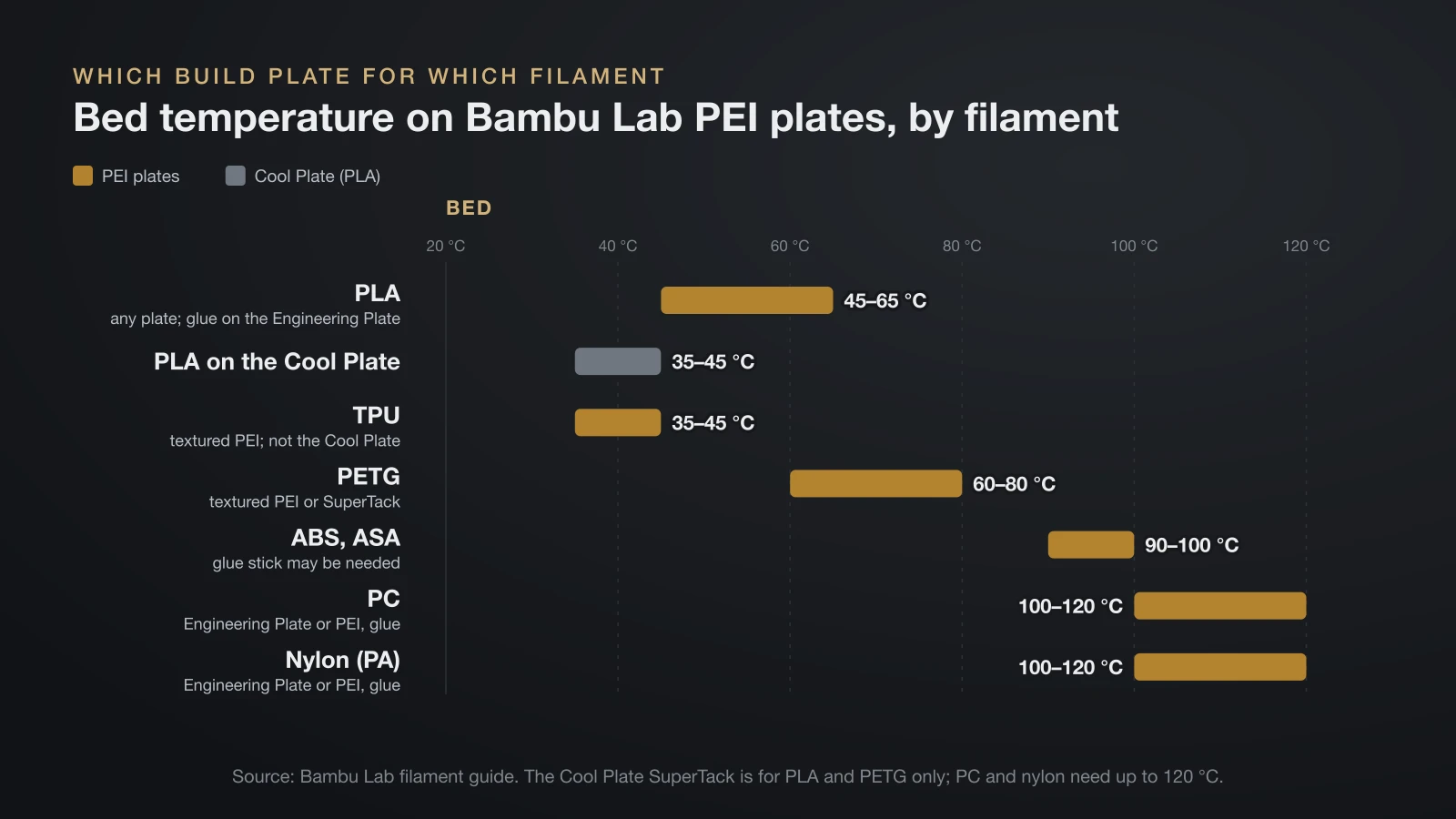
Every build surface has a maximum bed temperature, and that limit decides which filaments it can print. Bambu Lab’s filament guide runs its PEI and Engineering plates at up to 120 °C (248 °F) for PC and nylon. BuildTak is designed for beds of 110–125 °C. The Cool Plate SuperTack is limited to PLA and PETG.
Low bed temperatures have a side benefit in enclosed printers. For filaments that soften below 60 °C, such as PLA, Bambu Lab recommends opening the door or removing the top cover when the bed is set above 45 °C, so the chamber doesn’t soften filament in the extruder. More in our guide to enclosed 3D printers.
Buying a build plate: sizes and compatibility
Before you buy a spare or replacement plate, check four things: the size, the magnet and alignment-pin system, the highest bed temperature you run and, on Bambu Lab printers, the plate generation. Plates are sized to each printer, so buy the one made for your model. Bambu Lab’s current sizes:
| Plate size | Bambu Lab printers |
|---|---|
| 350 × 320 mm | H2D, H2S |
| 330 × 320 mm | H2C, A2L |
| 256 × 256 mm | X2D, P2S, P1 series, X1 series, A1 |
| 180 × 180 mm | A1 mini |
Generation matters too. Bambu Lab’s second-generation 256 mm plates carry an updated code that the P2S and X2D use for automatic plate detection; first-generation plates still fit but aren’t recognized. A larger plate only helps if the printer’s motion reaches it, so compare build volumes, not plate sizes, when shopping.
Care and when to replace a build plate
Handle plates by the edges, because skin oils reduce adhesion. Bambu Lab cleans with dish soap and hot water and forbids acetone on its plates; Prusa uses about 90% isopropyl alcohol on a cold sheet and allows acetone only on smooth PEI, one or two times a month. Our list of 3D printer accessories covers the cleaning supplies.
Signs a plate is worn out:
- Grip is gone after a proper clean. Prusa treats its sheets as consumables whose coatings diminish over time.
- Smooth PEI has polished itself. Prusa says this can happen after 1–2 years and that light sanding with 600–1000 grit paper brings fresh PEI to the surface.
- Deep gouges or peeling coating. Bambu Lab says minor scratches on its SuperTack plate don’t significantly affect adhesion, but a coating that is gouged through or peeling no longer grips evenly.
- Small bubbles under smooth PEI are not a reason to replace it. Prusa says they rarely affect prints and usually disappear within days or weeks.
For scale, Bambu Lab rates its SuperTack plate at less than 20% adhesion loss after 300 prints, measured with its PLA Basic on an A1.
The bottom line
Start with textured PEI on a flexible steel plate: it handles PLA, PETG and TPU without glue and releases parts once cool. Add smooth PEI for glossy or precise bottoms, use glue as a release layer for PETG on smooth PEI and for ABS, ASA, PC and nylon, and move to G10, a nylon sheet or an engineering plate only for the materials that need them. Recheck the Z offset every time you change surface type.
Sources
- Bambu Lab Wiki: Introduction to Bambu Lab build plates (plate types, construction, glue rules, 35 °C release, 0.5 mm steel, SuperTack temperatures and 300-print test, plate sizes and generations) and Filament guide (bed temperatures per plate and filament, glue, cleaning, chamber advice)
- Prusa Knowledge Base: Flexible steel sheets (sheet types, magnets and pins, consumables), Smooth steel sheet (materials, separation layer, 90% IPA, acetone, 1–2 years, 600–1000 grit, bubbles), Textured steel sheet and Satin steel sheet
- Polymaker Wiki: Build plates (glass, G10 and material recommendations)
- BuildTak: FAQ (construction, 110–125 °C beds, compatible materials, TPU, cleaning)