
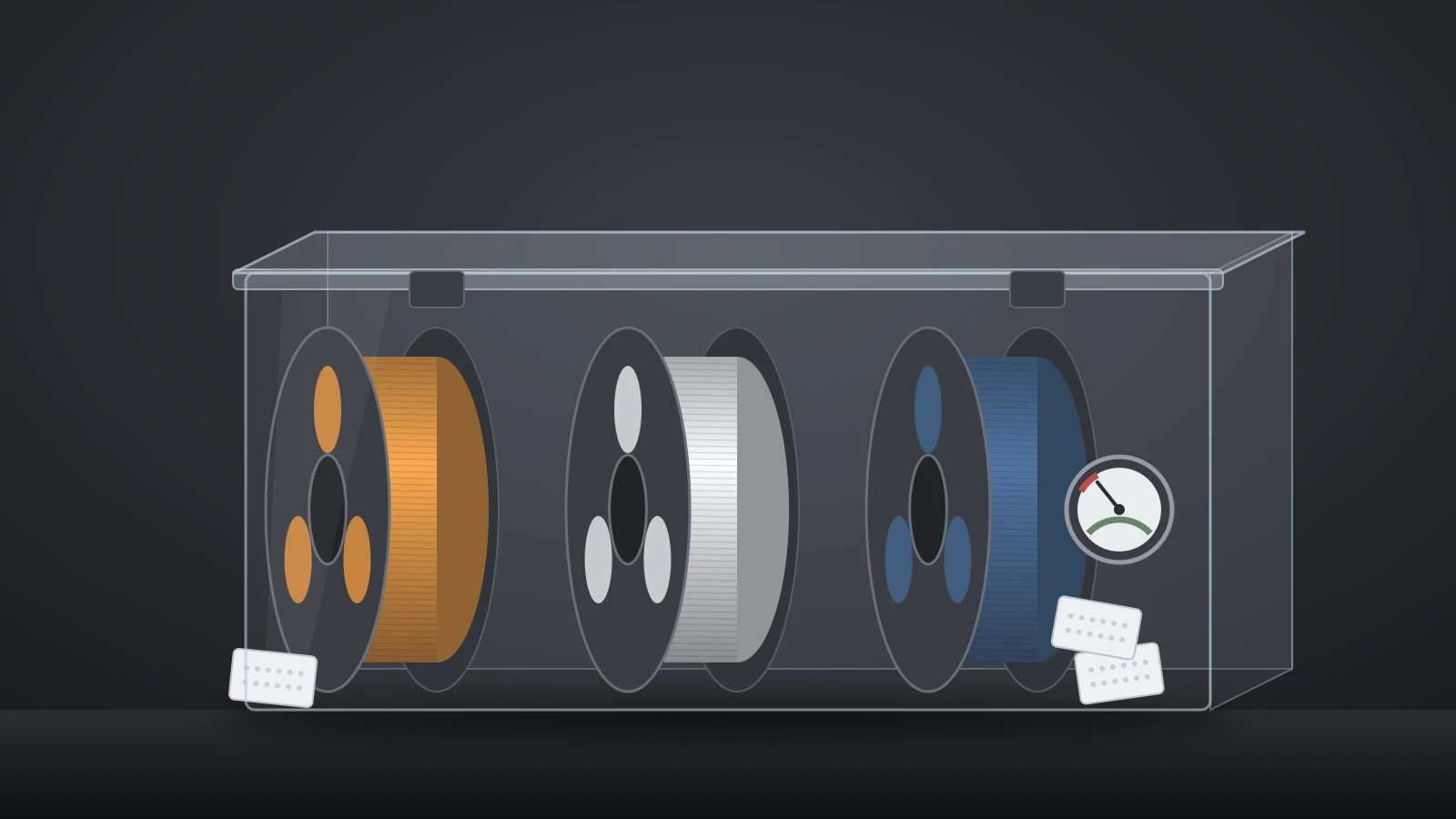
Good filament storage means keeping spools sealed, dark and dry: an airtight box or vacuum bag with fresh silica gel desiccant, ideally below 20% relative humidity (RH) for most materials, and a hygrometer to prove it. PLA tolerates more humidity than PETG, TPU or nylon, which need dry storage and often drying before you print.
Moisture is the enemy because it turns to steam in the hot nozzle. This guide gives humidity targets per material from Prusa and Bambu Lab, compares boxes, bags and dry boxes, and covers desiccant, racks and safe drying. For the material itself, see our PLA filament guide; for the most water-hungry plastic, see nylon filament.
The short answer
| Material | Keep below (Prusa) | Desiccant while printing (Bambu Lab) | Drying, forced-air oven (Bambu Lab) |
|---|---|---|---|
| PLA | 30% RH (40% short term) | Recommended | 50 °C (122 °F), 8 h |
| PETG | 20% RH | Recommended | 60–65 °C, 8 h |
| ABS / ASA | 30% RH (ideally 15% / 10%) | Recommended | 75–85 °C, 8 h |
| TPU | 20% RH (ideally 15%) | Required | 70 °C, 8 h |
| PC | 20% RH | Required | 75–85 °C, 8 h |
| Nylon and nylon CF | Below 20% RH (Polymaker) | Required | 75–85 °C, 8–12 h |
| PVA support | 20% RH | Required | 75–85 °C, 8–12 h |
Store spools out of direct sunlight, away from heat sources, and at a stable room temperature; UltiMaker gives -20 to +30 °C (-4 to 86 °F) as the storage range for most of its filaments.
Why filament storage matters
Filament storage matters because most 3D printing plastics absorb water from the air, and that water ruins prints. Bambu Lab explains that moisture vaporizes in the hot nozzle, so the molten plastic expands and extrudes erratically, causing bubbles, stringing, oozing, holes, rough surfaces and weaker parts.
It happens faster than most people expect:
- Typical rooms are humid. Bambu Lab puts indoor air at about 45–65% RH, and higher in humid weather.
- Fresh-dried filament gets damp quickly. At around 55% RH, Bambu Lab says dried filament usually absorbs enough water to affect quality within 2–12 hours, depending on the material.
- Dry storage buys days. At 20% RH, most filaments stay dry for roughly 2–7 days, and lower humidity lasts longer.
- Some materials are worse. UltiMaker notes that nylon, TPU and PETG can absorb moisture within 24 hours of exposure.
Prusa adds poor layer adhesion, blobs and “bubbling and smoke during extrusion” to the list of symptoms, and Polymaker points to popping or cracking noises from the nozzle as a sign of wet filament.
How dry should filament be? Humidity by material
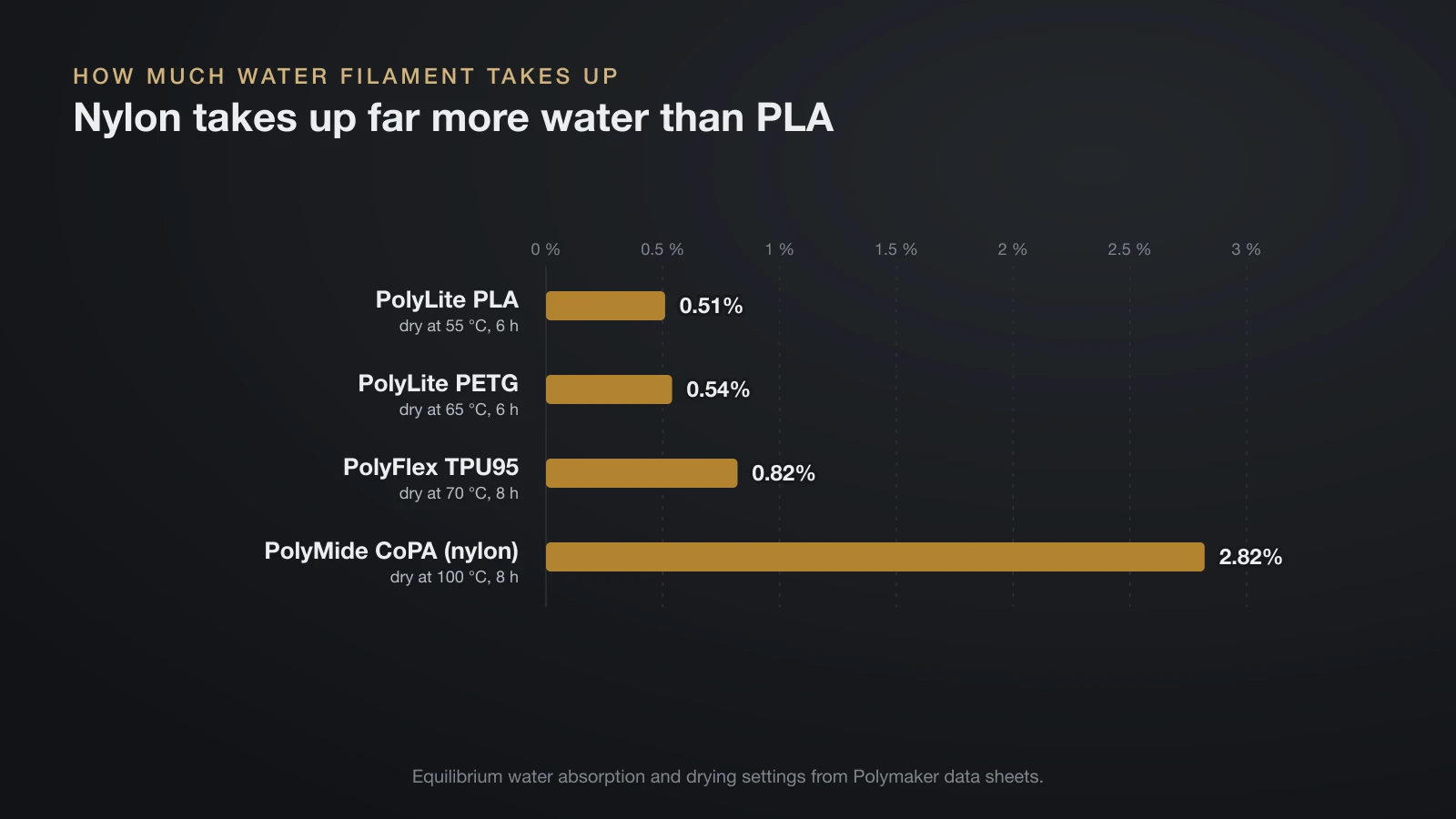
Most filaments should be stored below 20–30% relative humidity, and the more a plastic absorbs, the drier it needs to be. The equilibrium values below show how much water each plastic takes up when it is left long enough in humid air, from Polymaker’s data sheets.
| Polymaker data sheet | Equilibrium water absorption | Polymaker drying setting |
|---|---|---|
| PolyLite PLA | 0.51% | 55 °C, 6 h |
| PolyLite PETG | 0.54% | 65 °C, 6 h |
| PolyFlex TPU95 | 0.82% | 70 °C, 8 h |
| PolyMide CoPA (nylon) | 2.82% | 100 °C, 8 h |
PLA is the forgiving one. Bambu Lab’s PLA guide says standard PLA can sit at 50–60% room humidity and needs drying less often than PETG or nylon, and Polymaker calls PLA far less susceptible to being too wet. Even so, Bambu Lab’s PLA data sheet specifies printing and storage below 20% RH, sealed with desiccant.
Flexible and engineering plastics need stricter storage. Our guides to TPU filament and PCTG filament list each maker’s drying advice, and PCTG makers even disagree on how hygroscopic it is, so storing it dry is the safe default.
3D printer filament storage options compared
The best 3D printer filament storage is any sealed container that holds humidity low and lets you check it. The options differ in cost, capacity and whether you can print straight from them.
| Option | Best for | Limits |
|---|---|---|
| Factory vacuum bag, resealed | Unopened and rarely used spools | Fiddly to reseal; no humidity reading |
| Vacuum storage bag with desiccant | Long-term storage of any spool | Needs a pump; one spool per bag |
| Airtight bin with gasket and desiccant | Several spools in one box | Opening it lets room air in |
| Dry box with a filament outlet | The spools you print every day | Holds one to a few spools; does not dry filament |
| Multi-spool feeder with desiccant | Multi-material printing | Only as dry as its desiccant |
Polymaker calls vacuum-sealed storage with desiccant the minimum requirement, and UltiMaker recommends vacuum-sealed bags for rarely used filaments. Prusa’s general advice is a closed box with desiccant, and if space is short, priority for the most hygroscopic materials such as nylon, polypropylene, PVA and BVOH.
A simple filament storage box
A DIY filament storage box is the cheapest way to store several open spools. Use a rigid plastic bin with a rubber gasket in the lid, add loose or bagged silica gel, and tape a small digital hygrometer to the inside wall where you can read it without opening the lid. Keep one box for forgiving plastics like PLA and a separate, drier one for TPU, nylon or PC.
Desiccant and hygrometers: keeping the box dry
Desiccant does the actual drying inside a sealed box, and a hygrometer tells you when it has stopped working. Silica gel is the usual choice; Bambu Lab now ships silica gel in its feeders and has dropped calcium chloride, because calcium chloride can liquefy as it absorbs water and corrode electronics.
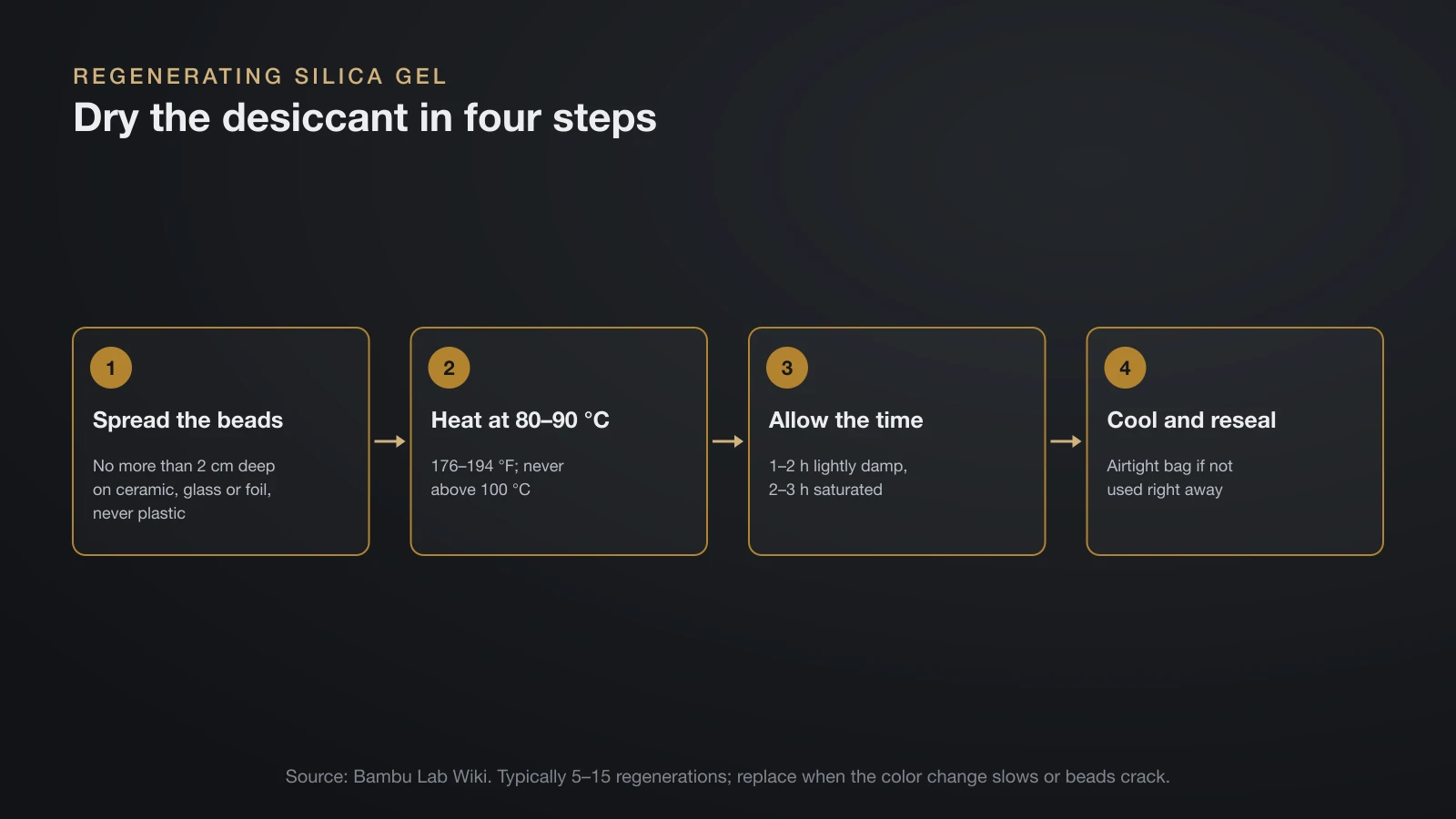
Indicating silica gel changes color as it fills with water. When it is spent, it can be regenerated. Bambu Lab’s routine:
- Spread the beads no more than 2 cm deep on a ceramic, glass or foil tray, never plastic.
- Heat at 80–90 °C (176–194 °F), never above 100 °C, which damages the gel.
- Allow 1–2 hours for lightly damp beads and 2–3 hours for saturated ones.
- Cool and reseal them in an airtight bag if you are not using them right away.
Bambu Lab says silica gel can typically be regenerated 5–15 times; replace it when the color change gets slow or the beads crack. Use a dedicated tray rather than kitchen cookware.
A hygrometer turns guesswork into a number. Even a good one has a tolerance: Prusa lists ±3% RH accuracy for the hygrometer in its own dry box, so read trends rather than single digits. Prusa says to replace or regenerate the desiccant once the reading rises above the limit for the material inside.
Printing directly from a dry box
Printing from a dry box keeps the spool sealed while the printer pulls filament out through an outlet. Prusa’s USS Drybox, for example, holds the spool over silica gel during printing and includes a digital hygrometer.
Two limits apply. First, Prusa states plainly that the drybox does not dry filament: a damp spool must be dried before it goes in. Second, Bambu Lab notes that freshly dried filament should go straight into a sealed container or feeder with effective desiccant and be used soon, because it starts absorbing water again.
Multi-spool feeders work the same way and add automatic material changes; our guide to multi color 3D printers explains how they work. Some newer feeders can also heat and dry filament, but Bambu Lab warns that low-softening plastics such as PLA, TPU and PVA can deform if dried while the spool is held still.
Filament spool holders and racks
A filament spool holder or rack keeps spools organized and turning freely, but an open holder does nothing against humidity. UltiMaker suggests vertical spool holders or wall-mounted racks for open shelf storage, which suits PLA in a dry room and the spools of the project you are printing this week.
Things to check before you choose a 3D printer filament holder:
- Free rotation: a spool that does not turn freely starves the nozzle, one of the first causes our under-extrusion guide checks.
- Spool fit: hub diameter and spool width vary between brands and between plastic and cardboard spools.
- Sun and heat: keep racks away from windows and radiators, as both Bambu Lab and UltiMaker advise.
- Location: shelves or drawers under the printer save space; our guide to choosing a 3D printer table covers storage underneath.
A 3D printed filament holder is a popular first project and works well for PLA spools in daily use. For moisture-sensitive spools, mount the holder inside a sealed box instead of on the wall. Other useful add-ons are listed in our 3D printer accessories guide.
Damp spool? Dry it before you store it
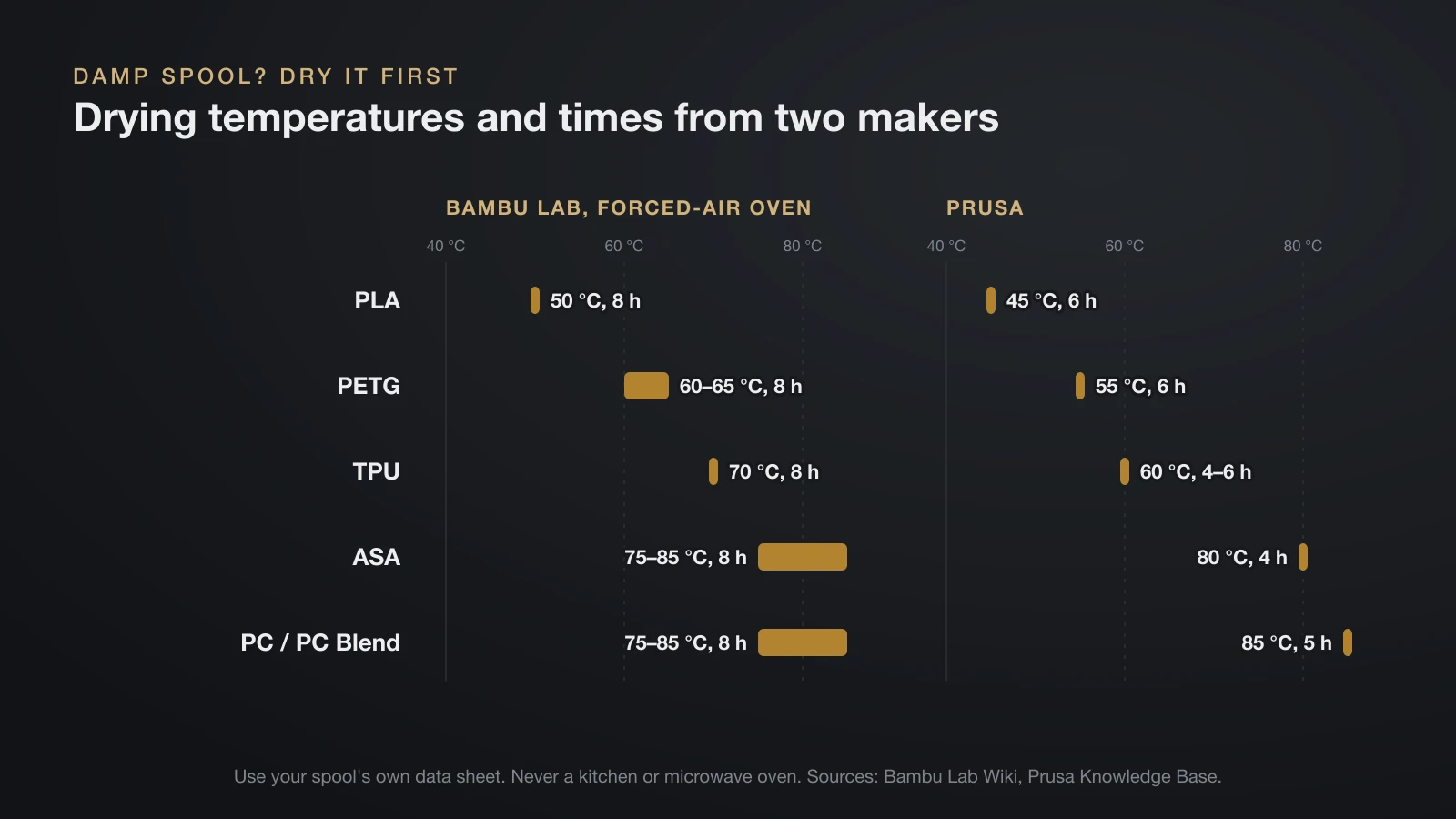
A damp spool should be dried, in a filament dryer or forced-air oven, before it goes back into storage, because a sealed box only holds the moisture level the filament already has. Use the temperature from your spool’s own data sheet; the two makers below show the range.
| Material | Bambu Lab, forced-air oven | Prusa |
|---|---|---|
| PLA | 50 °C, 8 h | 45 °C, 6 h |
| PETG | 60–65 °C, 8 h | 55 °C, 6 h |
| TPU | 70 °C, 8 h | 60 °C, 4–6 h |
| ASA | 75–85 °C, 8 h | 80 °C, 4 h |
| PC / PC Blend | 75–85 °C, 8 h | 85 °C, 5 h |
Safety and spool limits matter here:
- No kitchen or microwave oven. Bambu Lab says microwaves heat unevenly and kitchen ovens have hot spots near the elements that can damage spool and filament; Prusa adds that home ovens do not measure temperature precisely.
- Check the spool. Bambu Lab warns that some third-party spools are not heat resistant enough, and Prusa says its older black Prusament spools are safe only up to 45 °C.
- Do not overdo PC. Bambu Lab notes that repeated heating and cooling can make PC filament brittle, so keep it sealed after one drying.
Long-term filament storage and shelf life
Long-term filament storage is mostly a matter of keeping spools sealed until you need them. UltiMaker gives its own moisture-sensitive filaments, such as PVA, nylon and TPU 95A, a recommended shelf life of one year under proper storage, and more chemically inert ones like PP and PC up to two years.
Nylon shows why sealing matters. Bambu Lab says nylon-based filaments left in open air for about 3 months absorb so much water that a normal 80–90 °C oven struggles to dry them, so unused nylon must stay sealed with desiccant. Label each bag with the material and the date you opened it.
Filament storage mistakes to avoid
Most filament storage problems come from a few habits that are easy to fix:
- Leaving the spool on the printer for weeks between prints.
- Trusting a box without a hygrometer, or with desiccant that has been spent for months.
- Storing different materials together when one needs much drier air than the rest.
- Putting a damp spool into a dry box and expecting it to recover.
- Storing near windows, heaters or the printer’s exhaust, where sun and heat age the plastic.
- Losing the loose end. Clip or tuck it into the spool holes so the winding does not tangle.
The bottom line
Store filament sealed, dark and dry: airtight boxes or vacuum bags with fresh silica gel, a hygrometer, and below about 20–30% RH depending on the material. PLA forgives a humid room for a while, but PETG, TPU, nylon, PC and PVA do not. Dry damp spools before storing them, regenerate desiccant when it changes color, and print moisture-sensitive spools straight from a dry box.
Sources
- Bambu Lab: Wiki Filament drying recommendations and PLA usage guide, and the PLA Basic technical data sheet (moisture symptoms, indoor humidity, 2–12 hours and 2–7 days, drying table, desiccant requirements, silica gel regeneration, calcium chloride, spool and oven warnings, PC brittleness, nylon after 3 months, PLA at 50–60% RH, below 20% RH storage)
- Prusa Knowledge Base: Drying filament and Prusa USS Drybox (symptoms, storage priorities, drying temperatures and times, oven and spool limits, maximum humidity per material, hygrometer accuracy, drybox does not dry filament)
- Polymaker: Good practices and technical data sheets for PolyLite PLA, PolyLite PETG, PolyFlex TPU95 and PolyMide CoPA (vacuum sealing with desiccant, popping noises, equilibrium water absorption, drying settings, nylon below 20% RH)
- UltiMaker: 3D printer filament storage tips (storage temperature range, below 20% RH, absorption within 24 hours, shelf life, sunlight, vacuum bags, spool holders and racks)