

PCTG filament is a glycol-modified copolyester, a close relative of PETG that uses more of the glycol CHDM in its recipe. On manufacturer data sheets it is far tougher than PETG in notched impact tests, but slightly less stiff and only a few degrees more heat resistant. It prints like PETG, just hotter, at about 250–270 °C (482–518 °F).
That toughness makes PCTG a good fit for parts that get dropped, bent or clipped on and off. For gears and sliding parts, nylon filament is the better choice; for heat and sunlight, ASA filament is. This guide explains the chemistry in plain words, then compares PCTG and PETG from the same manufacturers’ data sheets.
The short answer
| PCTG filament | |
|---|---|
| What it is | A glycol-modified copolyester, PETG’s CHDM-rich cousin |
| Vs PETG | Much higher notched impact strength and elongation, slightly higher heat deflection, lower stiffness and yield strength |
| Notched impact (ISO 180) | 92 kJ/m² vs 5 kJ/m² for PETG (Fiberlogy) |
| Heat deflection, 0.45 MPa | 76 °C vs 68 °C for PETG (Fiberlogy) |
| Nozzle temperature | 250–270 °C (Fiberlogy), 230–270 °C (Extrudr) |
| Bed temperature | 90–110 °C (Fiberlogy data sheet, Extrudr) |
| Build surface | Textured PEI; smooth PEI or glass only with an adhesive layer |
| Part cooling | 0–25% (Fiberlogy), 20–50% (Extrudr) |
| Enclosure | Not required; Extrudr suggests one for larger parts |
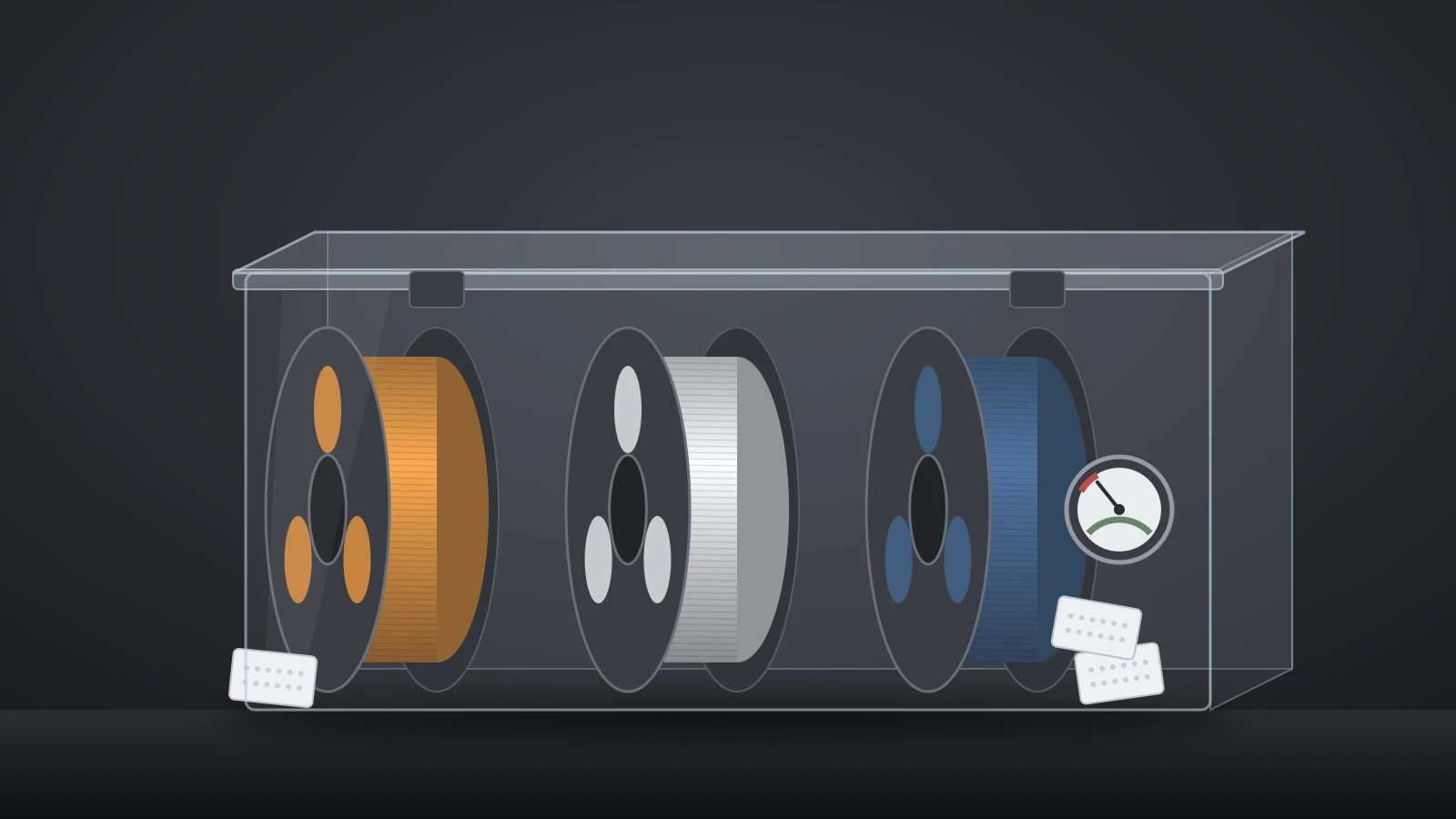
| Drying | 60 °C for 4 h (Fiberlogy), 65 °C for 4–6 h (Spectrum) |
| Choose it for | Parts that get dropped, hit or flexed; clear covers |
| Skip it for | Stiff brackets, hot or sunny spots, food containers |
What is PCTG filament?
PETG and PCTG are both copolyesters: PET-type plastics made from terephthalic acid and a mix of two glycols, ethylene glycol (EG) and cyclohexanedimethanol (CHDM). The letters hint at which glycol dominates: PETG is PET modified with some CHDM, while in PCTG, CHDM is the main glycol.
Resin maker Eastman Chemical gives real examples in its U.S. Patent 5,989,663 (1999). It describes its PETG 6763 as 31 mol% CHDM and 69 mol% EG, and its PCTG 5445 as 65 mol% CHDM and 35 mol% EG. Same building blocks, reversed proportions.
Prusa explains that the glycol modification makes PET less brittle, easier to print and more transparent. PCTG shifts the recipe further toward CHDM, and the data sheets below show the result: much higher impact toughness, a little less stiffness.
Different filament brands may use different PCTG resins, so compare values within one brand’s data sheets rather than across brands.
PCTG vs PETG: data sheet comparison
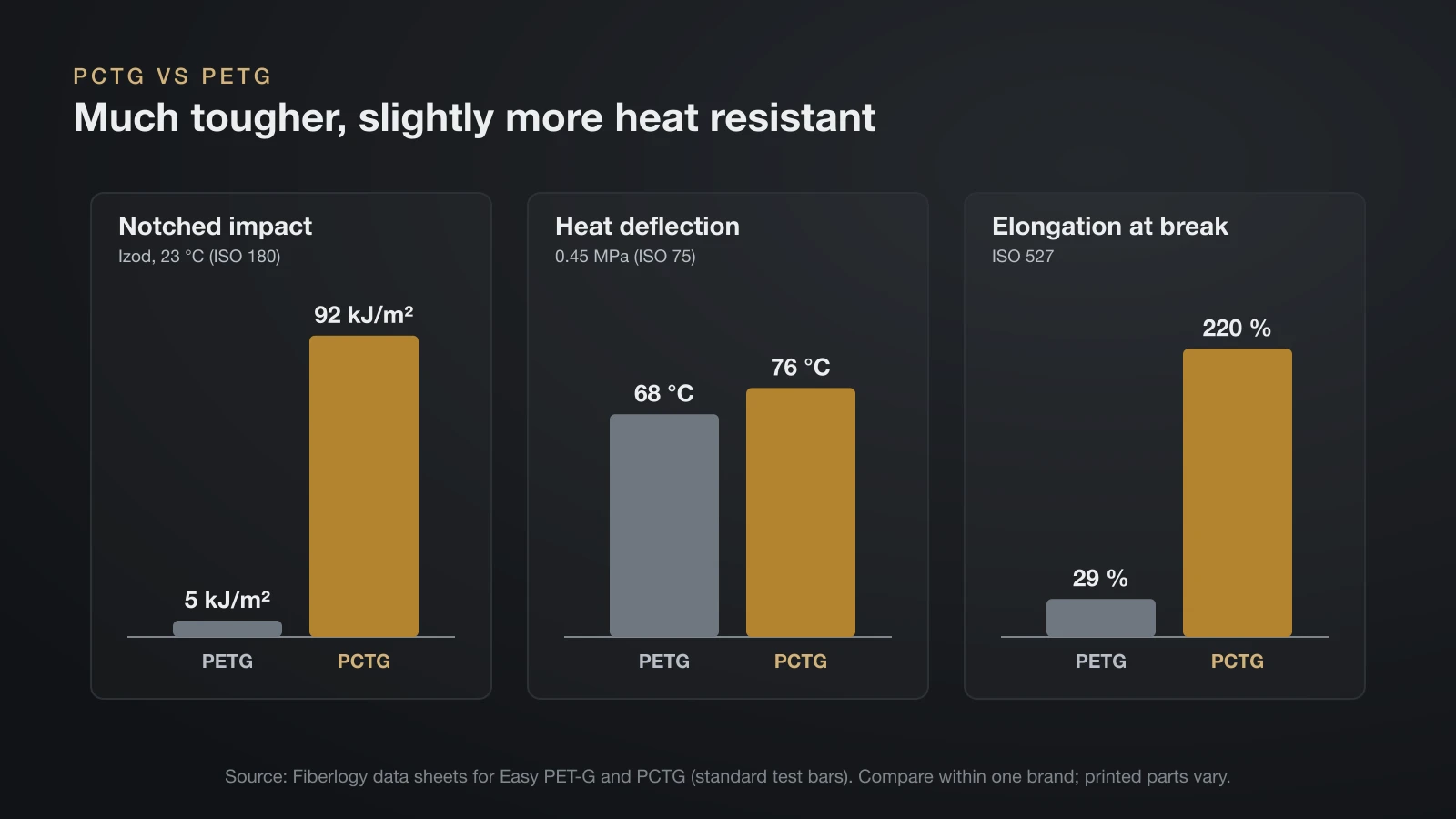
Fiberlogy publishes both materials with the same ISO test methods, so this table compares like with like:
| Fiberlogy data | Easy PET-G | PCTG |
|---|---|---|
| Notched Izod impact, 23 °C (ISO 180) | 5 kJ/m² | 92 kJ/m² |
| Heat deflection, 0.45 MPa (ISO 75) | 68 °C | 76 °C |
| Heat deflection, 1.8 MPa (ISO 75) | 62 °C | 64 °C |
| Tensile strength at yield (ISO 527) | 51 MPa | 43 MPa |
| Elongation at break (ISO 527) | 29% | 220% |
| Flexural modulus (ISO 178) | 2,000 MPa | 1,600 MPa |
| Density | 1.29 g/cm³ | 1.23 g/cm³ |
| Nozzle temperature | 220–250 °C | 250–270 °C |
| Drying | 60 °C for 4 h | 60 °C for 4 h |
Extrudr’s data sheets show the same pattern. Its PCTG reaches 94 kJ/m² notched impact (ISO 180) against 4.7 kJ/m² for its PETG, stretches 215% before breaking against 28%, and has a lower flexural modulus, 1,650 vs 2,100 MPa.
What the numbers mean in practice:
- Tougher, not stronger. PCTG soaks up far more energy before a crack runs through it and stretches much further before it breaks. It yields at a lower stress (43 vs 51 MPa) and bends more easily.
- Heat is only slightly better. At 0.45 MPa, PCTG deflects at 76 °C (169 °F) versus 68 °C (154 °F) for PETG; at 1.8 MPa the gap is 2 °C. Prusament PETG also lists 68 °C at 0.45 MPa.
- Clarity is a claim, not a number. Spectrum markets its PCTG as more transparent than standard PETG in clear colors, and Fiberlogy highlights high optical transparency, but neither publishes haze figures.
- Chemical resistance is similar on paper. Fiberlogy and Extrudr list high chemical resistance for PCTG, and Extrudr says the same of its PETG.
One caveat: these are values for standard test bars. Fiberlogy notes its figures come from reference materials and supplier test data, so they compare the plastics rather than predict a printed part, where layer bonding and print orientation also matter.
PCTG filament print settings
Three manufacturers, three slightly different starting points. If you are coming from PETG, compare them with the ranges in our PETG temperature guide:
| Setting | Fiberlogy PCTG | Extrudr PCTG | Spectrum PCTG guide |
|---|---|---|---|
| Nozzle | 250–270 °C | 230–270 °C | 250–270 °C, start at 255 °C |
| Bed | 90 °C (90–110 °C on the data sheet) | 90–110 °C | 75–90 °C |
| Build surface | Textured PEI; smooth PEI or glass with adhesive | Adhesive not required | PEI, glue stick or textured sheet |
| Part cooling | 0–25% | 20–50% | 30–60% |
| Enclosure | Not required | For larger components | Optional but recommended |
| Speed | Not listed | 20–200 mm/s, max 9 mm³/s flow | 30–60 mm/s |
Against the same brands’ PETG, PCTG wants a hotter nozzle: Fiberlogy lists 220–250 °C for its PETG and Extrudr 210–230 °C. Extrudr also gives PCTG a hotter bed (90–110 °C vs 60–90 °C for its PETG) and a lower flow limit (9 vs 12 mm³/s), so it prints a little slower at high flow. Fiberlogy’s data sheet lists its PCTG as 1.75 mm filament with a ±0.02 mm tolerance; see our 1.75 mm filament guide for more on that size.
Bed adhesion: protect smooth PEI
Spectrum warns that PCTG adheres strongly to the print surface, sometimes too well, and suggests a glue stick or Magigoo as a release layer. Fiberlogy lists smooth PEI and glass only with an adhesive, and textured PEI without one. Prusa gives the same advice for PETG: smooth PEI can bond too strongly, so print on a textured sheet or apply glue stick first.
Stringing and cooling
Spectrum suggests 1–4 mm of retraction on direct drive extruders and 4–6 mm on Bowden setups, at 25–40 mm/s, tuned with a retraction tower. It also warns against overcooling: keep the fan below 60%, because too much airflow weakens layer bonding. Printing slower, around 40 mm/s, improves layer adhesion and surface finish in Spectrum’s guide.
Does PCTG need to be dried?
Manufacturers disagree. Spectrum’s data sheet calls its PCTG hydrophobic and says a dry box is not necessary, yet its printing guide calls PCTG hygroscopic and recommends 65 °C (149 °F) for 4–6 hours. Fiberlogy lists 60 °C (140 °F) for 4 hours, the same as for its PETG. If prints show bubbles, rough surfaces or extra oozing, which Spectrum links to wet filament, dry the spool.
When to choose PCTG over PETG
Choose PCTG when:
- The part gets dropped, hit or flexed: clips, snap fits, protective covers and cases.
- You want a clear part; Fiberlogy suggests PCTG for lamps, lenses and decorative items.
- You want PETG-style printing with more toughness and no enclosure.
Stay with PETG when:
- Stiffness matters, as in brackets and shelf supports: PETG has the higher modulus in both brands’ data.
- You print fast or on a hotend that tops out around 250 °C: PETG runs cooler and at higher flow.
Pick something else when:
- Heat or sun is the main threat: Prusament ASA deflects at 93 °C at 0.45 MPa, well above PCTG’s 76 °C, and resists UV. An enclosed 3D printer makes ASA much easier to print.
- The part slides or wears: nylon, with its low friction and abrasion resistance, is built for that.
- It is a simple indoor print: a toughened PLA is often enough; see PLA+ vs PLA.
Is PCTG filament food safe?
Some PCTG is sold with food-contact approvals, but a printed part is a different matter. Fiberlogy says its PCTG Pure TR version is approved for food contact, and Extrudr lists FDA among its PCTG certifications while noting that certifications depend on the color.
Prusa’s guidance for PETG, a close relative, is a useful reference. Even a food-safe plastic has tiny layer grooves once printed, and bacteria can grow in them, so Prusa does not recommend printing dishes or items for direct food contact. If you print them anyway, Prusa suggests a food-safe coating and a clean stainless steel nozzle, and you should check the certificate for the exact product and color.
Soft, flexible parts are no easier: our guide on whether you can 3D print silicone covers what silicone makers do and don’t claim for skin and food contact.
The bottom line
PCTG filament is PETG’s tougher sibling: on data sheets it survives notched impact far better and stretches much further, while heat resistance rises only a few degrees and stiffness drops. Print it 20–40 °C hotter than the same brand’s PETG, protect smooth PEI with glue, and dry it if you see bubbles. Choose it for parts that get dropped, flexed or need to be clear, and stay with PETG for stiff parts and fast prints.
Sources
- Fiberlogy: PCTG technical data sheet, PCTG product page and Easy PET-G product page (impact, heat deflection, tensile, elongation, flexural modulus, density, print and drying settings, build surfaces, food-contact version, data source note)
- Extrudr: PCTG technical data sheet and PETG technical data sheet (impact, elongation, flexural modulus, print settings, flow limits, certifications)
- Spectrum Filaments: PCTG material guide and PCTG technical data sheet (print settings, release layer, retraction, cooling, drying, transparency)
- Prusa: PETG material guide, ABS material guide, material table, Prusament PETG data sheet and Prusament ASA page (glycol modification, smooth PEI, food-contact guidance, ABS enclosure and fumes, heat deflection values)
- Eastman Chemical Company: U.S. Patent 5,989,663 (1999; composition of Eastman PETG 6763 and PCTG 5445)