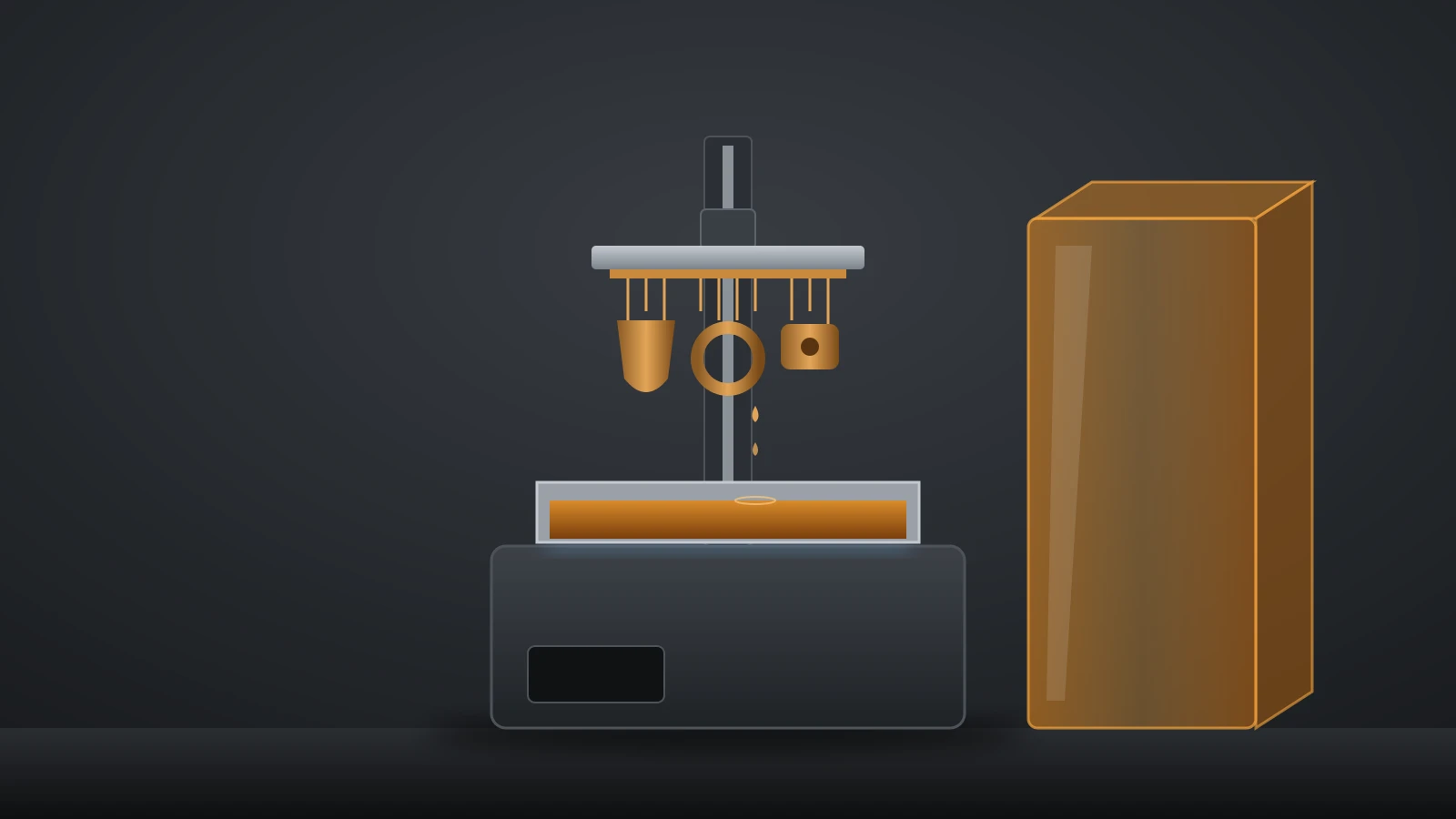

Yes, you can 3D print silicone, but not on a normal filament printer. Silicone cures through a chemical reaction instead of melting, so it needs dedicated systems: industrial printers, Formlabs’ Silicone 40A Resin on its SLA printers, or a liquid-dispensing toolhead for the Prusa XL. On FDM printers, the practical routes are TPU filament or a printed mold for casting.
This guide compares all four routes, explains why TPU is not silicone and walks through casting real silicone in a 3D print. If you design your own parts or molds, our guide on how to make 3D models for printing covers the modeling side.
The short answer
| Route | What you get | Hardness examples | Equipment | Best for |
|---|---|---|---|---|
| Real silicone printing | Cured silicone parts | 25A (Stratasys P3 Silicone 25A), 40A (Formlabs Silicone 40A) | Industrial DLP or dispensing systems, Formlabs Form 3/4, Prusa XL with silicone toolhead | Seals, gaskets, wearables, small production runs |
| Silicone-like resins | Rubbery photopolymer, not pure silicone | 50A to 86A (Formlabs Elastic 50A, Flexible 80A, Rebound) | Resin (SLA) printer | Soft-touch prototypes, grips |
| TPU or TPE filament | Flexible thermoplastic, not silicone | About 45A to 95A | FDM printer that handles flexibles | Bumpers, feet, cases, washers |
| Print a mold, cast silicone | Real cast silicone | 00-10 to 60A (Smooth-On examples) | Any printer plus two-part silicone | Soft parts, one-offs and small batches at home |
If you own an FDM printer and need real silicone, cast it. If a firm, rubbery plastic is enough, print TPU.
Why can’t a normal 3D printer print silicone?
An FDM printer melts a thermoplastic filament, pushes it through a hot nozzle and lets it harden as it cools. Silicone does not behave like that. Stratasys, which sells a silicone printing system, explains that the FDM process fails with silicone because silicone does not melt the way thermoplastics do.
Silicone parts start as a liquid or paste that cures through a chemical reaction. Smooth-On’s casting silicones, for example, are two-part systems cured by a platinum or tin catalyst, taking from 30 minutes (Mold Star 20T) to 16 hours (Smooth-Sil 960) at room temperature. Once cured, silicone cannot be remelted and extruded again like a spool of plastic.
Even the one silicone add-on for a desktop filament printer is not FDM. Prusa Research lists a Silicone Printing Toolhead for its Original Prusa XL, developed by Filament2, and describes it as non-FDM printing: a precision mixing nozzle for two-part liquid materials such as heat-resistant silicone.
Ways to 3D print real silicone
Industrial silicone printers
Stratasys prints P3 Silicone 25A, a true silicone with a silicon-oxygen backbone developed with Shin-Etsu, on its Origin P3 DLP printer. Post-processing includes heating the parts in an oven at 85 °C (185 °F) and 85% relative humidity. Stratasys positions the system for functional, low-volume manufacturing such as custom seals, tool grips and gaskets.
Formlabs Silicone 40A Resin (SLA)
Formlabs sells Silicone 40A Resin for its Form 4, Form 4B, Form 3 and Form 3B printers. It calls the resin the first accessible 100% silicone 3D printing material, with no added monomer or acrylate. Formlabs lists Shore 40A hardness, 230% elongation at break, 12 kN/m tear strength and a temperature range of -25 °C to 125 °C (-13 °F to 257 °F).
Parts are washed in isopropyl alcohol or an ether-based solution and then post-cured, the usual SLA workflow. Formlabs names seals, gaskets, wearables and customized medical devices as recommended uses.
Prusa XL Silicone Printing Toolhead
The toolhead mixes a two-part liquid material in the nozzle. Filament2 packs the material in flexible tubes it calls Liquid Filament, which the printer feeds like regular filament. Because the XL can carry several toolheads, Prusa says you can combine FDM plastic and silicone in one part, or print one object from silicones of different hardness.
Silicone-like resins
Most flexible resins are not pure silicone. Formlabs contrasts Silicone 40A with flexible resins that blend silicone with monomers or acrylates, and its own elastomeric resins range from Shore 50A (Elastic 50A) to 86A (Rebound). Formlabs describes silicone-like resins as generally less durable than standard silicone.
Silicone filament vs TPU: is TPU silicone?
No. Flexible filaments are TPE, thermoplastic elastomers, and Prusa explains that TPU is a subtype of TPE, with Shore hardness as the main difference. They are rubbery plastics that melt, which is exactly why they print on FDM machines. Silicone is a different polymer family that cures instead of melting, so there is no meltable silicone filament for a standard hotend.
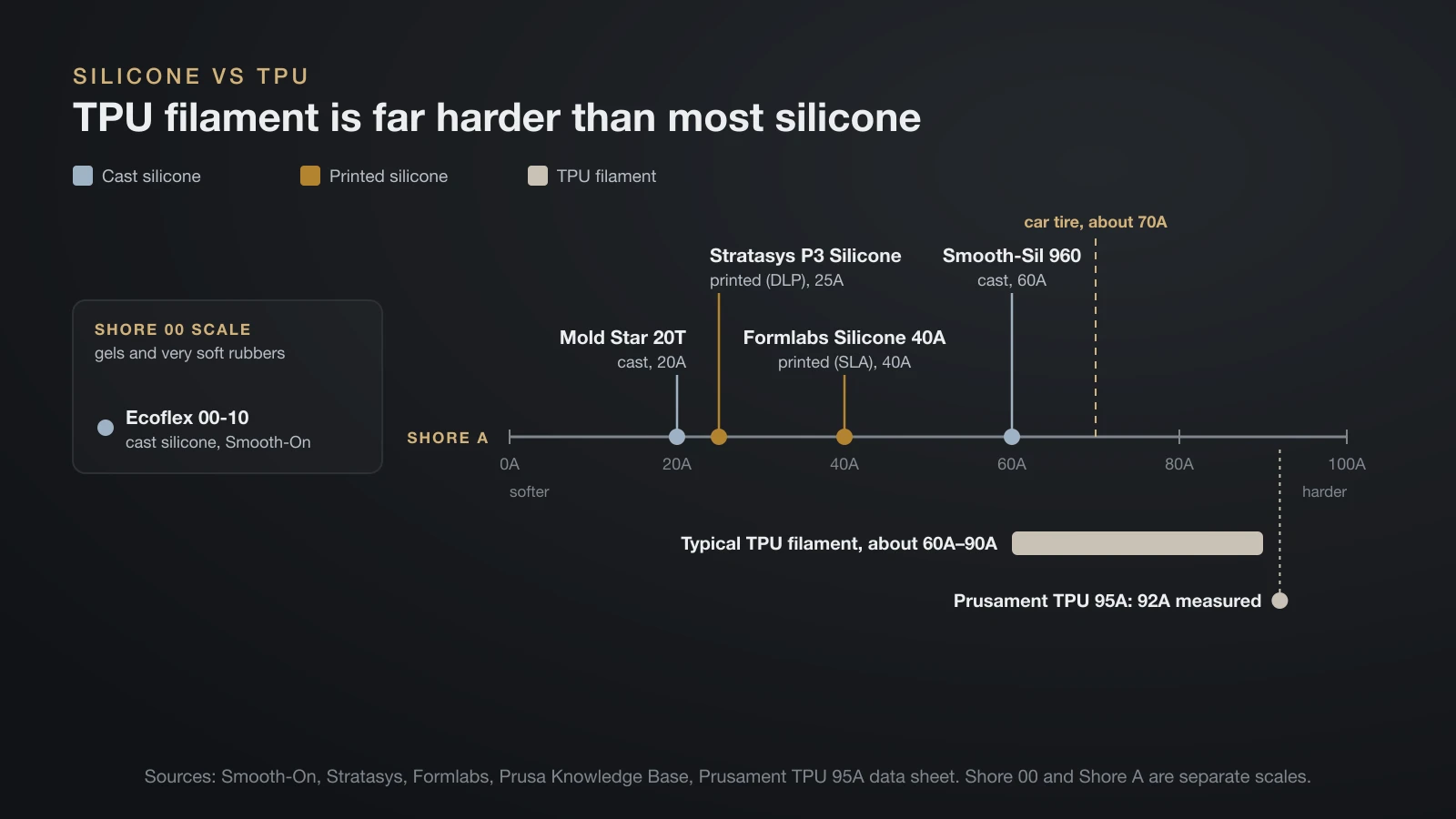
The hardness gap is large. Shore 00 measures very soft rubbers and gels, Shore A covers flexible rubbers, and Smooth-On uses a car tire as its example of 70A.
| Material | Type | Shore hardness |
|---|---|---|
| Smooth-On Ecoflex 00-10 | Cast platinum silicone | 00-10 |
| Smooth-On Mold Star 20T | Cast platinum silicone | 20A |
| Stratasys P3 Silicone 25A | Printed silicone (DLP) | 25A |
| Formlabs Silicone 40A Resin | Printed silicone (SLA) | 40A |
| Smooth-On Smooth-Sil 960 | Cast platinum silicone | 60A |
| Typical TPU filament | Thermoplastic elastomer | About 60A–90A (Prusa) |
| Prusament TPU 95A | Thermoplastic elastomer | 92A measured, 39D (Prusament) |
TPU also recovers less after being squeezed while warm. In Prusament’s compression set test for TPU 95A, the share of the squeeze that does not recover rises from 33.5% at 23 °C to 82.7% at 85 °C. Formlabs likewise describes FDM elastomers as generally less durable than silicone, with lower temperature resistance.
TPU is still a great material for bumpers, furniture feet, phone cases, washers and soft vise jaws; Prusa lists washers, RC tires, shoe soles and belts as typical flexible prints. If you need a tough part that bends rather than a soft, rubbery one, nylon filament or PCTG filament may suit you better than TPU.
Does silicone stick to PLA?
Not usually. Smooth-On demonstrates its Mold Star 20T, a platinum silicone, on a PLA print, and says a release agent is not usually necessary with that product, though it makes demolding easier. For a smooth, easy-release surface, Smooth-On recommends that FDM prints in PLA or ABS get a coat of XTC-3D followed by Ease Release 200.
The coating needs its own release layer, because Smooth-On says liquid mold rubbers adhere to cured XTC-3D. Apply Ease Release 200 or 205 over it and let it dry before pouring.
The real risk is cure inhibition: a contaminant keeps the silicone from curing properly. Platinum silicones are the sensitive type. Smooth-On warns that Mold Star 20T will not cure against surfaces containing sulfur, even when sealed, and that latex gloves, sulfur clays, some woods and fresh polyester, epoxy or urethane can inhibit it. Resin prints are a known trap: platinum silicone can fail against a UV resin print that is not fully cured.
Platinum vs tin cure silicone
| Smooth-On guidance | Platinum cure (addition) | Tin cure (condensation) |
|---|---|---|
| Cure inhibition | More sensitive: sulfur, latex, uncured UV resin | Far less likely to be inhibited by UV resin |
| Mixing | Many mix 1:1 by volume | Mixed by weight on a gram scale |
| Viscosity | Many are low viscosity | Very thick; needs vacuum degassing |
| Mold life | Long library life, dimensionally stable | Shorter library life |
Tin and platinum silicones are not compatible and cannot be used together. For SLA masters and platinum silicone, Smooth-On’s rules are strict: clean the print, UV cure it for at least 6 hours with every surface exposed, and prefer clear resin, which lets light cure the whole part.
How to cast silicone in a 3D printed mold
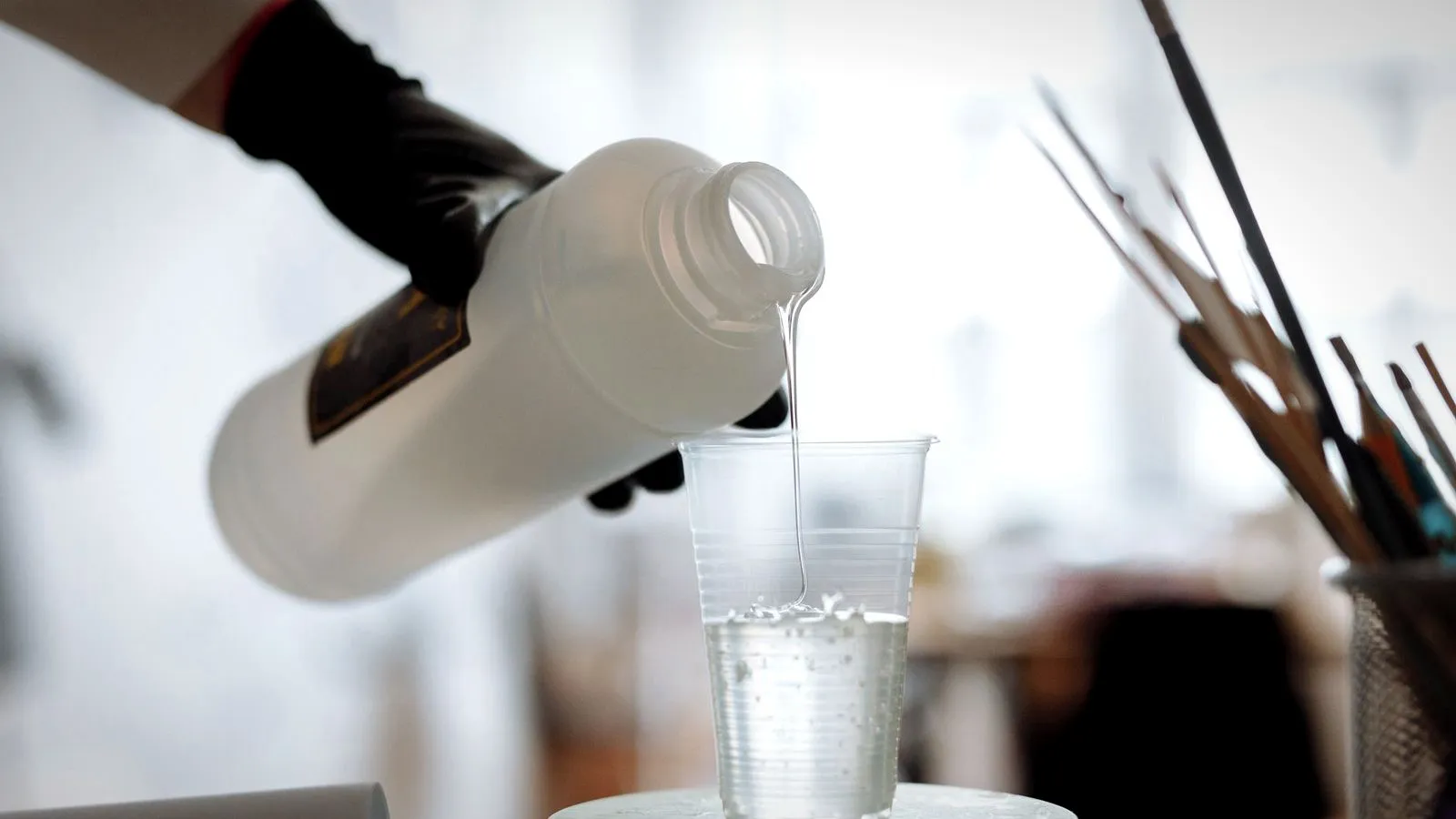
This is the route most makers use for real silicone parts. Our guide to 3D printed molds covers mold design in depth; the core steps look like this:
- Print the master or mold. Smooth-On’s own tutorial uses a PLA print; if you are choosing a spool, see PLA+ vs PLA.
- Smooth and seal it. Sand away the worst layer lines, then brush on a sealer such as XTC-3D. Our guide on how to paint 3D prints covers sanding and surface prep.
- Apply release agent. Mist Ease Release 200 over the sealed surface and let it dry fully.
- Build the mold box. Glue the master down so it cannot float when the silicone goes in.
- Mix exactly, in vinyl gloves. Mold Star 20T mixes 1A:1B by volume, tin cure silicones are weighed, and Smooth-On warns that latex gloves inhibit platinum cure.
- Pour within the pot life. Mold Star 20T gives you 6 minutes and, thanks to its low viscosity, usually needs no vacuum degassing.
- Wait for full cure. That is 30 minutes for Mold Star 20T, 4 hours for Ecoflex 00-10 and 16 hours for Smooth-Sil 960 at room temperature.
Before an important pour, Smooth-On recommends a small compatibility test on a non-critical area of the model.
Is 3D printed silicone safe for skin and food?
Only rely on what the manufacturer states for the exact product. Formlabs lists a skin contact biocompatibility rating for Silicone 40A Resin and directs regulatory questions to its quality team. Smooth-On says cured Mold Star 19T, 20T and 31T have been certified skin safe by an independent laboratory, and it lists Ecoflex 00-10 in its Skin Safe FX Materials category.
None of these statements covers food contact, and Formlabs describes typical FDM elastomers and silicone-like resins as not food-safe. For medical, baby or food uses, follow the product’s certificates and applicable rules; this guide is general information, not medical advice.
The bottom line
You can 3D print real silicone, but only with dedicated equipment: industrial DLP systems, Formlabs’ Silicone 40A Resin on Form 3 and Form 4 printers, or Prusa’s liquid toolhead for the XL. A standard FDM printer cannot melt silicone, and TPU is a firmer, different material. For most makers, printing a mold and casting platinum or tin cure silicone is the practical way to real silicone parts.
Sources
- Formlabs: Silicone 40A Resin product page and silicone 3D printing guide (100% silicone claim, Shore 40A, elongation, tear strength, temperature range, compatible printers, post-processing, skin contact rating; Shore ranges of flexible resins and FDM elastomers)
- Smooth-On: Mold Star 20T, Ecoflex 00-10, Smooth-Sil 960, XTC-3D, sealer and release agent guide, molding UV resin prints guide, PLA mold tutorial and Shore hardness scale (hardness, mix ratios, pot life, cure times, cure inhibition, tin vs platinum, release agents, skin safety)
- Stratasys: Silicone 3D printing: can you print real silicone? (why FDM cannot print silicone, P3 Silicone 25A with Shin-Etsu, post-cure conditions, 1,000-hour aging test at 150 °C)
- Prusa: Original Prusa XL Silicone Printing Toolhead, flexible materials guide and Prusament TPU 95A data sheet (non-FDM two-part toolhead, TPU as a TPE subtype, typical TPU hardness, measured Shore 92A and 39D, compression set)
- Filament2: Liquid Filament (silicone-filled flexible tubes fed like filament, developed with Prusa Research)