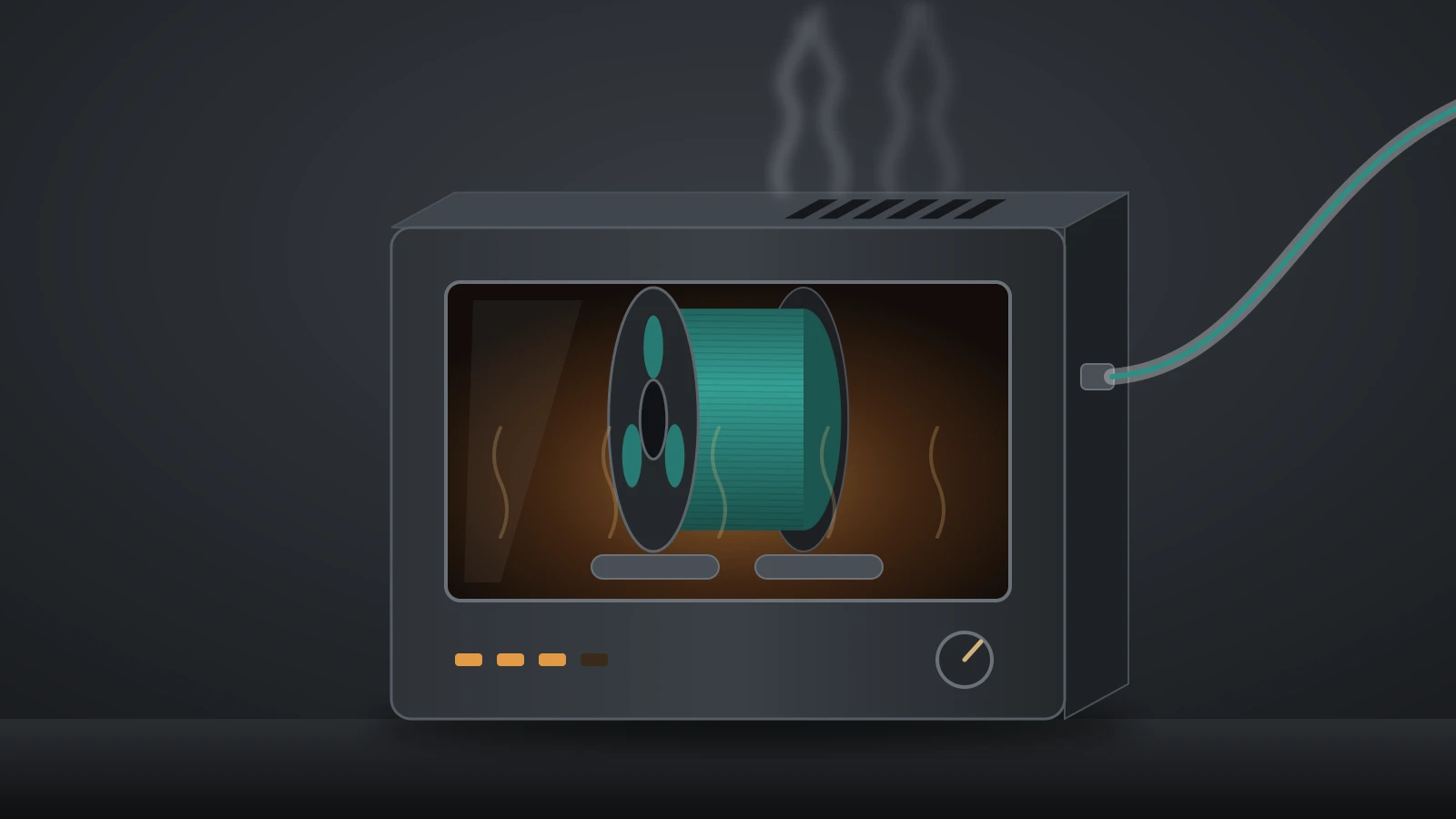
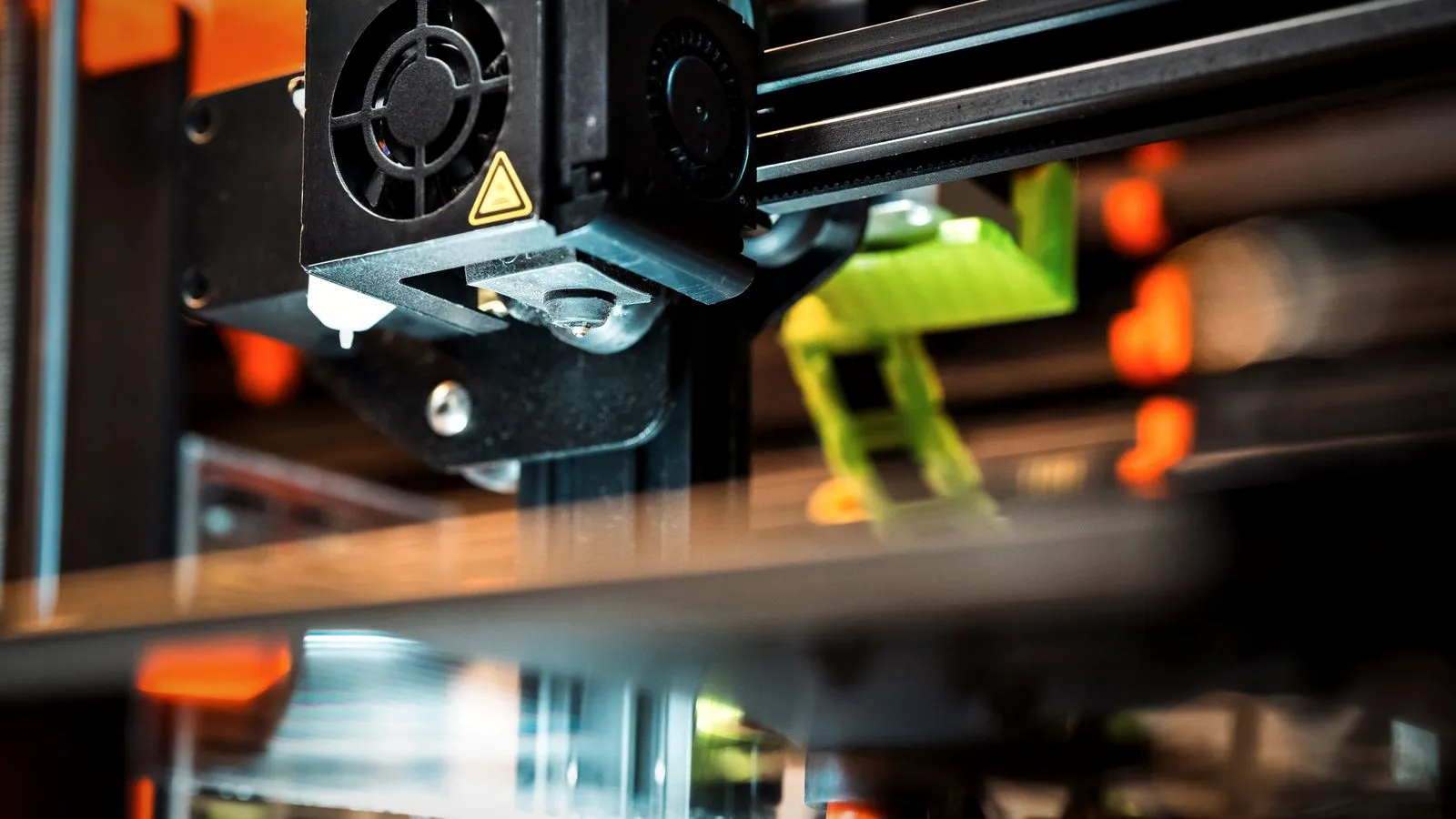
Polycarbonate 3D printer filament (PC) is one of the toughest, most heat-resistant plastics a desktop printer can handle: Prusament PC Blend keeps its shape to 113 °C (235 °F) under a light load. The catch is printing. PC runs at roughly 250–295 °C (482–563 °F) on a 90–120 °C bed, and most grades need an enclosure and dry filament.
That makes PC a material for an enclosed 3D printer with an all-metal hot end, not for a first print. This guide compares PC with PETG, ASA and nylon on one maker’s data sheets, then covers printer requirements, settings, blends and fumes.
The short answer
| Polycarbonate (PC) filament | |
|---|---|
| What it is | A tough engineering plastic; most spools are modified PC or PC blends |
| Best for | Parts that face heat and impact: fan shrouds, brackets, hinges, housings |
| Heat deflection (ISO 75, 0.45 MPa) | 113 °C (Prusament PC Blend), 111 °C (Polymaker PolyLite PC) |
| Nozzle temperature | 250–270 °C (Polymaker), 260–280 °C (Bambu Lab), 275 ± 10 °C (Prusament) |
| Bed temperature | 90–105 °C (Polymaker), 90–110 °C (Bambu Lab), 110 ± 10 °C (Prusament) |
| Build surface | Textured PEI, satin or powder-coated sheet with glue; not bare smooth PEI |
| Enclosure | Needed for most grades; Bambu Lab lists a 45–60 °C chamber |
| Drying | 80 °C for 8 h (Bambu Lab), 75 °C for 6 h (Polymaker); none for Prusament PC Blend |
| Hot end | All-metal; E3D rates its PTFE-lined Lite6 to 240 °C, too low for PC |
| Skip it for | First prints, open-frame printers, large flat parts, safety-critical parts |
What is polycarbonate 3D printer filament?
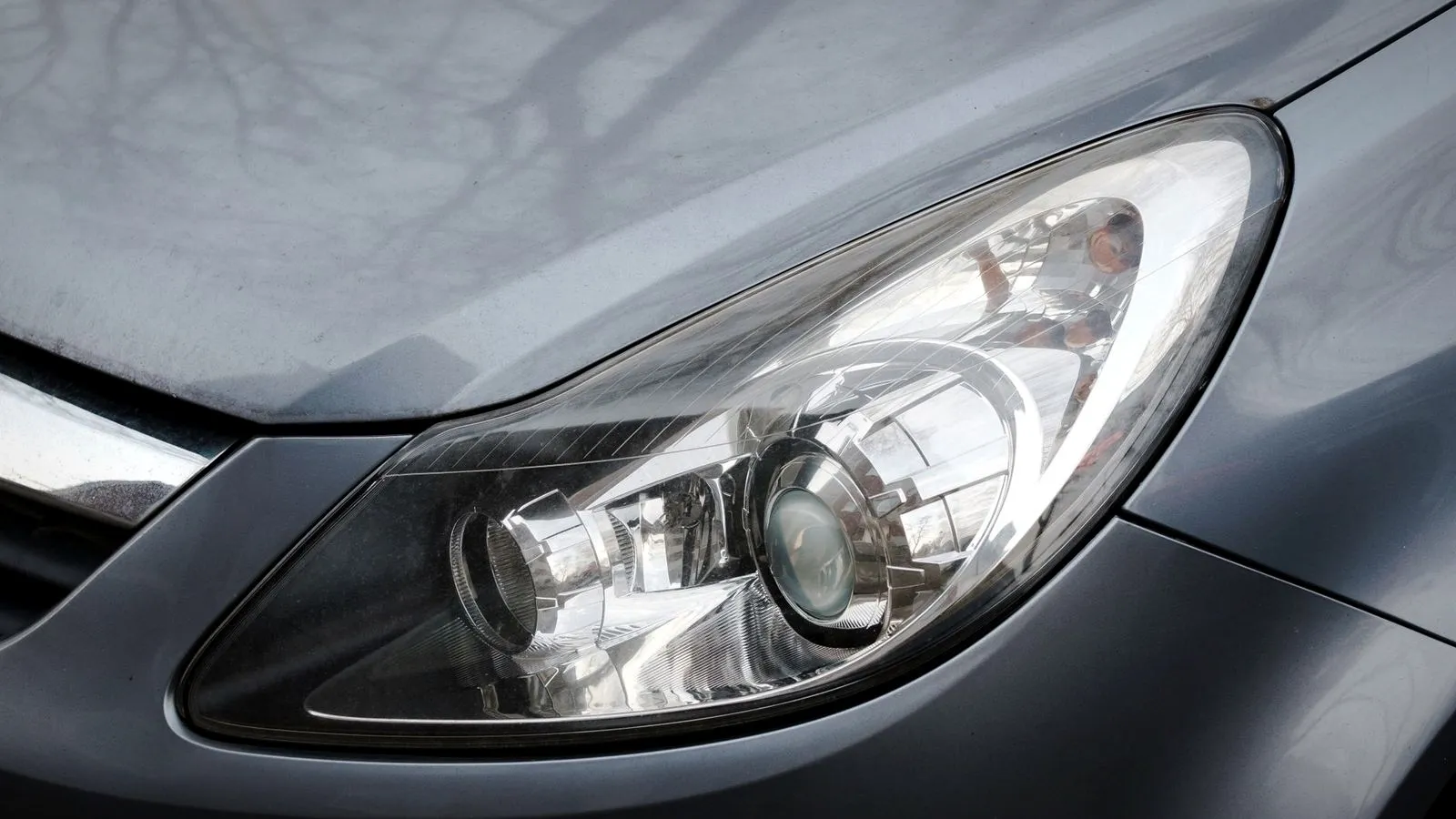
Polycarbonate (PC) filament is made from polycarbonate, a family of polymers known for tenacity, tensile strength and temperature resistance. Prusa names CDs, protective glasses and shields, and car headlight covers as everyday PC products. Polymaker describes the resin in its PolyLite PC as light diffusing, with 89% light transmission in its test.
Pure polycarbonate is hard to print. Prusa calls it unsuitable for 3D printing because of poor surface adhesion and significant thermal expansion, so prints tend to deform and crack. That is why most spools sold as PC contain additives or are blends, and why two “PC” filaments can print very differently.
What people print with polycarbonate
- Heat-exposed printer parts: Prusa names fan shrouds as a typical PC print.
- Mechanical parts: Prusa’s sample prints include pulley linear bearings, hinges, valve levers, air filter covers and battery packs.
- Car parts in hotter spots: our guide to 3D printed car parts compares PC with ASA and nylon for cabin temperatures.
Polycarbonate filament properties vs PETG, ASA and nylon
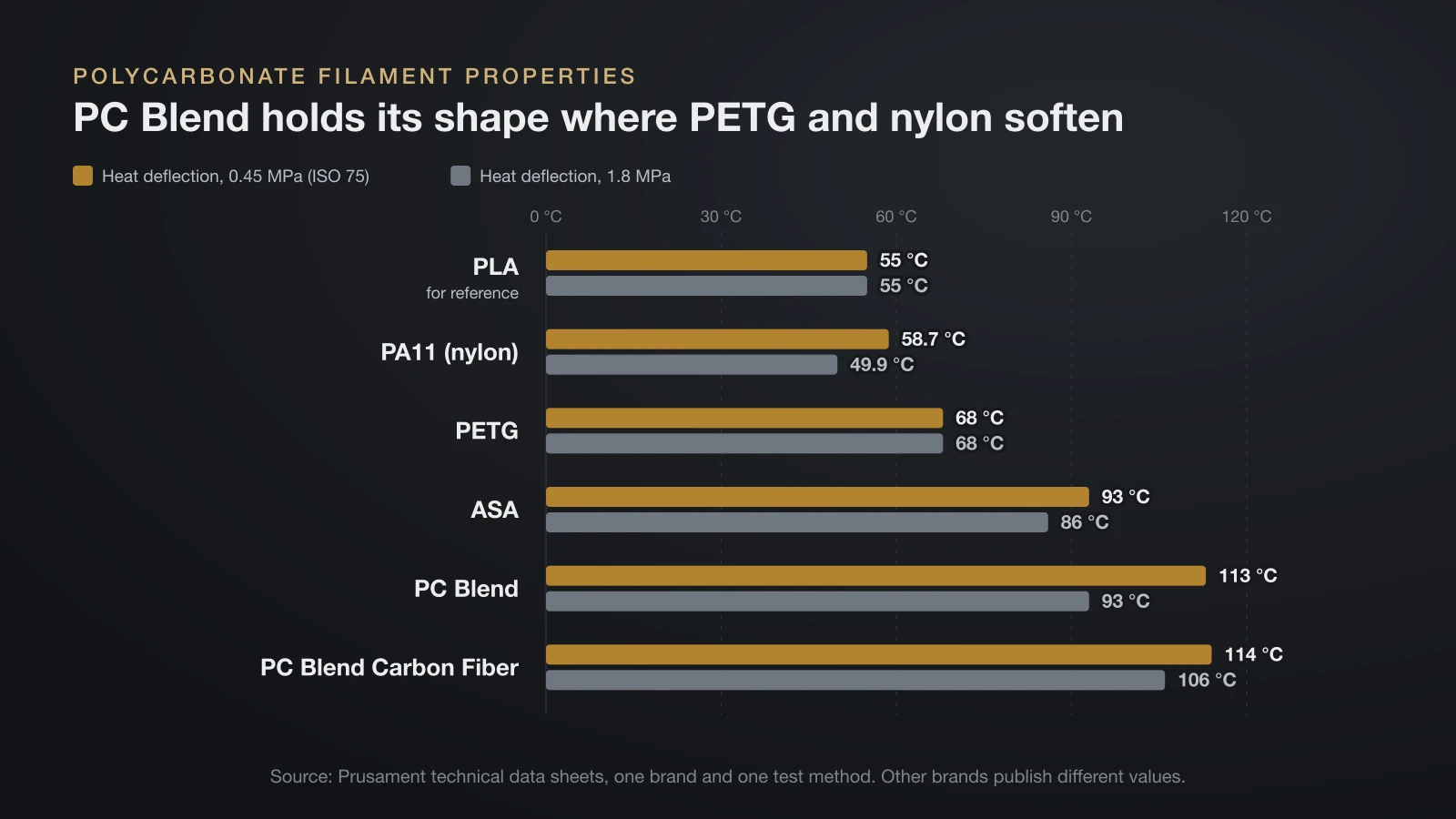
In Prusament’s data sheets, PC Blend beats PETG, ASA and PA11 nylon on heat deflection and tensile strength; nylon’s clear win is layer bonding. A fair comparison needs one manufacturer and one test method, and Prusa Polymers publishes data sheets for PC Blend, PETG, ASA and PA11 nylon, with heat deflection measured per ISO 75 and strength measured on bars printed flat (horizontal).
| Prusament data sheet | PETG | ASA | PA11 (nylon) | PC Blend | PC Blend Carbon Fiber |
|---|---|---|---|---|---|
| Heat deflection, 0.45 MPa (ISO 75) | 68 °C | 93 °C | 58.7 °C | 113 °C | 114 °C |
| Heat deflection, 1.8 MPa (ISO 75) | 68 °C | 86 °C | 49.9 °C | 93 °C | 106 °C |
| Tensile yield strength, printed flat | 47 MPa | 42 MPa | 38.3 MPa | 63 MPa | 64 MPa |
| Notched Charpy impact, printed flat | 6 kJ/m² | 12 kJ/m² | 12.9 kJ/m² | 12 kJ/m² | 12 kJ/m² |
| Interlayer adhesion | 18 MPa | 11 MPa | 32 MPa | 21 MPa | 23 MPa |
| Nozzle temperature | 250 ± 10 °C | 260 ± 10 °C | 275 ± 10 °C | 275 ± 10 °C | 285 ± 10 °C |
| Bed temperature | 80 ± 10 °C | 110 ± 5 °C | 100 ± 10 °C | 110 ± 10 °C | 110 ± 10 °C |
Heat is where PC pulls ahead. PC Blend deflects at 113 °C under the light load and still at 93 °C (199 °F) under the heavier 1.8 MPa load, where ASA drops to 86 °C and PA11 to 49.9 °C. For reference, Prusament PLA deflects at 55 °C (131 °F) under both loads.
PC Blend and its carbon fiber version are also the strongest in tension here, at 63–64 MPa, and PC Blend’s notched impact value matches ASA’s at twice PETG’s. Nylon keeps one clear win, layer bonding (32 vs 21 MPa), which is one reason our nylon filament guide recommends it for parts that flex and rub.
Brands differ: Polymaker’s PolyLite PC lists 111 °C at 0.45 MPa but 107 °C at 1.8 MPa, so compare materials within one brand’s data.
PETG vs polycarbonate
Prusament PETG prints at 250 ± 10 °C on an 80 ± 10 °C bed, about 25 °C cooler at the nozzle and 30 °C cooler at the bed than PC Blend. PC buys roughly 45 °C more heat deflection, a third more tensile strength and double the notched impact value. Prusa itself suggests beginners start with PLA or PETG. If you mainly need more toughness than PETG rather than heat resistance, PCTG filament is the gentler step up.
Can your 3D printer print polycarbonate?
Check these six points before buying a spool:
- Hot end: it must hold roughly 250–295 °C for hours. E3D limits its PTFE-lined Lite6 to 240 °C (464 °F) because of the liner and says it cannot print polycarbonate, so you need an all-metal design rated above your print temperature. Our 3D printer extruder guide explains the parts involved.
- Heated bed: 90–120 °C, depending on the grade. Prusa uses 110 °C for the first layer and 115 °C after that.
- Enclosure: Bambu Lab says its PC needs an enclosed printer and lists its open P1P and A-series models as incompatible.
- Build surface: Prusa warns that PC’s adhesion can damage a smooth PEI sheet, so use a textured PEI, satin or powder-coated sheet with glue as a separation layer.
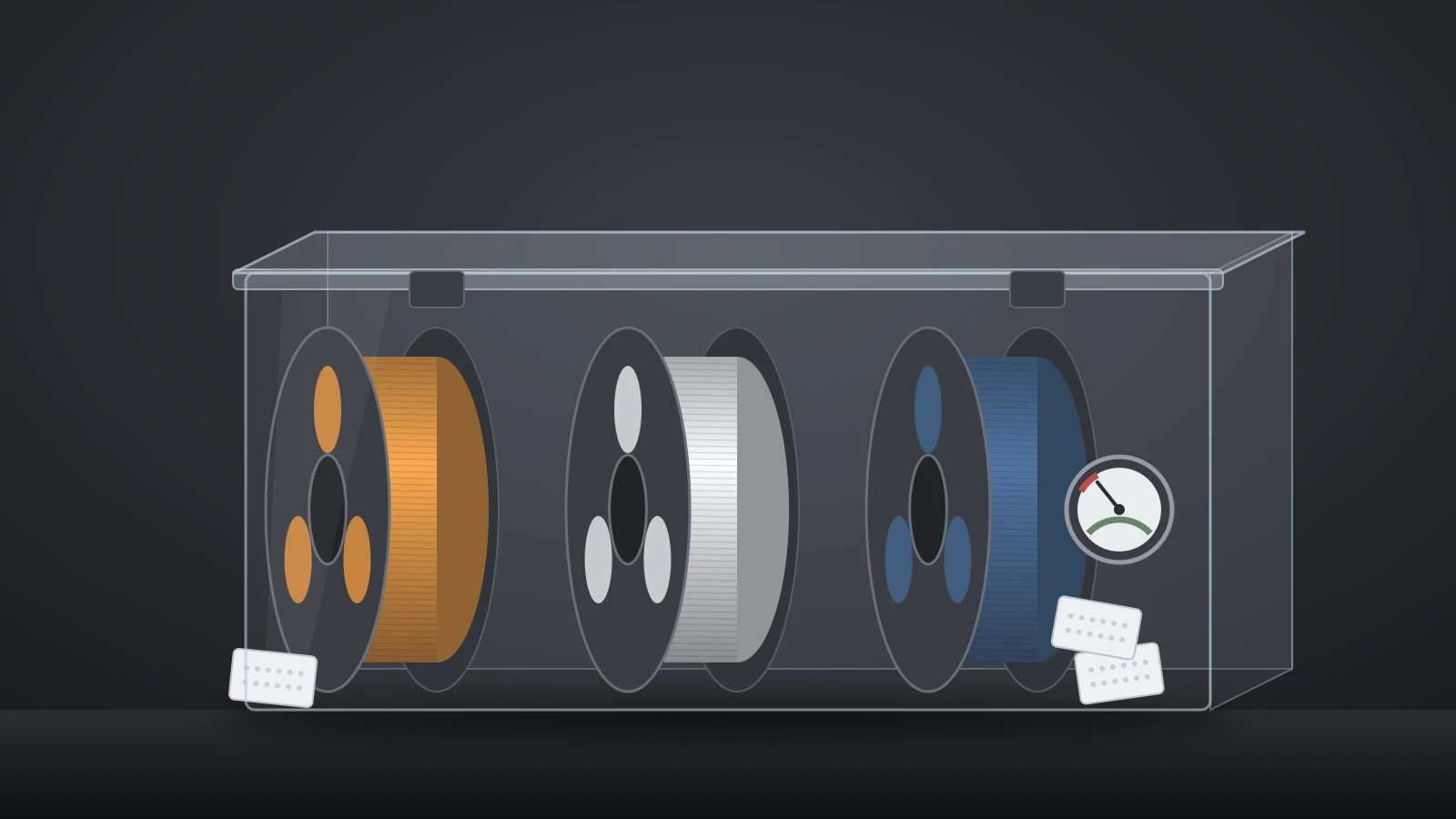
- Dry storage: a dryer or dry box. Bambu Lab asks for printing and storage below 20% relative humidity.
- Hardened nozzle: only for carbon fiber PC, such as Prusament PC Blend Carbon Fiber.
Polycarbonate filament print settings
The three PC filaments below print at 250–285 °C on a 90–120 °C bed, with the part cooling fan low or off. Start from the data sheet for your exact spool, because recommendations spread this far:
| Setting | Prusament PC Blend | Bambu Lab PC | Polymaker PolyLite PC |
|---|---|---|---|
| Nozzle | 275 ± 10 °C | 260–280 °C | 250–270 °C |
| Bed | 110 ± 10 °C | 90–110 °C | 90–105 °C |
| Build surface | Satin sheet; smooth PEI or powder-coated sheet with glue stick | Engineering, High Temperature or Textured PEI plate, with glue | Textured PEI, glue when needed |
| Part cooling fan | 20% (0–30%) | 0–60% | Off |
| Enclosure | Skirt or enclosure recommended | Chamber at 45–60 °C | Needed, heated chamber for large parts |
| Drying | Not needed | 80 °C for 8 h | 75 °C for 6 h |
| Annealing | Not listed | 85–100 °C for 6–12 h | 90 °C for 2 h |
A routine for a first PC print:
- Dry the spool unless the maker says otherwise, in a forced-air dryer: Bambu Lab warns that kitchen and microwave ovens can damage filament. Store opened spools airtight with desiccant.
- Prepare the plate with a thin layer of glue, even on textured sheets, to protect the surface.
- Warm the air. Let the bed heat the closed enclosure. Without one, Prusa suggests centering the part inside a skirt set as tall as possible.
- Add a brim. Prusament recommends a 4 mm brim for parts bigger than 5 cm.
- Keep cooling low, raising it only for overhangs and bridges.
- Mind the room. Prusa says that below about 18 °C (64 °F) a printer may fail to hold PC bed temperatures and stop with a thermal runaway error.
- Anneal if needed. Polymaker recommends 90 °C for 2 hours right after printing to release internal stress.
Warping is PC’s main failure. Prusa says PC is not suitable for large objects that cover the whole sheet, and that rounded corners and less dense infill reduce warping.
PC blends: PC-ABS, PC-PBT and carbon fiber PC
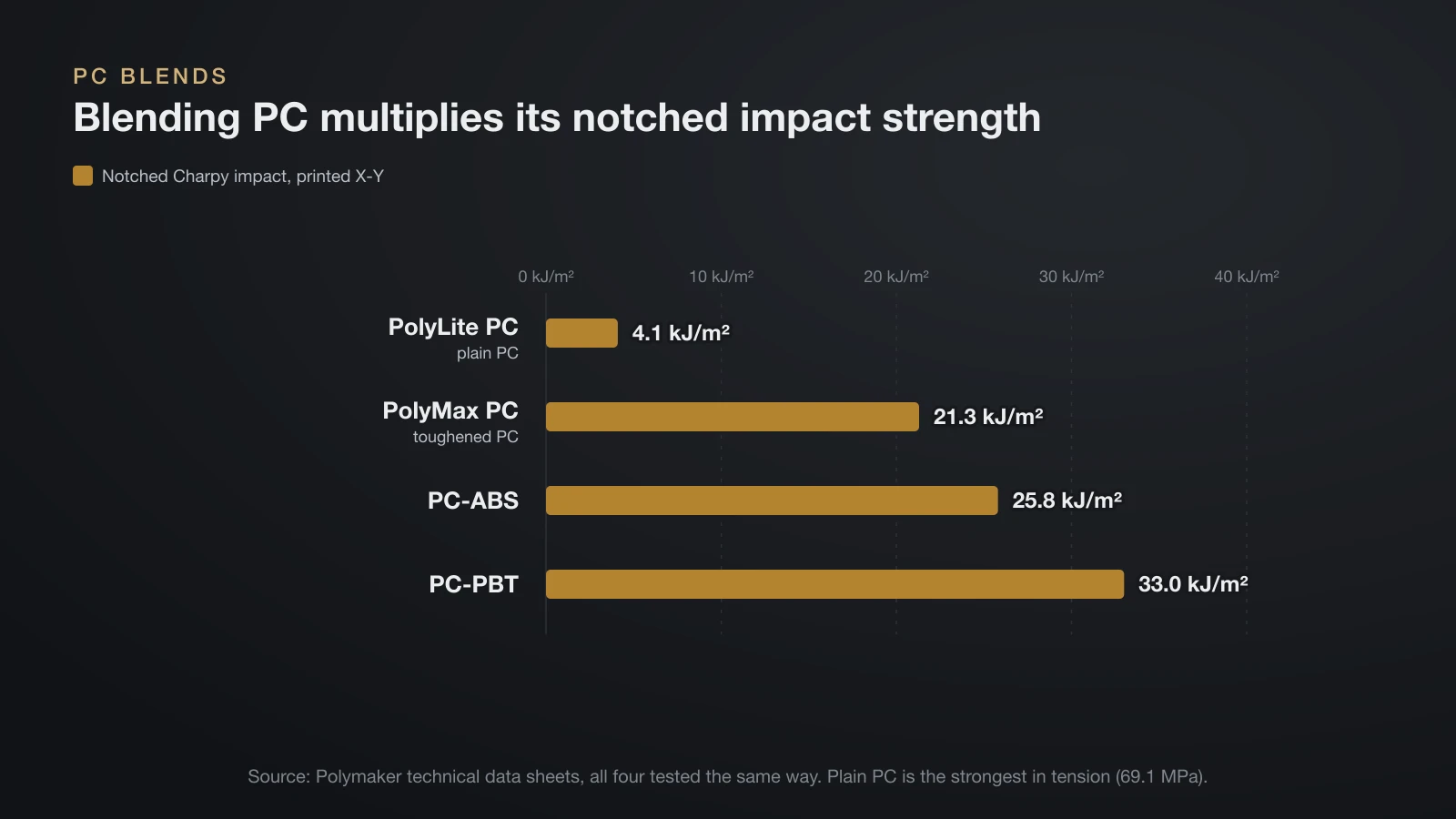
Blending trades some stiffness or heat resistance for toughness. Polymaker tests four PC-family filaments the same way:
| Polymaker data sheet | PolyLite PC | PolyMax PC | PC-ABS | PC-PBT |
|---|---|---|---|---|
| Heat deflection, 0.45 / 1.8 MPa | 111 / 107 °C | 114 / 99 °C | 112 / 106 °C | 107 / 91 °C |
| Tensile strength, X-Y | 69.1 MPa | 53.4 MPa | 39.9 MPa | 50.4 MPa |
| Notched Charpy impact, X-Y | 4.1 kJ/m² | 21.3 kJ/m² | 25.8 kJ/m² | 33.0 kJ/m² |
| Nozzle temperature | 250–270 °C | 250–270 °C | 250–270 °C | 260–280 °C |
| Bed temperature | 90–105 °C | 90–105 °C | 90–105 °C | 100–115 °C |
- Plain PC (PolyLite PC) is the strongest in tension but the most notch sensitive. PolyMax PC, which Polymaker describes as combining strength and toughness, has about five times the notched impact value.
- PC-ABS keeps nearly all the heat resistance and adds toughness, plus a good surface finish and compatibility with metal plating.
- PC-PBT is the toughest of the four, even in the cold (15.7 kJ/m² notched at -30 °C), with good chemical resistance.
- Carbon fiber PC warps less. Prusament PC Blend Carbon Fiber prints at 285 ± 10 °C, needs no enclosure or drying, shrinks less than 1% and can be annealed from 114 °C to 130 °C (266 °F) temperature resistance. It needs a hardened steel nozzle, and the filament breaks more easily than plain PC Blend.
Polycarbonate fumes and ventilation
Prusa lists a moderate odor among PC’s drawbacks and notes that PC Blend contains no styrene. Bambu Lab asks for good ventilation with its ABS, ASA and PC filaments and advises against printing in living areas.
A 2024 NIOSH study summarizes earlier measurements showing that printing PC releases ultrafine particles and volatile organic compounds, including bisphenol A (BPA) and phenol. Rats exposed to PC printing emissions at the one concentration tested showed no significant lung or whole-body effects, which does not show the fumes are harmless for people.
- Print in a ventilated room you are not sitting in. NIOSH’s lower-exposure setup is a printer “in an enclosed chamber equipped with a filtering device, or exhausted to the outdoors.”
- Replace activated carbon filters on the maker’s schedule, and keep children and pets away while printing.
When to use polycarbonate filament, and when not to
Use PC when a part must stay rigid well above PETG’s limits, take knocks or insulate electrical parts (Prusa lists good electrical insulation among its pros), and your printer meets the checklist above. Skip it when:
- You are new to printing or your printer is open-frame.
- The part is large and flat, covering most of the build plate.
- Sun and weather are the main threat: start with our ASA filament guide instead.
- The part touches food. Bambu Lab states that the PC filaments in its guide are not food-contact grade.
- Failure could hurt someone. Data sheet values come from ideal test bars, and Prusa Polymers stresses that results depend heavily on print settings and conditions.
For parts that must survive well beyond PC’s range, the next step is ultra-high-temperature plastics on specialized machines; see our guide to PEEK 3D printer filament. For a more forgiving material, our guide to PETG print temperature covers the easier option.
The bottom line
Polycarbonate 3D printer filament gives you the best heat resistance and strength of the common engineering filaments, at about 113 °C heat deflection for Prusament PC Blend. It asks a lot in return: an all-metal hot end, a bed near 110 °C, an enclosure, dry filament and patience with warping. Blends such as PC-ABS and PC-PBT trade a little stiffness for far more impact toughness, and they are often the smarter buy.
Sources
- Prusa Research and Prusa Polymers: technical data sheets for Prusament PC Blend, PC Blend Carbon Fiber, PETG, ASA, PA11 and PLA; product pages for PC Blend and PC Blend Carbon Fiber; Knowledge Base Polycarbonate (PC) guide (properties, print and drying settings, surfaces, warping tips, uses, odor)
- Polymaker technical data sheets: PolyLite PC, PolyMax PC, PC-ABS, PC-PBT (properties, print, drying and annealing settings)
- Bambu Lab: PC technical data sheet V3.0 (print and drying settings) and Wiki ABS / ASA / PC usage guide (enclosure, ventilation, food contact)
- E3D: Lite6 hot end announcement (240 °C PTFE liner limit)
- NIOSH: Farcas M.T. et al. (2024), Pulmonary evaluation of whole-body inhalation exposure of polycarbonate (PC) filament 3D printer emissions in rats, Journal of Toxicology and Environmental Health, Part A 87(8): 325–341; Approaches to Safe 3D Printing, DHHS (NIOSH) Publication 2024-103