
ABS filament (acrylonitrile butadiene styrene) is a tough, heat resistant 3D printing plastic for functional parts. Data sheets put its nozzle temperature at about 240–270 °C (464–518 °F) and its bed at 80–110 °C, and it deflects under load near 84–87 °C (183–189 °F), far above PLA. It warps without an enclosure and gives off styrene fumes.
Those two drawbacks decide where ABS belongs. It prints best in an enclosed 3D printer placed in a ventilated room, and it rewards that effort with parts that survive heat, impacts and acetone smoothing.
The short answer
| ABS filament | |
|---|---|
| What it is | Acrylonitrile butadiene styrene, an amorphous petroleum-based plastic |
| Best for | Tough indoor parts that get warm, enclosures, jigs, acetone smoothed parts |
| Heat deflection (ISO 75) | 87 °C at 0.45 MPa, 84 °C at 1.8 MPa (Bambu Lab); 81–97 °C at 0.45 MPa across brands (Prusa) |
| Nozzle temperature | 240–270 °C (Bambu Lab), 255 °C (Prusa), 245–265 °C (Polymaker) |
| Bed temperature | 80–100 °C (Bambu Lab), 100 °C (Prusa), 90–100 °C (Polymaker) |
| Enclosure | Needed; Bambu Lab lists a 45–60 °C chamber |
| Part cooling fan | 0–80% (Bambu Lab), off (Polymaker) |
| Drying | 80 °C for 8 h (Bambu Lab), 70 °C for 6 h (Polymaker) |
| Fumes | Styrene and ultrafine particles; ventilate or filter |
| Skip it for | Outdoor parts (UV), food contact, open printers in living space |
What is ABS filament?
ABS filament is a thermoplastic made from three building blocks: acrylonitrile, butadiene and styrene. Polymaker describes the blend as combining rigidity, impact resistance and thermal stability. It is petroleum based and amorphous, so it softens gradually when heated instead of melting at a sharp point.
Polymaker calls ABS a long-standing cornerstone of both industrial manufacturing and 3D printing. Prusa lists LEGO bricks, car parts and phone parts among its classic uses. Its close cousin, ASA filament, swaps the butadiene rubber for an acrylate rubber to gain UV resistance.
Density is a small advantage. ABS weighs 1.05 g/cm³ against 1.24 g/cm³ for PLA on Bambu Lab’s data sheets, so a 1 kg spool holds about 18% more filament length (estimate: 1.24 ÷ 1.05, same diameter assumed).
ABS filament properties vs PLA, PETG and ASA
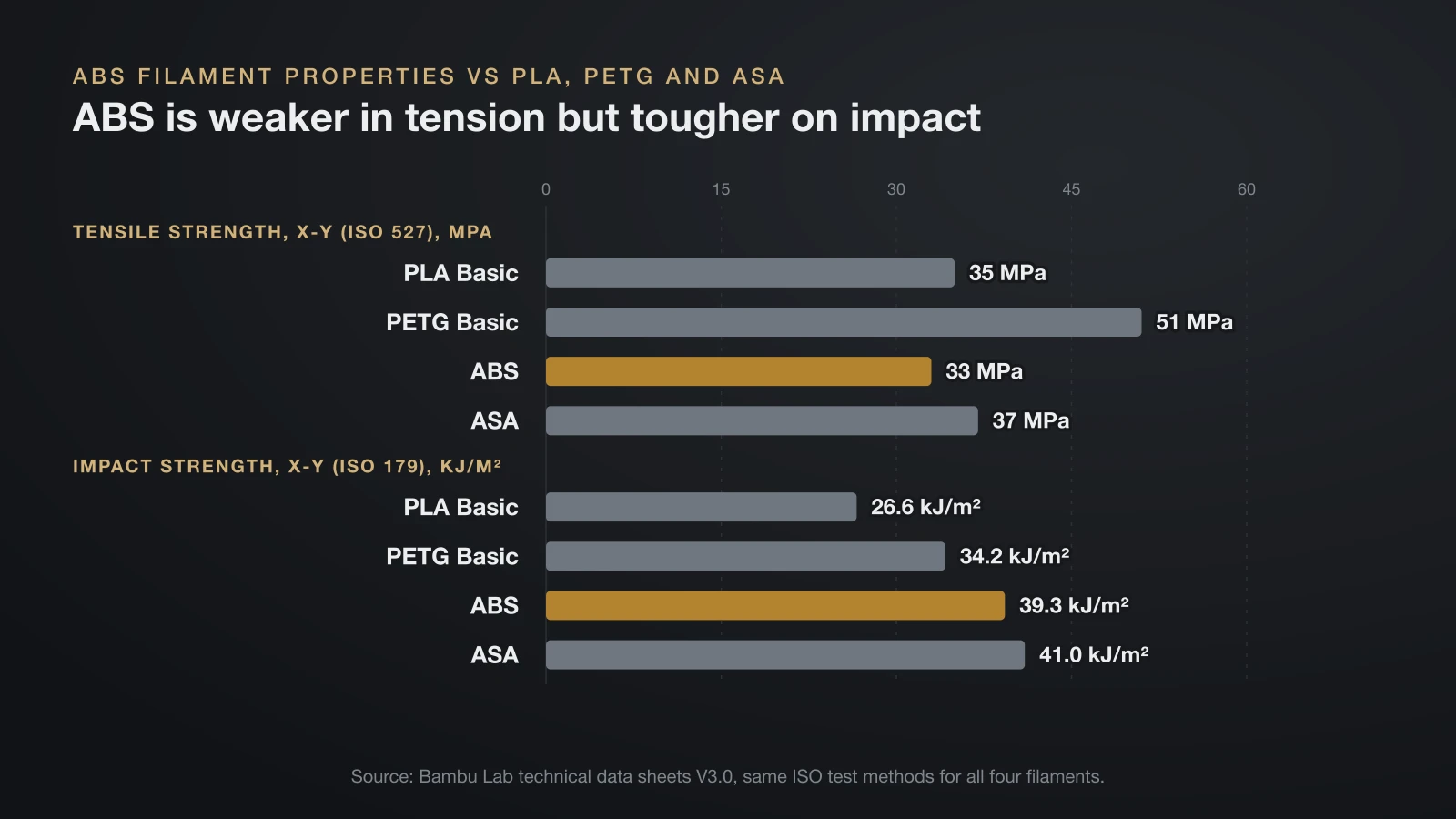
ABS trades raw strength for heat and impact resistance: it deflects under load roughly 30 °C later than PLA and absorbs more impact energy, but it has lower tensile strength than PLA or PETG. To compare fairly, every value below comes from Bambu Lab’s version 3.0 data sheets, tested with the same ISO methods.
| Bambu Lab data sheet | PLA Basic | PETG Basic | ABS | ASA |
|---|---|---|---|---|
| Heat deflection, 0.45 MPa (ISO 75) | 57 °C | 71 °C | 87 °C | 100 °C |
| Heat deflection, 1.8 MPa (ISO 75) | 54 °C | 68 °C | 84 °C | 92 °C |
| Vicat softening (ISO 306) | 57 °C | 69 °C | 94 °C | 106 °C |
| Tensile strength, X-Y (ISO 527) | 35 MPa | 51 MPa | 33 MPa | 37 MPa |
| Impact strength, X-Y (ISO 179) | 26.6 kJ/m² | 34.2 kJ/m² | 39.3 kJ/m² | 41.0 kJ/m² |
| Density | 1.24 g/cm³ | 1.25 g/cm³ | 1.05 g/cm³ | 1.05 g/cm³ |
| Nozzle temperature | 190–230 °C | 230–260 °C | 240–270 °C | 240–270 °C |
| Bed temperature | 35–45 °C | 65–75 °C | 80–100 °C | 80–100 °C |
Brands differ. Prusa’s material table lists heat deflection temperatures of 81–97 °C at 0.45 MPa for the ABS filaments it covers, so compare materials within one maker’s data. For PLA’s much lower limits, see our guide to the PLA melting point and softening temperatures.
Is ABS stronger than PETG?
ABS is not stronger than PETG in tension or bending, but it is tougher on impact and handles heat better. In Bambu Lab’s data, PETG Basic reaches 51 MPa tensile strength against 33 MPa for ABS, and 75 MPa bending strength against 62 MPa. ABS absorbs 39.3 kJ/m² in the impact test against 34.2 kJ/m² for PETG, and deflects under load about 16 °C higher. PETG prints far more easily; our PETG temperature guide covers its settings.
ABS vs PLA
PLA is stiffer and much easier to print, while ABS is tougher and survives heat. PLA filament prints at 190–230 °C on a 35–45 °C bed with the fan on and needs no enclosure. ABS needs about 40–50 °C more at the nozzle, a bed more than twice as hot and a warm chamber, and it releases more fumes. In return, it holds its shape in places where PLA would sag.
ABS filament print settings
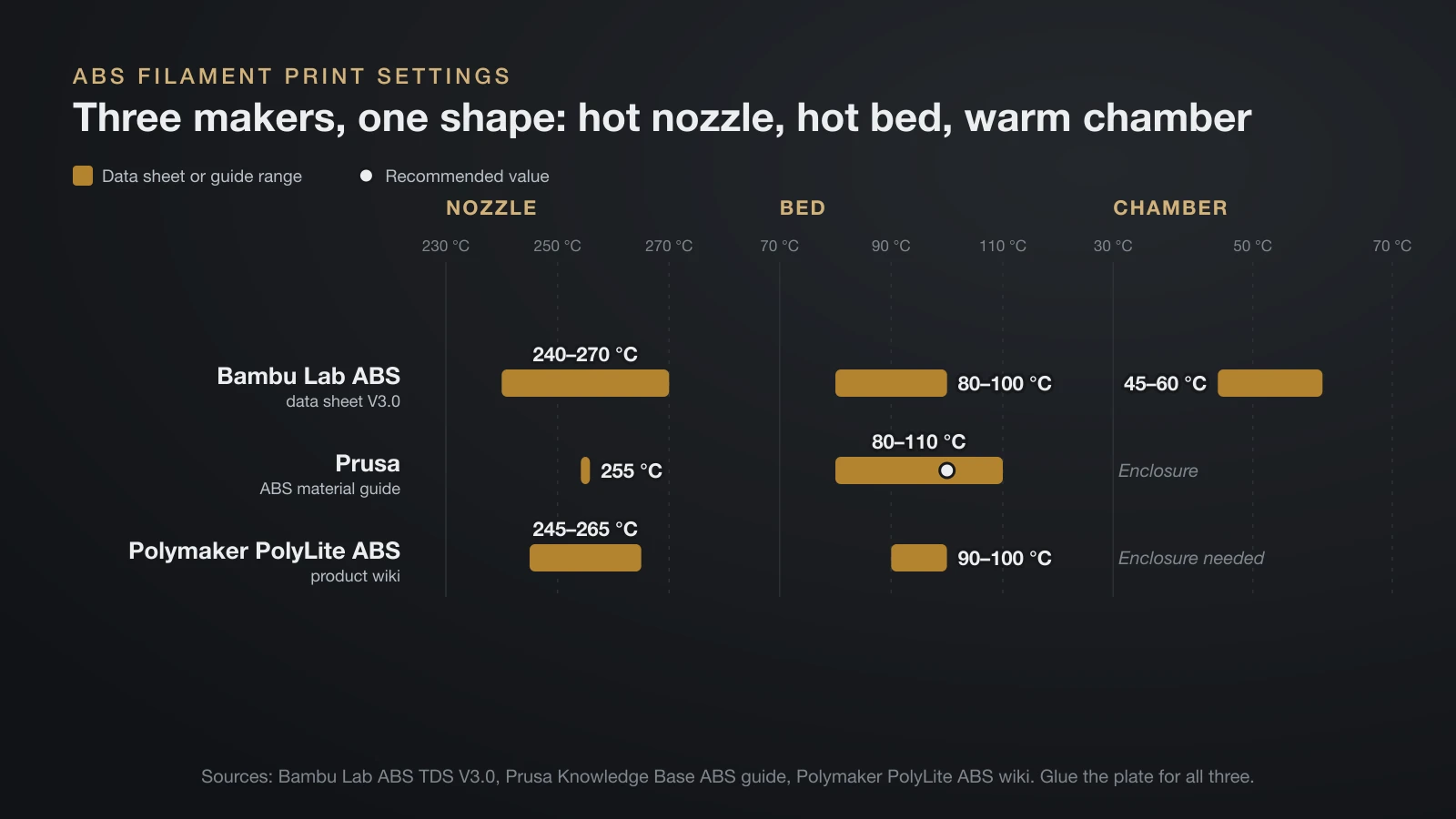
ABS prints at about 240–270 °C with an 80–110 °C bed, little or no part cooling and a closed chamber. Start from your spool’s own data sheet; the three makers below agree on the general shape but not on exact numbers.
| Setting | Bambu Lab ABS | Prusa (ABS guide) | Polymaker PolyLite ABS |
|---|---|---|---|
| Nozzle | 240–270 °C | 255 °C | 245–265 °C |
| Bed | 80–100 °C | 100 °C (80–110 °C) | 90–100 °C |
| Build surface | Engineering, High Temperature or Textured PEI plate, with glue | Smooth or powder-coated PEI with glue stick | PC or textured PEI, glue when needed |
| Part cooling fan | 0–80% | Not listed | Off |
| Chamber | 45–60 °C | Enclosure | Enclosure needed |
| Speed | Under 300 mm/s | Not listed | 50–200 mm/s |
A reliable first ABS print:
- Dry the spool if it has been open for a while (see the drying section below).
- Glue the plate. Bambu Lab, Prusa and Polymaker all list glue for ABS on their PEI surfaces.
- Heat soak the chamber. Polymaker suggests running the bed at 90–100 °C for 10 minutes before printing so the enclosure warms up.
- Keep the fan low or off. Raise it only for overhangs and bridges.
- Print hotter and slower for strength. Polymaker notes that slower, hotter printing improves layer adhesion at the cost of uglier overhangs.
- Let the part cool inside the closed printer before you open the door.
For its PolyLite ABS, Polymaker recommends, but does not require, an all-metal hotend that can reach above 250 °C.
Why ABS warps and how big an enclosure you need
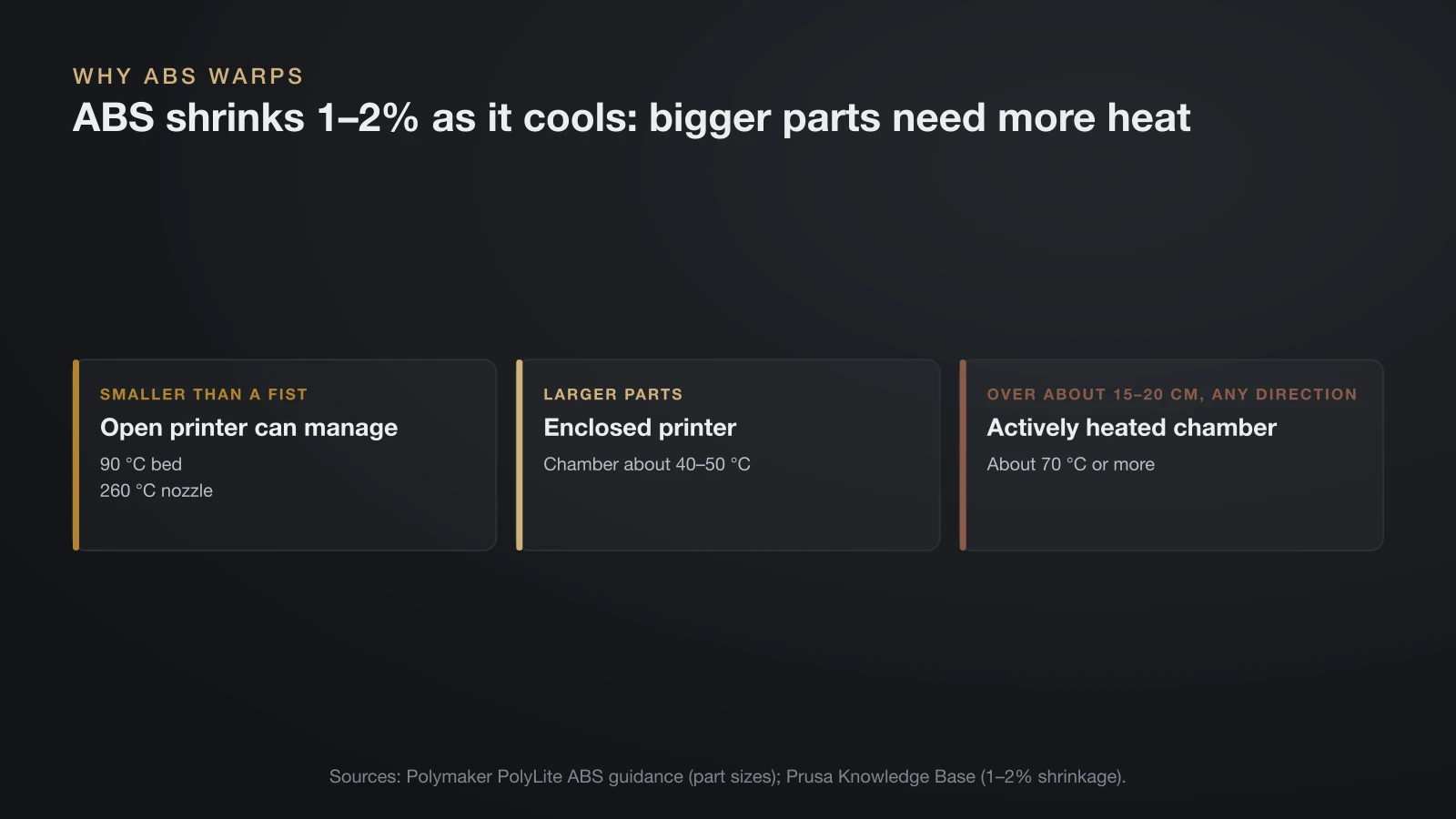
ABS warps because it shrinks as it cools, about 1–2% according to Prusa, and uneven cooling pulls corners off the bed and splits tall walls between layers. Prusa lists significant warping as ABS’s main disadvantage and says the printer should be inside an enclosure. Our 3D print warping guide covers the fixes that apply to every material.
How much heat you need depends on part size. Polymaker gives a rough guide for its PolyLite ABS:
| Part size | What Polymaker says it needs |
|---|---|
| Smaller than a fist | An open printer with a 90 °C bed and 260 °C nozzle can manage |
| Larger parts | An enclosed printer, chamber about 40–50 °C |
| Over about 15–20 cm in any direction | An actively heated chamber, about 70 °C or more |
Without an enclosure, Prusa suggests the draft shield in PrusaSlicer, a thin wall printed around the model that keeps it slightly warmer. Prusa also warns that printing inside an enclosure can deform the plastic fan shroud over time. Our guide to enclosed 3D printers compares passive and heated chambers.
ABS fumes and ventilation
ABS releases more fumes than PLA, mainly styrene vapor and ultrafine particles, so it should be printed in a ventilated room or in a filtered or vented enclosure. Prusa lists “potentially dangerous fumes (styrene)” among ABS’s drawbacks.
The research points the same way:
- Particles: NIOSH notes that researchers have found higher airborne ultrafine particle concentrations from ABS than from PLA, and that substituting PLA reduces that hazard where the part allows.
- Styrene: Azimi and colleagues (2016) measured styrene emissions of roughly 10–110 µg per minute from ABS and HIPS filaments, against about 4–5 µg per minute of lactide from PLA.
- ABS vs ASA: Wojnowski and colleagues (2022) found ASA released less than a quarter as much styrene as ABS at the same 240 °C nozzle temperature.
- Temperature and brand: NIOSH reports that emissions rise mainly with extruder temperature and also vary by filament brand.
Practical steps from NIOSH guidance:
- Use the lowest nozzle temperature that gives good parts.
- Prefer a filtered or exhausted enclosure; a filtered enclosing hood cut particle emissions by 97–99% in a study NIOSH cites.
- Keep the enclosure closed for about 20 minutes after the print ends before opening it.
How to dry ABS filament
Dry ABS at 70–80 °C for 6–8 hours, following your brand’s data sheet, whenever an opened spool starts to pop, string or print rough walls. Bambu Lab’s drying guide lists drying ABS as recommended rather than required.
| Source | Drying setting |
|---|---|
| Bambu Lab ABS data sheet | 80 °C for 8 h, forced-air oven |
| Bambu Lab drying guide | 75–85 °C for 8 h |
| Polymaker PolyLite ABS | 70 °C for 6 h |
Bambu Lab specifies a forced-air oven and warns that a kitchen or microwave oven can damage filament. Check the spool’s heat rating first: Bambu Lab’s ABS ships on a PC + ABS spool rated to 90 °C. Store dry spools below 20% relative humidity with desiccant. Our filament dryer guide compares dryers and their temperature limits.
Acetone smoothing ABS
ABS dissolves in acetone, which lets you weld parts, make an “ABS slurry” for bed adhesion and vapor smooth prints to a glossy, injection-molded look. Prusa and Polymaker both list acetone smoothing as a main reason to choose ABS, and Polymaker notes it also makes parts less porous.
The process carries real risk:
- Fire: acetone is highly flammable, and NIOSH warns that solvent vapors can create an explosion hazard in poorly ventilated areas.
- Health: NIOSH notes acetone can irritate the eyes and respiratory tract.
- Method: Polymaker points out that non-heated, cold vapor methods reduce fire risk compared with heated ones.
- Overexposure: too much acetone softens detail and, per Polymaker, may cause cracking later.
Smooth parts in a well-ventilated space, far from flames and hot surfaces, with eye protection and gloves.
What is ABS filament good for?
ABS filament is good for indoor functional parts that must survive heat, knocks or acetone finishing. Typical uses from Prusa and Polymaker:
- Enclosures and housings: electronics boxes, appliance and tool housings.
- Jigs, fixtures and tool handles that take wear.
- Car interior parts out of direct sun; see our guide to 3D printed car parts.
- Toys and building bricks, the original ABS application.
- Parts you want to smooth or glue with acetone.
Prusa says ABS lacks UV resistance and that outdoor parts turn yellowish and more brittle over time, so use ASA outside. Polymaker states that ABS is not food safe and adds that no 3D printing material on the market is FDA food safe compliant.
Does ABS stick to PLA?
ABS and PLA do not bond reliably to each other, so test before combining them in a part that must hold together. In a 2025 multi-material study, Dağlı found cracks and voids along PLA to ABS interfaces under the microscope, while PLA to PETG interfaces bonded better. That is one lab study without bond-strength numbers, but the two materials also print about 40–50 °C apart, so a structural part is safer in one material.
The bottom line
ABS filament is the tough, heat resistant choice for indoor functional parts, deflecting under load near 84–87 °C on Bambu Lab’s data sheet and absorbing more impact than PLA or PETG. It needs 240–270 °C at the nozzle, a hot bed, an enclosure and a dry spool, and it releases styrene and particles, so ventilate or filter. For outdoor parts choose ASA; for easy, strong indoor parts choose PETG.
Sources
- Bambu Lab technical data sheets V3.0: ABS, ASA, PETG Basic and PLA Basic, plus the wiki filament drying recommendations (heat deflection, Vicat, tensile, bending, impact, density, print settings, chamber, glue, drying, storage humidity, spool rating, oven warning)
- Prusa Knowledge Base: ABS material guide and material table (255 °C nozzle, 100 °C bed, smooth or powder-coated PEI with glue, enclosure, 1–2% shrinkage, draft shield, fan shroud, styrene fumes, ventilation, acetone smoothing, no UV resistance, uses; ABS heat deflection 81–97 °C at 0.45 MPa)
- Polymaker: PolyLite ABS, ABS overview and Smoothing wiki pages (245–265 °C, 90–100 °C bed, fan off, 50–200 mm/s, drying 70 °C for 6 h, heat soak, part size vs chamber, all-metal hotend, amorphous, not food safe, ABS slurry, acetone flammability, cold vapor, cracking)
- NIOSH (CDC): Approaches to Safe 3D Printing, publication 2024-103 (ABS vs PLA ultrafine particles, extruder temperature and brand, lowest temperature, 97–99% reduction with a filtered hood, 20-minute clearance, solvent flammability, acetone irritation)
- Peer-reviewed studies: Azimi P. et al. (2016), Emissions of ultrafine particles and VOCs from desktop 3D printers, Environ. Sci. Technol. 50(3); Wojnowski W. et al. (2022), Emission profiles of volatiles during 3D printing with ABS, ASA, nylon and PETG, Molecules 27(12); Dağlı S. (2025), Mechanical characterization and interface evaluation of multi-material composites manufactured by hybrid fused deposition modeling (HFDM), Polymers 17(12)