
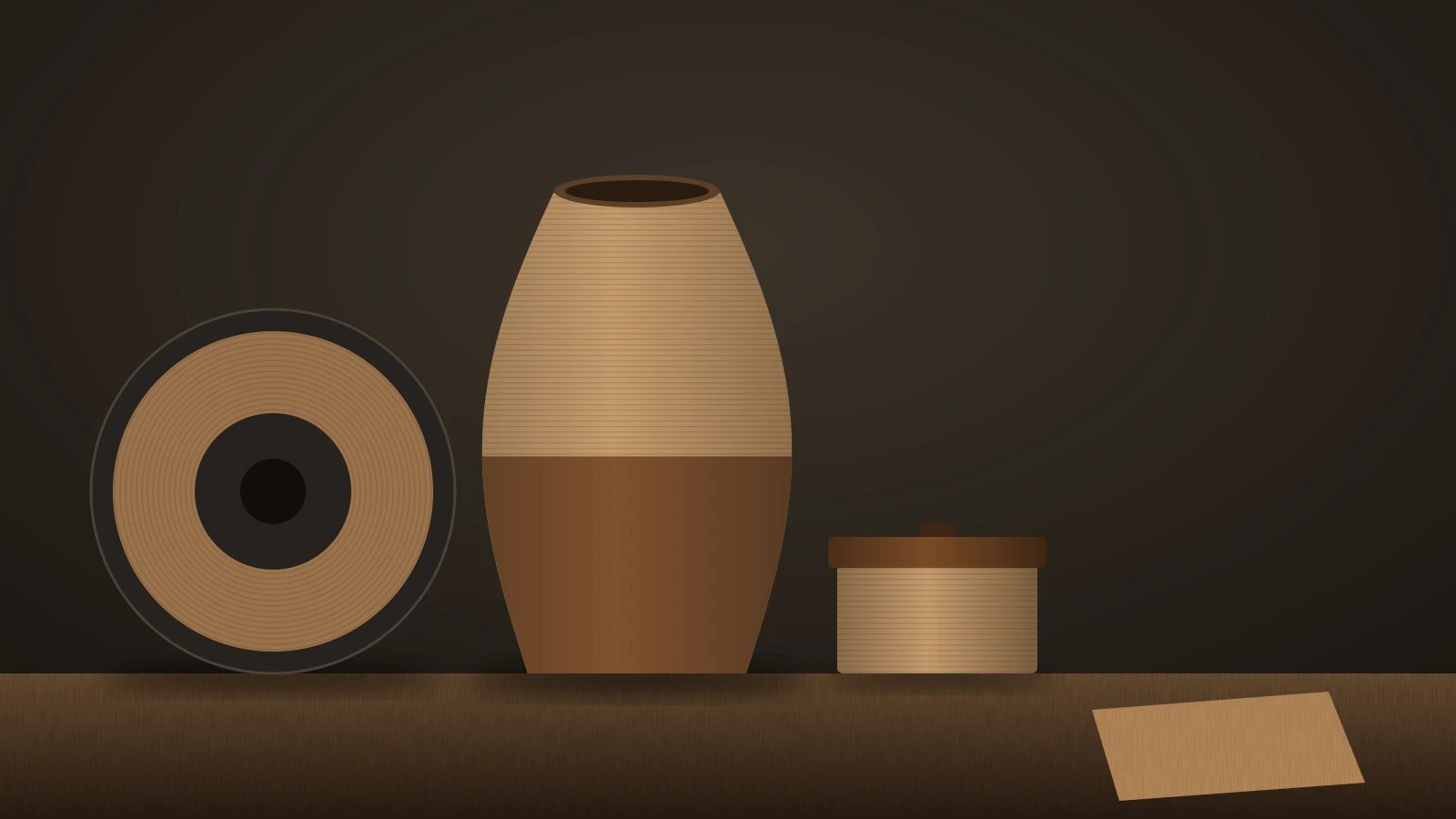
Wood PLA is PLA filament blended with fine wood powder or fibers (10–18% by weight in Bambu Lab’s PLA Wood) that prints into matte parts which look, feel and even smell like wood. It prints at ordinary PLA temperatures, about 190–240 °C (374–464 °F), but clogs small nozzles, absorbs moisture and is weaker than plain PLA.
What you buy as “wood filament” varies more than the label suggests. Some spools hold real wood particles, one popular brand holds none, and the settings, nozzle and finishing all follow from that. For the base material, see our guide to PLA filament.
The short answer
| Wood PLA filament | |
|---|---|
| What it is | PLA with wood powder or fibers; Bambu Lab PLA Wood is 10–18% wood by weight |
| Nozzle temperature | 190–240 °C (Bambu Lab), 195 ± 10 °C (Prusament Woodfill), 200–220 °C (colorFabb) |
| Bed temperature | 35–45 °C (Bambu Lab), 50–70 °C (colorFabb, Prusament) |
| Nozzle size | 0.6 mm or larger (Prusa); 0.4 mm works for some brands |
| Strength | Lower than plain PLA and more brittle |
| Drying | Required before use by Bambu Lab: 55 °C for 8 h (data sheet) |
| Finishing | Sands and stains like wood |
| Best for | Decorative pieces, boxes, figurines, props, anything meant to look wooden |
| Skip it for | Load-bearing parts, fine 0.2 mm nozzles, food contact |
What is wood PLA filament?
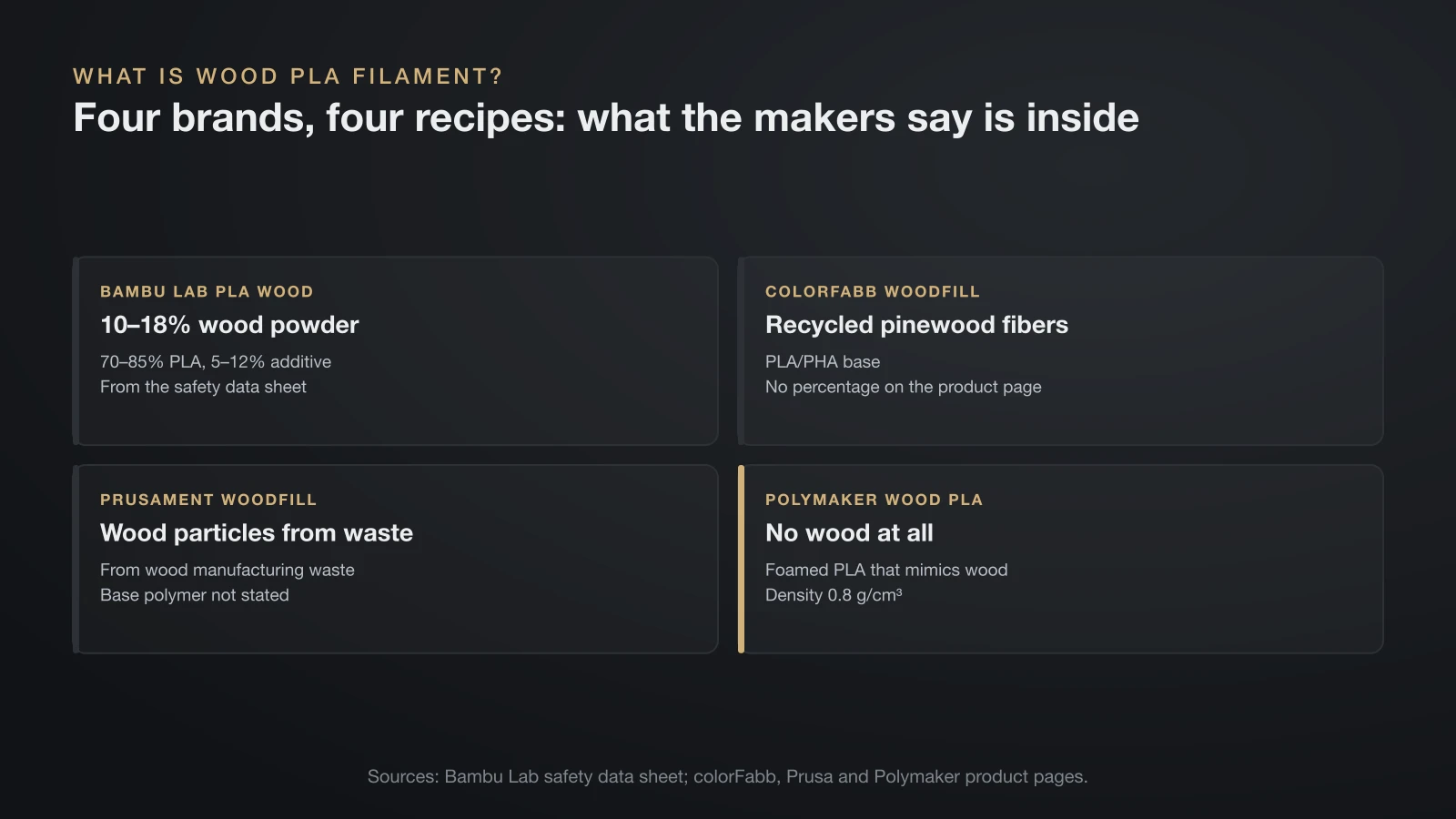
Wood PLA filament is standard PLA mixed with ground wood particles and a small share of additives. The plastic does the structural work and the wood provides color, texture and a matte surface. Prusa describes wood- and metal-filled filaments as usually PLA or PETG based and used mainly for looks.
Brands disclose very different recipes:
| Filament | What the maker says is inside |
|---|---|
| Bambu Lab PLA Wood | 70–85% PLA, 10–18% wood powder, 5–12% additive (safety data sheet) |
| colorFabb woodFill | PLA/PHA with fine recycled pinewood fibers (no percentage stated on the product page) |
| Prusament Woodfill | Wood particles from wood manufacturing waste (base polymer not stated) |
| Polymaker Wood PLA | No wood: foamed PLA that mimics wood, density 0.8 g/cm³ |
Polymaker’s version deserves a note. Formerly sold as PolyWood, it is made entirely of PLA with a foaming technology, so it looks and weighs like wood without the clog risk of real particles.
Wood PLA vs regular PLA
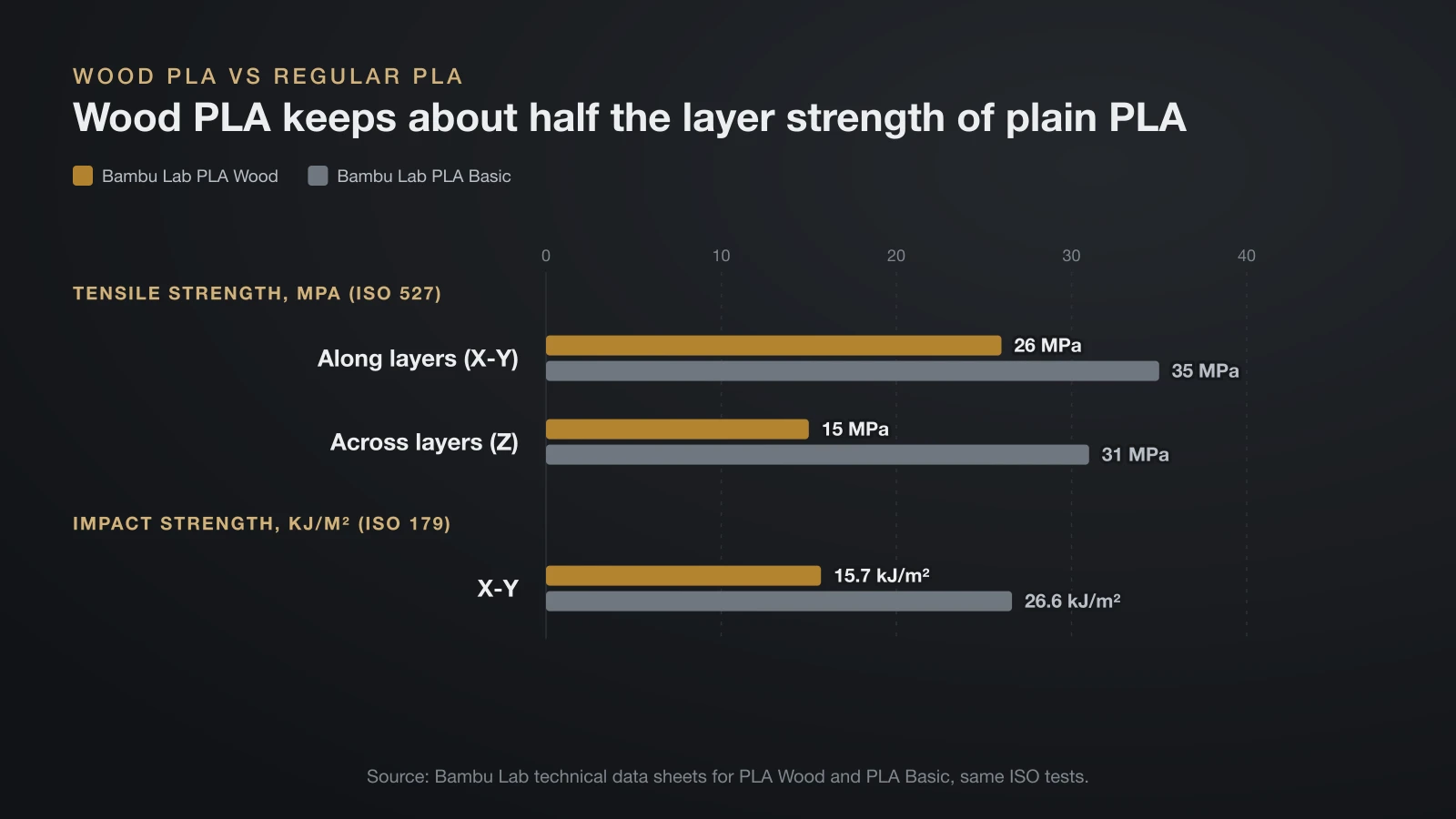
Wood PLA prints almost like regular PLA but is weaker, more brittle and much thirstier for moisture. Bambu Lab publishes data sheets for both materials with the same ISO tests, which makes a clean comparison.
| Bambu Lab data sheet | PLA Basic | PLA Wood |
|---|---|---|
| Density | 1.24 g/cm³ | 1.21 g/cm³ |
| Glass transition (DSC) | 60 °C | 54 °C |
| Heat deflection, 0.45 MPa (ISO 75) | 57 °C | 60 °C |
| Tensile strength, X-Y (ISO 527) | 35 MPa | 26 MPa |
| Tensile strength, Z (layer bond) | 31 MPa | 15 MPa |
| Impact strength, X-Y (ISO 179) | 26.6 kJ/m² | 15.7 kJ/m² |
| Saturated water absorption (25 °C, 55% RH) | 0.43% | 1.25% |
| Nozzle temperature | 190–230 °C | 190–240 °C |
| Nozzle sizes | 0.2–0.8 mm | 0.4–0.8 mm |
| Drying | 50 °C, 8 h | 55 °C, 8 h |
The weak point is the layer bond: PLA Wood reaches about half of PLA Basic’s strength across layers in this data. Heat resistance is similar, so wood PLA softens near 55–60 °C like any PLA; our guide to the PLA melting point explains those limits.
Wood PLA print settings
Print wood PLA at the brand’s listed nozzle temperature, usually around 195–220 °C, on a 0.4 mm or larger nozzle, with moderate speed and short retraction. The three makers below give the clearest official settings.
| Setting | Bambu Lab PLA Wood | Prusament Woodfill | colorFabb woodFill |
|---|---|---|---|
| Nozzle | 190–240 °C | 195 ± 10 °C | 200–220 °C |
| Bed | 35–45 °C, glue | 60 ± 10 °C | 50–60 °C |
| Build surface | Textured or smooth PEI | Satin, or smooth PEI with glue stick; not textured | Clean glass or PEI |
| Nozzle size | 0.4, 0.6 or 0.8 mm | 0.4 mm brass works | 0.4 mm or larger |
| Speed | Under 250 mm/s | Not listed | 40–60 mm/s, about 30 mm/s for detail |
| Retraction | 0.6–1.0 mm | Not listed | 1–2 mm at 20–30 mm/s |
| Part cooling fan | On | Not listed | 30–50% |
colorFabb suggests a 0.2 mm layer height as a starting point, and Prusa recommends at least 0.2 mm layers for wood-filled materials. Prusa also lists strong adhesion to PEI as a downside of Prusament Woodfill and calls for a separation layer such as glue stick.
Nozzle size and clogs
Wood particles are the main clog risk, so give them room. Prusa recommends at least a 0.6 mm nozzle and 0.2 mm layers for wood-filled filaments other than its own Prusament Woodfill, which it says prints on a standard 0.4 mm brass nozzle. Bambu Lab rules out its 0.2 mm nozzle for PLA Wood.
To keep the nozzle clear:
- Use the largest nozzle the detail allows, 0.6 mm if you print wood PLA often. Our 3D printer nozzle guide compares sizes and materials.
- Keep retraction short. colorFabb warns that excessive retraction can cause clogs, especially with Bowden extruders.
- Clean the nozzle regularly, as colorFabb advises.
If a jam does happen, our guide to a clogged 3D printer nozzle walks through cold pulls and other fixes.
Temperature and color
Nozzle temperature changes the shade of wood PLA. colorFabb states that higher temperatures produce a darker color and lower ones a lighter color, so keep the temperature constant for an even finish. Bambu Lab adds that natural wood powder can cause slight color variation, depending on drying level and raw material.
How to finish wood PLA: sanding, staining and sealing
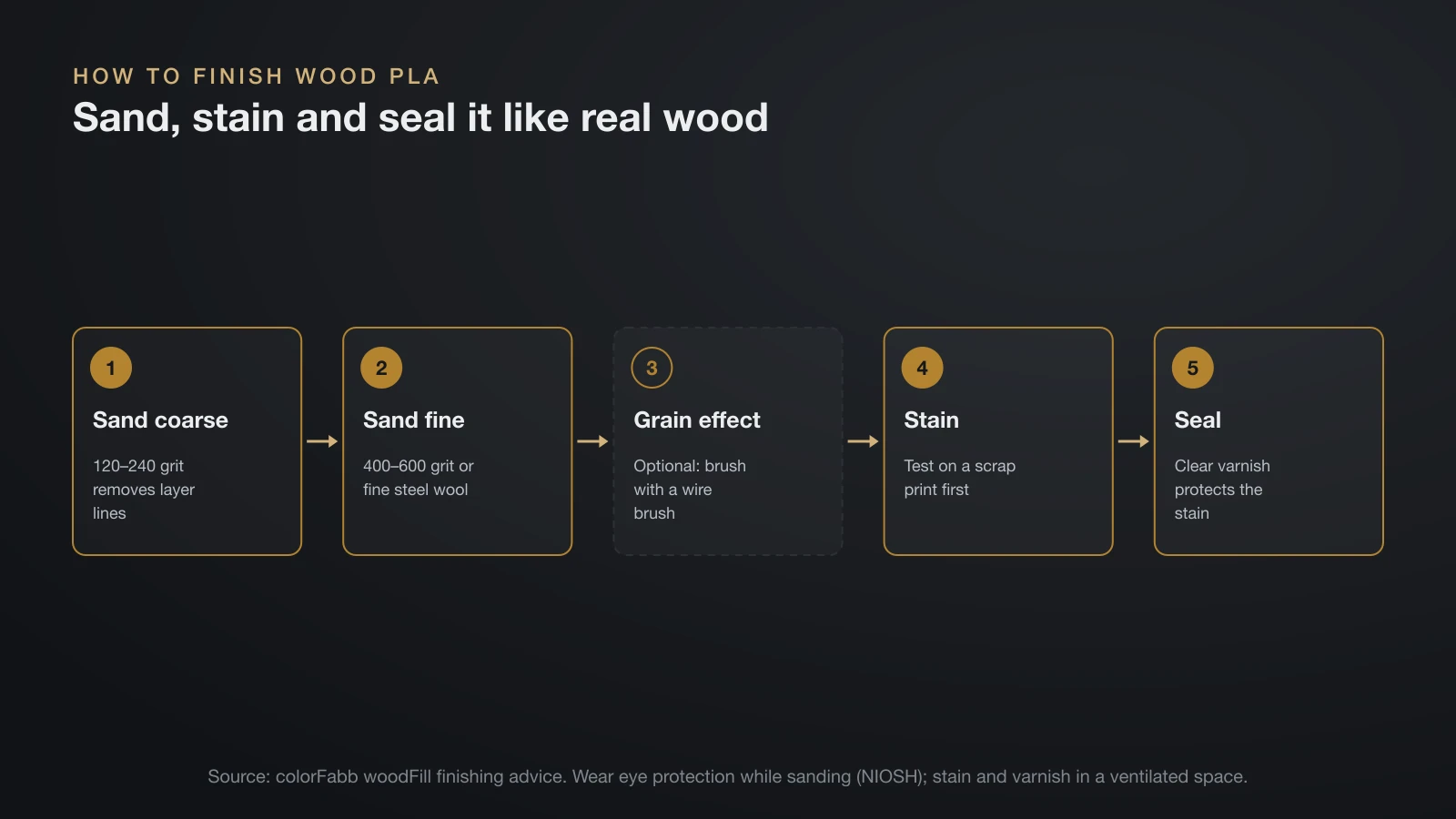
Wood PLA can be sanded, stained and sealed much like real wood, which is the main reason to choose it over a brown plain PLA. Prusa says wood-filled prints can be stained to highlight their texture and give them a weathered look, and colorFabb lists sanding, steel wool, stain and varnish.
A finishing sequence based on colorFabb’s advice:
- Sand coarse: 120–240 grit to remove layer lines.
- Sand fine: 400–600 grit for a smooth surface, or fine steel wool for a polished look.
- Raise a grain effect (optional): colorFabb describes brushing the surface with a wire brush.
- Stain: test on a scrap print first, then apply wood stain to darken the color or match a wood tone.
- Seal: a clear varnish protects the surface and the stain.
Protect yourself while sanding. NIOSH recommends eye protection during sanding and grinding, wet wiping and a HEPA-filtered vacuum for cleanup instead of dry sweeping. Prusa warns that thin protrusions and surface details break easily, so sand around them with care. Use stains and varnishes in a ventilated space, following the product label.
Fumes, smell and safety
Wood PLA gives off a mild wood smell while printing, which Bambu Lab attributes to the wood powder, and the maker still asks for a well-ventilated room or an air filtration system. In a 2016 chamber study, Azimi and colleagues found caprolactam among the largest volatile emissions from nylon-based and imitation wood and brick filaments, at roughly 2–180 µg per minute across those samples.
Treat it like any other filament: print in a ventilated room, keep the nozzle at the lowest temperature that prints well, as NIOSH advises, and keep filament scraps out of reach of children and pets, as Bambu Lab advises. Bambu Lab states its PLA Wood is not food grade, so skip it for cups, plates and food containers.
Woodworking 3D prints: jigs, templates and guides
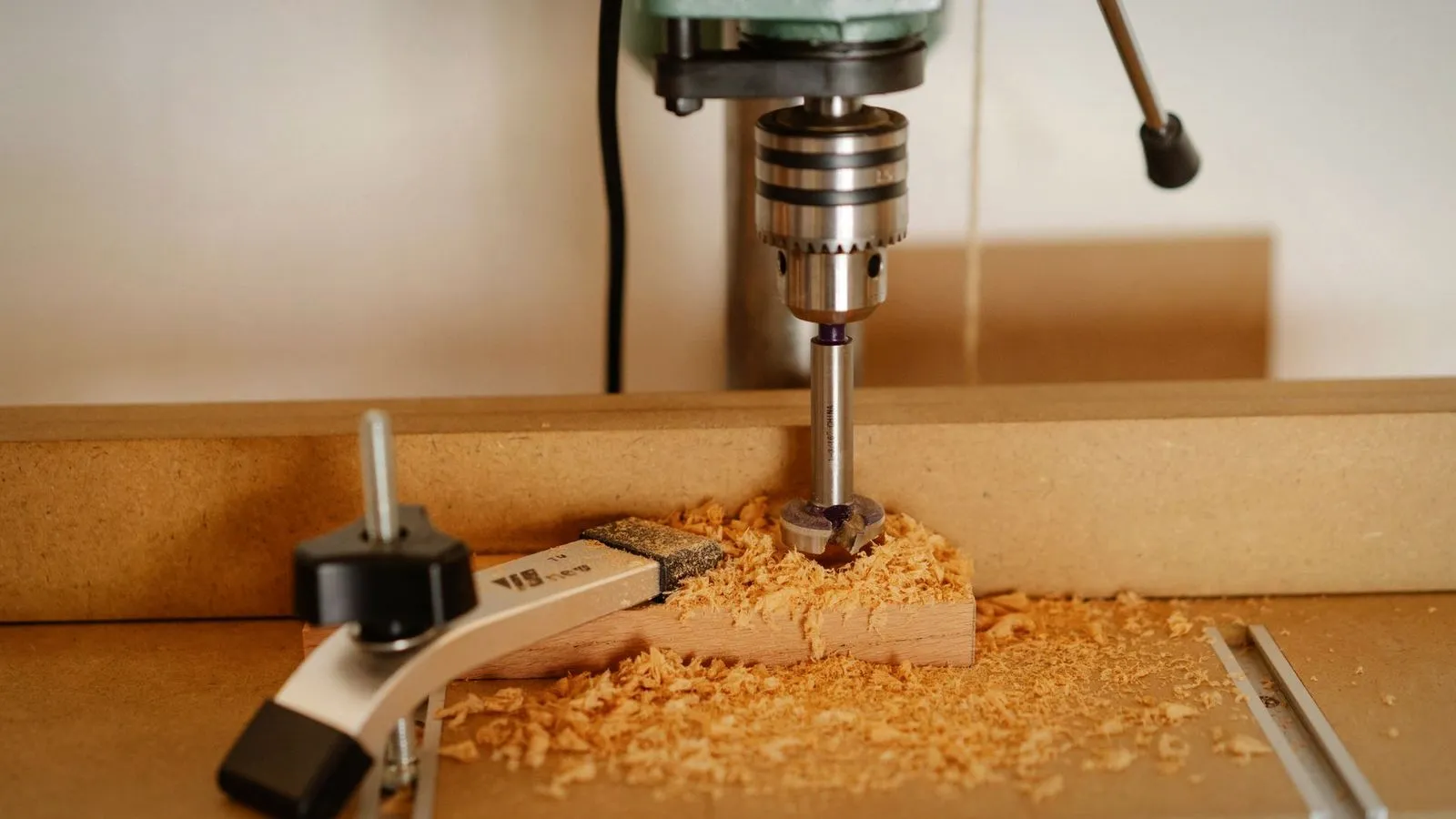
3D printing pairs well with woodworking for jigs, templates and small shop aids, but those parts should usually be printed in plain PLA, PETG or a tougher filament rather than wood PLA. Shop aids need strength and a solid layer bond, the two properties where wood PLA falls behind in Bambu Lab’s data.
Common woodworking 3D prints:
- Drilling jigs and dowel guides that set hole spacing and depth.
- Marking and layout templates, such as corner radius and spacing gauges.
- Router templates and guide bushing adapters for repeated shapes.
- Clamp pads, glue spreaders and featherboard parts.
- Hardware aids: hinge and shelf-pin jigs.
Keep printed parts away from blade and bit contact, and never use a print as a guard or safety device. Our guide to 3D printed tools covers which shop tools print well and which materials to use.
Wood PLA does have a place in the shop: knobs, drawer pulls, inlays and small boxes that should blend in with real wood. Projects that depend on light shining evenly through the plastic, such as a lithophane 3D print, call for plain filament instead.
How to store and dry wood PLA
Store wood PLA sealed with desiccant and dry it before printing, because the wood particles soak up moisture faster than plain PLA. Bambu Lab recommends drying PLA Wood right after opening, at 55 °C (131 °F) for 8 hours in a forced-air oven, then keeping it below 20% relative humidity in a sealed container or its AMS.
Two cautions apply. Bambu Lab says a microwave or kitchen oven can damage filament, and its PLA Wood spool is ABS rated to 70 °C, above the 55 °C drying temperature. Prusament Woodfill is the exception that does not need drying, according to Prusa. Our filament storage guide covers boxes, desiccants and humidity targets.
The bottom line
Wood PLA is PLA with a minority share of wood particles (10–18% in Bambu Lab’s), or foamed PLA in Polymaker’s case, chosen for its wood look, smell and ability to take stain. Print it at the brand’s PLA-like temperatures on a 0.6 mm nozzle if you can, keep retraction short and the spool dry. Sand and stain it for a real wood finish, but use plain PLA or PETG for anything that carries a load.
Sources
- Bambu Lab: PLA Wood technical data sheet, PLA Wood safety data sheet, PLA Wood product page and PLA Basic data sheet (composition 70–85% PLA, 10–18% wood powder; print, drying and storage settings; nozzle sizes; density, glass transition, heat deflection, tensile, impact and water absorption; color variation, smell, ventilation, not food grade, spool rating, oven warning)
- Prusa Knowledge Base: Composite materials with metal or wood particles and Prusament Woodfill (PLA or PETG base, clog risk, minimum 0.6 mm nozzle and 0.2 mm layers, weaker mechanical resistance and layer adhesion, fragile details, staining; 195 ± 10 °C, 60 ± 10 °C, 0.4 mm brass, sheets, no drying needed, brittle)
- colorFabb: woodFill product page and How to print with woodFill (PLA/PHA with recycled pinewood fibers; 200–220 °C, 50–60 °C bed, speed, layer height, retraction, fan, nozzle advice, darker color at higher temperature, sanding grits, steel wool, wire brush, stain, varnish)
- Polymaker: Wood PLA product page (no wood powder, foamed PLA, density 0.8 g/cm³)
- Safety: NIOSH (CDC) Approaches to Safe 3D Printing, publication 2024-103 (lowest printing temperature, eye protection for sanding, wet wiping, HEPA vacuum) and Azimi P. et al. (2016), Emissions of ultrafine particles and VOCs from desktop 3D printers, Environ. Sci. Technol. 50(3) (caprolactam from imitation wood filaments)