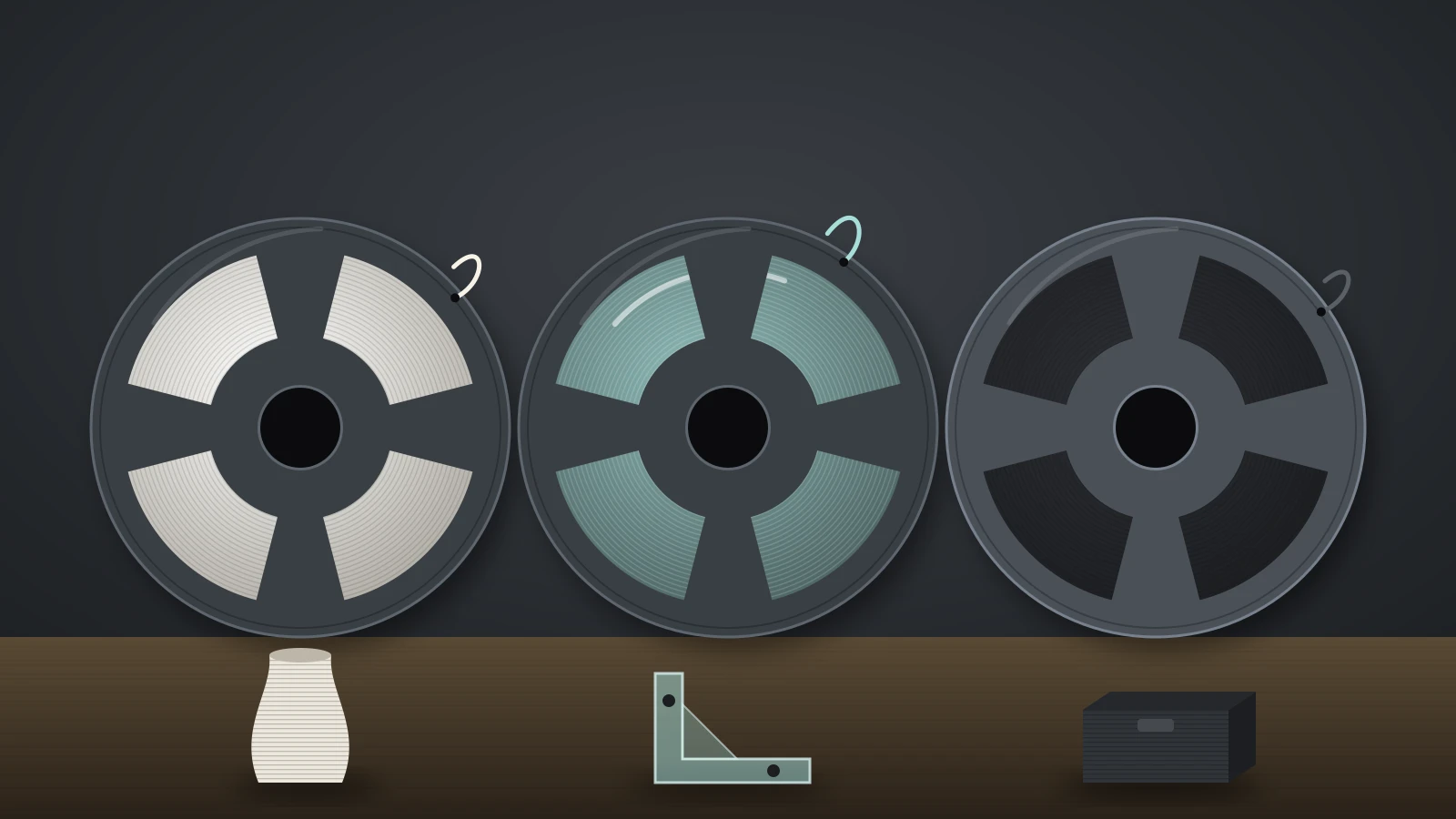

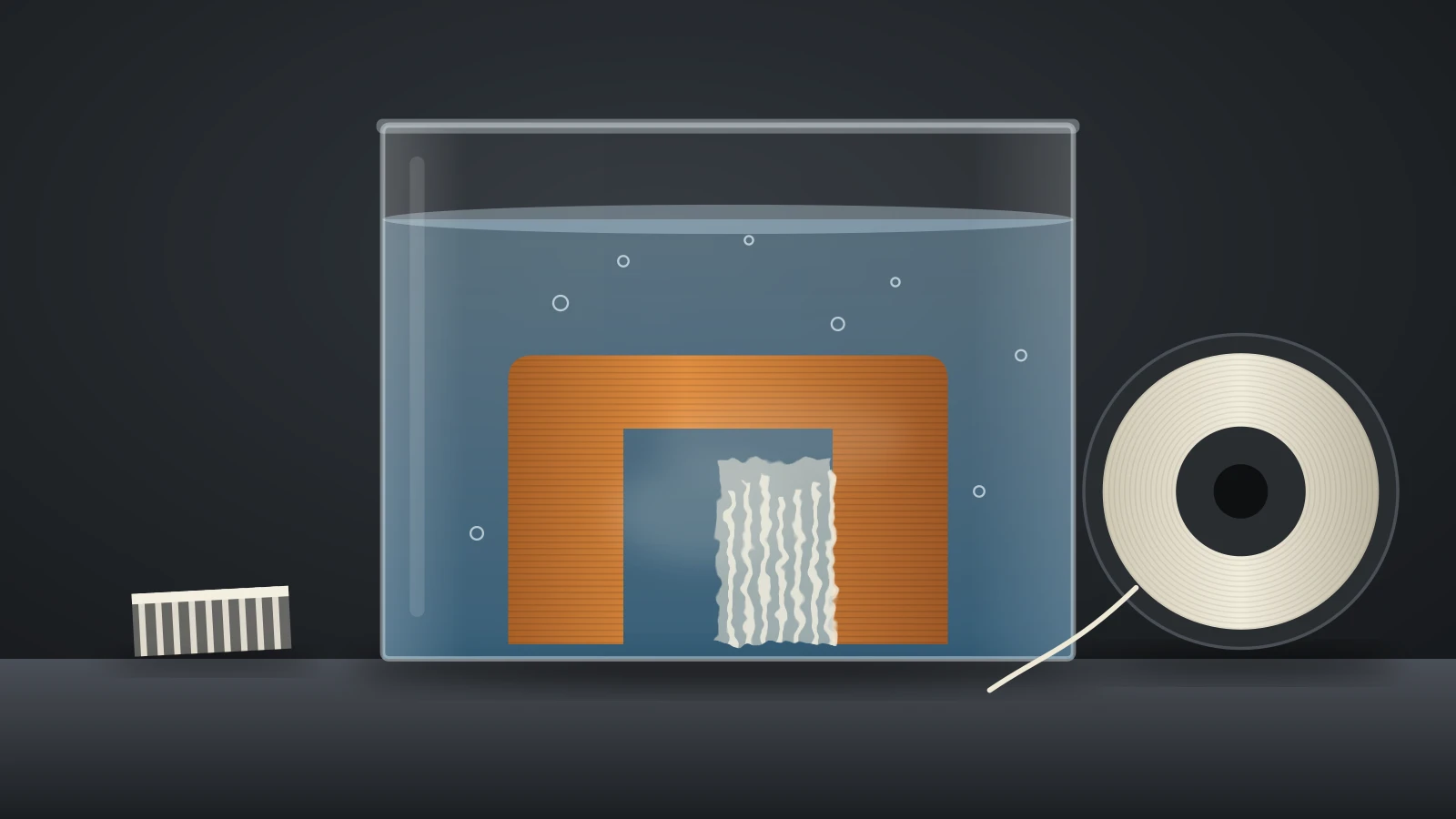
PVA filament (polyvinyl alcohol) is a water-soluble support material for 3D printers that can print two materials at once. You print the model in PLA or another compatible plastic, print the supports in PVA, then soak the part in water until the supports dissolve. It leaves clean undersides and internal cavities that breakaway supports cannot reach.
The catch is handling. PVA absorbs moisture fast and needs a printer with a second nozzle or a filament changer. Bambu Lab, Polymaker, Prusa and UltiMaker each publish settings, drying and dissolving advice for their own soluble filaments, and they don’t always agree. For the support settings themselves, see our guide to 3D printing supports.
The short answer
| PVA filament | |
|---|---|
| What it is | Polyvinyl alcohol, a water-soluble support material |
| Printer needed | Dual nozzle, tool changer or automatic filament changer |
| Best partner | PLA; Polymaker also lists TPU, PVB and nylon |
| Nozzle temperature | 215–225 °C (Polymaker), 220–250 °C (Bambu Lab) |
| Bed temperature | 25–60 °C (Polymaker), 35–45 °C (Bambu Lab) |
| Storage while printing | Below 20% relative humidity, sealed with desiccant |
| Drying | 75–85 °C for 8–12 h (Bambu Lab), 80 °C for 12 h (Polymaker) |
| Dissolving | Plain water, warm and moving; at most 50 °C (122 °F) for PLA parts |
| Waste water | Down the drain only if it goes to a wastewater treatment plant (UltiMaker) |
What is PVA filament used for?
PVA filament is used almost only for support structures that you want to remove without tools. Bambu Lab describes PVA as a flexible, biodegradable polymer that absorbs moisture easily and dissolves in liquid water. Prusa describes BVOH and PVA as special water-soluble materials used mainly for printing supports.
Soluble supports solve three problems that breakaway supports handle badly:
- Internal cavities and channels: water reaches places that pliers cannot, such as the inside of a print-in-place mechanism.
- Clean undersides: Prusa recommends a support Z distance of 0 mm with soluble supports, so the support touches the part directly and leaves no gap marks.
- Fragile parts: Bambu Lab notes that dissolving lowers the risk of damaging the part during support removal.
PVA is not a material for finished parts: it dissolves in water, softens when damp and, as Prusa notes, has a high price. Treat it as a consumable that ends up down the drain.
How water-soluble supports work
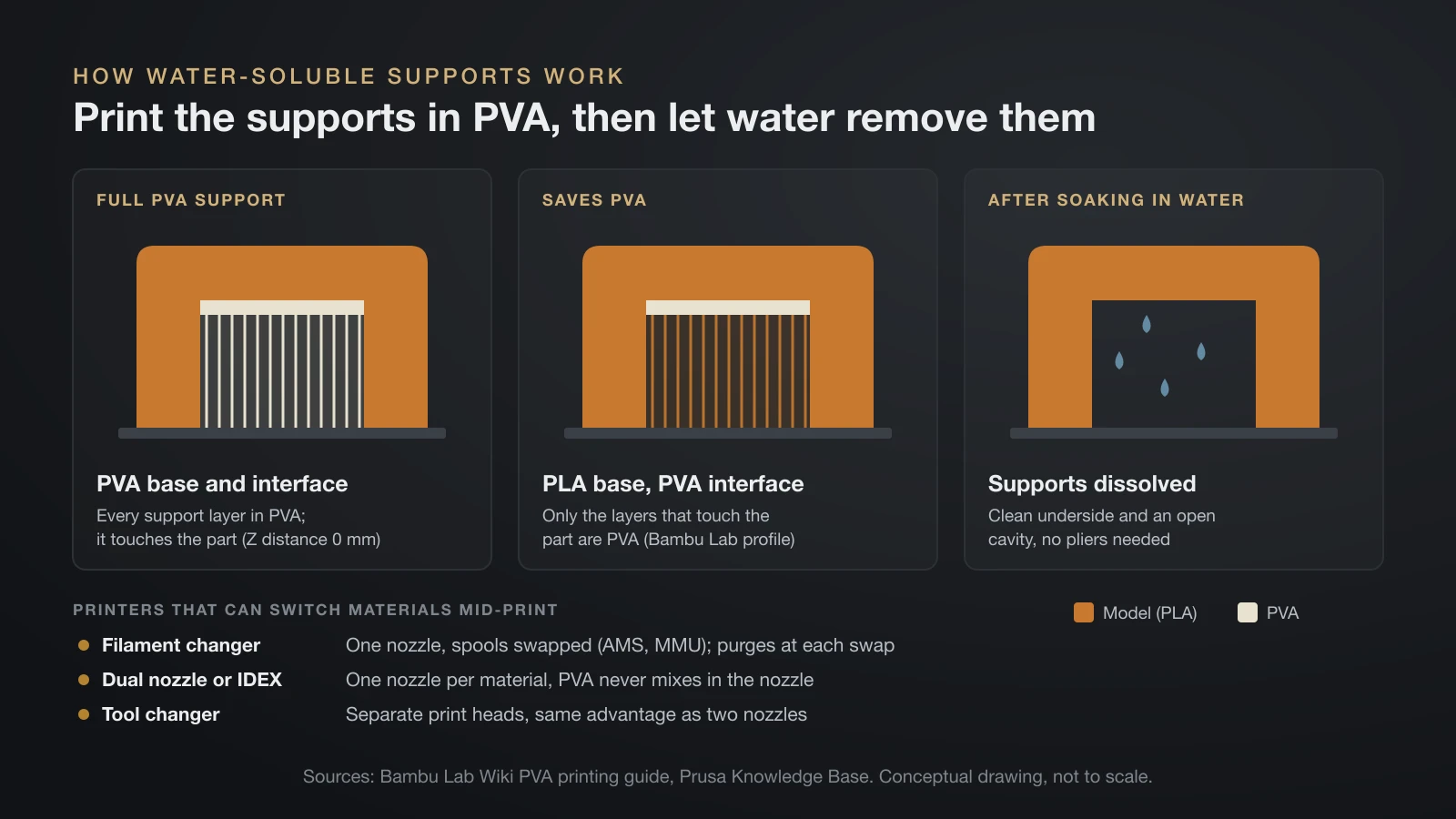
Water-soluble supports work by printing two materials in the same job: the model in its normal filament and every support layer in PVA. That needs a printer that can switch materials during a print. Our guide to multi-color 3D printers explains the three common designs:
- Filament changer: one nozzle, with a unit such as Bambu Lab’s AMS or Prusa’s MMU swapping spools. Each swap purges the old material, which adds waste and time.
- Dual nozzle or IDEX: two nozzles, one per material, so PVA never mixes with the model filament inside a hot nozzle.
- Tool changer: separate print heads, with the same advantage as two nozzles.
Prusa warns that frequent filament changes can leave traces of PLA in the supports and stop them dissolving fully; more purging reduces the effect.
PVA for the whole support or only the interface
Bambu Lab’s guide recommends PVA for both the support base and the support interface, printed as normal grid supports rather than tree supports, which it calls too tall and unstable in PVA. It also publishes a profile that prints the support base in PLA and only the interface layers in PVA, which uses far less of the expensive filament.
What to check before buying PVA filament
Before you buy PVA filament, check that the brand states which model materials it supports and that the spool arrives sealed, since a material mismatch or damp filament ruins soluble supports faster than any printer setting.
- A published data sheet with print temperature, drying settings and a list of compatible model materials. Polymaker’s PolyDissolve S1 sheet rates adhesion with each of its material families.
- The partner you print most. PLA works with every PVA covered here; PETG, ABS and PC are brand-dependent (see the table below).
- Spool size. PVA is often sold on smaller spools: Bambu Lab’s comes as 0.5 kg net. A smaller spool spends less time open to room air.
- Packaging and storage. Look for a vacuum-sealed bag with desiccant, and plan a sealed dry box for printing, as covered in our filament storage guide.
- Feeder compatibility. Check whether your filament changer accepts PVA, and in what condition. Bambu Lab says damp PVA turns soft and sticky and is no longer suitable for its AMS units.
Which materials work with PVA supports?
PVA supports work best with PLA, because both print at similar nozzle temperatures and PVA bonds well to it. Prusa recommends PLA as the main material for exactly that reason. Beyond PLA, the makers disagree:
| Model material | Polymaker PolyDissolve S1 | Bambu Lab PVA | Prusa (BVOH and PVA) |
|---|---|---|---|
| PLA | Supports the model very well | Supported | Recommended main material |
| PETG | Generally supports, depending on geometry | Not compatible | Not listed; Prusa suggests HIPS for PETG |
| ABS | Generally doesn’t support, depending on geometry | Not listed | Not listed |
| PC | Generally doesn’t support, depending on geometry | Not listed | Not listed |
| TPU, nylon, PVB | Supports the model very well | Not listed | Not listed |
Polymaker’s ratings apply to its own filament families, so treat them as a guide for other brands, not a guarantee. Polymaker also names PolyDissolve S1 as a recommended support material for its foaming LW-PLA.
PVA filament print settings
PVA filament prints at roughly PLA temperatures, with a cool bed and the part fan on. The three makers publish these settings for their own filaments:
| Setting | Polymaker PolyDissolve S1 | Bambu Lab PVA | Prusa (PVA+ / BVOH) |
|---|---|---|---|
| Nozzle | 215–225 °C | 220–250 °C | 195 °C / 215 °C |
| Bed | 25–60 °C | 35–45 °C | 60 °C |
| Build surface | PC or textured PEI | Cool, high temperature or textured PEI plate, with glue | Smooth PEI or satin sheet |
| Part cooling fan | On | On | Not stated |
| Speed | 50–150 mm/s | Below 200 mm/s | Not stated |
| Retraction | 1–3 mm at 20–40 mm/s | 0.6–1.0 mm at 20–40 mm/s | Not stated |
| Enclosure | Not needed | Chamber 25–45 °C | Not stated |
Bed adhesion is PVA’s weak spot. Prusa says BVOH and PVA stick poorly to the print surface, much better to PLA than to PEI, and advises against printing them directly on the bed: print a raft of one or two PLA layers under the supports instead. If the PLA itself lifts, our guide to a 3D print not sticking to the bed covers the fixes.
When loading, Bambu Lab suggests feeding the filament by hand first to check that it extrudes straight down at 240–250 °C. If it curls or sputters even though the spool is dry, do a cold pull or replace the nozzle.
How to dry and store PVA filament
PVA filament must be kept dry from the moment the bag is opened, because it takes on water far faster than common filaments. Bambu Lab gives the timescale: in a room at about 55% relative humidity (RH), freshly dried PVA gets damp enough to hurt print quality in roughly 1–3 hours. In a dry box at 20% RH, it stays dry for about 1–3 days.
Polymaker’s moisture curve for PolyDissolve S1 tops out at 10.21% water absorption at 70% RH and 23 °C. Bambu Lab links damp PVA to loading failures, stringing and clogs.
- Drying: Bambu Lab’s drying guide lists 75–85 °C for 8–12 hours in a forced-air oven; Polymaker lists 80 °C for 12 hours. Our filament dryer guide covers dryer types and spool heat limits.
- Static drying: Bambu Lab warns that PVA should not be dried in a static mode without the spool turning, because the windings can stick together.
- Straight into storage: move the spool into a sealed box right after drying, without waiting for it to cool.
- Desiccant: Bambu Lab’s PVA guide prefers calcium chloride desiccant for PVA, saying silica gel cannot keep it dry for long.
- Quick check: Bambu Lab says properly dried PVA feels stiffer to bend than its PLA Basic filament, and its guide compares it with a strand left in room air for 15 minutes.
How to dissolve PVA supports
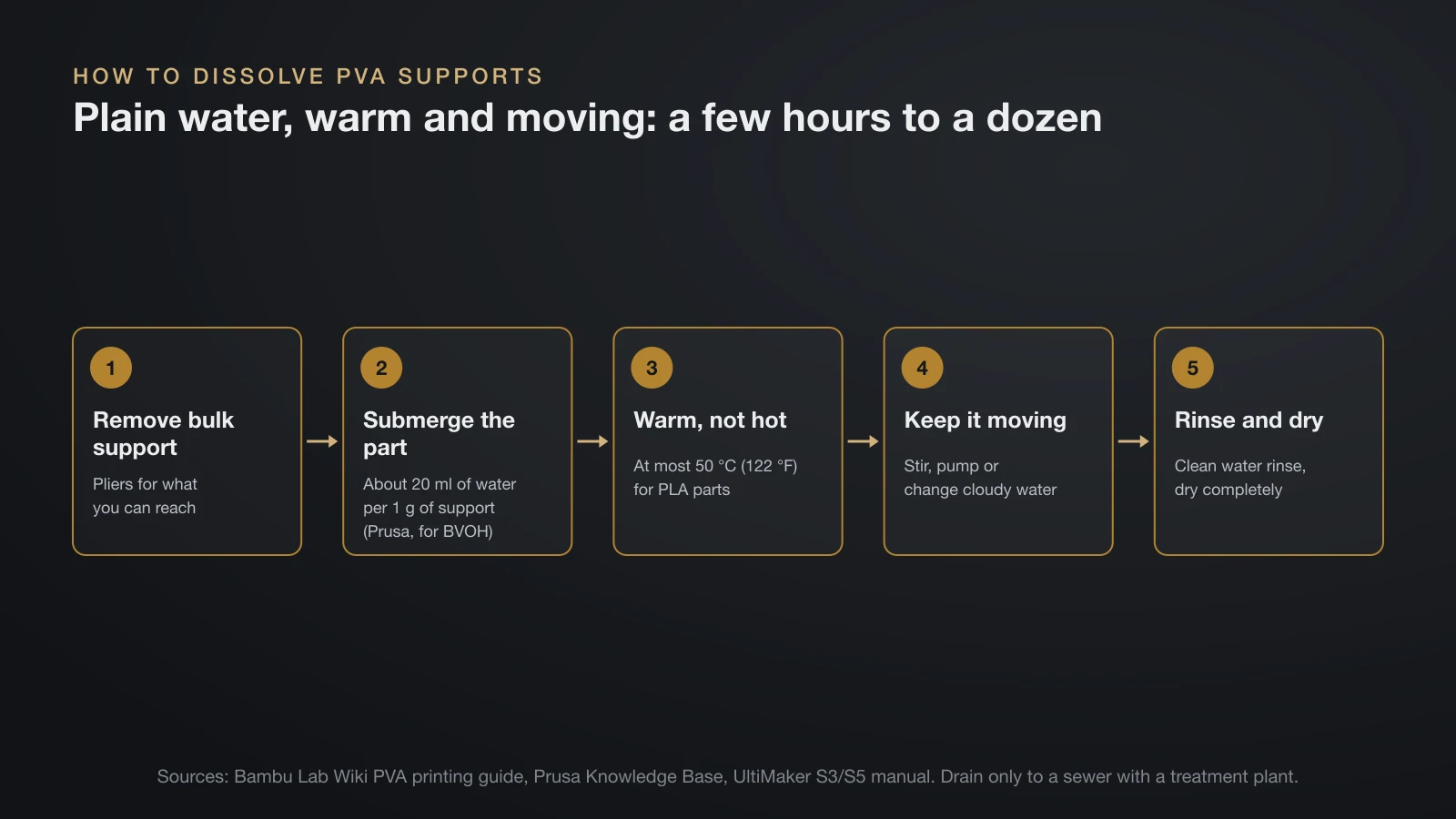
PVA supports dissolve in plain tap water; no chemicals are needed. Bambu Lab says the process takes from a few hours to a dozen hours, and that warm water and agitation speed it up.
- Remove what you can by hand. Bulk support that pliers can reach does not need to dissolve.
- Submerge the part in water. Use enough of it: Prusa gives a rough ratio of 1 g of BVOH to about 20 ml of water.
- Keep the water warm, not hot. For PLA parts, Bambu Lab sets 50 °C (122 °F) as the limit, so the part does not deform.
- Keep the water moving. Stirring, a pump or regular water changes help, because Bambu Lab says agitation speeds dissolving.
- Rinse and dry. UltiMaker’s steps are to rinse the print with clean water to remove leftover PVA, then let it dry completely.
Bambu Lab warns that water can seep into the voids inside a typical print during soaking. Reused water works too, but UltiMaker notes that it saturates with dissolved PVA over time and slows the process.
How to dispose of dissolved PVA water
UltiMaker says the water can go down the drain, provided the local sewer network is connected to a wastewater treatment plant. It describes PVA as biodegradable and recommends checking local regulations for fuller guidance.
After pouring it away, UltiMaker suggests running hot tap water for about 30 seconds to flush out saturated PVA water and avoid long-term clogging. A septic tank is not a wastewater treatment plant, so UltiMaker’s condition is not met there; for any other outlet, follow your local rules.
PVA vs BVOH vs HIPS
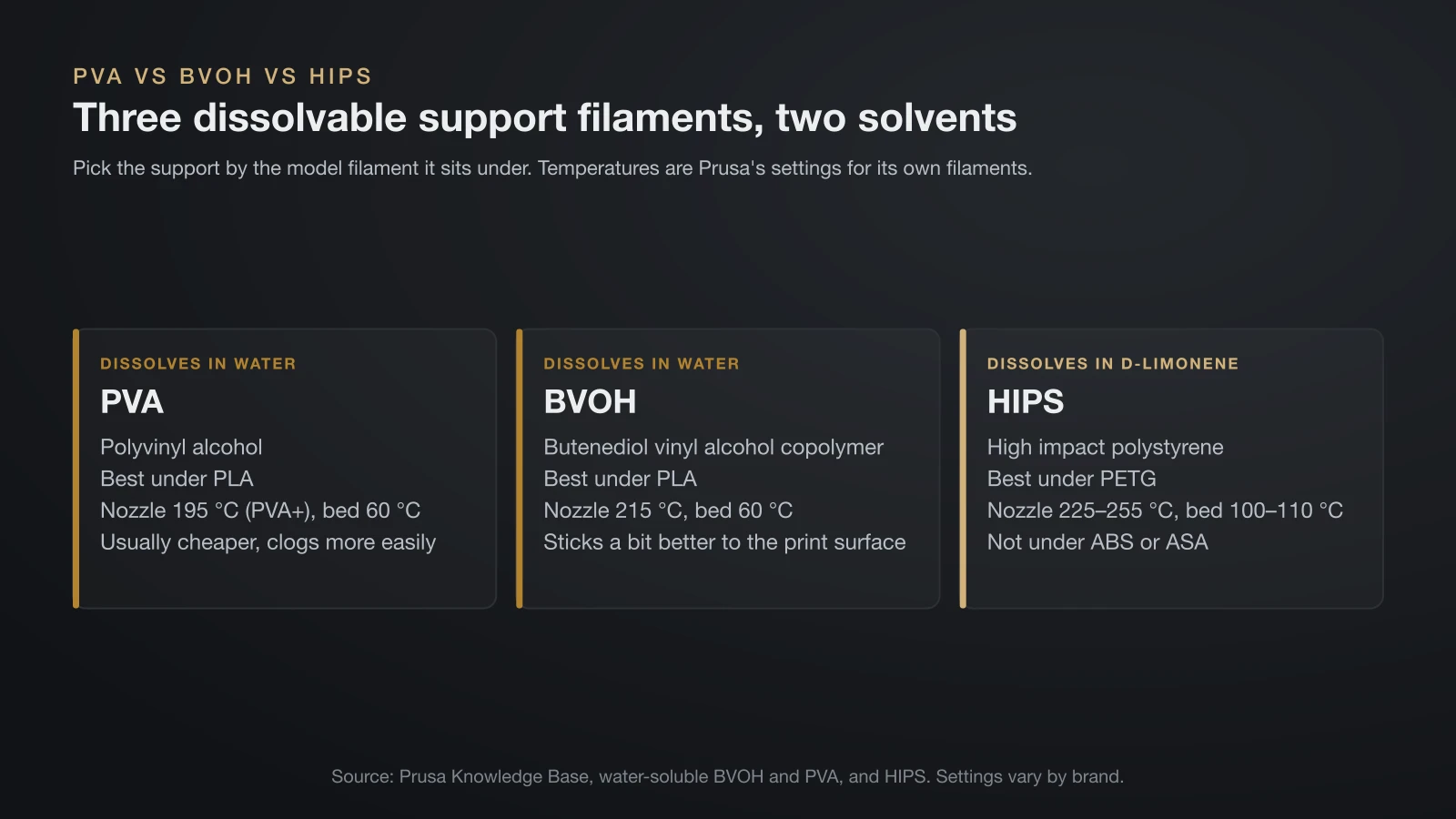
PVA, BVOH and HIPS are the three common dissolvable support materials, and the right one depends on your model filament. PVA and BVOH dissolve in water; HIPS needs a solvent.
| PVA | BVOH | HIPS | |
|---|---|---|---|
| Full name | Polyvinyl alcohol | Butenediol vinyl alcohol copolymer | High impact polystyrene |
| Dissolves in | Water | Water | d-Limonene |
| Best model material | PLA | PLA | PETG (per Prusa) |
| Prusa’s nozzle setting | 195 °C (PVA+) | 215 °C | 225–255 °C |
| Prusa’s bed setting | 60 °C | 60 °C | 100–110 °C |
| Notes from Prusa | Usually cheaper; more prone to clogging | Sticks a bit better to the print surface | Unsuitable under ABS or ASA, which partly dissolve in limonene |
Prusa does not recommend soaking HIPS parts for long: it suggests a brief dip in limonene to loosen the supports, then removal by hand. Limonene can leave a lasting citrus smell on the part.
Common PVA printing problems
Most PVA printing problems trace back to moisture or the support layout, so check those before changing anything else:
- Clogs and feeder jams: dry the spool. Prusa notes that PVA clogs more readily than BVOH, and Bambu Lab says damp PVA turns soft and sticky. Its guide suggests feeding from a sealed dry box, or from an AMS HT used as a heated dry box: drying mode at about 80 °C, spool rotation off and no automatic loading.
- Collapsed supports: use normal grid supports instead of tree supports.
- Supports that won’t fully dissolve: raise the purge volume so PLA does not contaminate the PVA.
PVA glue is not PVA filament
The “PVA” on bottles of white craft glue usually stands for polyvinyl acetate, a different polymer from the polyvinyl alcohol in support filament. Glue sticks used on a build plate are a bed adhesive or release layer, not a support material, and you can’t print them. For which glue to use on the bed or to join PLA parts, see our guide to glue for PLA.
The bottom line
PVA filament gives the cleanest supports a home printer can make, as long as you have a two-material setup and keep the spool bone dry. Pair it with PLA, print it at roughly PLA temperatures on a PLA raft, store it below 20% RH and dissolve it in warm, moving water no hotter than 50 °C. For PETG, test first or switch to HIPS; for ABS and ASA, PVA is the riskier choice.
Sources
- Bambu Lab: PVA technical data sheet V1.0 (settings, spool), Wiki PVA printing guide (moisture, supports, PETG, dissolving) and Filament drying recommendations (drying)
- Polymaker: PolyDissolve S1 technical data sheet V5.5 (compatibility, settings, drying, moisture curve) and PolyLite LW-PLA data sheet (recommended support material)
- Prusa Knowledge Base: Water-soluble BVOH and PVA (settings, raft, dissolving ratio) and HIPS (limonene, compatibility)
- UltiMaker: UltiMaker S3 and S5 user manual, section 4.5 (dissolving and disposal)