
ABS vs PLA comes down to heat against ease. PLA prints at 190–230 °C (374–446 °F) on a cool bed and is a little stiffer, but it softens near 55–60 °C (131–140 °F). ABS needs 240–270 °C (464–518 °F), a hot bed and an enclosure, but holds its shape to about 84–87 °C (183–189 °F) and takes knocks better.
PLA is the default for models and indoor parts; ABS is the upgrade for parts that get warm or take impacts. Full settings for each live in our ABS filament guide and PLA filament guide.
The numbers below come from one maker, Bambu Lab, whose version 3.0 data sheets test both plastics with the same ISO methods; compare within one brand, because others differ slightly.
The short answer
| PLA | ABS | |
|---|---|---|
| Ease of printing | Easy, open printer is fine | Harder: hot bed, enclosure, warping |
| Nozzle / bed | 190–230 °C / 35–45 °C | 240–270 °C / 80–100 °C |
| Bends under load (0.45 MPa) | 57 °C | 87 °C |
| Tensile strength along layers | 35 MPa | 33 MPa |
| Impact strength along layers | 26.6 kJ/m² | 39.3 kJ/m² |
| Stiffness | Stiffer | More flexible |
| Fumes | Low | Styrene and more particles; ventilate |
| Smoothing | Wet sanding | Acetone vapor or sanding |
| Pick it for | Models, prototypes, decor, cool indoor parts | Warm or knocked indoor parts, enclosures, car interiors |
ABS vs PLA properties: the data sheet comparison
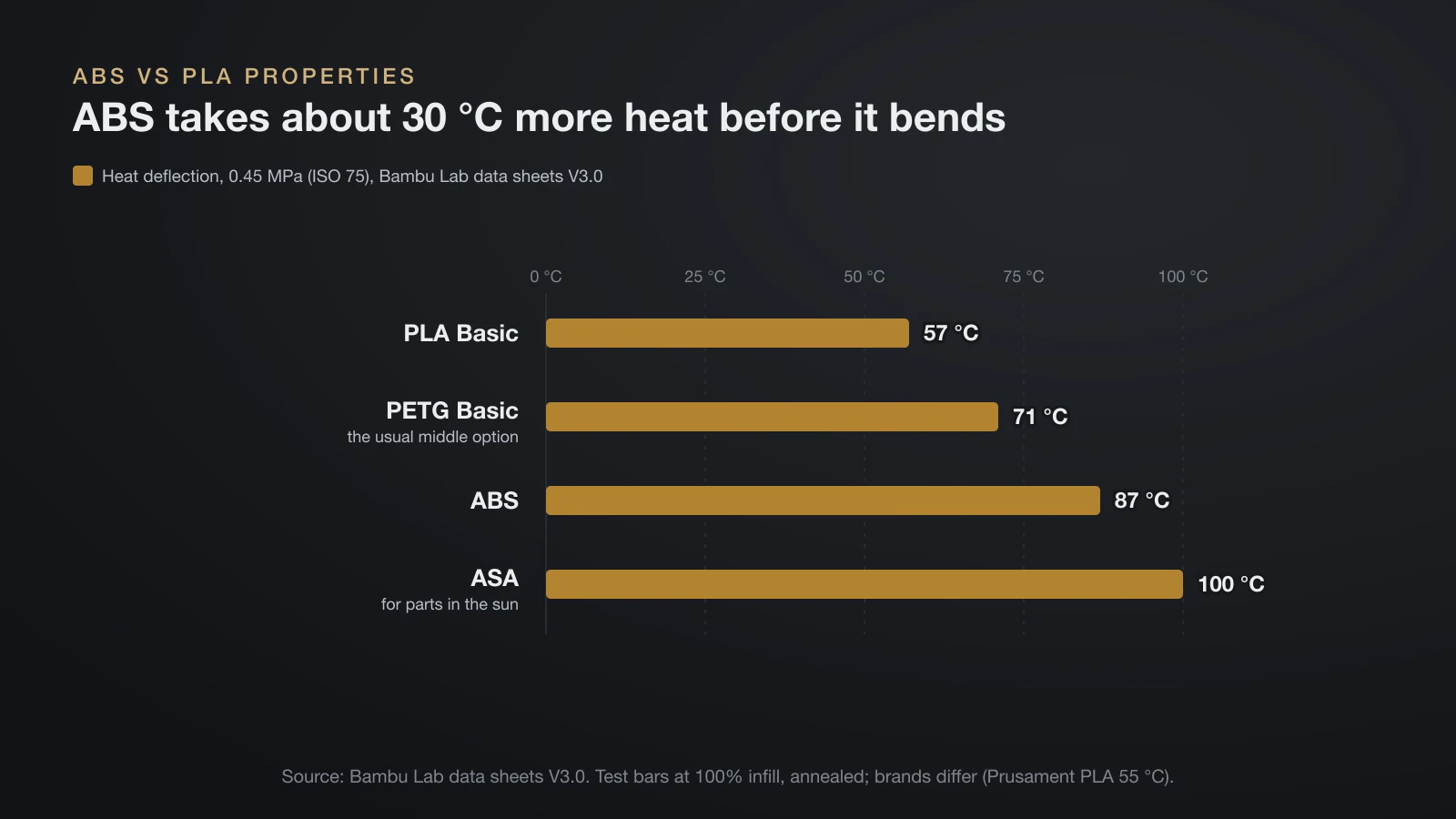
ABS and PLA have almost the same tensile strength, but ABS absorbs more impact and survives about 30 °C more heat, while PLA is stiffer and stronger in bending. The table lists Bambu Lab’s PLA Basic and ABS sheets line by line.
| Bambu Lab data sheet (V3.0) | PLA Basic | ABS |
|---|---|---|
| Density (ISO 1183) | 1.24 g/cm³ | 1.05 g/cm³ |
| Heat deflection, 0.45 MPa (ISO 75) | 57 °C | 87 °C |
| Heat deflection, 1.8 MPa (ISO 75) | 54 °C | 84 °C |
| Vicat softening (ISO 306) | 57 °C | 94 °C |
| Tensile strength, X-Y / Z (ISO 527) | 35 / 31 MPa | 33 / 28 MPa |
| Young’s modulus, X-Y (ISO 527) | 2,580 MPa | 2,200 MPa |
| Bending strength, X-Y (ISO 178) | 76 MPa | 62 MPa |
| Elongation at break, X-Y | 12.2% | 10.5% |
| Impact, X-Y unnotched / notched (ISO 179) | 26.6 / 7.9 kJ/m² | 39.3 / 21.5 kJ/m² |
| Impact, Z (ISO 179) | 13.8 kJ/m² | 7.4 kJ/m² |
| Water absorption (25 °C, 55% RH) | 0.43% | 0.65% |
PETG, the usual middle option, falls between the two on heat: Bambu Lab’s PETG Basic deflects at 71 °C at 0.45 MPa.
Bambu Lab printed every test bar at 100% infill and annealed it before testing (PLA at 55 °C for 8 hours, ABS at 80 °C for 12 hours), so real parts with infill score lower.
Brands also vary. Prusament PLA lists 55 °C at 0.45 MPa, the value used across this site, and Prusa’s material table gives 81–97 °C for the ABS filaments it covers. Our guide to the PLA melting point explains why PLA bends so far below its melting temperature.
Is ABS stronger than PLA?
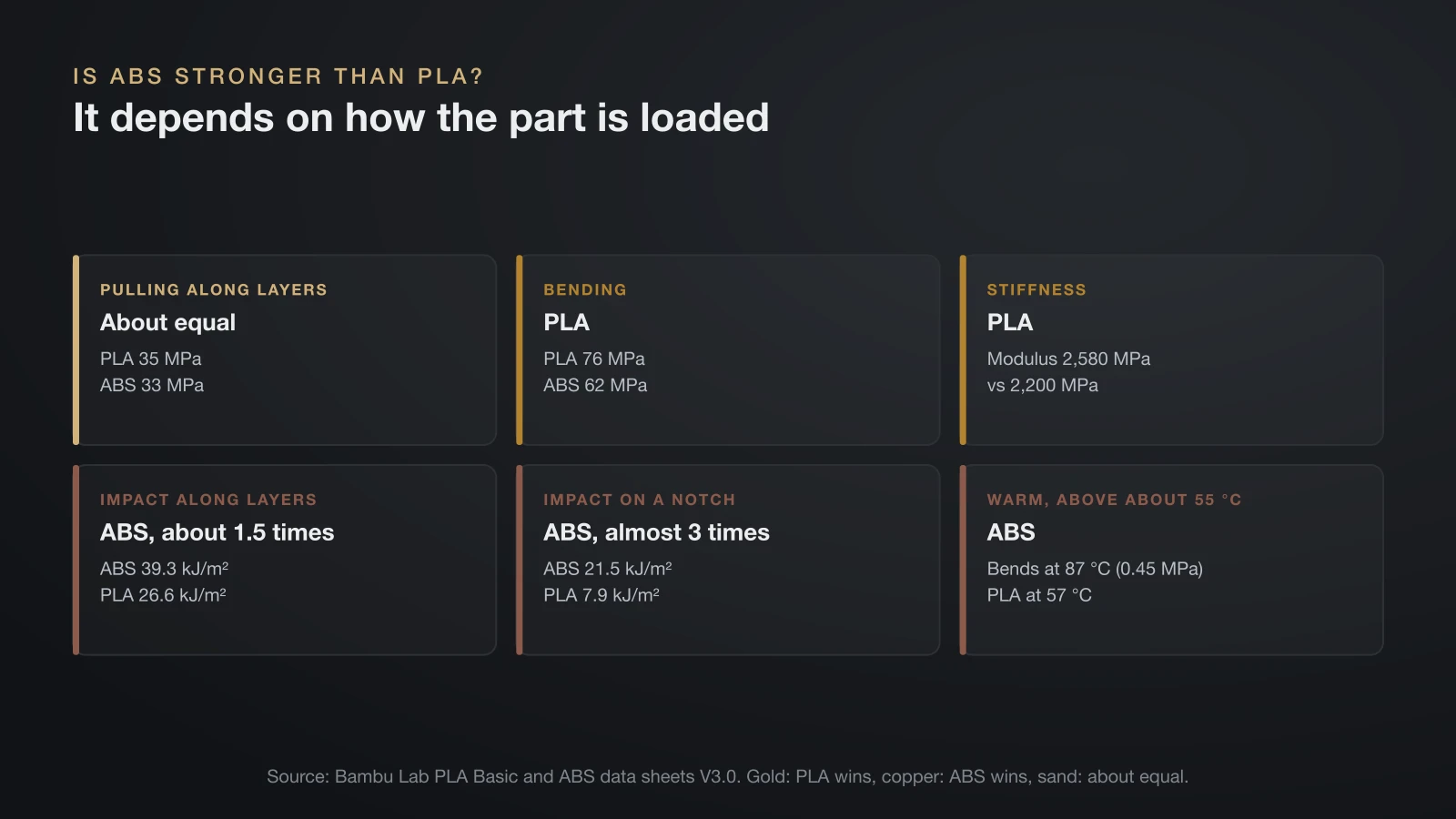
ABS is not stronger than PLA in a simple pull or bend, but it is tougher on impact and keeps its strength at higher temperatures. Which one counts as stronger depends on how the part is loaded:
| Load on the part | Stronger in Bambu Lab’s data | Numbers |
|---|---|---|
| Pulling along the layers | About equal, PLA slightly ahead | 35 vs 33 MPa |
| Bending | PLA | 76 vs 62 MPa |
| Stiffness (resisting flex) | PLA | 2,580 vs 2,200 MPa modulus |
| Sudden impact along the layers | ABS, about 1.5 times | 39.3 vs 26.6 kJ/m² |
| Impact on a notch or sharp corner | ABS, almost 3 times | 21.5 vs 7.9 kJ/m² |
| Impact across the layers (Z) | PLA in this test | 13.8 vs 7.4 kJ/m² |
| Load in a warm place, above about 55 °C | ABS | PLA starts to bend first |
In practice, PLA makes a rigid bracket that snaps when it fails, while ABS gives a little and survives drops; Prusa says PLA breaks along layers or into shards on impact. In heat, ABS wins outright, because a PLA part that sags at 60 °C has no useful strength left.
Layer direction matters for both. Each plastic loses tensile strength across the layers (31 and 28 MPa in the Z direction), so orient parts so the main load runs along the lines. For a wider ranking that includes nylon, polycarbonate and fiber-filled grades, see our guide to the strongest filament.
Printing ABS vs PLA: what each one needs
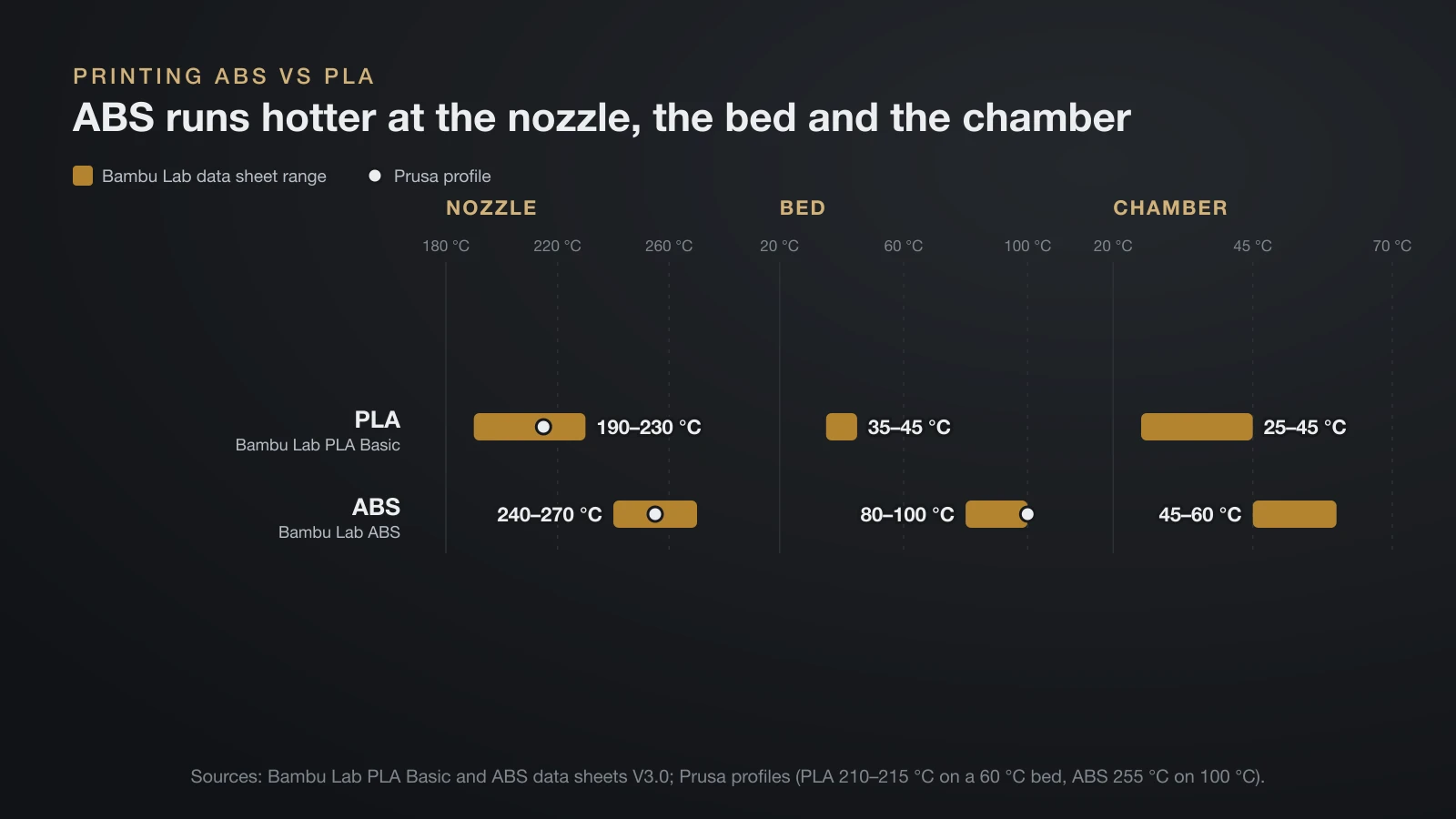
PLA prints on almost any FDM printer with the fan on, while ABS needs a hotter nozzle, a bed near 100 °C, little cooling and a warm, closed chamber. Bambu Lab sorts its materials the same way: ABS, ASA, PC and nylon need higher bed and chamber temperatures to suppress warping and layer separation, so it recommends an enclosed printer, while PLA is not prone to warping and runs on open or enclosed machines.
| Setting | PLA Basic | ABS |
|---|---|---|
| Nozzle | 190–230 °C | 240–270 °C |
| Bed | 35–45 °C | 80–100 °C |
| Chamber | 25–45 °C | 45–60 °C |
| Part cooling fan | On | 0–80% |
| Bed preparation | Glue | Glue |
| Drying before printing | 50 °C for 8 h | 80 °C for 8 h |
Prusa’s profiles differ slightly: ABS at 255 °C on a 100 °C bed, PLA at 210–215 °C on a 60 °C bed.
Warping is the real difference. Prusa says ABS shrinks about 1–2% as it cools and lists significant warping as its main drawback. PLA has the opposite issue in an enclosure: Bambu Lab recommends opening the door when the bed runs above 45 °C, so chamber heat does not soften PLA in the extruder.
If prints come loose with either plastic, work through our checklist for a 3D print not sticking to the bed; the PLA temperature guide lists plate-by-plate values.
Can you print ABS on a PLA printer?
You can print small ABS parts on many printers bought for PLA, as long as the hotend and bed reach ABS temperatures, but larger parts need an enclosure. Check these points before loading a spool:
- Nozzle temperature. ABS needs 240–270 °C. Polymaker recommends an all-metal hotend that can go above 250 °C for its PolyLite ABS but says it is not required; check your hotend’s rated maximum.
- Bed temperature. The bed must hold 80–100 °C for a whole print, and up to 110 °C for large parts on Prusa’s guidance.
- Part size. Polymaker says parts smaller than a fist can print on an open printer with a 90 °C bed and a 260 °C nozzle, larger parts need an enclosure at about 40–50 °C, and parts over about 15–20 cm need an actively heated chamber near 70 °C or more.
- Build surface. Bambu Lab and Prusa both use PEI with glue stick for ABS.
- Drafts. Without an enclosure, Prusa suggests the draft shield in PrusaSlicer, a thin wall printed around the part to hold in warmth.
If ABS becomes a regular material, an enclosed 3D printer solves warping and makes filtration easier in one step.
Fumes and safety: ABS vs PLA
ABS gives off more fumes and particles than PLA, so it needs more ventilation. NIOSH reports that researchers have measured higher airborne ultrafine particle concentrations when printing ABS than PLA, and it suggests substituting PLA where the part allows as a way to reduce that hazard. Prusa lists potentially dangerous styrene fumes among ABS’s disadvantages and says the room should be well ventilated.
Temperature matters as much as material. NIOSH notes that emissions in a chamber study depended mainly on extruder temperature, and that filament brand also played a role, so ABS starts at a disadvantage by running 40–50 °C hotter.
Steps from NIOSH guidance that apply to both plastics:
- Use the lowest nozzle temperature that still gives good parts.
- Print inside a filtered enclosing hood; one study NIOSH cites cut particle emissions by 97–99%.
- Leave the enclosure closed for about 20 minutes after the print finishes before opening it.
Neither plastic is a good choice for cups or dishes. Prusa notes that even food-safe PLA resin leaves layer grooves that can harbor bacteria, and the same applies to any printed surface.
Finishing: acetone smoothing vs sanding
ABS can be vapor smoothed with acetone to a glossy finish, while PLA is finished by wet sanding, priming and painting. Prusa lists acetone smoothing and gluing as a main reason to choose ABS; acetone also welds ABS parts together. For PLA, Prusa says sanding needs water cooling (wet sanding) and that chemical smoothing needs dangerous solvents and laboratory conditions.
Acetone vapor is highly flammable, so smooth ABS in a ventilated space away from flames and heaters. Both plastics take primer and paint well; see how to paint 3D prints.
Outdoor use, UV and heat
Neither ABS nor PLA is a strong outdoor material, and ASA is the usual answer for parts in the sun. Prusa says PLA degrades under UV light and deforms above 60 °C. For ABS the makers disagree: Bambu Lab’s ABS data sheet names UV resistance among the material’s strengths, without a test value, while Prusa says outdoor ABS parts turn yellowish and brittle over time.
ASA filament settles the question. It prints much like ABS but, according to Prusa, resists UV better, warps less and smells less:
| Bambu Lab data sheet | PLA Basic | ABS | ASA |
|---|---|---|---|
| Heat deflection, 0.45 MPa | 57 °C | 87 °C | 100 °C |
| Tensile strength, X-Y | 35 MPa | 33 MPa | 37 MPa |
| Impact strength, X-Y unnotched | 26.6 kJ/m² | 39.3 kJ/m² | 41.0 kJ/m² |
ABS or PLA: which to choose for your project
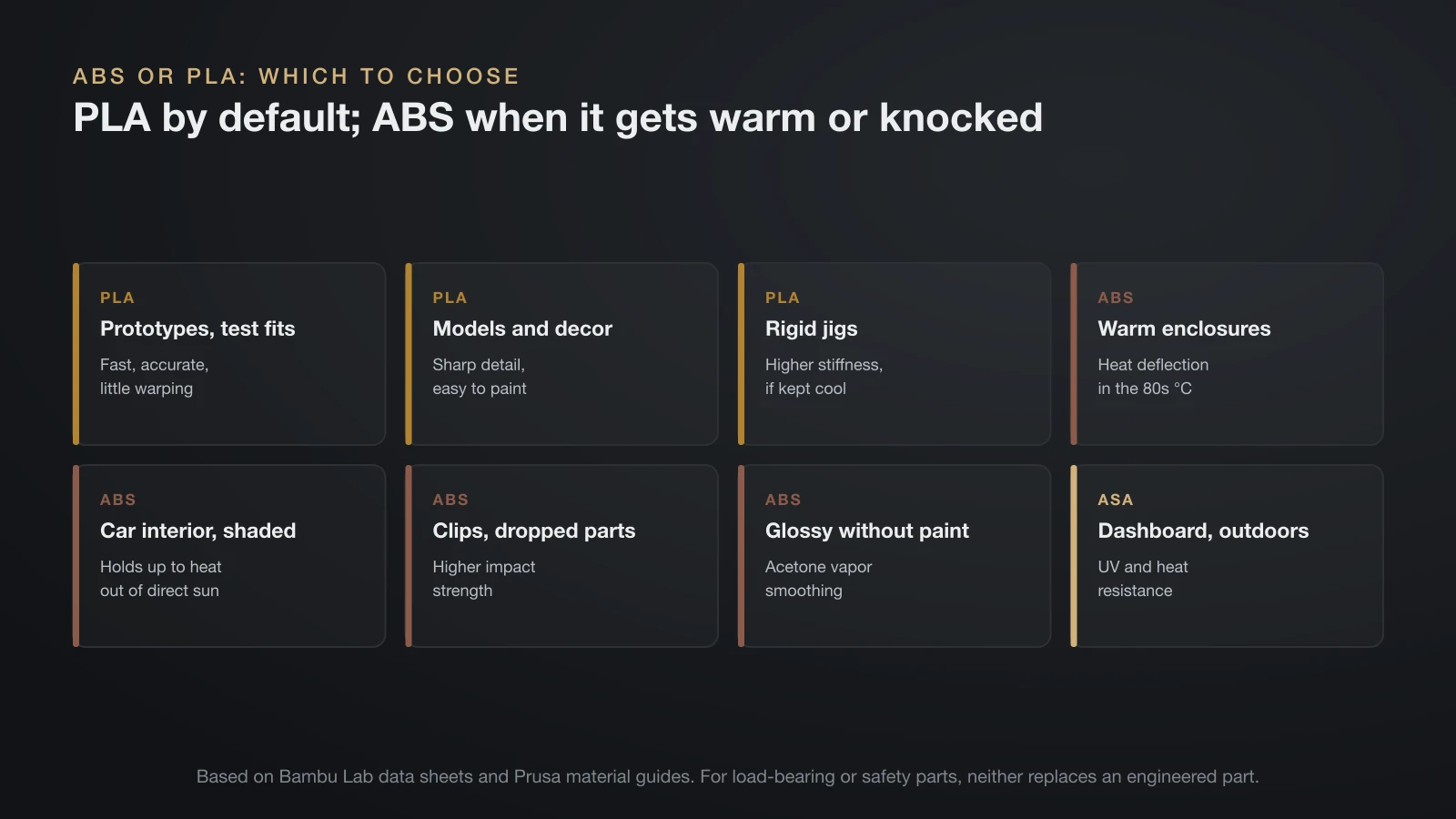
Choose PLA unless the part will get warm, take repeated knocks or need an acetone finish; choose ABS when it will. This table matches common jobs to the better material, with ASA where neither fits well.
| Project | Better choice | Why |
|---|---|---|
| Prototypes and test fits | PLA | Fast, accurate, little warping |
| Display models, figures, decor | PLA | Sharp detail, easy to paint |
| Cosplay props worn indoors | PLA | Easy large prints; see our guide to 3D printed cosplay |
| Props worn in hot sun or a hot car | ABS or ASA | PLA softens near 55–60 °C |
| Electronics enclosures near warm parts | ABS | Heat deflection in the 80s °C |
| Car interior parts out of direct sun | ABS | Heat; see 3D printed car parts |
| Dashboard or outdoor parts in sun | ASA | UV and heat resistance |
| Clips, handles, parts that get dropped | ABS | Higher impact strength |
| Rigid jigs that must not flex | PLA | Higher stiffness, if kept cool |
| Parts you want glossy without paint | ABS | Acetone vapor smoothing |
For load-bearing or safety-critical parts, neither plastic replaces an engineered part.
Cost and how far a spool goes
ABS and PLA cost about the same per spool, so price rarely decides the choice; our guide to 3D printer filament cost lists current maker prices.
Density gives ABS a small edge: at 1.05 against 1.24 g/cm³, a 1 kg ABS spool holds roughly 18% more length (estimate: 1.24 ÷ 1.05, same diameter). The bigger cost of ABS is its setup: hot bed, enclosure and ventilation.
The bottom line
In the ABS vs PLA choice, PLA wins on ease, detail and stiffness, and ABS wins on heat and impact. Bambu Lab’s data sheets put the two almost level in tensile strength (35 vs 33 MPa) but 30 °C apart in heat deflection (57 vs 87 °C). Print PLA by default, switch to ABS for warm or knocked indoor parts, and use ASA outdoors.
Sources
- Bambu Lab: technical data sheets V3.0 for PLA Basic, ABS and ASA, the PETG Basic data sheet and the Wiki filament guide (density, heat deflection, Vicat, tensile, modulus, bending, elongation, notched and unnotched impact, water absorption, specimen annealing, print, chamber and drying settings, UV wording, enclosed printer recommendation, door open above 45 °C)
- Prusa Knowledge Base: ABS, PLA and ASA material guides and the material table, plus the Prusament PLA data sheet (255 °C and 100 °C ABS settings, 80–110 °C bed, 1–2% shrinkage, warping, styrene fumes, draft shield, UV, acetone smoothing, PLA 210–215 °C and 60 °C bed, deformation above 60 °C, brittleness, wet sanding, food contact, ABS heat deflection 81–97 °C and Prusament PLA 55 °C at 0.45 MPa)
- Polymaker Wiki: PolyLite ABS (all-metal hotend above 250 °C recommended but not required, part size vs enclosure and chamber temperature, 90 °C bed and 260 °C nozzle for small parts)
- NIOSH (CDC): Approaches to Safe 3D Printing, publication 2024-103 (higher ultrafine particles from ABS than PLA, substitution, extruder temperature and brand effects, 97–99% reduction with a filtered enclosing hood, 20-minute clearance time, lower nozzle temperature)